[Hospitality DX] Crafting Fair and Profitable Cancellation Policies with Sensei AI: Preventing Revenue Loss Through Seasonal Optimization
Cancellation policies are key to balancing profitability and guest satisfaction. Learn how to use Sensei AI to create "fair" and "profitable" policies that optimize for both peak and off-peak seasons to maximize your revenue.

![[Hospitality DX] Crafting Fair and Profitable Cancellation Policies with Sensei AI: Preventing Revenue Loss Through Seasonal Optimization](/content/images/size/w1200/2025/12/washitsu-1.png)
Reviewing Your Cancellation Policy
For any lodging facility, the cancellation policy is a critical rule that directly impacts business management.
However, these policies are often handled based on individual intuition—such as "referencing nearby competitors" or "setting it by gut feeling"—which frequently leads to missed bookings during peak seasons or lost opportunities during off-peak periods.
Fears like "higher fees might decrease bookings" or "being too flexible might increase last-minute cancellations" often result in settings that lack a clear, logical basis. In such situations, it is difficult to maximize revenue while maintaining fairness and customer satisfaction.
Three Ways Sensei AI Transforms Your Cancellation Policy into a Strategic Asset
- Analysis Based on Objective Data
Sensei AI goes beyond intuition and experience to design rules based on solid evidence. - Optimal Rule Proposals for Different Seasons and Guest Segments
The AI optimizes policies specifically for peak vs. off-peak seasons and group vs. individual bookings. For example, it can suggest flexible settings like "fees apply from 14 days prior during peak season" while keeping "weekdays free of charge until the day before," minimizing revenue loss. - Balancing Customer Satisfaction and Profitability
The AI doesn't just set fees; it also analyzes how to communicate them. By analyzing reaction trends on SNS and review sites, it can generate "persuasive wording" and "trouble-avoidance phrasing," securing profits without damaging the guest experience.
[Sensei AI - Hospitality] 3 Steps to Design the Optimal Cancellation Policy
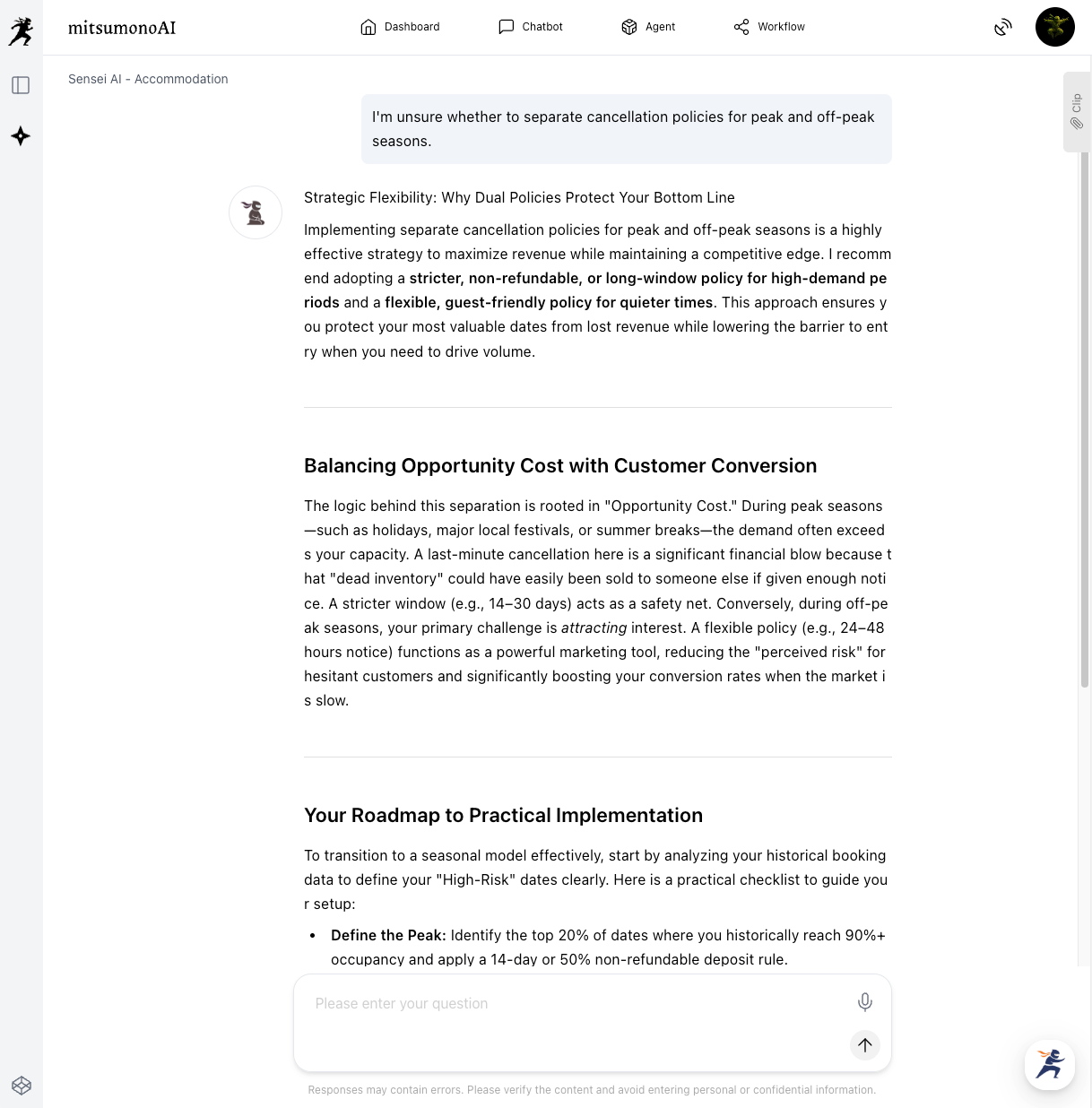
Step 1: Consult the AI for Policy Guidelines
First, ask Sensei AI what kind of cancellation policy is desirable. At this stage, sharing your specific concerns—such as whether to differentiate between peak and off-peak seasons or how much flexibility to offer—will help you get more concrete advice.
"I want to know if I should treat group and individual bookings differently."
Step 2: Have the AI Evaluate Your Current Policy
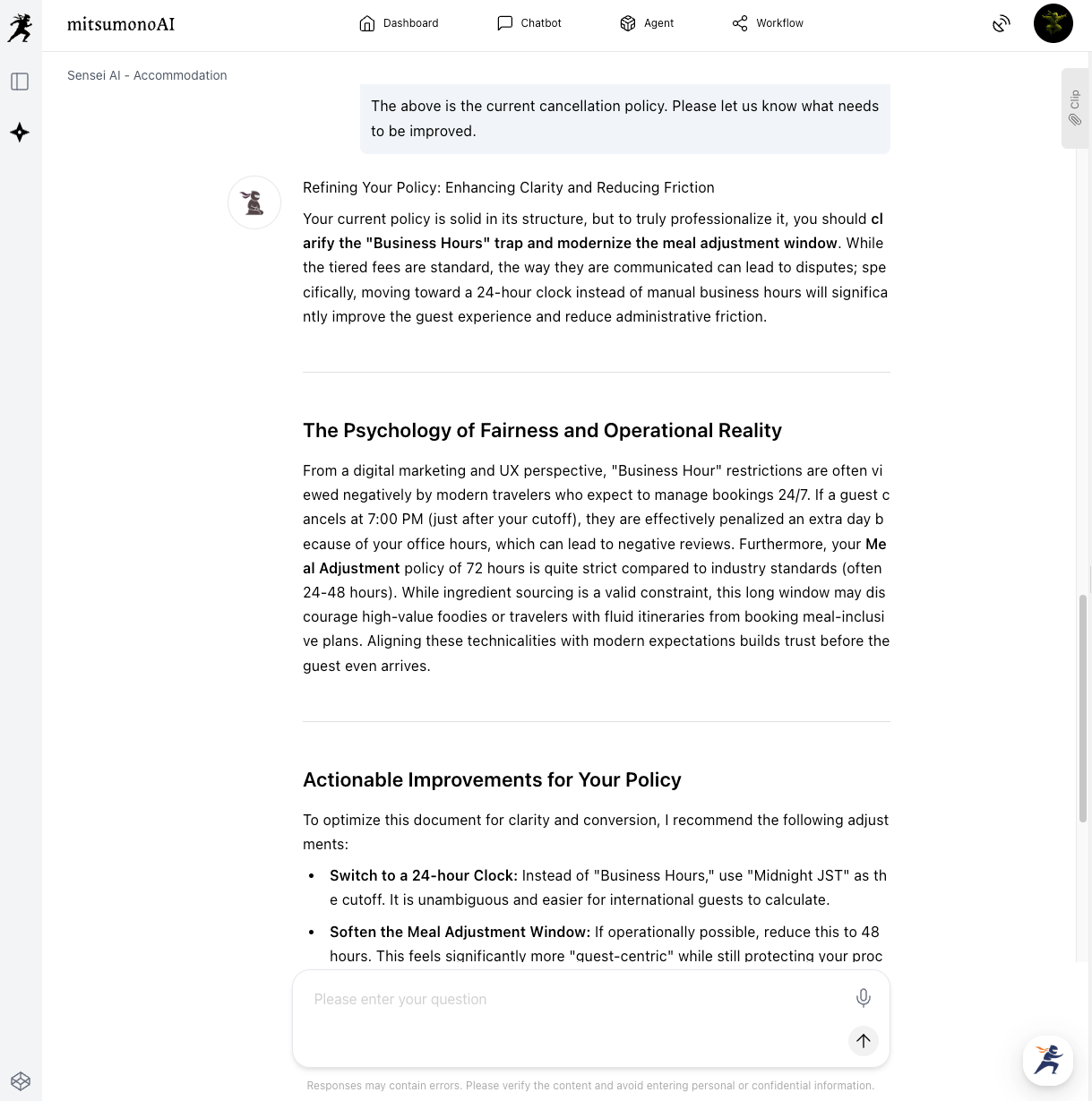
Next, submit your current cancellation policy and have the AI provide a rigorous evaluation. The AI will check the balance of profitability, fairness, and guest acceptance against historical data and industry standards to identify areas for improvement.
Step 3: Create a New Policy Table and Guest-Facing Text
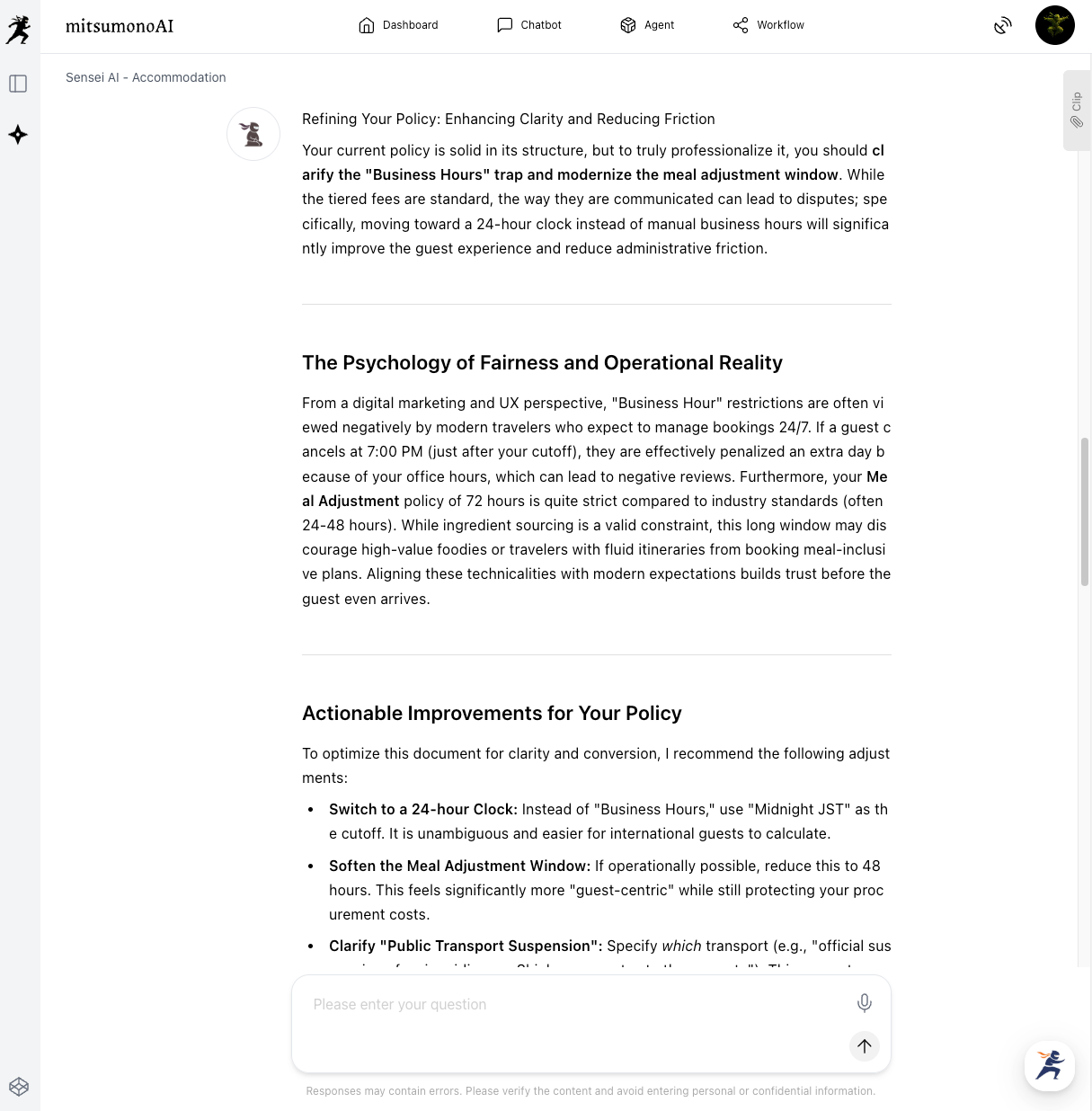
Finally, based on the AI's suggestions, create a policy table and customer-facing text tailored to different seasons. If necessary, prepare table-style explanations or Q&As to ensure consistent operation among your staff.
✅ Cancellation Policy Review Checklist
- Designed policies suitable for different seasons and guest segments.
- Created guest-facing text that is easy to understand.
- Verified the balance between profitability, fairness, and guest acceptance.
Expected Results from Reviewing Your Cancellation Policy
By utilizing AI to review your policies, you can expect results such as:
- Last-minute cancellation rate: 20–30% reduction
- Booking conversion rate in off-peak seasons: 15% increase
- Time spent on policy design and verification: Approx. 70% reduction
Summary: Preventing Revenue Loss with AI
A cancellation policy is more than just a rule; it is a system to protect your facility's profits. Using Sensei AI not only drastically reduces the time required for reviews, fee setting, and document creation, but also minimizes revenue loss by allowing for appropriate seasonal adjustments.
Start by having the AI evaluate your current policy today.
Sensei AI is an AI consultant specialized in industries like hospitality, F&B, and retail. On mitsumonoAI, we introduce ways to use AI to improve the quality of decision-making while streamlining daily operations such as strategy formulation, product planning, and customer analysis.
For the latest ideas and use cases, please visit the link below.