Improving Complaint Handling Skills Program | How to Create Practical Role-Playing Scenarios
Role-playing is an effective training method for enhancing staff's ability to handle customer complaints and requests. Training based on customer personas, which helps staff understand customer psychology, boosts their confidence and improves service skills.


Tools to Use
- Persona Creation Assistant
Practical Role-Playing Scenarios Created with AI
Practical role-playing practice is effective for improving customer service staff skills. Role-playing is adopted by many service industries such as restaurants, ryokans (Japanese inns), and call centers because it allows for "learning through simulated experience" and "practice in a safe environment," which cannot be achieved through classroom lectures.
However, for the particularly difficult aspect of customer service—handling "complaints"—sufficient training may not be possible because creating scenarios that anticipate various situations and customer attributes is time-consuming.
This time, we will leverage the power of AI to introduce the procedure for creating "role-playing scenarios" aimed at developing practical response skills in a wide range of situations, standardizing service quality, and improving customer satisfaction.
Specific Procedures
Step 1: Identify the specific complaint content for which you want to strengthen handling skills
First, clearly define the specific type of complaint the team wants to improve its handling skills for.
For example, in the case of an accommodation facility, the following complaints can be set as role-playing themes:
- Complaints regarding facilities/equipment
- The room lighting is too dark and hard to see.
- Complaints regarding staff service
- The service attitude was unfriendly, without a smile, which was unpleasant.
- The reservation details were incorrect, and check-in took a long time.
- Complaints regarding meals
- The meal service was slow.
- The allergy accommodation was insufficient, causing anxiety.
This time, we will create a role-playing scenario focusing on the complaint: "The meal service was slow."
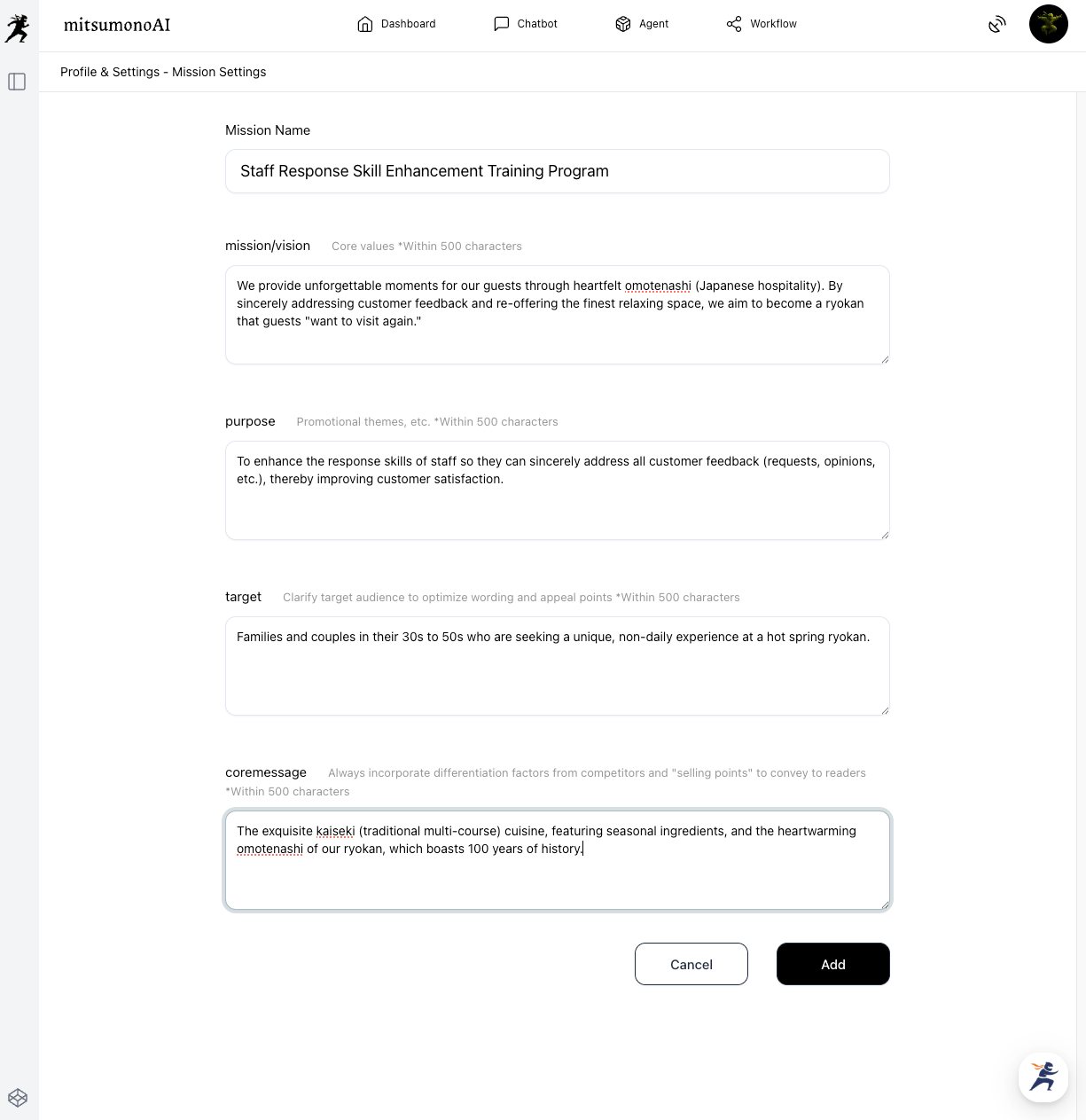
Step 2: Register the Mission
▶︎ Mission
Register the goal (Mission) you want to achieve through this role-playing training.
Step 3: Define the Persona (Role-Playing Partner)
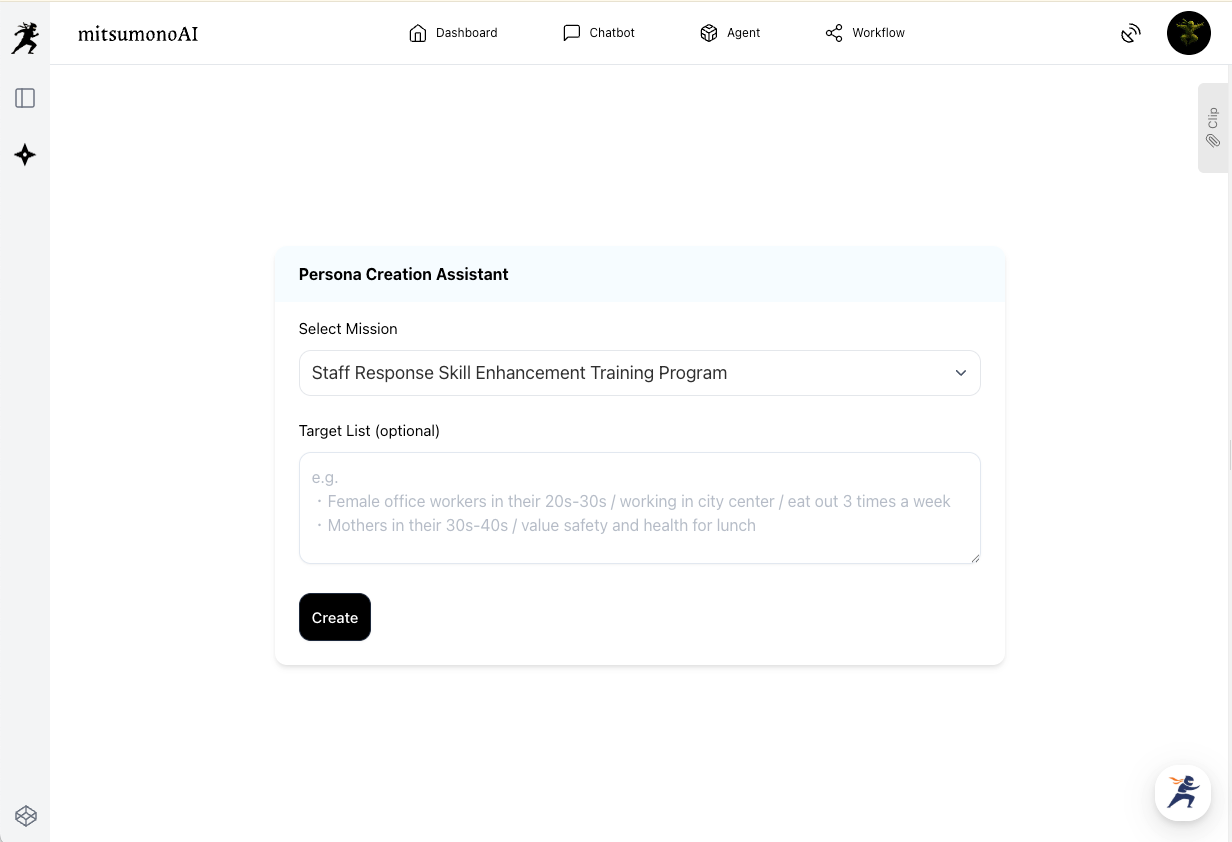
▶︎ Persona Creation Assistant
Specifically define the customer persona that the staff will interact with during the role-playing.
Select the Mission you created earlier and click "Generate."
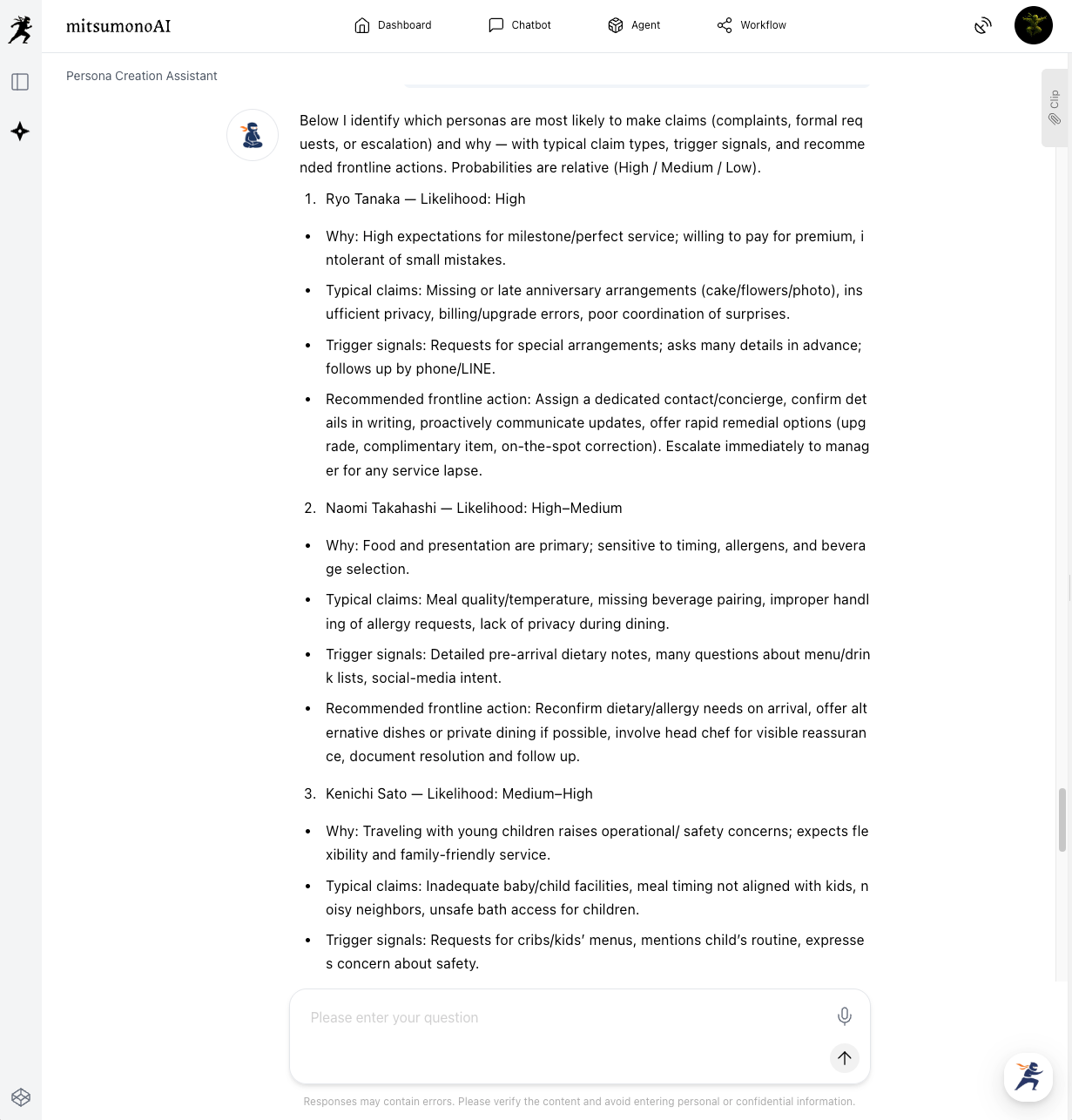
From the list of generated personas, select the customer profile most suitable for the scenario you want to practice.
This time, we will use "Ryo Tanaka ("Anniversary Planner Ryo")" whom the AI narrowed down as the "persona most likely to make a complaint," as the person appearing in the role-playing.
Step 4: Generate the Role-Playing Scenario
Based on the customer service challenge identified in Step 1 and the customer persona defined in Step 2, provide the following instructions to create a dialogue-based role-playing scenario for a specific situation.
Generate a dialogue-based role-playing scenario for a ryokan complaint response under the following conditions.
[Basic Setting]
・Location: The dining area of "Mitsumo Onsen Ryokan"
・Challenge: The meal service is significantly delayed.
・Objective: To sincerely address the customer's complaint and improve customer satisfaction through the staff's response skills.
[Customer Persona]
Ryo Tanaka ("Anniversary Planner Ryo")
*Input the name of the persona selected in Step 2 here.
[Additional Instructions]
・The staff's dialogue should strongly reflect polite language and an attitude of empathy.
・Briefly summarize the key points of the response at the end of the scenario.
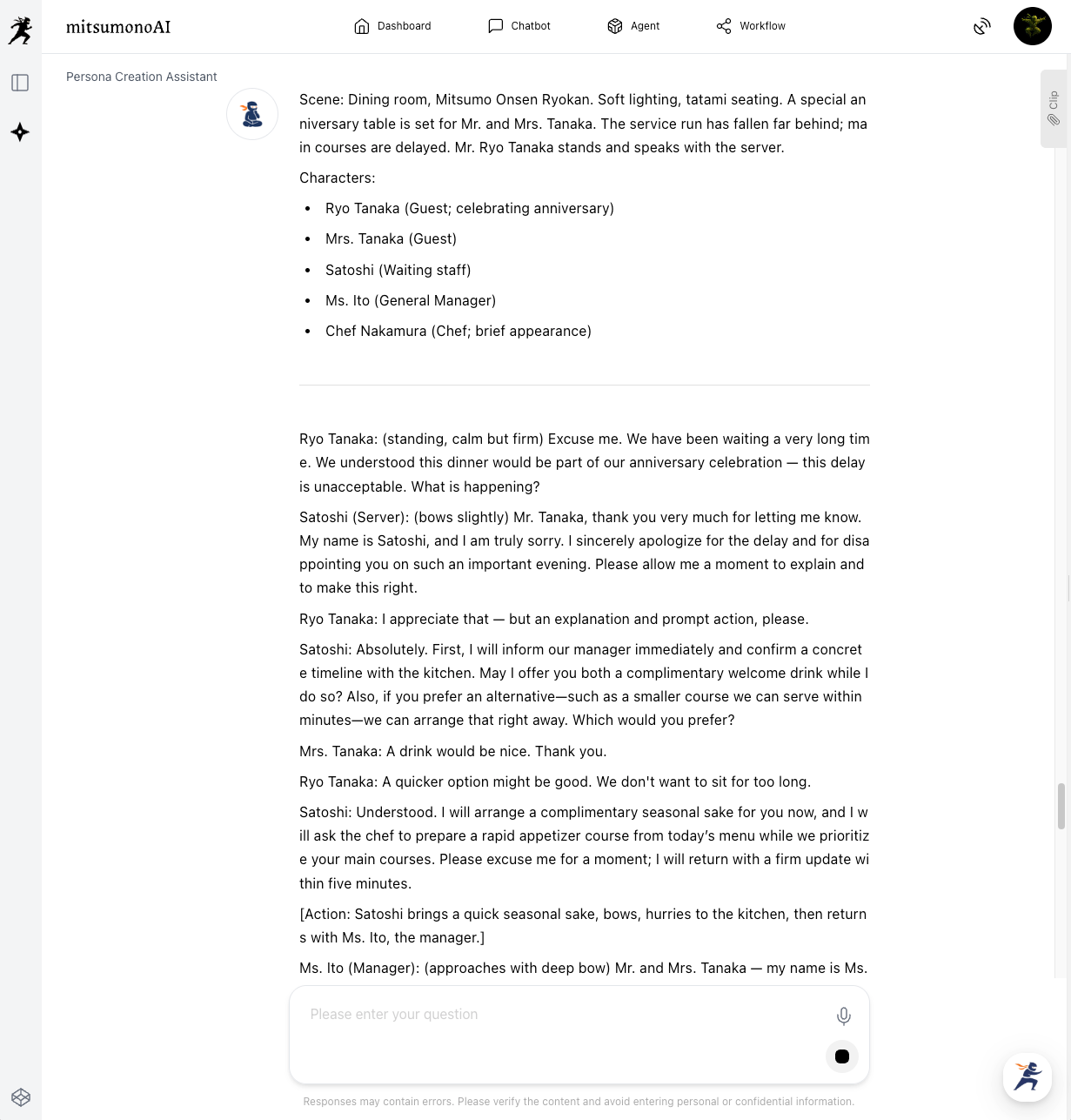
Step 5: Utilize the Generated Scenario for Employee Training to Develop Practical Skills
Actively utilize the diverse role-playing scenarios generated by the AI in employee training.
By practicing repeatedly based on the scenarios, staff can practically develop the skills to handle various customer service situations. Furthermore, practicing with objective feedback helps to clarify individual issues and standardize service skills.
Through such practical training, staff gain confidence in interacting with customers and can provide high-quality omotenashi.
Outcomes Achieved Through Utilization (Examples)
- Improvement in Customer Service Skills
- Staff's response skills and confidence improve through practical practice in diverse, persona-based situations.
- Efficiency in Role-Playing Practice
- Significantly reduces the time and effort required for scenario creation, enabling more practical practice sessions.
- Standardization of Service Quality
- Contributes to reducing skill gaps among staff and providing consistently high-quality service through common scenarios and feedback.
- Improvement in Customer Satisfaction
- Leading to high customer evaluations as staff become capable of providing responses that are empathetic to the customer in any situation.
Target Values for One Year (Reference Example)
- KGI (Key Goal Indicator):
- Customer Satisfaction Score (Service-related item): Average 8.5 points or higher (e.g., previous year average 8.0 points)
- KPIs (Key Performance Indicators):
- Frequency of role-playing practice: Twice a month or more
- Number of AI-generated scenarios utilized: 5 types or more per year
- Number of customer complaints related to service: 15% reduction compared to the previous year