How to Implement Data-Driven Performance Reviews Using AI
chieve both efficiency and fairness in evaluations. Use the "File Analysis Assistant" to analyze objective data, streamlining the process while eliminating subjective bias for a truly impartial review.


Tools to Use
File Analysis Assistant
From "Impression"-Based Evaluation to "Data"-Driven Evaluation
When performance review season arrives, do you face issues like "evaluation criteria vary among reviewers, lacking fairness," or "data collection from massive materials takes too long"?
In conventional evaluation methods, there is always room for the evaluator's subjectivity and impressions, often resulting in cases where the employee being reviewed is not fully satisfied with the outcome.
This is where objective data analysis by AI comes in handy. Simply upload employee sales performance, attendance data, and other records to the "File Analysis Assistant," and the AI will analyze the figures from an impartial perspective and automatically create a draft evaluation.
Concrete Steps
Objectively Analyze Employee Data with the "File Analysis Assistant"
First, upload the data file (Excel, CSV, etc.) that will be the basis for the evaluation to the "File Analysis Assistant." The AI will read the file and present the analysis results based on your instructions.
Next, input specifically how you want the data to be analyzed.
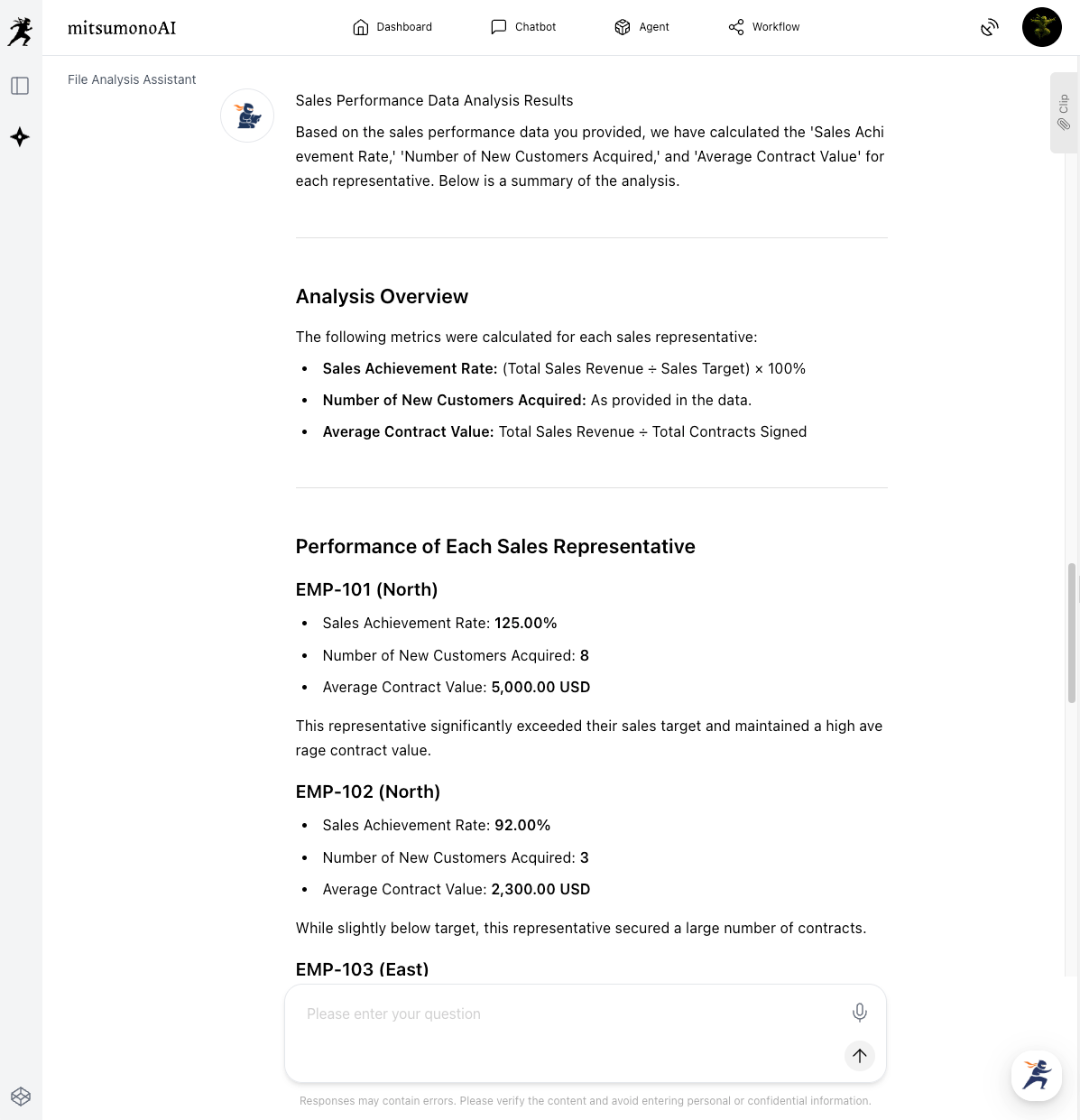
The report generated by the AI is based on objective figures, which helps eliminate bias in the initial stage of evaluation. By using this primary information as a standard, all evaluators can start discussions based on the same data, preventing discrepancies in evaluation criteria.
Points to Note
AI analysis is strictly a support tool for quantitative evaluation. The final evaluation must be conducted by humans, while referencing the AI's analysis results.
It is crucial to incorporate qualitative aspects that cannot be quantified by AI, such as "leadership," "contribution to the team," and "mentoring of junior staff," into the evaluation through interviews with supervisors and colleagues.
By combining objective data (AI analysis) with multi-faceted character evaluation (human judgment), you can complete a fair and balanced performance review that every employee can be satisfied with.
Targeted Outcomes Achieved Through Utilization (Example)
Introducing objective data analysis by AI will significantly enhance the efficiency and fairness of performance review operations. It establishes an evaluation process based on data, not the subjective views of the evaluator, thereby increasing the satisfaction and motivation of the employees being reviewed.
As a result, it contributes to building a more just and transparent performance review system and improving overall organizational performance.
Target Figures for Six Months Following the Initiative
KGI:
- Employee satisfaction with performance reviews: 10% improvement from the current level
KPI :
- Total man-hours spent on performance review operations: 20% reduction from the current level
- Variance in evaluation scores among reviewers (e.g., standard deviation): 15% reduction from the current level