How to Fairly Evaluate Multiple Proposals | Objective Evaluation Processes Enabled by AI
Learn how to use File Analysis Assistant PRO to structure diverse proposals into a uniform format and build an evaluation process based on objective data. Combining AI's insights with human judgment ensures decision-making that the whole organization can get behind.


The Dilemma of Subjectivity and Efficiency in Proposal Evaluation
Various proposals are submitted within an organization every day. From marketing initiatives and new business pitches to operational improvement plans, the content and formats vary widely. However, when evaluating these proposals, many organizations tend to face the following challenges:
- Vague evaluation criteria
Proposals are often judged on subjective criteria like "novelty" or "impact," making it difficult to logically explain why a project was selected or rejected. - Evaluator bias
The subjective views of the evaluator—such as personal experience, preferences, or their relationship with the proposer—can creep in and undermine fair judgment. - Lack of evaluation resources
There is often insufficient time and labor to carefully read and compare a large number of proposals, leading to decisions made based on surface-level impressions.
In this article, we will introduce how to fundamentally solve these issues by using "File Analysis Assistant PRO." Let’s break away from evaluations that rely on subjectivity and intuition and build an objective, fair decision-making process based on data.
Why AI Enables "Fair Evaluation"
AI is excellent at processing information consistently according to set criteria, without the biases or preconceptions that humans carry. This capability dramatically enhances the fairness and objectivity of proposal evaluation.
Three Benefits of Implementing AI
- Obtaining objective decision-making materials
Because AI analyzes all proposals using the same criteria and process, you get objective information based on data. Evaluators can then combine this objective data with the organization’s actual situation and management judgment to make fairer, more persuasive decisions. - Focusing on judgment through a faster process
AI completes the reading and summarizing of proposals in minutes—a task that previously took humans hours. Evaluators can focus their time on more essential discussions and decision-making, taking into account the organization's reality and feasibility based on the information organized by AI. - Preventing oversights and improving quality
By objectively comparing multiple proposals, you can prevent important perspectives from being overlooked. Additionally, potential execution challenges hidden in each project are brought to light, enabling higher-quality decision-making.
In Practice | A 3-Step Evaluation Process with File Analysis Assistant PRO
Let's look at the process for objectively evaluating multiple proposals and determining priorities. In this scenario, we assume we are evaluating proposals submitted in different formats from various departments within a company.
Step 1: Clearly Define the Organization's "Evaluation Criteria"
The most important first step is to clearly define the criteria the AI will use for evaluation. This serves as the foundation for the evaluation and the standard for judgment across the organization.
[Example of Evaluation Criteria Definition]
- Strategic Significance: Is it highly aligned with the organization's management goals or mid-term plans?
- Feasibility: Is it achievable in terms of budget, personnel, and technology? Is the implementation period appropriate?
- Clarity of Effect Measurement: Are the success indicators specifically defined? Is it possible to measure the effects?
- Risk Assessment: Are there any implementation challenges or concerns? Have countermeasures been considered?
Step 2: Unify Proposals into a "Standard Format"
Upload proposals submitted in various formats to the "File Analysis Assistant" to structure and standardize the information.
"Please summarize the key points of these three proposals using the following items:
1.Title of the proposal
2.Purpose and background
3.Specific proposal content
4.Expected effects and outcomes
5.Required budget and personnel
6.Implementation schedule
7.Assumed risks and challenges"
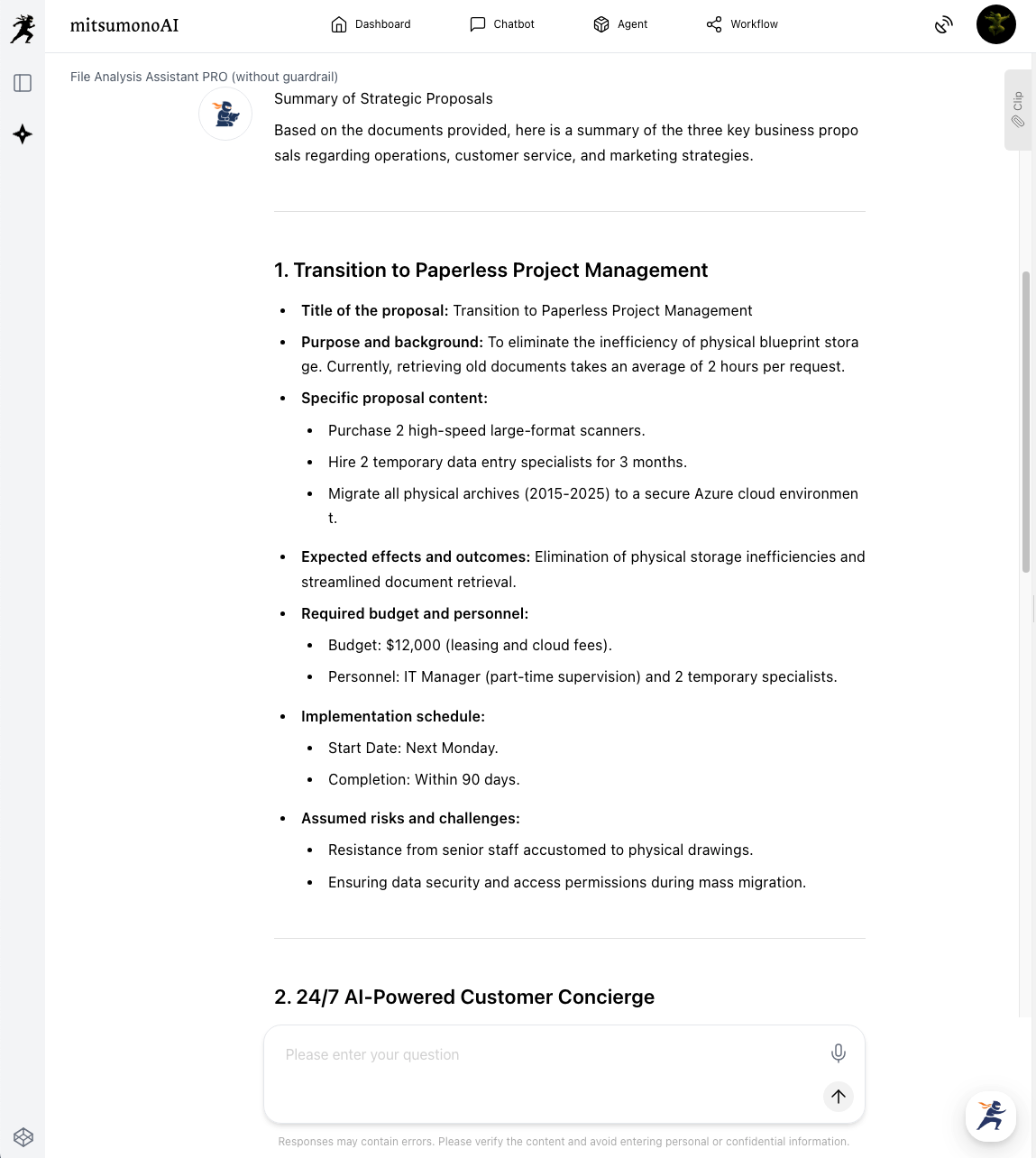
This instruction allows you to grasp the content across all proposals, even those with different styles.
At this stage, important missing items will become clear—such as "there is no mention of assumed risks or challenges." Evaluators can then point out specific deficiencies to the proposers and provide constructive feedback to improve the quality of the proposals.
Step 3: Perform "Scoring" and "Prioritization" Based on Evaluation Criteria
Have the AI evaluate each proposal based on the analysis results from Step 2. By using the evaluation criteria defined in Step 1, you can apply the organization's judgment standards consistently.
"Based on the three proposals and the analysis results above, please score each according to the following four criteria (Strategic Significance, Feasibility, Clarity of Effect Measurement, Risk Assessment) on a scale of 1 to 10. Additionally, for each proposal, please provide the 'reasoning for the score,' 'potential risks and challenges in execution,' and its 'relative priority compared to the other proposals.'"
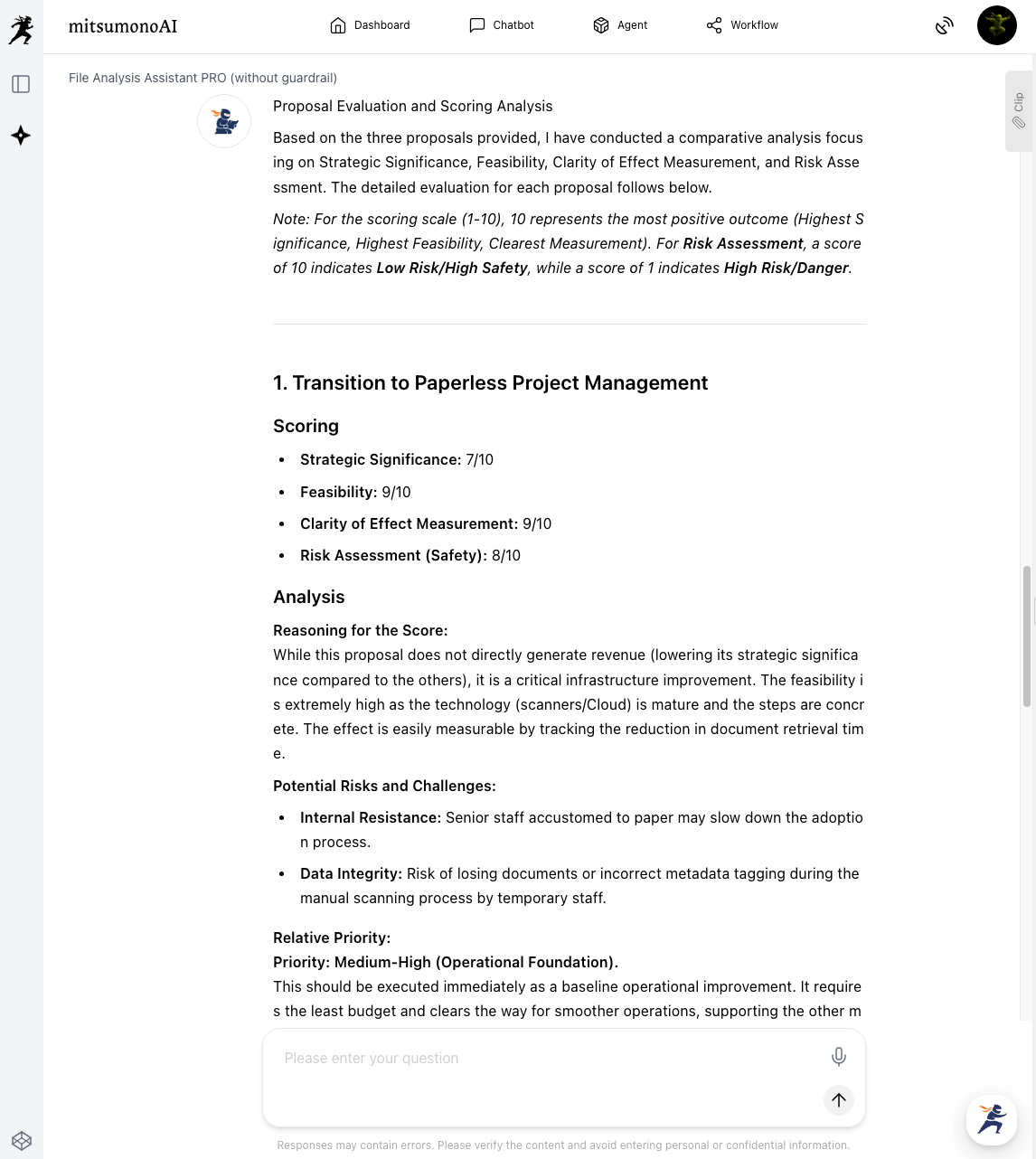
By analyzing proposals based on objective data in this way, the characteristics and challenges of each project become clear.
Evaluators can set grounded priorities by comparing these AI analysis results with the organization's actual situation and management strategy.
Since you can explain "why this project is prioritized" and "why that one is deferred" using both objective data and management judgment, it becomes easier for both the proposer and the evaluator to accept the outcome.
Leveraging the Evaluation Process for Organizational Decision-Making
This AI evaluation flow has the power to foster an organizational culture that goes far beyond a one-time review.
- Specific Feedback for Proposers
AI evaluation results serve as excellent feedback material for proposers. It leads to specific, constructive dialogue, such as: "Your proposal scored high on feasibility, but the AI noted that its 'relevance to management goals is unclear.' I agree with that assessment upon review. Is it possible to clarify this point?" - Improving Evaluation Skills
By learning what perspectives the AI used to evaluate a proposal, evaluators can improve the accuracy of their own future decision-making. This leads to an overall improvement in the judgment of the entire organization. - Continuous Improvement and Optimization
You can regularly review the evaluation criteria and processes to optimize them as the organization matures. Through an objective tool like AI, it is possible to continuously refine the organization's very standards of judgment.
Summary
Objectivity is the key to fair decision-making. By integrating AI into your proposal review process, you can move from "intuition-based" to "data-driven" leadership.
- Solve Inefficiency: Eliminate manual summary work and subjective bias.
- Structure Your Data: Use File Analysis Assistant PRO to create a level playing field for all proposals.
- Empower Human Judgment: Use AI to reveal the facts, so you can focus on the strategic final decision.
Let AI be the objective partner that helps your organization reach a true consensus.
Beyond streamlining proposal evaluation, we introduce various other business use cases for AI.
For hints on using AI to solve organizational challenges, please visit the mitsumonoAI blog site.