Eliminating "Evaluation Dissatisfaction" | A New Method for Developing Personnel Evaluation Standards Combining Satisfaction and Transparency
40% of employees are said to be dissatisfied with evaluations, rooted in human ambiguity and bias. By using AI's advanced reasoning for objective criteria and infusing them with the "soul" of company culture, we explain a next-gen process that achieves both satisfaction and growth.


40% of your employees are dissatisfied with their evaluation system
"Why did that person get promoted while my position stayed the same?"
Every time the evaluation season rolls around, do you feel a pit in your stomach from the cold stares or unconvinced expressions of your subordinates?
Many evaluators try to gloss over the situation with phrases like "I recognize your hard work" or "It was a comprehensive judgment," while inwardly feeling anxious because they cannot verbalize clear criteria. In fact, numerous surveys indicate that approximately 40% of employees harbor dissatisfaction toward their company's personnel evaluation systems.
Organizational exhaustion caused by "sensory evaluation"
- Loss of Trust:
The perception that "the boss's favorites get ahead" spreads, leading top talent to leave the company. - Managerial Burden:
Because criteria are vague, providing feedback takes an enormous amount of time, preventing managers from focusing on actual employee develop
ment. - Stalled Growth:
Since it is unclear what actions lead to a high rating, employees struggle to find a clear direction for improving their skills.
The essence of the problem lies in the fact that humans creating and operating these standards cannot escape "subjectivity" or the "halo effect" (the tendency for a positive impression in one area to influence total evaluation). Furthermore, busy HR and administration departments simply lack the resources to meticulously craft detailed Job Descriptions for every single employee.
If you continue this "lukewarm" approach, organizational engagement will continue to decline, and a future where the company's growth potential is eroded becomes inevitable.
AI becomes your "Fair HR Consultant" and "Structuring Pro"
To address this, we propose an approach that utilizes mitsumonoAI as a "partner for evaluation design without emotions." AI completely excludes office politics and personal preferences, structuring the "ideal state" based solely on logic and data.
The Solution Approach
Using the "advanced reasoning capabilities" of mitsumonoAI, we verbalize vague expectations into "specific behavioral indicators." Then, by having humans infuse the output with the "soul" of the company's culture (mission), we achieve both objectivity and employee buy-in.
- GPT-5 Thinking (Structural Architect):
Deconstructs complex and abstract job duties to logically build "5-level evaluation matrices" and other tools that leave no room for misinterpretation. - Persona Creation Assistant (Ideal Talent Modeler):
Visualizes the "talent the company truly needs right now" as detailed personality models based on management strategy. - File Analysis Assistant PRO (Guardian of Consistency): Reads past job descriptions and regulations to check for contradictions with new standards, ensuring legal and logical consistency.
The AI doesn't decide everything. The AI quickly creates a "logical draft (60–70% complete)" devoid of emotion, and humans then perform "adjustments for organizational fit." This results in higher quality and fairer standards compared to building them from scratch.
Practice | The process for creating evaluation standards that generate "Satisfaction"
Here, we explain the process of using AI to reconstruct evaluation criteria for "Next-Generation Leader Candidates," a category that often remains ambiguous.
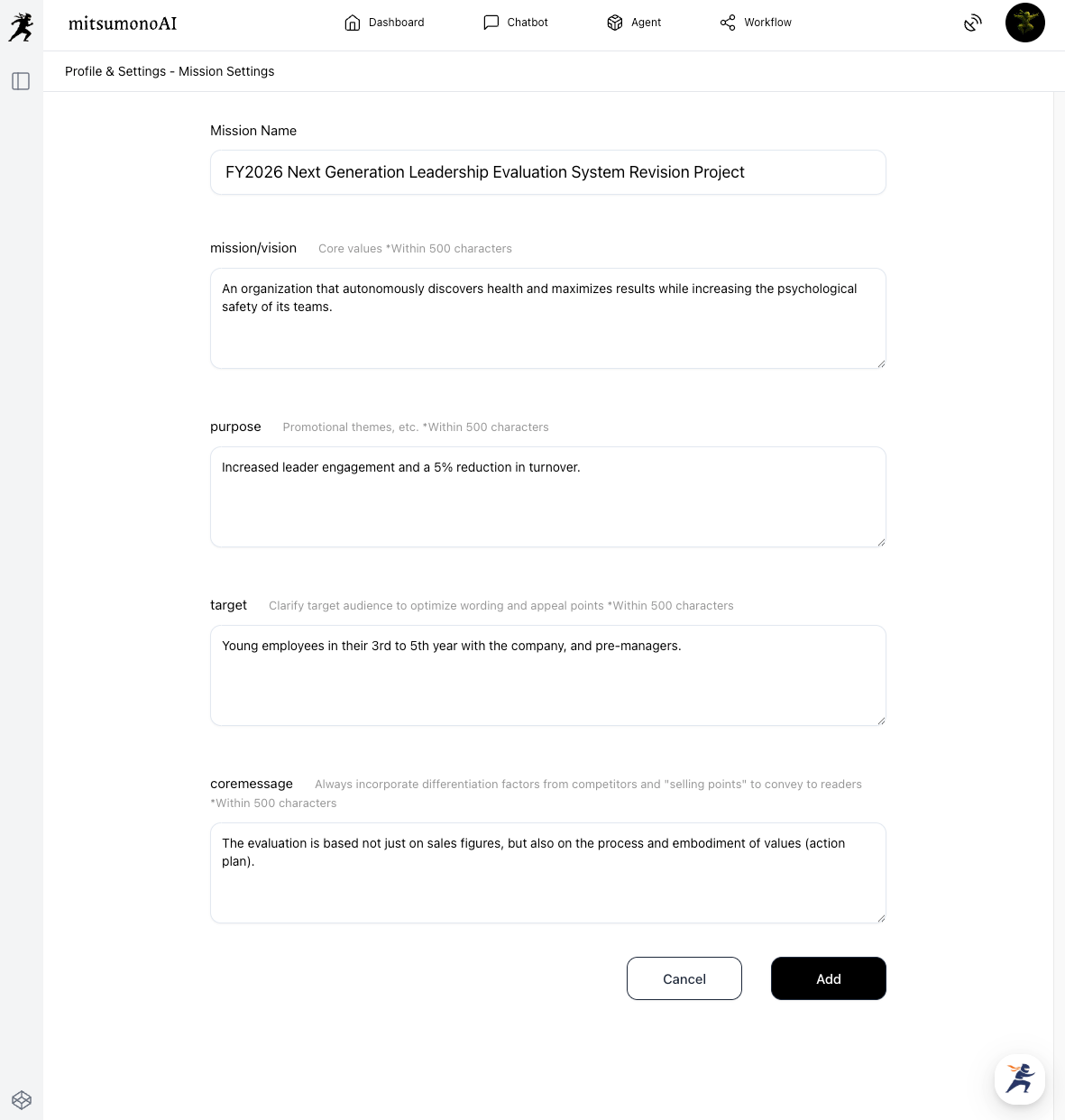
Step 0: Register the Mission
Install the "corporate philosophy"—the foundation of the evaluation system—into the AI. If this foundation is shaky, the criteria will end up as soulless copies of other companies.
[Preparation/Execution]:
Register the project definition in "My Mission" in the side menu.
Step 1: Clarify the Ideal Talent
Have the AI depict the specific target (persona) you want to evaluate and develop.
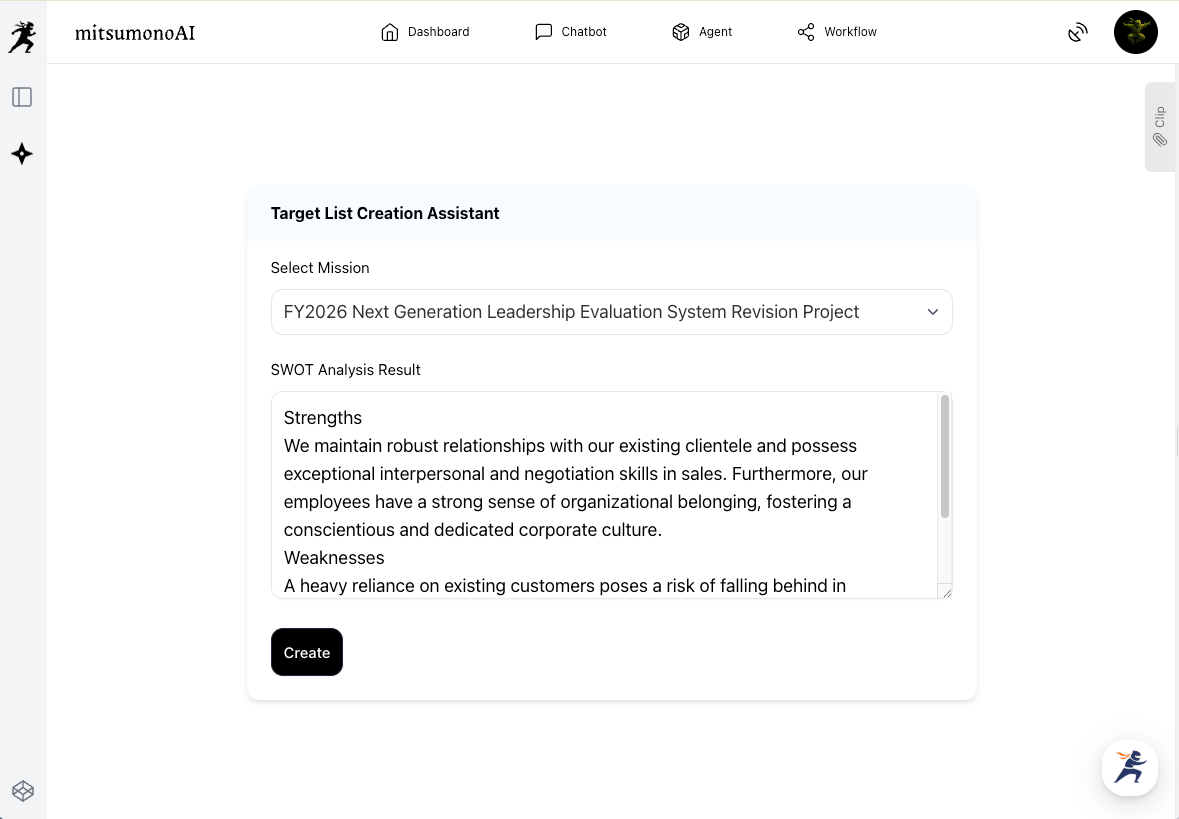
1-1. Identify Target Talent Layers
Input a SWOT analysis of the organization and have the AI identify the "target talent layers" (who should be evaluated and developed) to be addressed by the system revision.
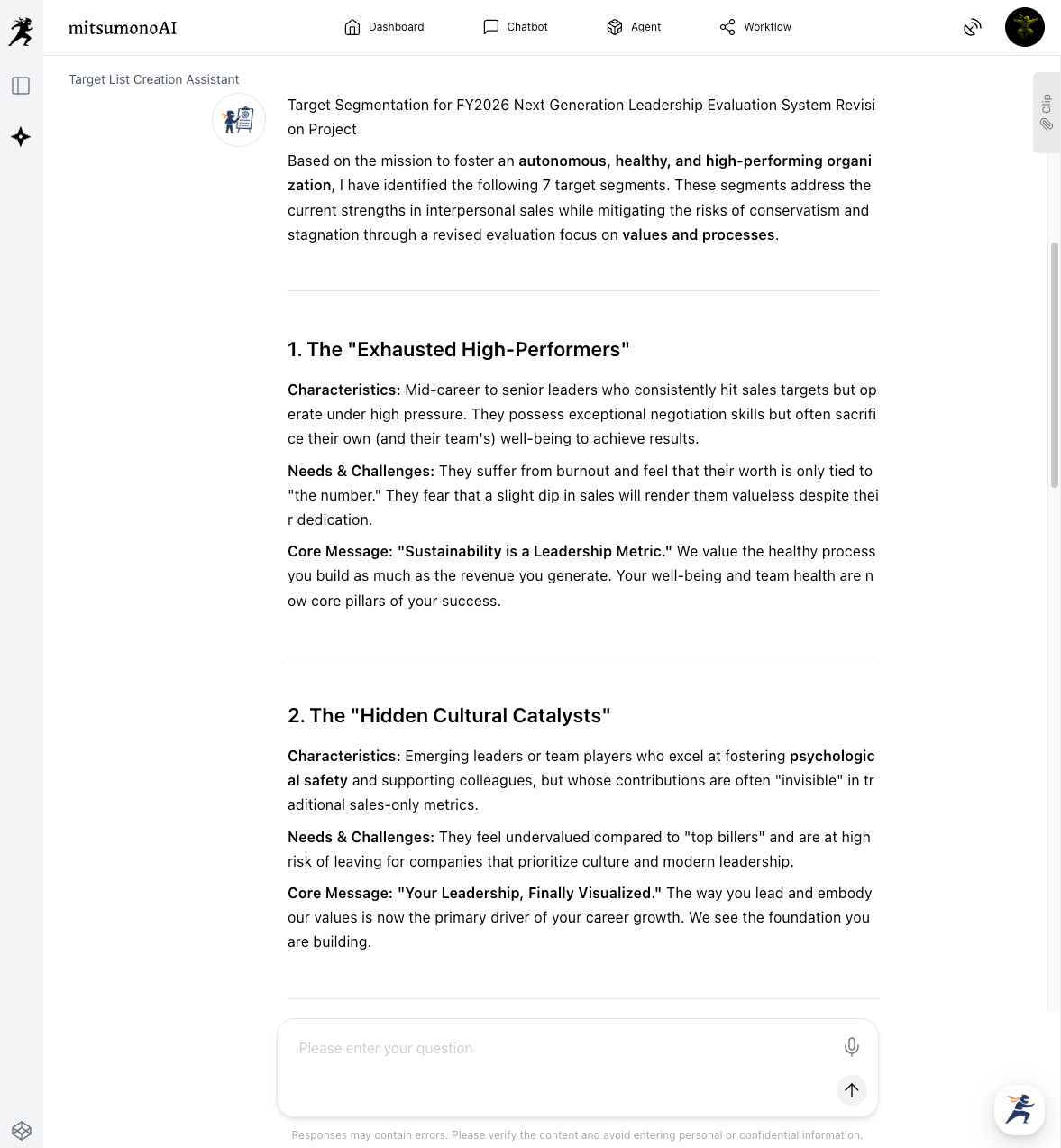
1-2. Understand Detailed Personas
From the candidates identified by the Target List Creation Assistant, select the "Next-Generation Leader Layer" as the core of this revision and generate a detailed persona (including their pains and worries).
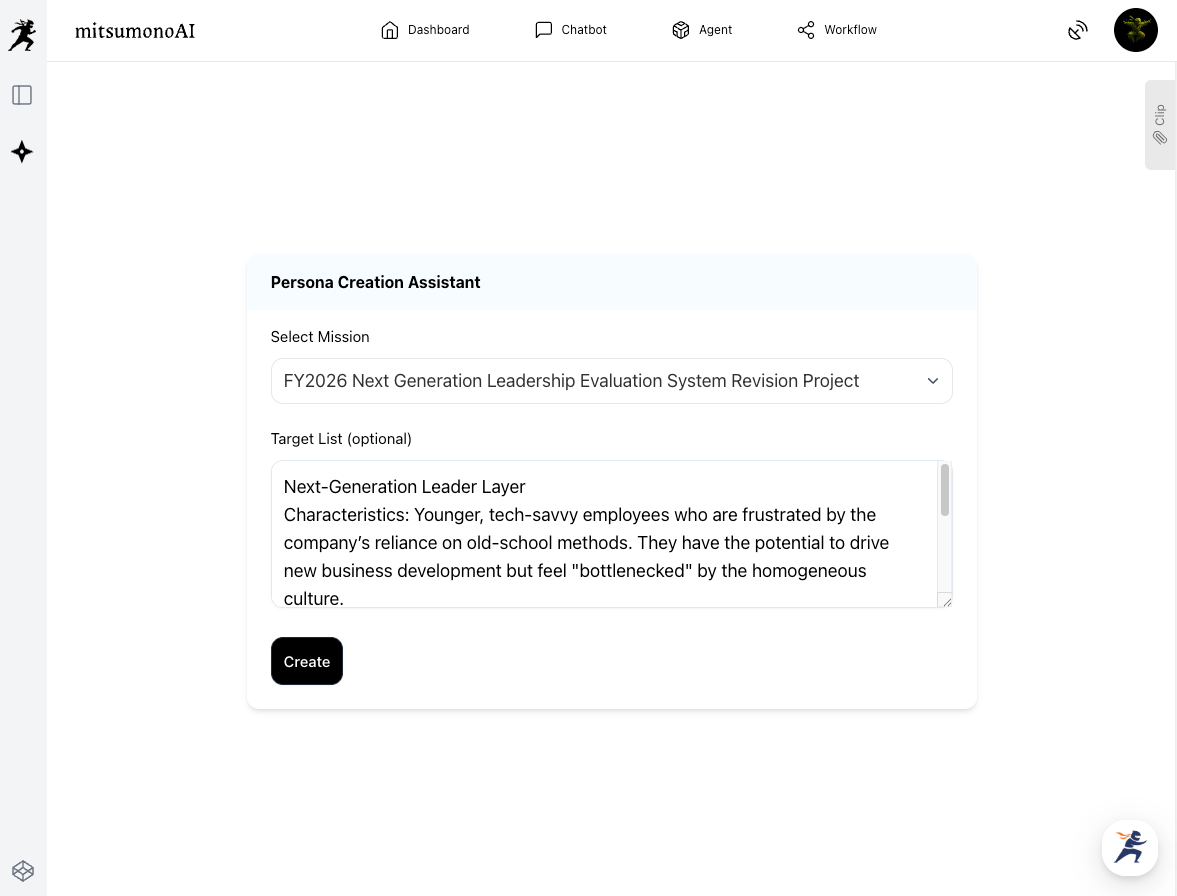
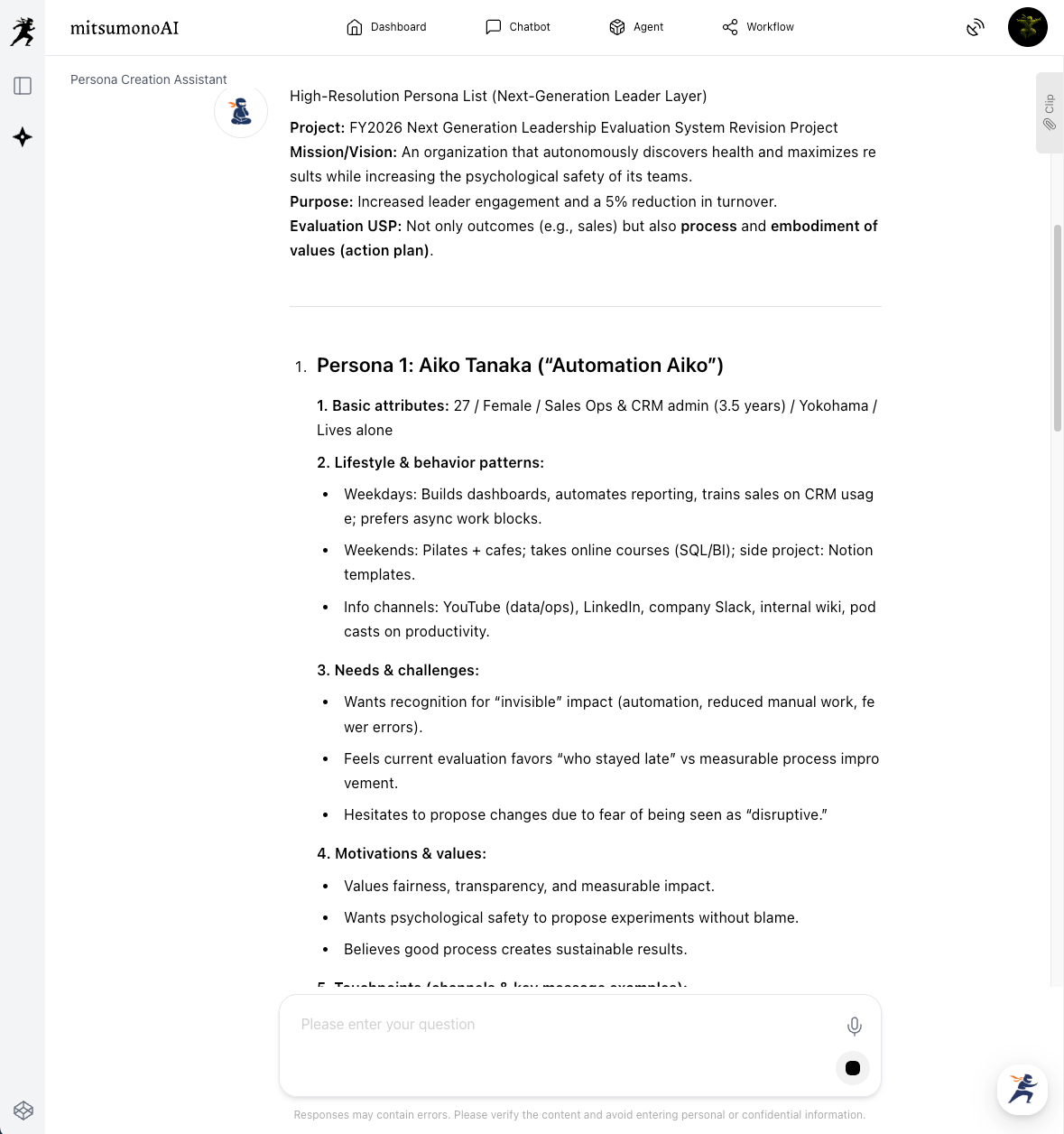
You can also dig deeper into the generated personas.
"Regarding the 'DX Promotion Leader Candidates,' please specifically describe their current challenges (e.g., being overwhelmed by operational tasks) and their anxieties regarding their careers."
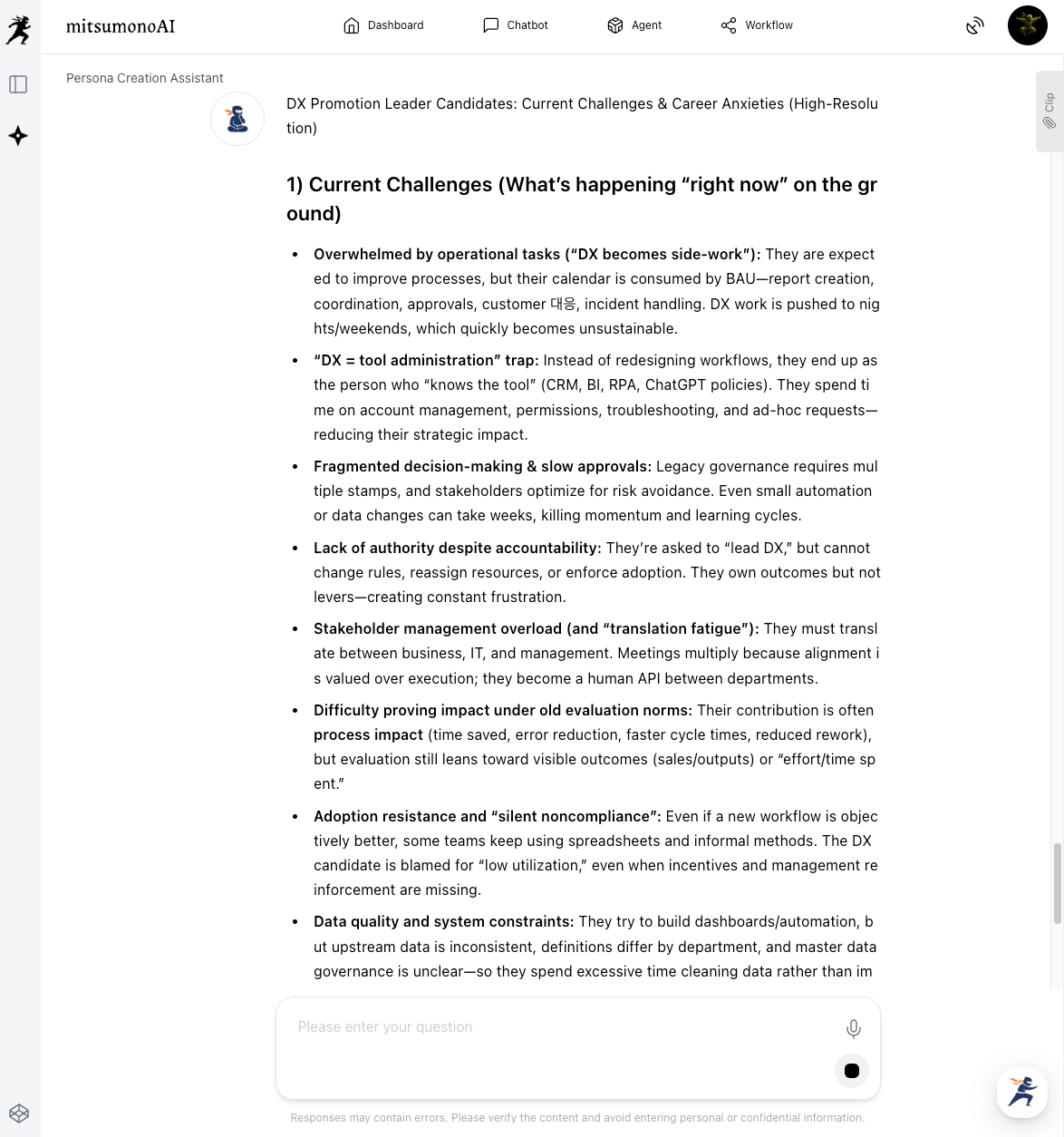
Step 2: Verbalization and Structuring of Evaluation Criteria
Based on the mission and persona, translate vague expectations into "measurable actions."
[Preparation/Execution]:
Use "AI Chat (GPT-5 Thinking)," which is capable of advanced reasoning.
"You are a professional in building personnel evaluation systems. Define the abilities required for the following persona 'S' to move up to the next grade across three items: 'Team Building,' 'Problem-Solving,' and 'Talent Development.'
Persona S:
・Needs/Challenges: Their proposals are rejected due to organizational habits or a lack of understanding from superiors. They feel a sense of powerlessness because their skills do not translate into recognition.
・Motivations/Values: Execution-oriented, wanting to improve operations through technology. They value fair evaluation and discretion, wanting the process and communication to be evaluated fairly rather than just the results of the improvement.
・Current Status: High technical and digital knowledge, but daily life is consumed by routine and reactive tasks, leaving no time for DX proposals or mid-to-long-term improvements.
・Pain Point: Feeling that their hands are tied because proposals get stuck in local customs or approval processes.
・Risk: Frustration on the verge of burnout, mismatch between evaluation and compensation, and anxiety about future career paths.
Conditions:
・Abstract words (e.g., 'Communicate well') are prohibited.
・Describe using 'behavioral facts' that are objectively observable.
・Output the results as a table with a 5-level (S to D) evaluation scale for each item."
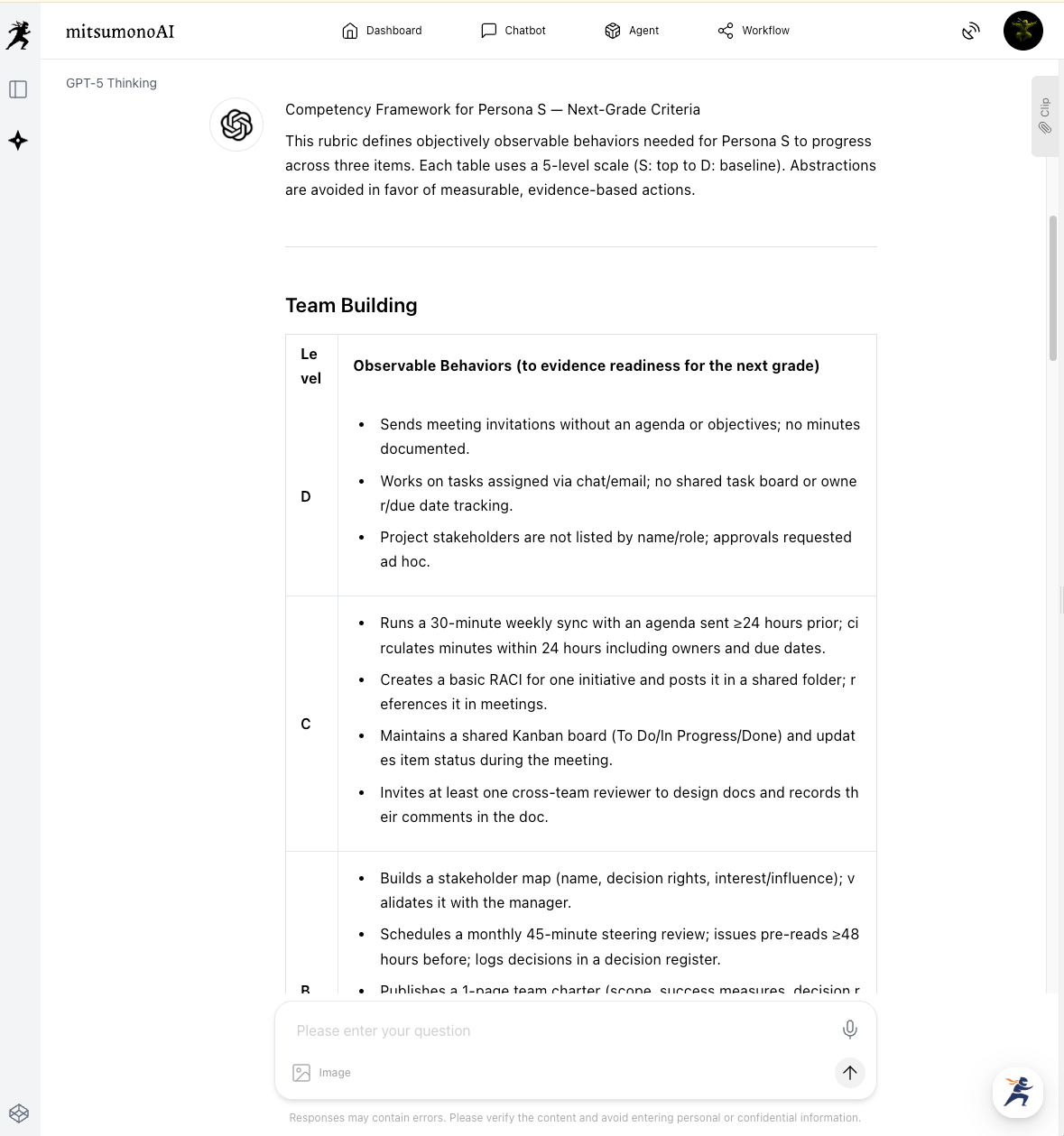
Toward a "Unified Talent Strategy" from Hiring to Development
the "objective evaluation criteria" created with AI can be utilized throughout your entire talent strategy, not just during evaluation season.
- Expansion to Recruitment:
By transferring created personas and evaluation criteria to Job Descriptions, you can drastically reduce post-hiring mismatches ("This job isn't what I thought it was"). - Automatic Generation of Development Plans:
Have the AI analyze the gap between current evaluations and target standards to create individual development roadmaps detailing specific training or OJT needed for the next term. - Improving 1-on-1 Quality:
By using the AI-generated "behavioral standards" as a guideline, managers can provide constructive feedback based on facts rather than emotions.
Summary: Graduating from "Gut-Feeling HR" to Accelerate Organizational Growth
Introducing AI into the evaluation system is by no means "taking the easy way out." Rather, it is a "proactive decision" to shine a light on areas that were previously forced to remain vague and to face every employee with sincerity.
The fusion of a logical framework provided by AI (GPT-5) and the organizational "temperature" provided by humans (Human-in-the-loop) elevates the resulting standards beyond simple numerical management into a "common language" that everyone can accept.
A fair and transparent evaluation system is, in itself, the strongest employee benefit and the true engine that drives an organization. Use mitsumonoAI to find the "optimal solution" unique to your company. Now is the time to prepare an environment where employees can drive themselves forward without hesitation.
mitsumonoAI can be used not only for restructuring evaluation systems and streamlining human resource development but also for solving various business challenges, improving operational efficiency, and creating new value.
Other use cases and the latest information are available on the mitsumonoAI blog site.