Building OJT Where New Hires Take the Lead with AI: A Manual for Standardizing Training and Boosting Productivity
Inconsistent and inefficient OJT slows growth and burdens mentors. This article explains how to use AI to clarify OJT goals and generate practical simulations, empowering new hires to grow autonomously while freeing senior staff from the weight of constant instruction.


Overcoming the "Invisible Walls" of OJT with AI
- "What is taught varies depending on which senior staff member is in charge of OJT."
- "The criteria for when a new hire is 'independent' is vague."
- "The training is too passive, so new hires don't develop the ability to think for themselves."
In many companies, these OJT issues occur on a daily basis. These challenges don't just slow down a new hire's growth; they are major factors that steal precious time from senior mentors and lower the productivity of the entire organization.
Human resource development is essential for a company's sustainable growth. However, traditional OJT is highly dependent on the individual, often relying on the mentor's personal experience and intuition. As a result, training quality fluctuates, leading to lower retention rates for new hires and performance gaps after they are officially assigned.
By reading this article, you will learn specific steps to build an environment where new hires can grow autonomously by gaining a new partner in AI—systematizing everything from "goal setting" to "practical training." You will find tips to eliminate individual bias, reduce the burden on instructors, and turn new hires into effective team members sooner.
How AI Standardizes OJT and Encourages New Hires to "Take the Lead"
mitsumonoAI integrates multiple AI assistants to solve the problems of personalization and inefficiency in OJT. It provides support as if you had a specialized "OJT Design Consultant" and a "Practical Training Development Team" stationed in-house.
- Feature 1: Objective Goal Setting
AI clarifies the criteria for "independence" based on data from top-performing employees, allowing OJT goals to be unified across the company. - Feature 2: Practical Material Generation
AI extracts situations new hires are likely to face from past failure cases and automatically generates realistic case study problems. - Feature 3: Efficient Operation and Updates
AI dramatically streamlines everything from OJT design to material preparation. Even if company rules change, you can maintain the latest educational system simply by updating the questions via AI.
By having AI define OJT goals based on data, you can eliminate the variance between instructors, and new hires can clearly understand exactly what they are aiming for. Furthermore, through practical simulation problems generated by AI, new hires can develop problem-solving skills in a safe environment and foster the ability to think autonomously.
Step-by-Step: Systematizing OJT with AI
Step 1: Unifying OJT "Goals" Across the Company with AI
The first priority is to define the "ideal state of an independent new employee" based on objective data and share it company-wide.
1. Extract characteristics of top performers with the [File Analysis Assistant]
Upload several past performance reviews or 1-on-1 meeting records of young employees (2–3 years in) who are currently thriving, and have the AI extract their common skills and behavioral traits.
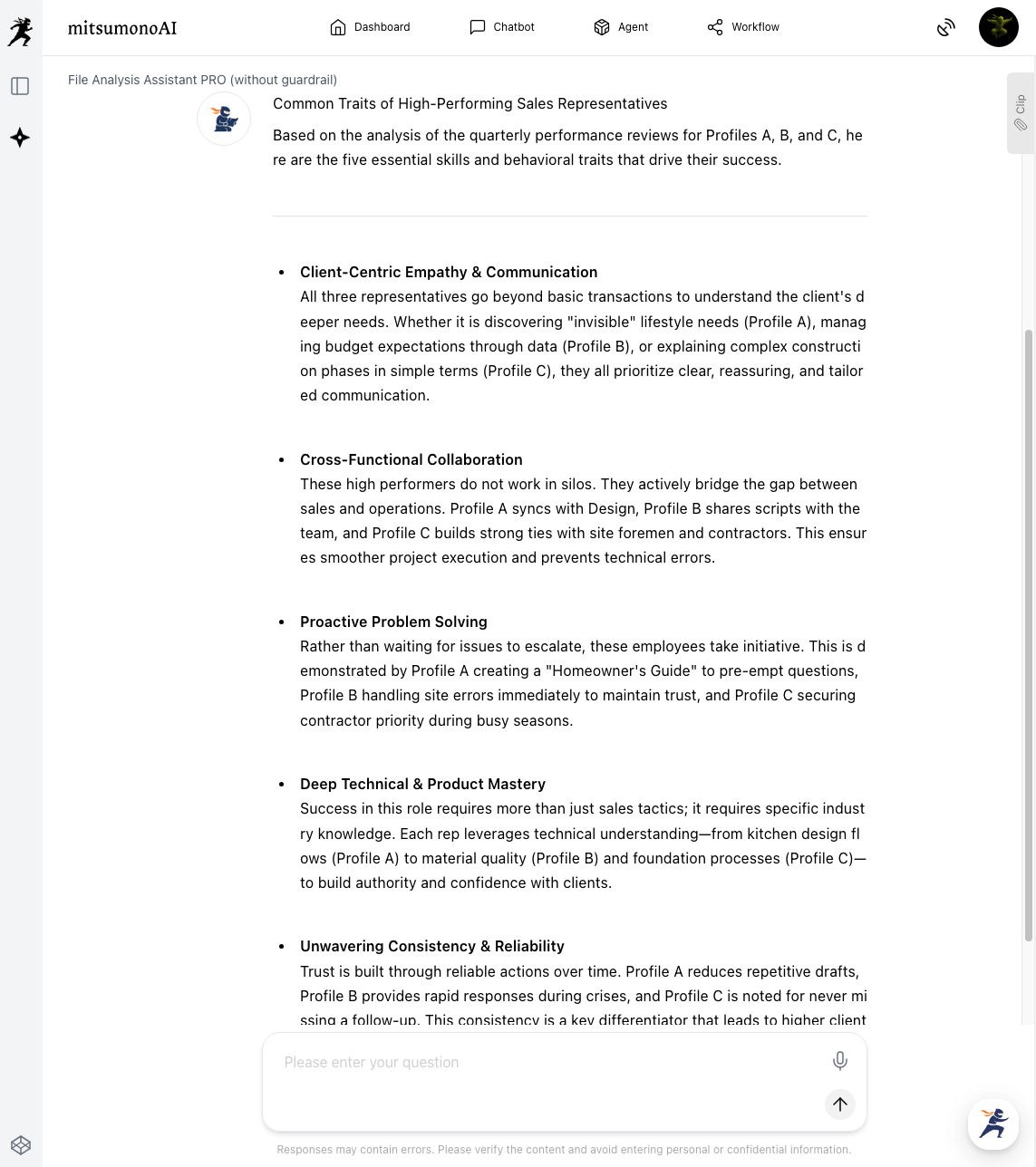
The AI will objectively derive specific commonalities, such as "the ability to interview and draw out latent customer needs," "smooth coordination with other departments like the design team," or "rapid reporting and response to troubles."
2. Verbalize the "Ideal New Hire" with the [Persona Creation Assistant]
Input the extracted commonalities (e.g., high interviewing skills, smooth coordination) into the Persona Creation Assistant to create a specific persona of the "ideal employee one year after joining." This becomes the goal of the OJT.
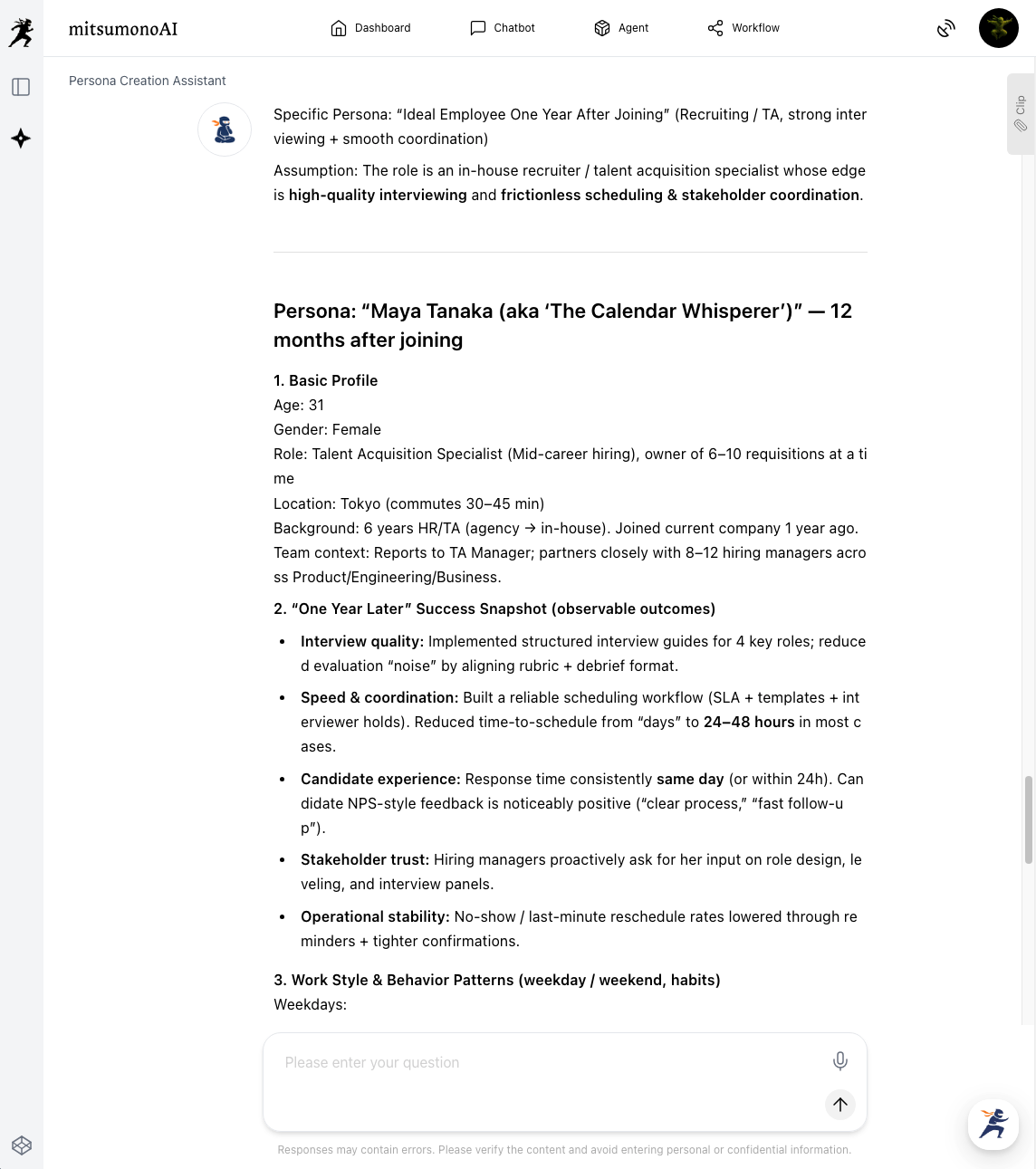
Through this step, OJT goals—which were previously left to the intuition of individual instructors—are defined as clear, company-wide standards.
Step 2: Automatically Generating "Practical Materials" from Past Failures
Next, to achieve these goals, have the AI create "virtual OJT" materials for new hires to cultivate practical problem-solving skills.
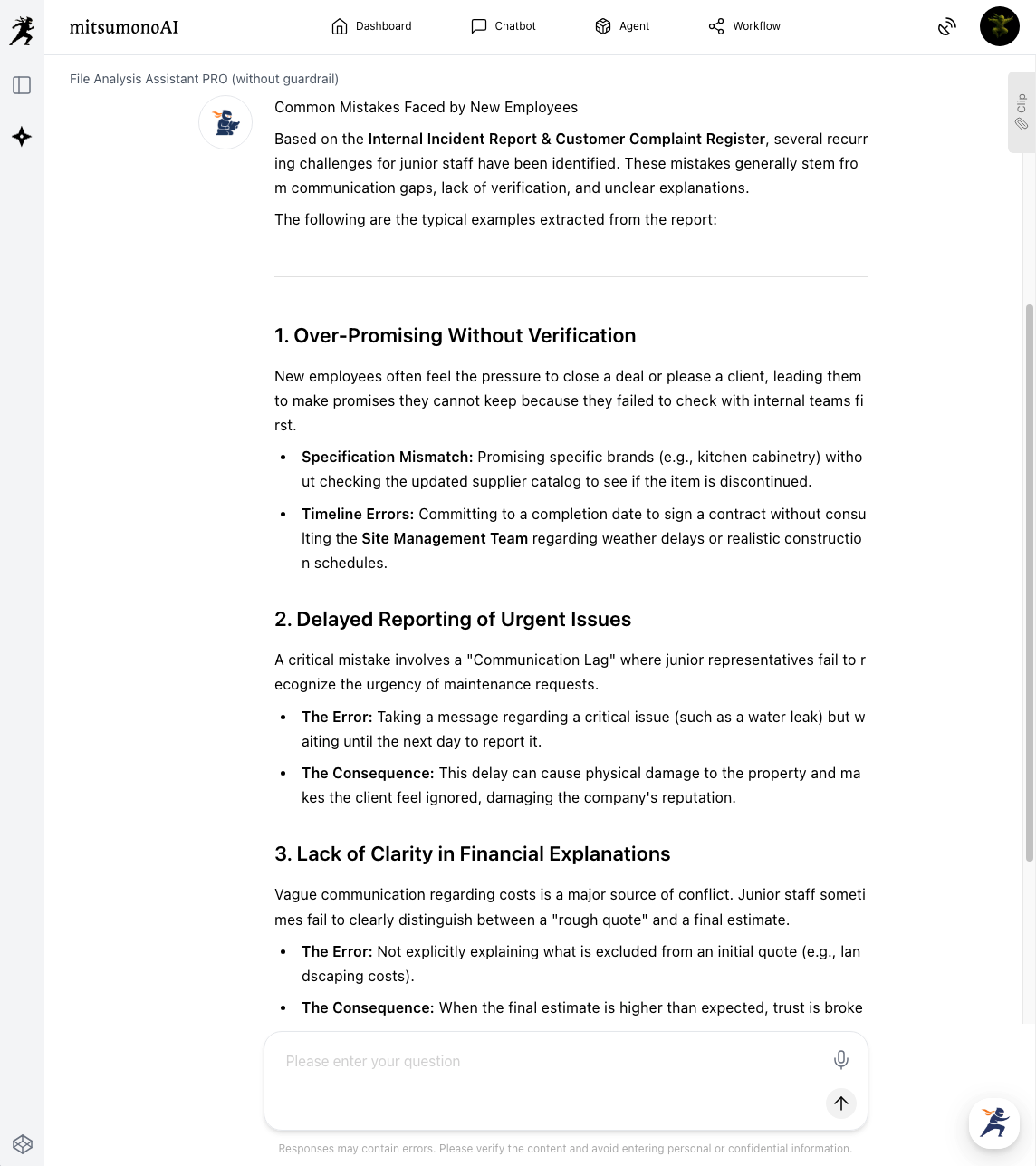
1. Extract typical failure cases with the [File Analysis Assistant]
Upload past trouble reports or customer complaint logs and have the AI extract "typical failure cases that new hires are likely to face."
2. Generate case study problems with [Sensei AI - Home Builder ]
Finally, input the extracted failure cases into the industry-specific Sensei AI - Home Builder to create practical role-playing problems.
The above are real failure cases experienced by our new hires in the past. Based on this situation, please create 5 role-playing problems for new sales reps. Format the questions as: 'You received this specific feedback from a customer. How would you answer first, and what action would you take next?'"
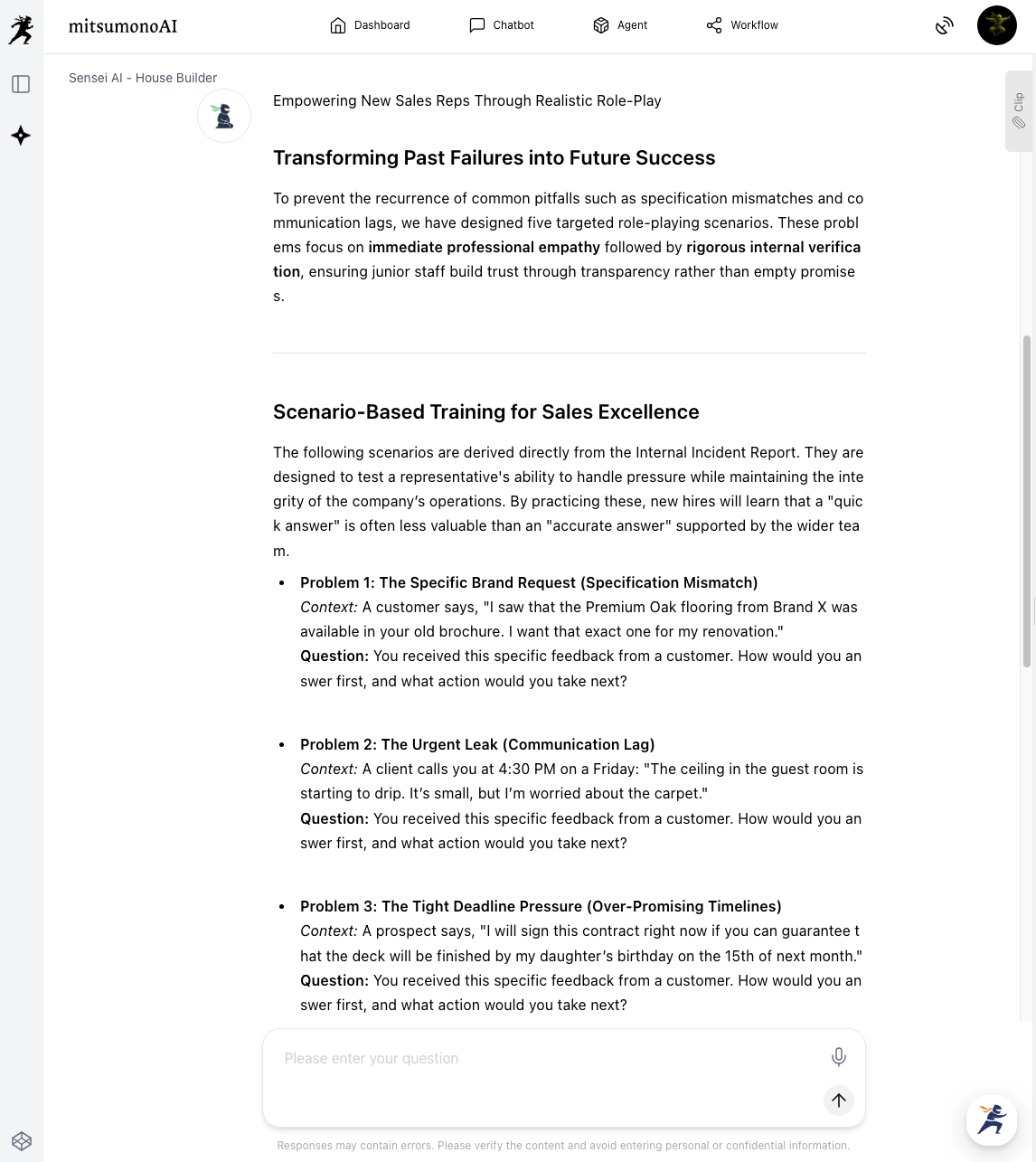
Through this step, past "near-miss" experiences are transformed into the best "teaching materials" for new hires to learn responsiveness in a safe environment.
Expansion: The Potential of AI to Strengthen Organizations
This AI-driven OJT system contributes to the efficiency and strengthening of the entire organization, far beyond just training new hires.
Transferring to Other Tasks and Domains
- Streamlining Internal Manuals:
Use the blog post creation workflow to systematically create operational manuals for new nurses or reception staff, ensuring uniform quality of education. - Upskilling Existing Employees:
Develop practical case study materials for specific skill-up training for mid-career employees or leadership training for managers.
Usage for Promotion and Branding
An advanced OJT system using AI is a major selling point in recruitment. By showcasing an environment where new hires can grow with peace of mind on the company website or at recruitment fairs, you can attract high-quality talent.
Summary
This article introduced specific steps to systematize "OJT goal setting" and "practical material generation" using AI. By utilizing AI:
- OJT quality is standardized, eliminating variance between instructors.
- New hires develop practical problem-solving skills, promoting "autonomous growth."
- Senior employees are freed from the burden of constant instruction and can concentrate on higher-value tasks.
It is now possible to confront OJT challenges—which were previously accepted as "just the way it is"—with the powerful weapons of data and AI. To increase employee engagement and improve the productivity of the entire organization, why not start improving your OJT with data-driven AI?
mitsumonoAI can be used not only for OJT but also for solving various business challenges, improving efficiency, and creating new value.