[For Management & HR] Identifying the "Root Cause" of Overtime with AI | Deriving Concrete Solutions from Data Analysis
Do you know the real reason why overtime is so high? This article explains how to objectively categorize the root causes of overtime based on employee data and formulate specific, data-driven solutions.

![[For Management & HR] Identifying the "Root Cause" of Overtime with AI | Deriving Concrete Solutions from Data Analysis](/content/images/size/w1200/2025/12/overtime-1.png)
Three Reasons Why the "True Cause" of Overtime Remains Hidden
To effectively reduce overtime, it is essential to accurately identify the reasons, periods, and causes of increased workloads. However, three major barriers stand in the way:
- Data Fragmentation: Numbers and Text Don't Connect
In most cases, "overtime hours (numerical data)" from attendance systems and "reasons for overtime (text data)" from application forms are managed separately. Linking these two to analyze which department and which specific task is causing how many hours of overtime requires immense effort. - Subjective Assumptions: The "Individual Issue" Bias
There is a tendency to attribute high overtime to a manager's subjective impression, such as "lack of skill" or "poor efficiency" of an individual. Such subjective judgments cause structural problems within the organization to be overlooked, stalling fundamental solutions. - Abstraction of Causes
Reasons for overtime are often dismissed with abstract phrases like "due to heavy workload" or "responding to urgent requests." It is rare to dig deeper into the root cause—the "true cause"—of why it is busy or why urgent requests occur so frequently.
AI Visualizes the Essence of the Overtime Problem
How can we overcome these three barriers and reach the root cause? AI visualizes the essence of the problem to realize organizational improvement.
- Eliminating Data Fragmentation: Integrated Analysis of Numbers and Text
AI simultaneously reads "structured data" such as overtime hours and department names, and "unstructured data" such as free-text reasons for overtime. It objectively identifies overtime patterns by department, making it clear which department is generating how many hours of overtime for what reasons. - Removing Subjective Bias: Objective Categorization of Reasons
AI understands the context of diverse free-text entries like "short-staffed" or "sudden spec changes" and automatically categorizes them into common root causes like "excessive workload," "rework," or "skill gaps." This eliminates the analyst's subjectivity and allows for a quantitative and objective grasp of organizational trends. - Preventing Abstraction: Extracting Suggestions for Concrete Solutions
AI analyzes correlations between categorized causes and derives insights that lead to specific improvement actions, such as "Department A has prominent overtime due to 'rework,' suggesting a potential issue in upstream communication."
[Practical Steps] Identifying Root Causes from Overtime Data with AI
Using a fictional tourism association as an example, we explain the specific steps to analyze the root causes of overtime using the "File Analysis Assistant."
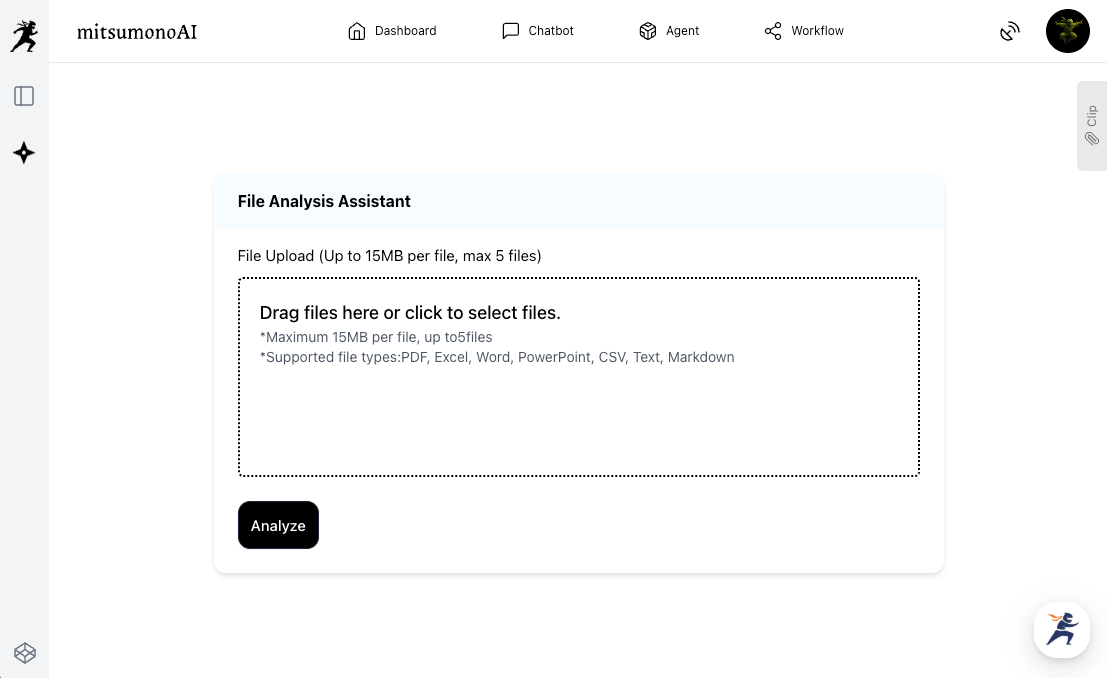
Step 1: [File Analysis Assistant] Upload Overtime-Related Data
First, upload the source data for analysis to the "File Analysis Assistant."
Data Format: Excel / CSV file
Required Fields: Department Name, Position, Overtime Hours, Reason for Overtime (Free-text)
Recommended Fields: Date, Project Name, Specific Task Details
Step 2: Instruct AI to "Categorize" and "Summarize" Overtime Reasons
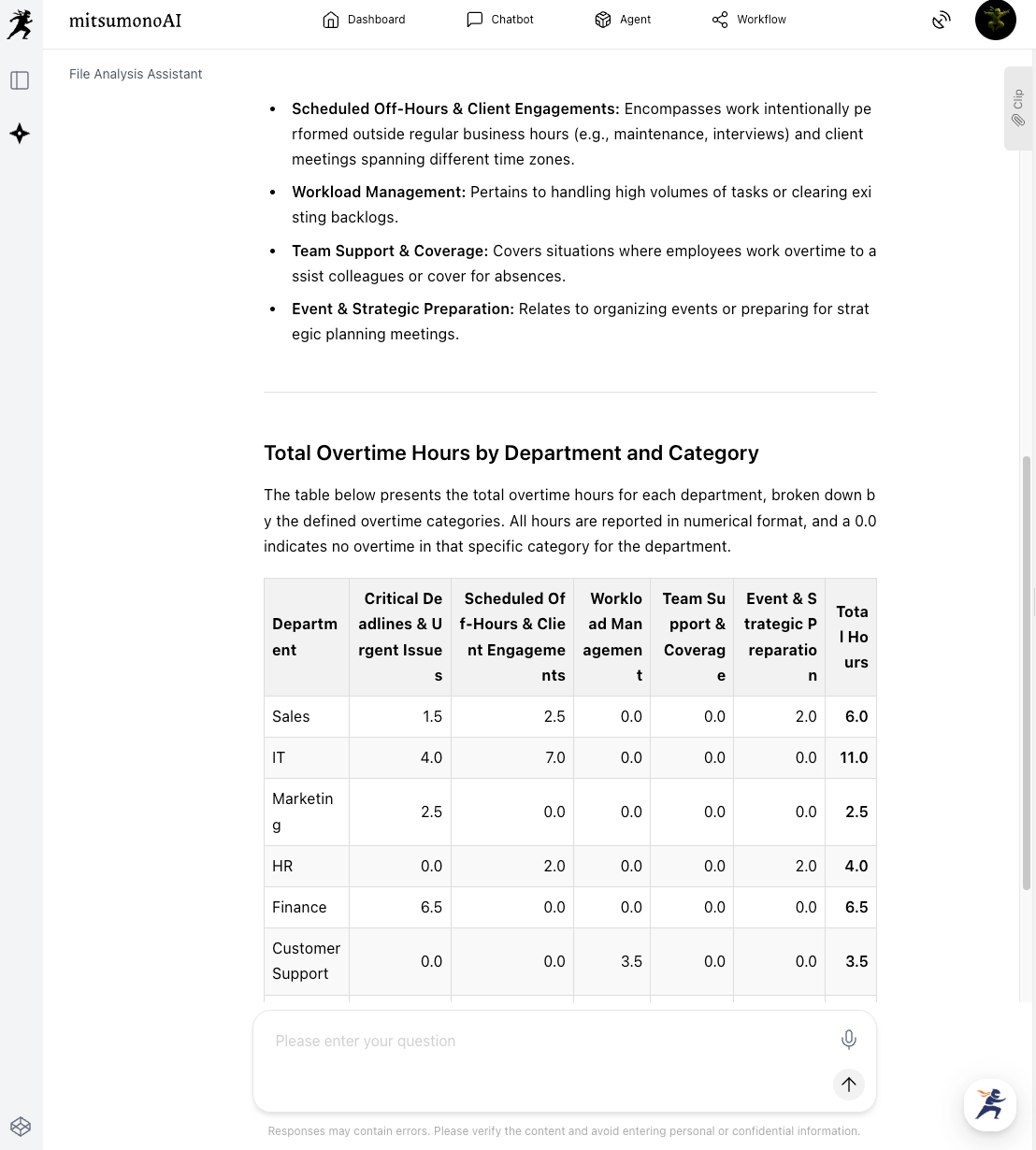
Instruct the AI to perform the following analysis on the uploaded data:
"Summarize the total overtime hours for each category by department and report it in a table format."
Step 3: Deepen "Solutions" through Dialogue with AI
Give instructions to further investigate the most serious issues found in the AI's analysis.
"It seems that only the IT department has a lot of overtime for routine work, but please consider the causes and solutions from various angles."
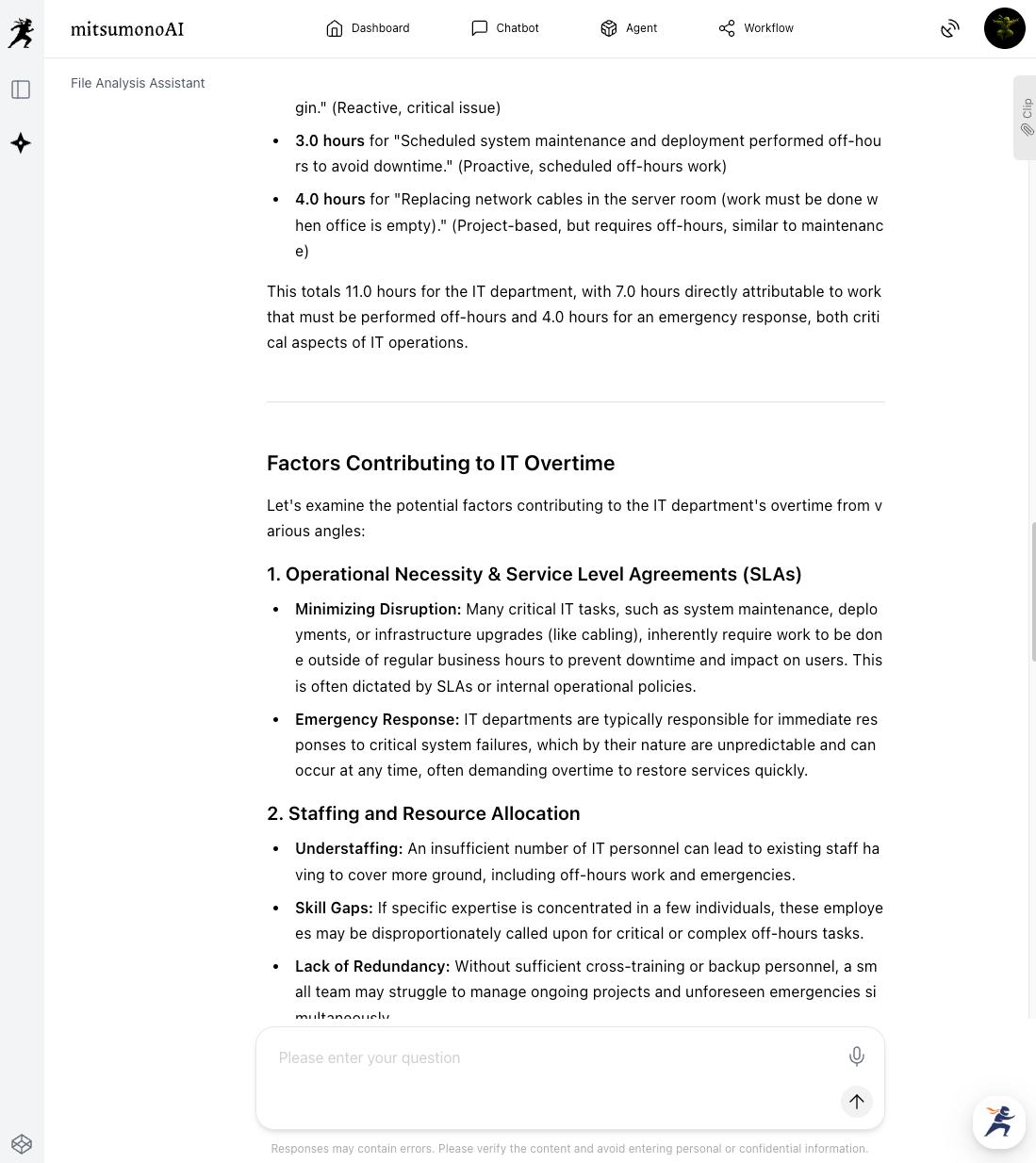
After examining the causes in this way, confirm with the heads of the relevant departments to consider and execute measures to reduce overtime.
✅ Analysis Completion Checklist
AI analysis is not the goal in itself. The most important thing is to connect the objective data obtained to concrete improvement actions starting tomorrow. Aim to clearly answer these five questions:
- Problem Identification
- Have you identified the "bottleneck"—which department and which task generates the most overtime?
- Categorization of Causes
- Have you used objective data to distinguish whether the main cause of overtime is an "individual skill" issue or an "organizational process" issue?
- Root Cause Hypothesis
- Why is the problem occurring? Have you formulated a hypothesis for the most likely "root cause" readable from the data?
- Direction of Solutions
- Do you see the direction for approaching the root cause (e.g., strengthening recruitment, training, introducing tools, or reviewing workflows)?
- The Next Move
- Are you ready to execute the first high-impact action that should be specifically started tomorrow?
Summary: Realizing "Data-Driven" Organizational Improvement with AI
This article introduced the steps to identify root causes from overtime data and derive concrete solutions using mitsumonoAI's "File Analysis Assistant." Utilizing AI enables:
- Identification of problems based on objective data.
- Categorization of causes without subjectivity.
- Formulation of actionable improvement steps.
It is now possible to confront overtime problems—which were previously given up on as "unavoidable"—with the powerful weapon of data.
Start your data-driven organizational improvement with AI to enhance employee engagement and improve overall productivity.
mitsumonoAI can be utilized not only for HR data analysis but also for solving various business challenges, streamlining operations, and creating new value.
Other use cases and the latest information are introduced on the following site.