Product Planning for EC and Retail : Leveraging Existing Customer Data for AI-Driven Success
Develop "products that sell" through data-driven planning. This article explains how to use AI to analyze existing customer data to predict "who will buy next" and "what should be sold next." Learn how to design upsell products that boost repeat rates and reduce risk through candid AI reviews.


Successful Product Planning Strategies Using Existing Customer Data: Objective Analysis and Idea Generation via AI
To increase the success rate of new product planning in the EC and retail industries, this article explains the process of target selection based on existing purchase data and the introduction of objective feedback using AI. We present specific steps to develop products that meet market needs through a data-driven approach, moving away from reliance on individual experience, intuition, or subjective internal judgments.
[Recommended for those facing these challenges]
- Wishing to break away from product development dependent on past successes or the "gut feeling" of project leads.
- Unable to effectively utilize existing customer purchase data for planning the next hit product.
- Lacking essential discussion or risk verification based on objective data during planning meetings.
- Facing challenges in reducing inventory risk for new products due to vague target audience segmentation.
Step-by-Step Guide: "Data-Driven" Upsell Product Planning with AI
In this simulation, we look at a case where an organic food EC site plans a new product for its existing customers.
Step 1: [Target List Creation] Letting AI Identify "Who Should Buy Next"
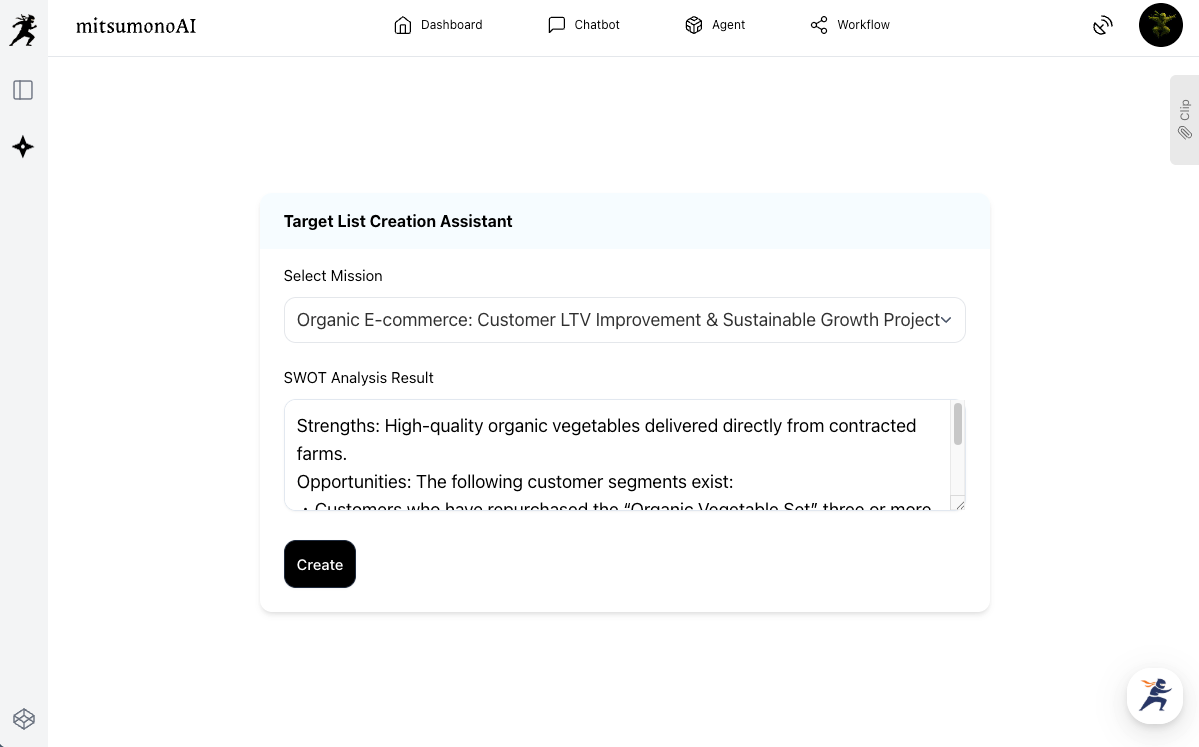
First, use the Target List Creation Assistant to identify the most promising customer segments among your existing customers to approach next.
[Preparation & Execution]
- Launch the assistant and select the pre-registered mission.
- In the "SWOT Analysis Results" field, briefly enter your company's strengths (USP) and the "Opportunities" identified from existing customer purchase data.
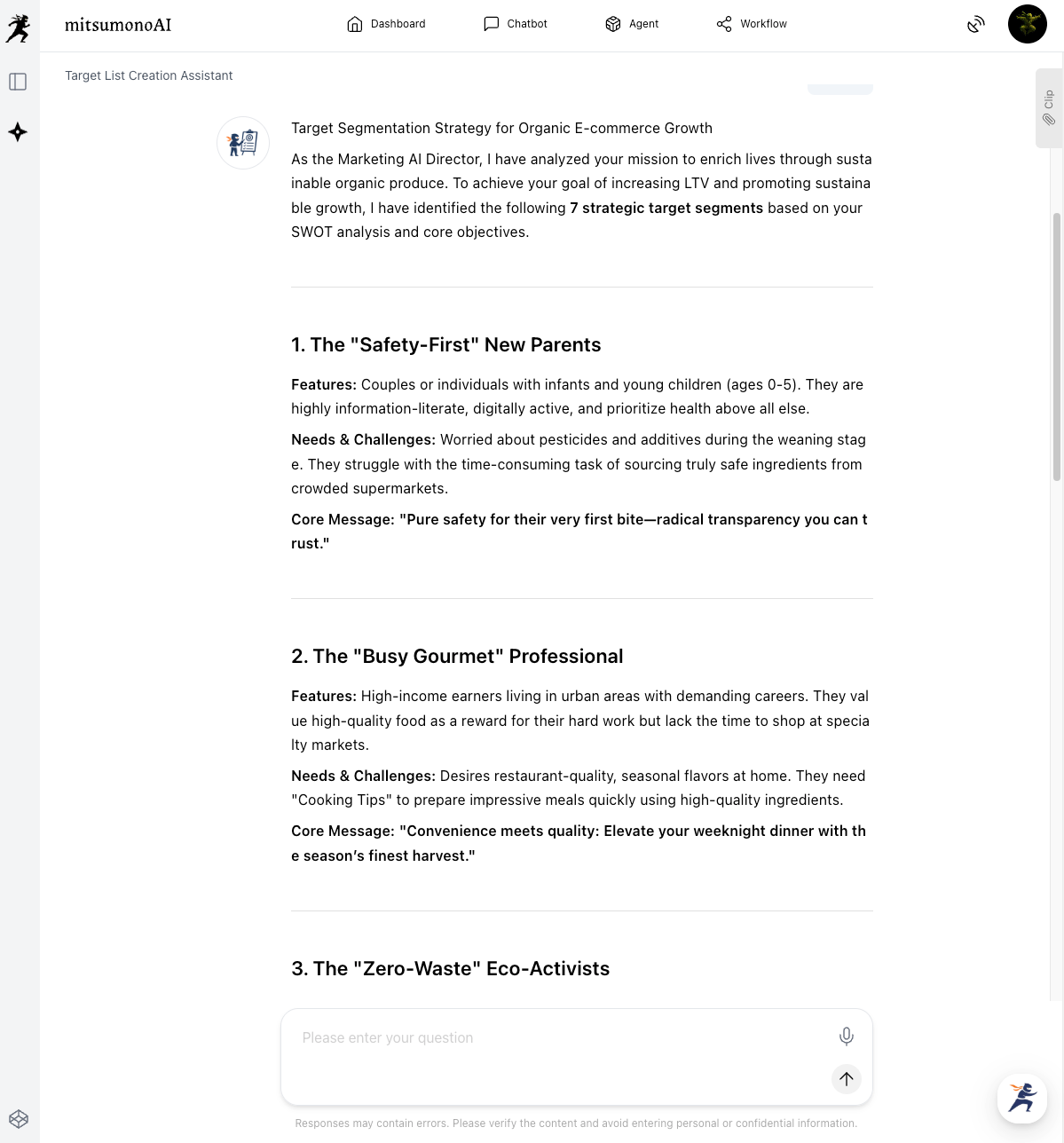
Save the target identified here to the "Clip" feature so it can be used in the next step.
 mitsumonoAI
Step 2: [Product Development Planner] Giving Shape to the Target's "Next Want"
Next, use the Product/Menu Development Planner to flesh out new product ideas that address the "latent needs" of the target segment identified in Step 1.
[Preparation & Execution]
Launch the planner, enter the customer persona obtained in Step 1 into the "Target" field, and request new product ideas.
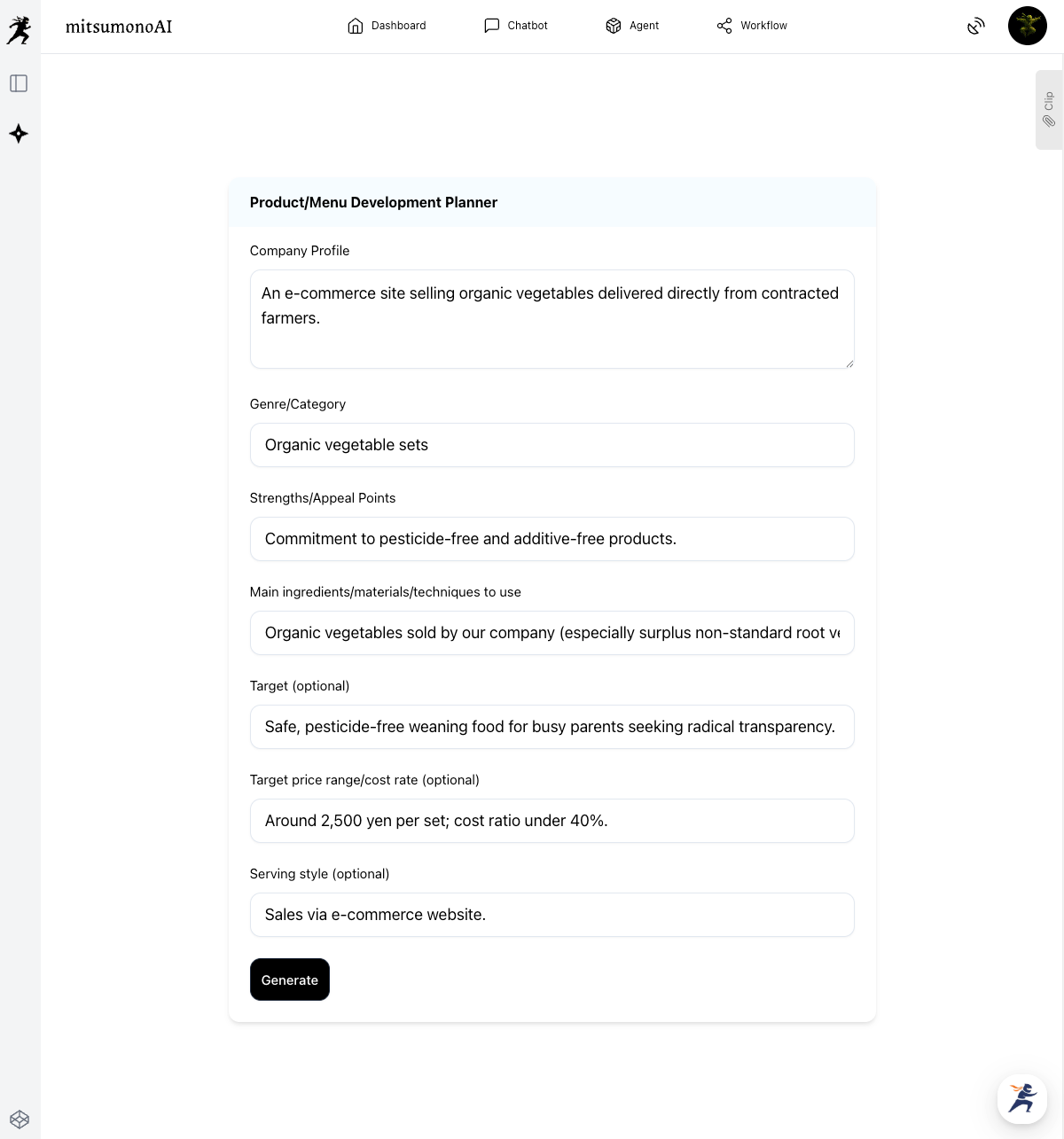
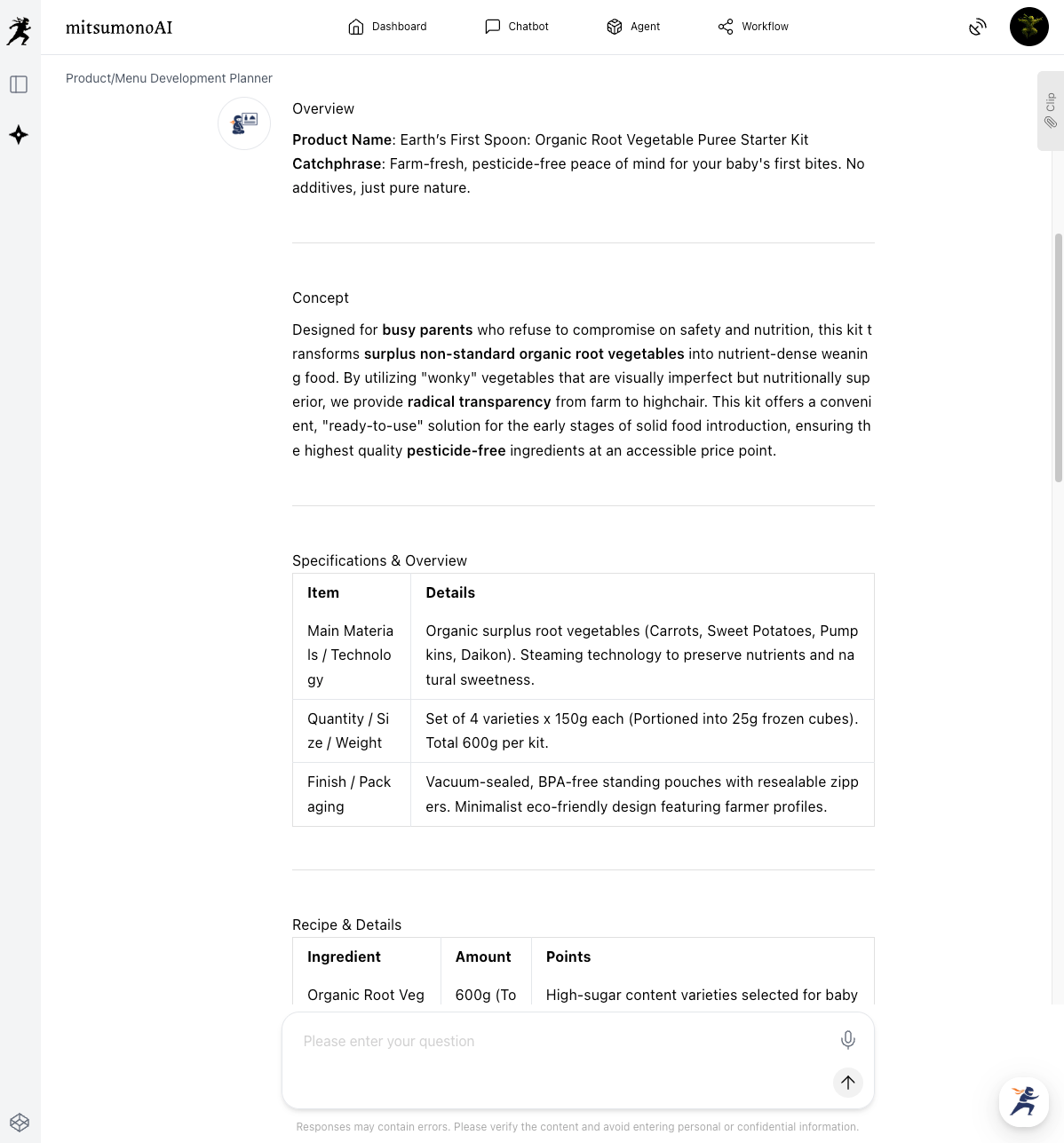
Based on the input, the AI will propose specific product ideas that perfectly satisfy both the target's needs and your company's resources.
Step 3: [Socratic Sparring with Sensei AI] Letting AI Point Out "Reasons It Won't Sell" Without Hesitation
Finally, subject your most promising product ideas to a rigorous, "zero-compromise" review by the industry-specific Sensei AI to eliminate weaknesses in the plan.
[Preparation & Execution]
Since this case involves food, launch Sensei AI - Restaurant to present your plan and ask for objective feedback.
Example Prompt: Sensei AI - Restaurant
"You are an experienced marketing consultant in the food industry. No sugar-coating is required. Please candidly point out three 'possibilities of failure' for the following plan and the 'primary reasons' for them from a critical perspective. Additionally, suggest specific improvements to avoid those failures.
[New Product Proposal]
(Paste results from Step 2)"
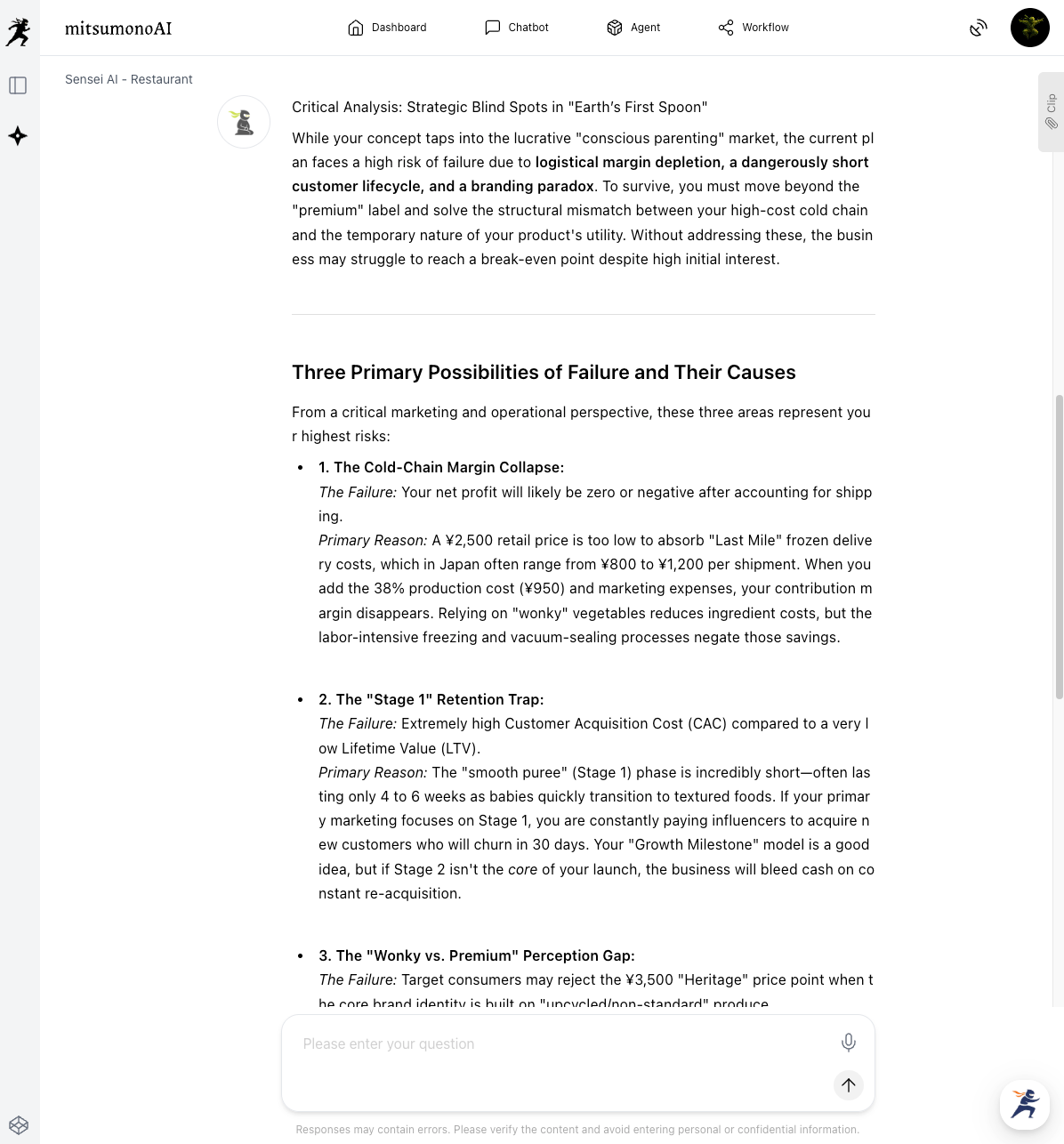
True to the request for "no sugar-coating," the AI will provide critical perspectives that are often difficult to voice within internal hierarchies but essential for business success, such as:
- Weakness in Differentiation vs. Price
- Design Risks of Root Vegetable Over-reliance
- Realities of Profitability and Logistics
Application and Expansion: From Planning to Promotion
Products refined through this process seamlessly transition into subsequent marketing activities.
- Naming and Package Design: Generate product names with the Naming Assistant and visualize the direction of package design using gemini-2.5-flash-image.
- SNS Teaser Ads: Use the Post Text Creation Workflow to communicate the story behind the development in words that resonate with the target, building anticipation before the launch.
- LP (Landing Page) Creation: Request the AI to write high-empathy LP copy that addresses the persona's challenges (e.g., "I want to give my child safe snacks").
Summary
In this article, we introduced three specific steps to plan "next-selling" upsell products from existing customer data using AI to increase success probability.
- In Step 1, let AI identify "premium customers who should buy next" from the data.
- In Step 2, let AI create ideas for "products those customers want next."
- In Step 3, let a "zero-compromise" AI point out the "weaknesses" of those ideas.
AI provides your planning with a compass called "Data" and a touchstone called the "Customer’s Perspective."
Why not graduate from product development based on "intuition" and "wishful thinking" and build a system with AI to create reproducible hit products?
mitsumonoAI is a business-specialized AI platform designed to simultaneously enhance "work quality" and "speed" through the use of AI.
It can be utilized not only for product planning but also for solving various business challenges, improving operational efficiency, and creating new value.