Rediscovering Regional Charm Through AI : Rebranding Strategies for Creating "Destination of Choice" Based on Data
Discover how to revitalize local economies by leveraging AI to rebrand regional resources. This guide outlines a 3-step strategy to transform provider-centric planning into data-driven, customer-focused experiences that attract repeat visitors and modernize traditional tourism assets.


Lush nature, unique cultures, and proud local specialties. While regions are brimming with hidden charms, these possibilities are often stifled by "communication gaps" or "entrenched customs."
In this article, we explain regional branding techniques using mitsumonoAI to move beyond emotional arguments and tradition toward a data-driven approach. By positioning AI as a powerful partner, you can aim for a transformation into a "region of choice" from an objective perspective.
Recommended for those facing these challenges:
- Inability to verbalize appeal: The value of products or experiences is not reaching consumers due to weak naming or poor messaging.
- Difficulty escaping the "provider mindset": Projects are biased toward the "creator's passion" or "local customs," resulting in a disconnect from customer needs.
- Stagnant ideas: Failure to differentiate from other regions, resulting in "generic projects" that get buried in the market.
- Delayed data utilization: Tourist data exists, but there is a lack of personnel or methods to analyze and apply it to strategy.
AI Becomes Your "Regional Brand Consultant"
mitsumonoAI provides six powerful AI assistants to solve deep-rooted regional branding issues, supporting everything from discovery to strategy formulation and implementation.
- Naming Assistant: Proposes "fresh and attractive names" that capture trends and symbolize the brand.
- Sensei AI - Masanori Satake: Provides "unbiased and precise feedback" on projects based on expert knowledge of Tourism DX.
- Persona Creation Assistant: Delves deep into the target customer segments to visualize latent needs and pain points.
- File Analysis Assistant PRO: Automatically analyzes the behavioral characteristics of repeat visitors simply by uploading existing data in CSV format.
- Product/Menu Development Planner: Connects resources with needs to design "marketable experience menus" from a customer perspective.
- New Business Development Assistant: Evaluates the feasibility of businesses from multiple angles, considering revenue targets and legal constraints.
By allowing AI to capture customer needs and re-evaluate regional resources, you can shift organizational mindsets and achieve essential regional DX and sustainable economic revitalization.
Step-by-Step Guide: Rebranding and Repeat Visitor Cultivation Plans with AI
Here, we simulate a case where a rural agricultural region, proud of its abundant produce, aims to attract repeat visitors from "urban families and young adults interested in food" by launching new experience programs and rebranding local specialties with AI.
Step 1: Deep Dive into the "Ideal Repeat Visitor" with the Persona Creation Assistant
First, clarify the specific image of the target tourist and use the Persona Creation Assistant to uncover latent needs and travel-related pain points.
[Preparation & Execution]
Launch the Persona Creation Assistant, select a pre-registered mission, and enter information into the target list.
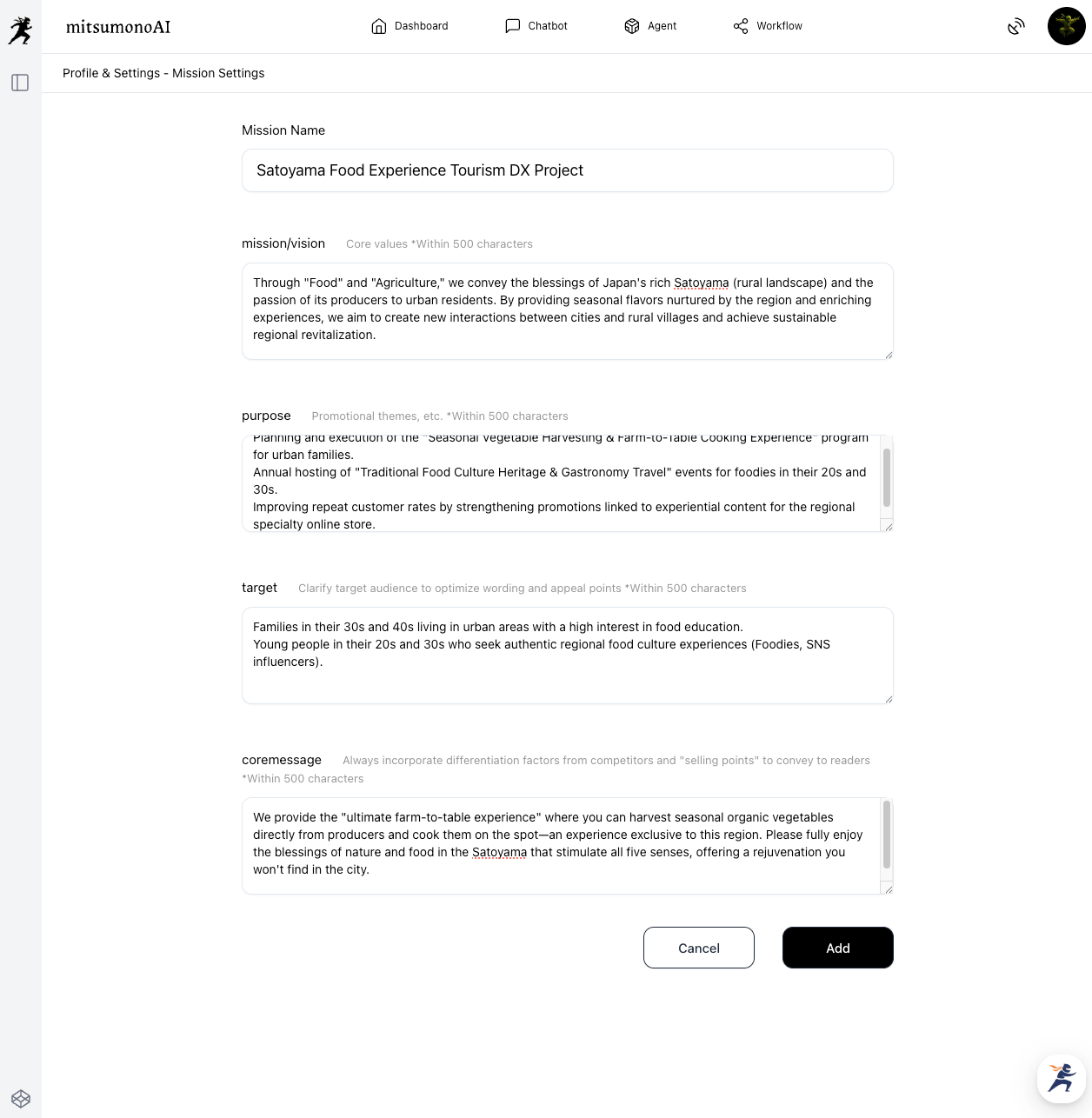
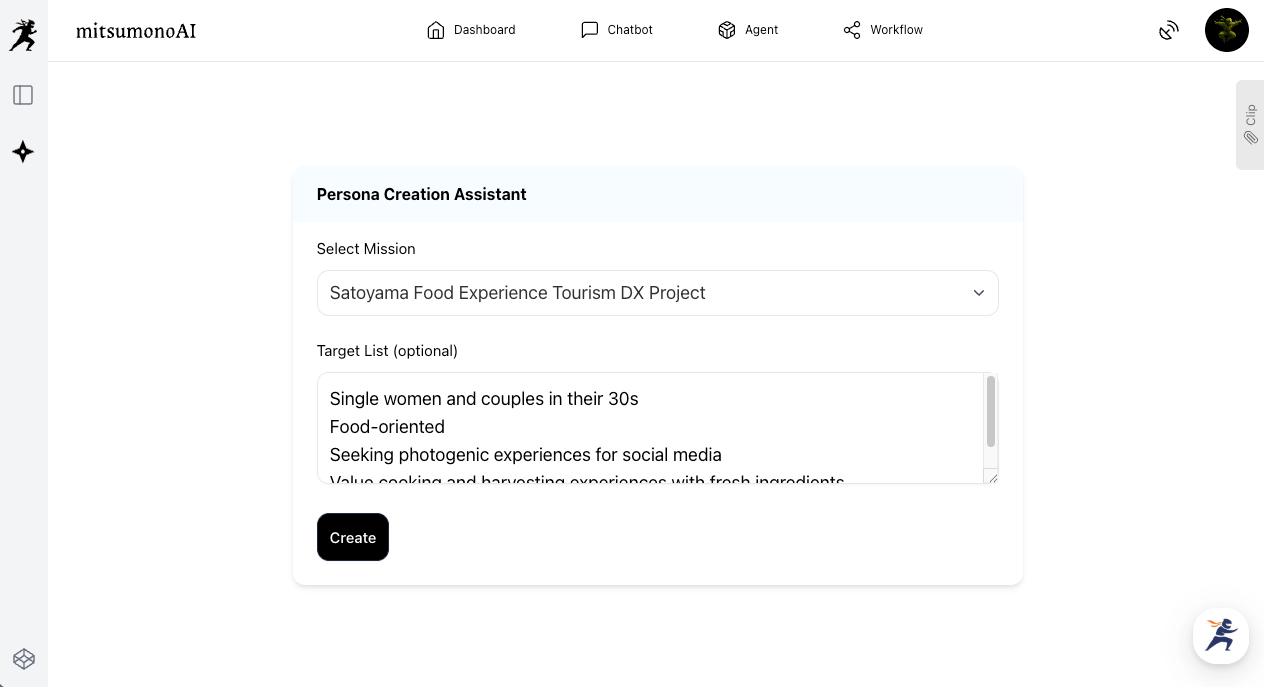
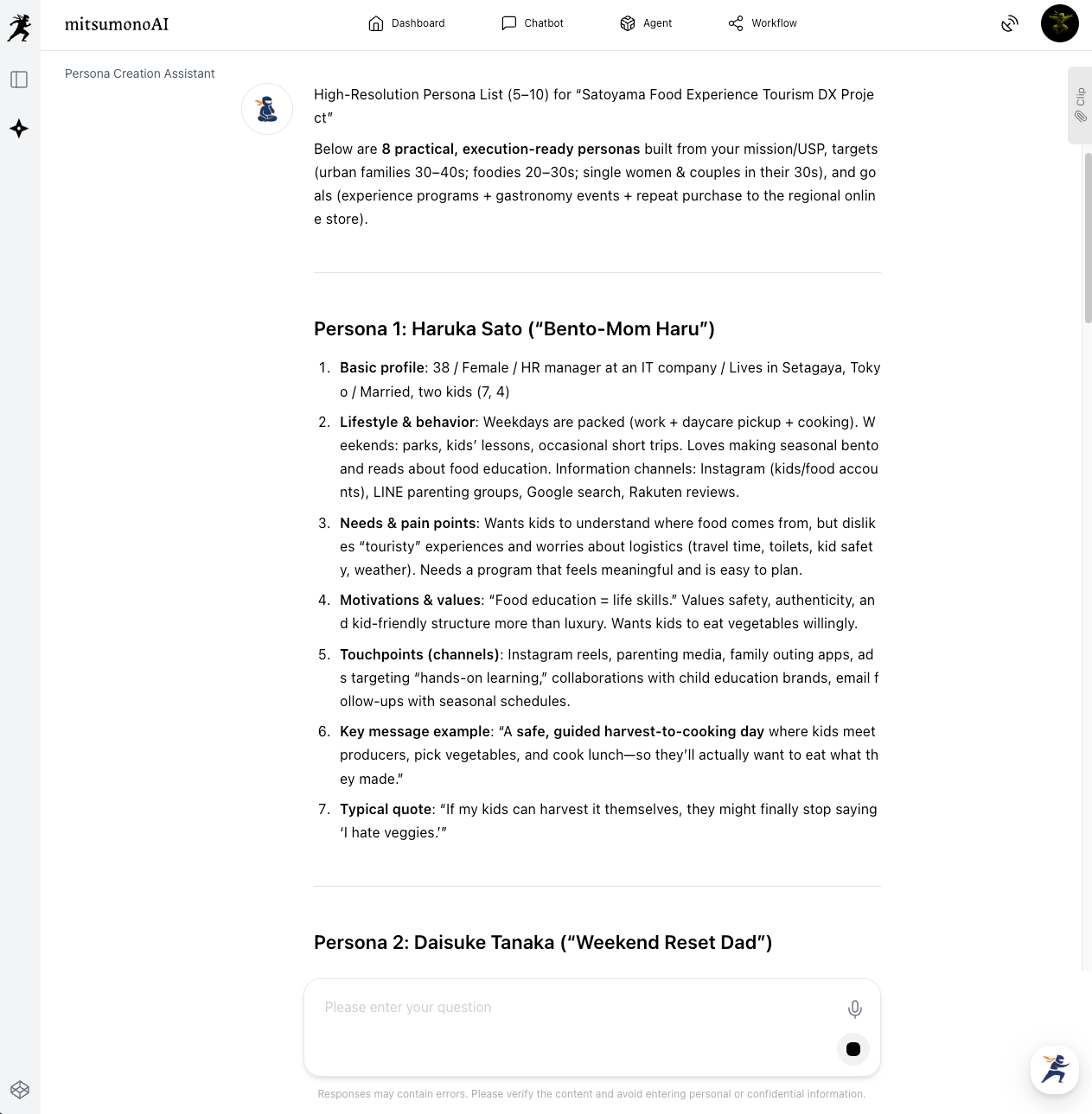
To understand latent pain points such as "why they don't return," issue additional instructions:
"I want to know why these personas do not repeat their visits to our destination. Please dig deeper into their latent pain points."
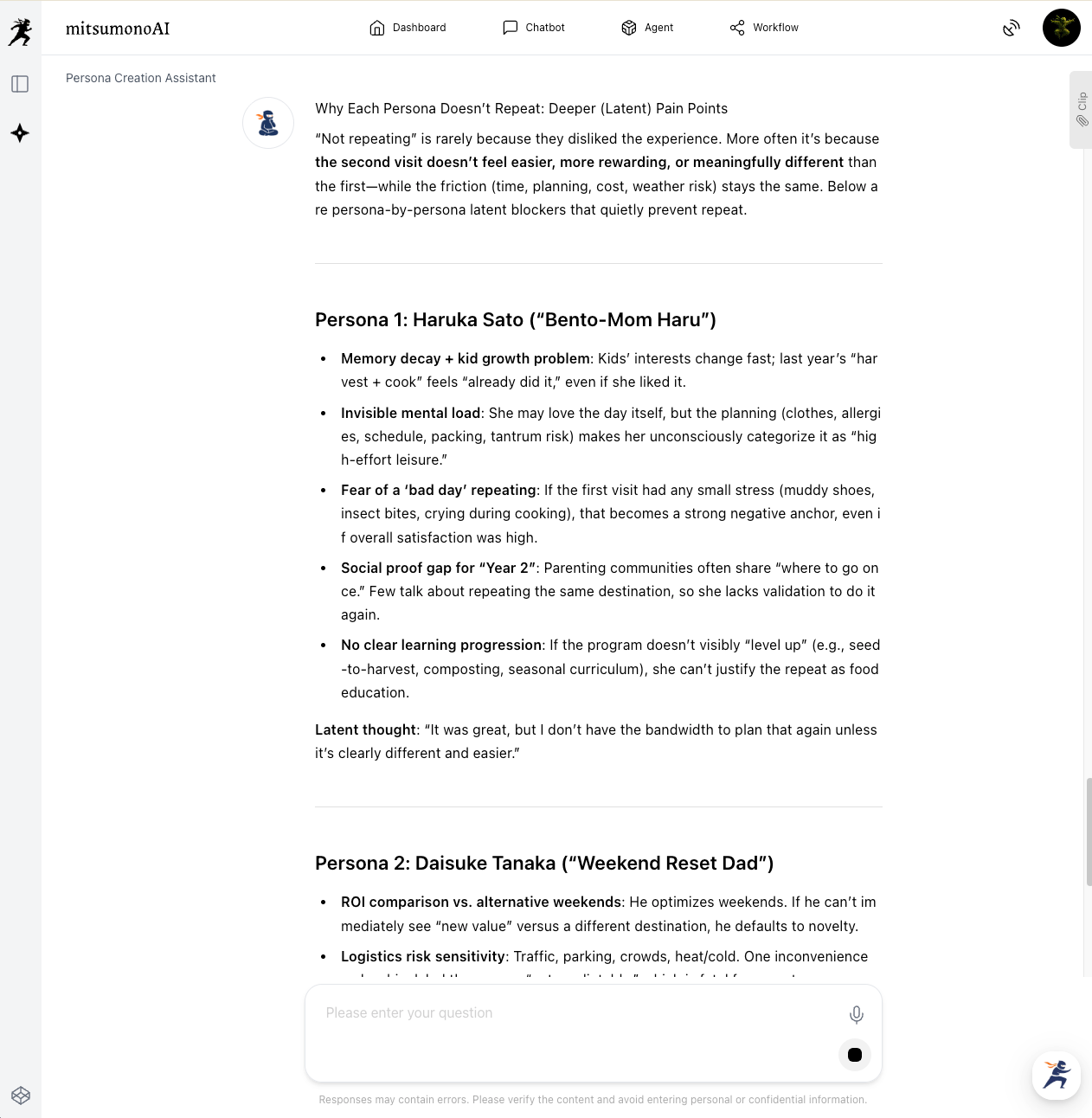
Through this step, vague categories like "urban families" or "foodies" evolve into concrete "tourist profiles who want to return."
Step 2: Analysis and Diagnosis with File Analysis Assistant PRO & Sensei AI - Masanori Satake
Next, analyze existing tourist data to discover hidden local charms and trends among repeaters. Furthermore, have the expert AI diagnose issues in the existing tourism strategy to find areas for improvement.
[Preparation & Execution]
Download order data from the past year in CSV format from your e-commerce management screen. For high-precision analysis, include items such as Order ID, Date/Time, Product Name, Unit Price, and Customer ID.
Upload the regional tourist data (e.g., farmhouse stay booking history, specialty product purchase history at direct sales offices, participation rates in agricultural experience programs, stay duration by age group, etc.) to the File Analysis Assistant PRO.
⚠️ To protect personal information, please replace customer names with IDs.
Prompt Example: File Analysis Assistant PRO
"Analyze the uploaded data and provide the following two points:
1.Extract issues regarding 'spending imbalances (e.g., concentration on specific specialties)' during tourist stays in this agricultural region, and propose three data-driven approaches for improvement.
2.Based on data regarding trends of repeaters—specifically 'experiences that triggered a return visit (e.g., farming experiences, local festivals)' and 'purchased specialties'—tell me three latent needs to increase the repeat rate for the following personas: [Attach personas from Step 1]"
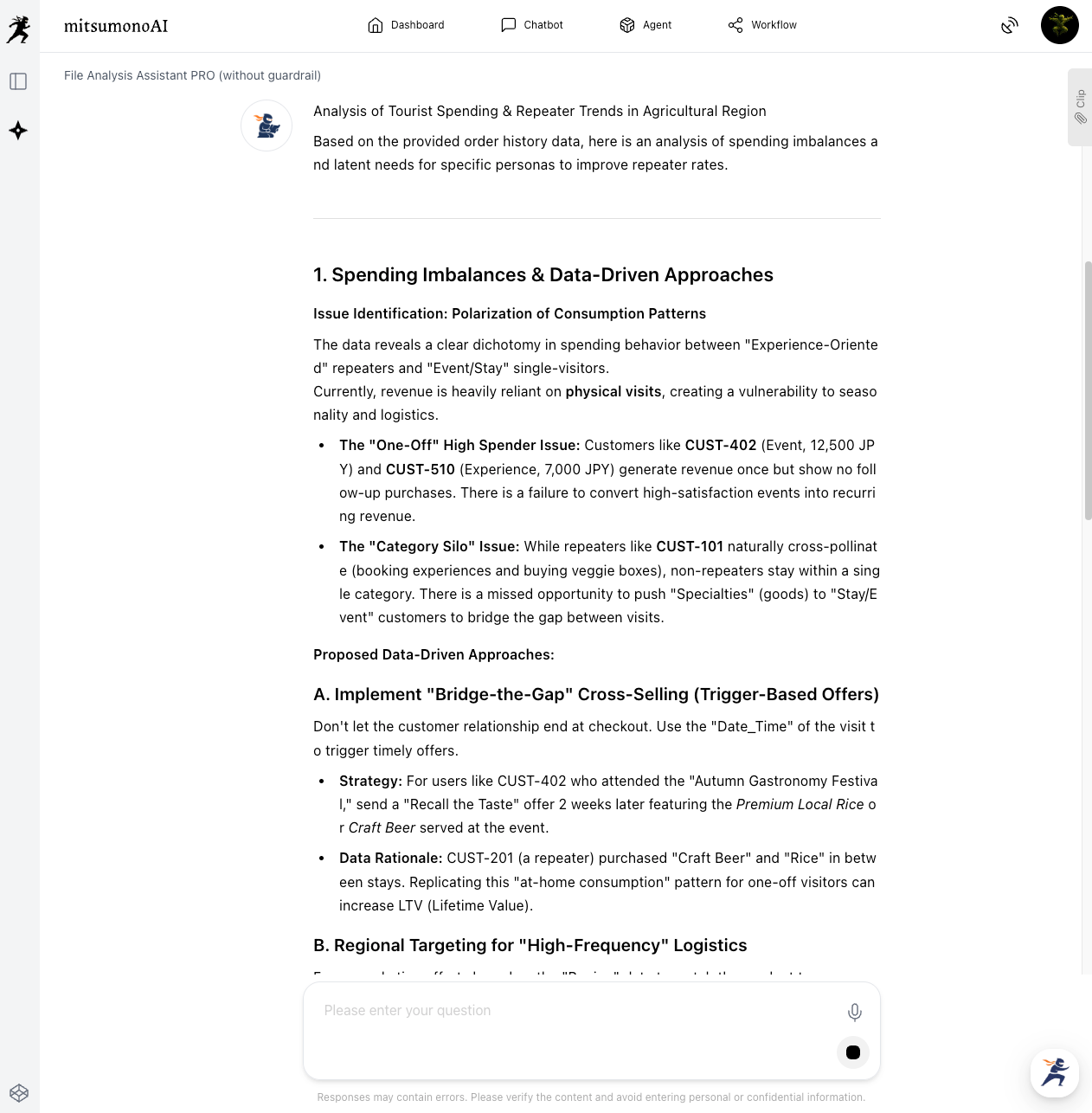
Next, launch Sensei AI - Masanori Satake, present your existing tourism strategy and challenges, and ask for feedback.
Prompt Example: Sensei AI - Masanori Satake
"From the perspectives of 'data-based repeat visitor cultivation' and 'Tourism DX,' please propose three improvements and specific strategic advice for the following tourism strategy. Please be candid. [Attach Regional Tourism Strategy Summary]"
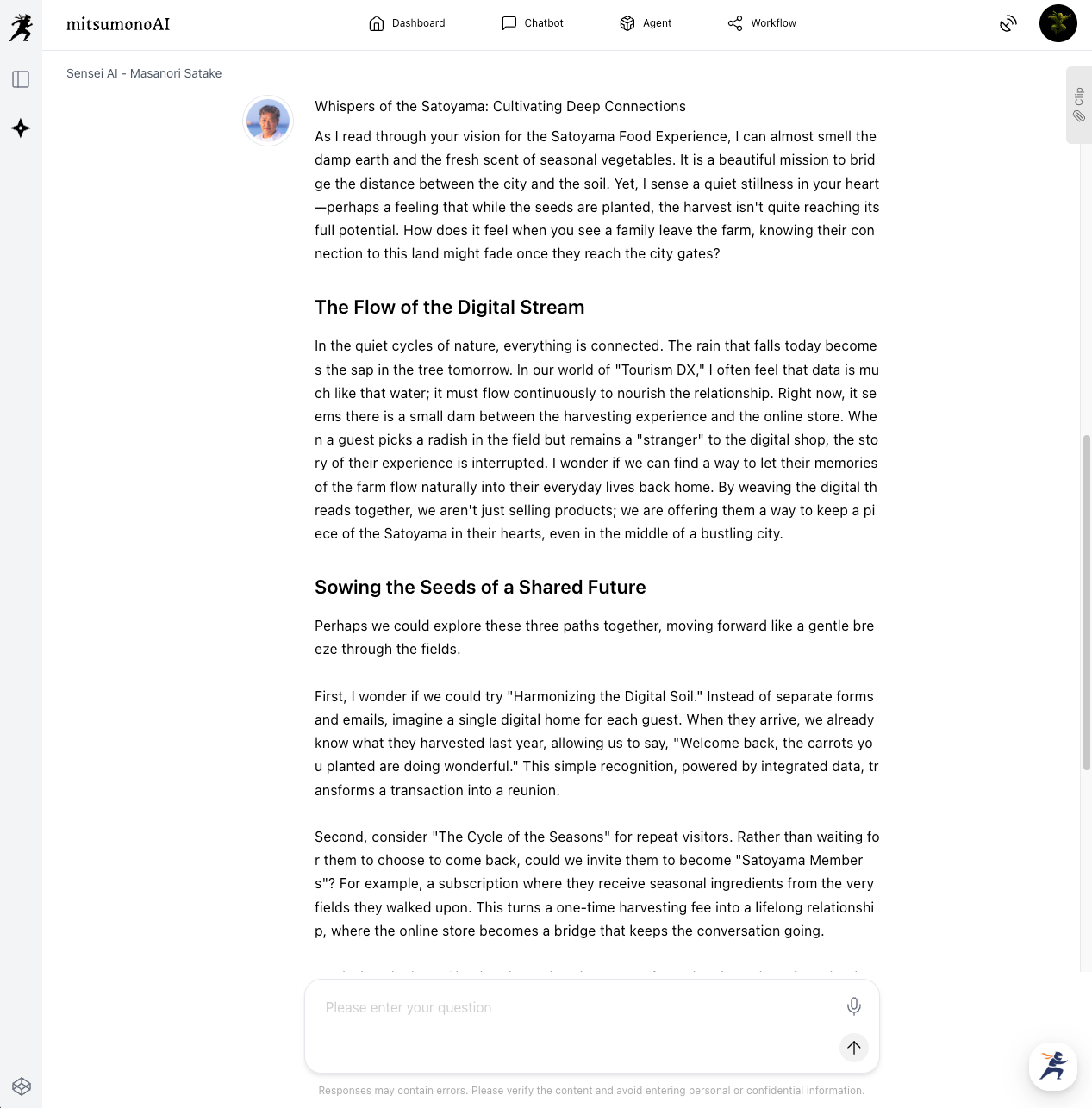
This step clarifies behavioral characteristics based on data, weaknesses in existing strategies, and specific directions for promoting Tourism DX. For example, insights might reveal that "families have a high repeat rate for harvesting experiences but low purchase values," "popularity is concentrated on specific crops while other hidden specialties are unrecognized," or "online information dissemination and booking systems are insufficient."
Step 3: Designing "Repeat-Worthy Experiences" and Building the Brand with AI
Finally, based on the insights from Steps 1 and 2, collaborate with AI to plan specific, attractive experiences, devise memorable naming, and verify the business feasibility.
[Preparation & Execution]
Launch the Product/Menu Development Planner, input the personas from Step 1, the analysis results from Step 2, and regional resources (seasonal produce, satoyama landscapes, traditional culture, etc.) to request experience plans.
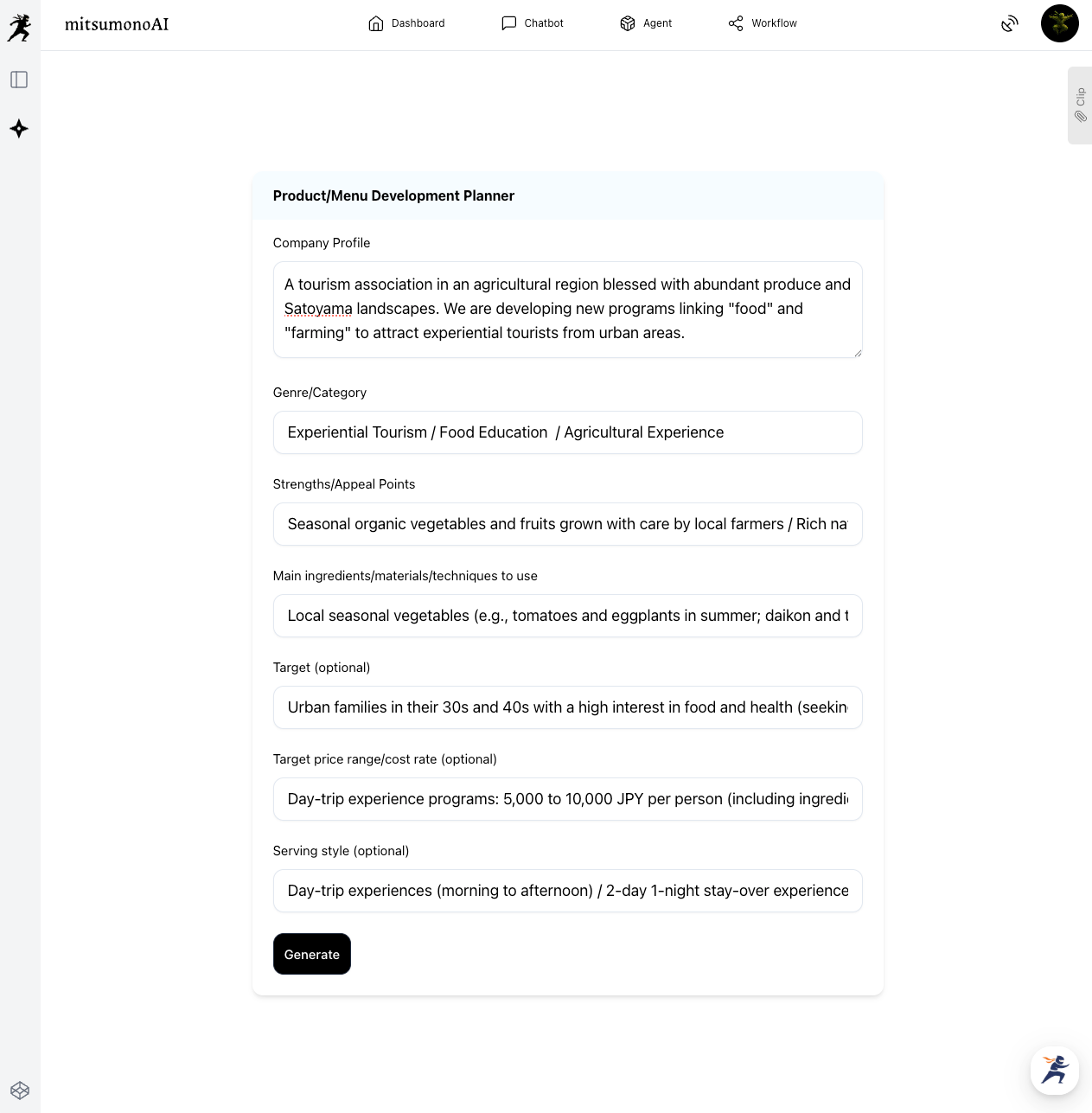
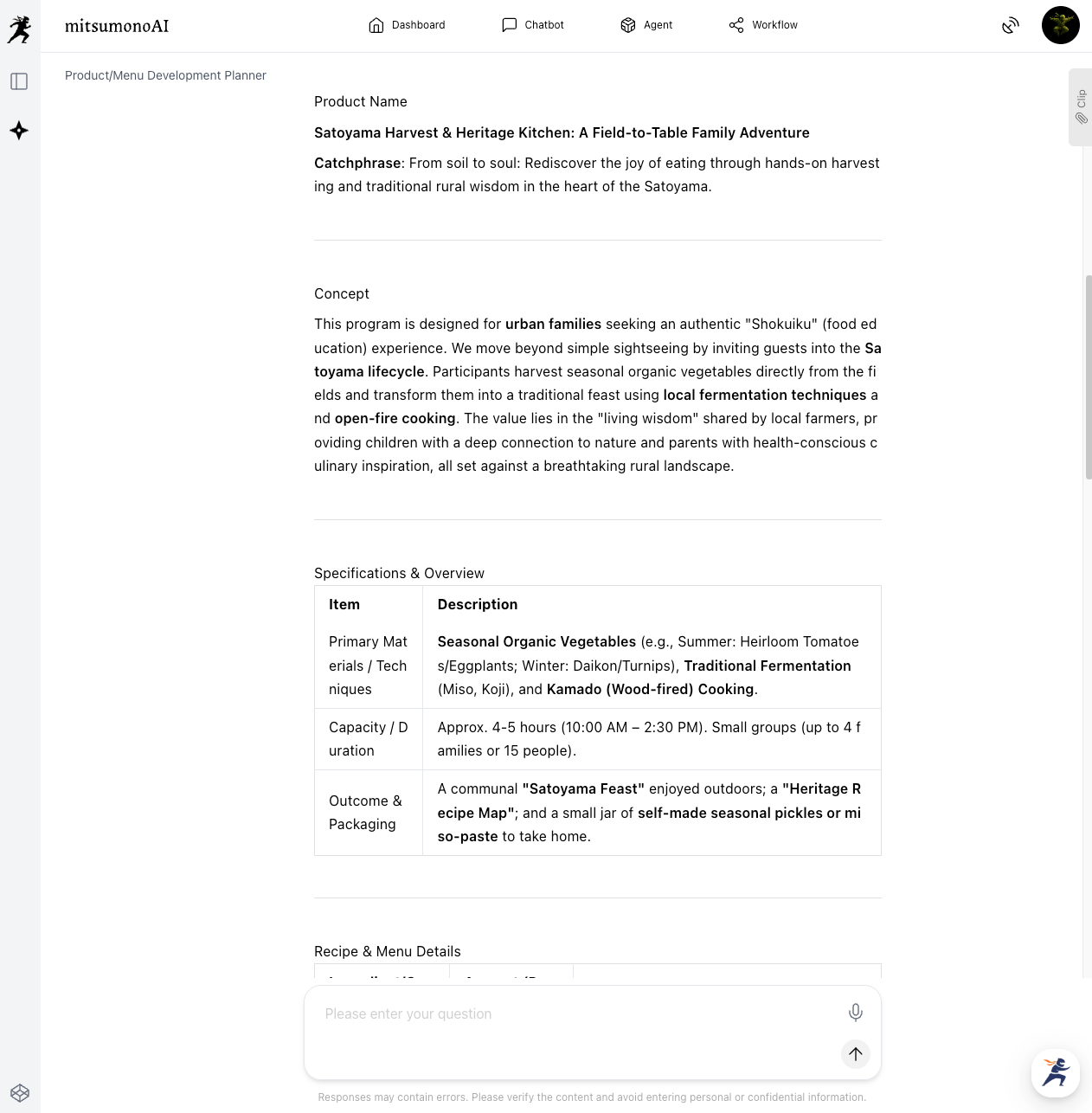
Next, launch the Naming Assistant to request attractive names based on the project drafts.
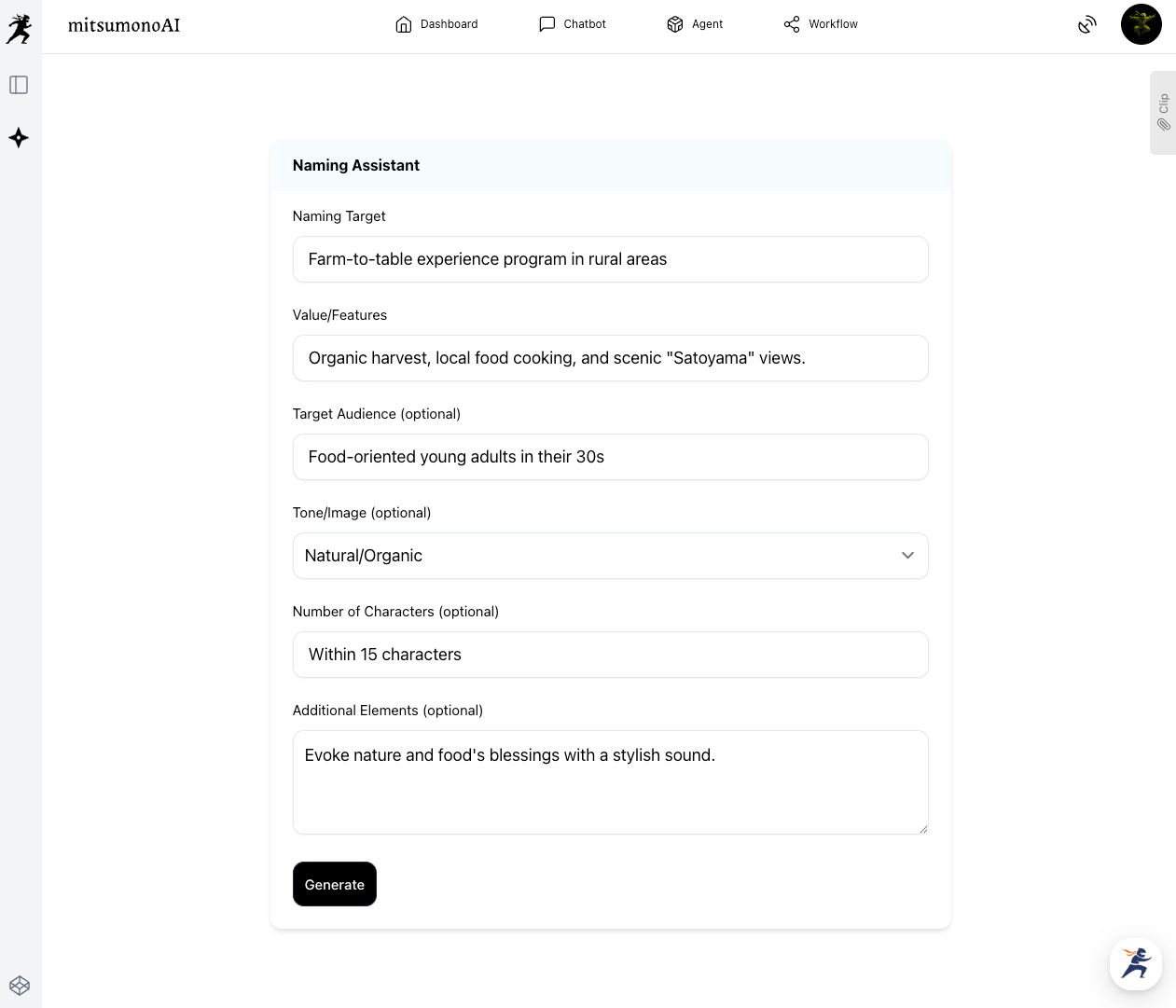
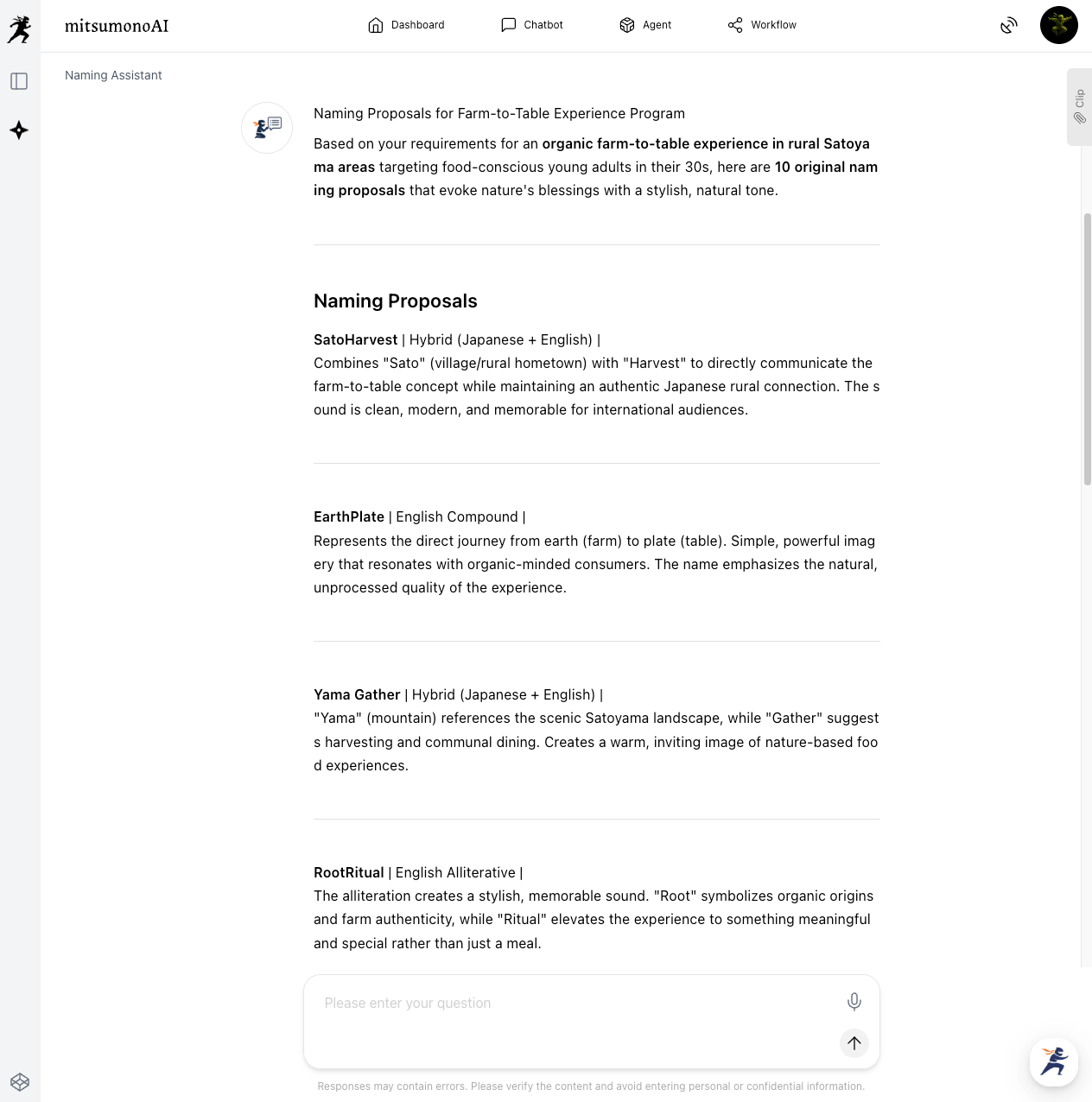
Finally, use the New Business Development Assistant to create a business plan outline and verify feasibility.
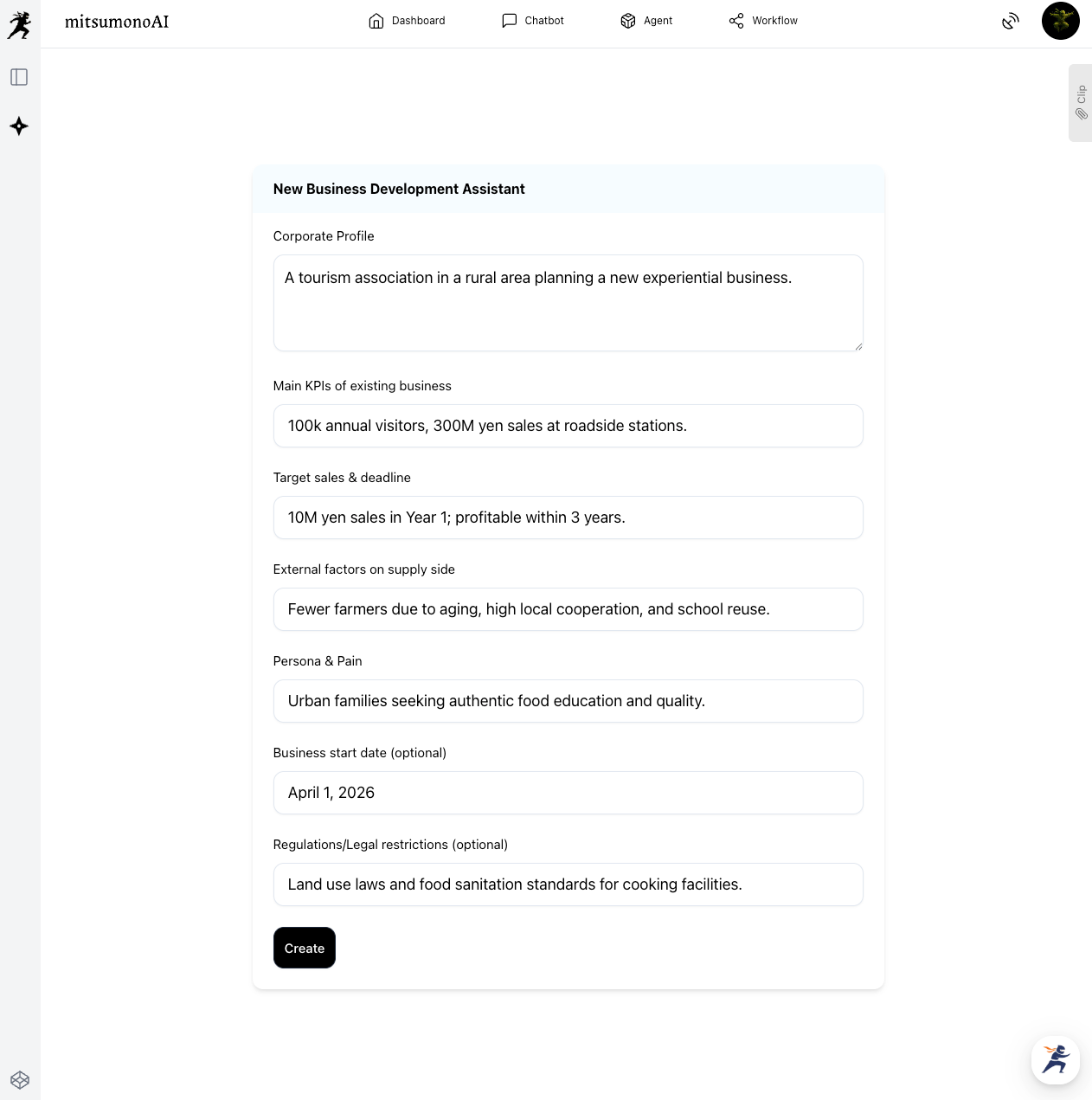
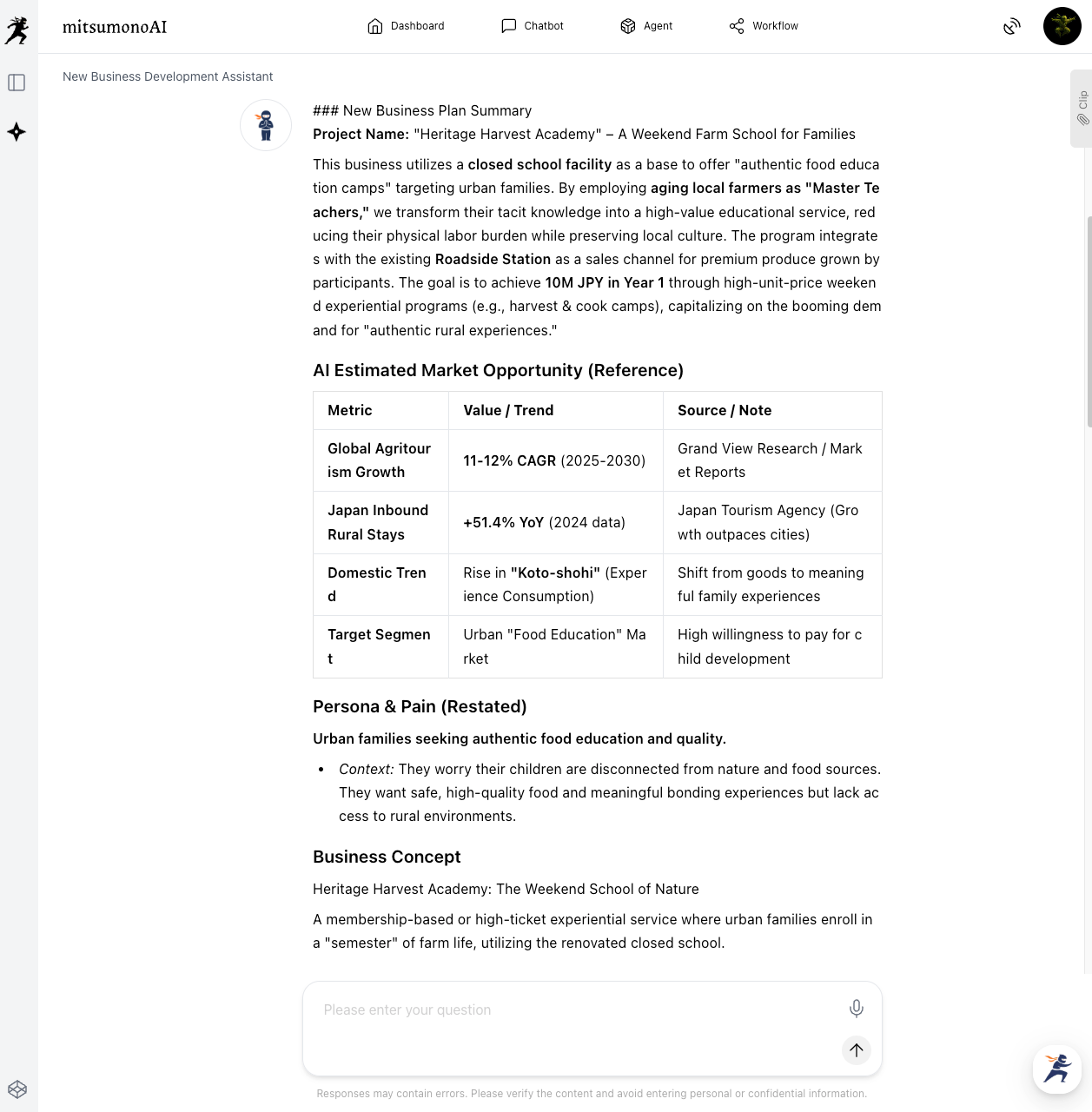
This step provides you with projects like "Seasonal Satoyama Kitchen Experience" or "Parent-Child Organic Vegetable Harvesting School," along with brand-enhancing names and a feasible business plan outline that considers goal setting and external factors.
Application and Expansion: Maximizing Information Quality
This process is not limited to a single regional branding or experience project. By utilizing AI, you can draw out regional appeal from multiple angles and lead to sustainable regional revitalization.
- Brand Power Analysis and Re-evaluation of All Regional Resources: Use similar methods to have AI analyze the latent appeal and market acceptance of all local specialties and tourism resources, then deploy rebranding strategies based on priority.
- Generating Q&A Content for Each Stage of the Tourist Journey: Link personas with AI chat to automatically generate comprehensive Q&A content addressing questions and needs at every phase—"discovery," "planning," "during the stay," and "after returning home"—improving the quality and quantity of information provided.
- Strengthening Cooperation with Municipalities/DMOs and Promoting Regional DX: Share AI data analysis results with local governments and DMOs (Destination Management/Marketing Organizations) to accelerate regional economic revitalization through tourism strategy formulation, digital marketing, and the cultivation of Tourism DX talent.
- Multilingual Expansion of Experiences and Application to Inbound Strategies: Use AI to automatically translate planned experience menus and rebranded specialties into multiple languages for inbound promotion. Implementing multilingual tourist guidance via AI chatbots will improve satisfaction and attract more foreign tourists.
Summary
This article introduced a specific 3-step process for rebranding regional specialties and tourism resources using AI to cultivate repeat visitors based on data.
- By combining objective AI data analysis with expert AI diagnosis, you can rediscover the latent value of a region and enable rebranding from a customer perspective.
- By collaborating with AI across the series of processes—persona creation, data analysis, experience planning, naming, and business planning—you can break away from stagnant regional revitalization and efficiently create experience projects that foster repeat visitors.
AI is your most reliable partner, balancing the "passion of local residents" who love their community with the "data-driven management perspective" essential for sustainable development.
Why not work with AI to build a mechanism for sustainable regional branding and repeat visitor cultivation?
mitsumonoAI is a business-specialized AI platform designed to simultaneously increase "work quality" and "speed."
Beyond regional branding and tourism strategy, it can be utilized to solve various business challenges, improve operational efficiency, and create new value.
Other use cases and the latest information are available on the mitsumonoAI blog site.