[For Hospitals & Clinics] AI Manual: Turning Patient Complaints into Revenue Sources
Daily complaints can become new revenue with AI. This article explains three steps to analyze internal feedback and plan new self-pay services that balance patient satisfaction and profitability.

![[For Hospitals & Clinics] AI Manual: Turning Patient Complaints into Revenue Sources](/content/images/size/w1200/2026/01/hospital-reception-1.png)
Tools to Use
- File Analysis Assistant
- Sensei AI - Restaurants
- General AI Chat (ChatGPT, Gemini, etc.)
Introduction: How to Turn "Complaints" into Management Resources
"The wait time is too long."
"The explanation was hard to understand."
"I'm unhappy with the staff's attitude."
Are you mentally exhausted from dealing with these daily complaints?
At many clinics, the current reality is that staff are preoccupied with immediate damage control, which doesn't lead to fundamental service improvements or new revenue streams.
However, these "voices of dissatisfaction" are actually a treasure trove of latent patient needs.
By using AI, you can analyze these voices and use them to plan new self-pay services.
This manual explains the three specific steps using AI to balance patient satisfaction with business growth.
"Voices of Dissatisfaction" are Signs of Latent Needs
Complaints are not just negative opinions; they are expressions of underlying desires, like "I wish it were more like this" or "I'd be happy if this service existed."
If you can accurately capture these, you can improve patient satisfaction and create new revenue sources.
However, it is unrealistic to manually analyze a large volume of surveys and complaint records during busy daily operations. This is where AI tools come in.
Strategic Analysis of "Patient Voices" and Service Planning with AI
This manual introduces three AI functions.
By combining them, you can transform often-overlooked patient feedback into valuable management resources.
First, the "Review Analysis Assistant" and "File Analysis Assistant" read the text data from surveys and complaint records accumulated in the clinic to analyze and classify frequent keywords and emotional trends.
Next, the "New Business Development Assistant" extracts latent needs from those analysis results and proposes ideas for new self-pay services that leverage regional characteristics and the clinic's strengths.
Three Steps to Planning Self-Pay Services Using AI
Step 1: Input Patient Voices into AI for Analysis
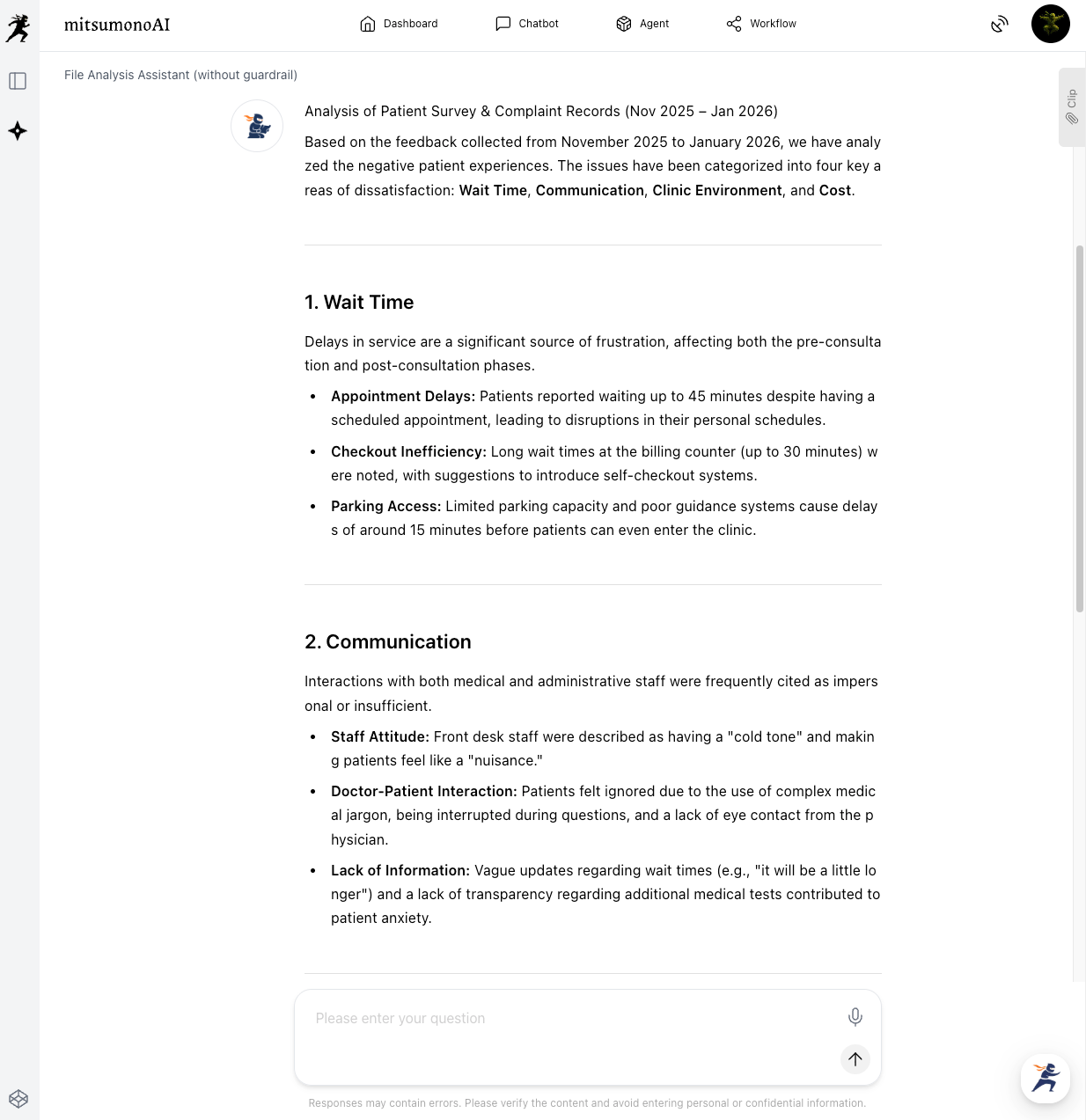
First, digitize the patient surveys and complaint records kept in the clinic and upload them to the "File Analysis Assistant." Then, give the AI the following instructions.
"Please analyze the patient surveys and complaint records for this clinic. Focus specifically on negative opinions and classify frequent topics of dissatisfaction into four categories: 'Wait Time,' 'Communication,' 'Clinic Environment,' and 'Cost.' Please summarize the specific content of each."
Step 2: Deep Dive into Latent Needs from AI Analysis
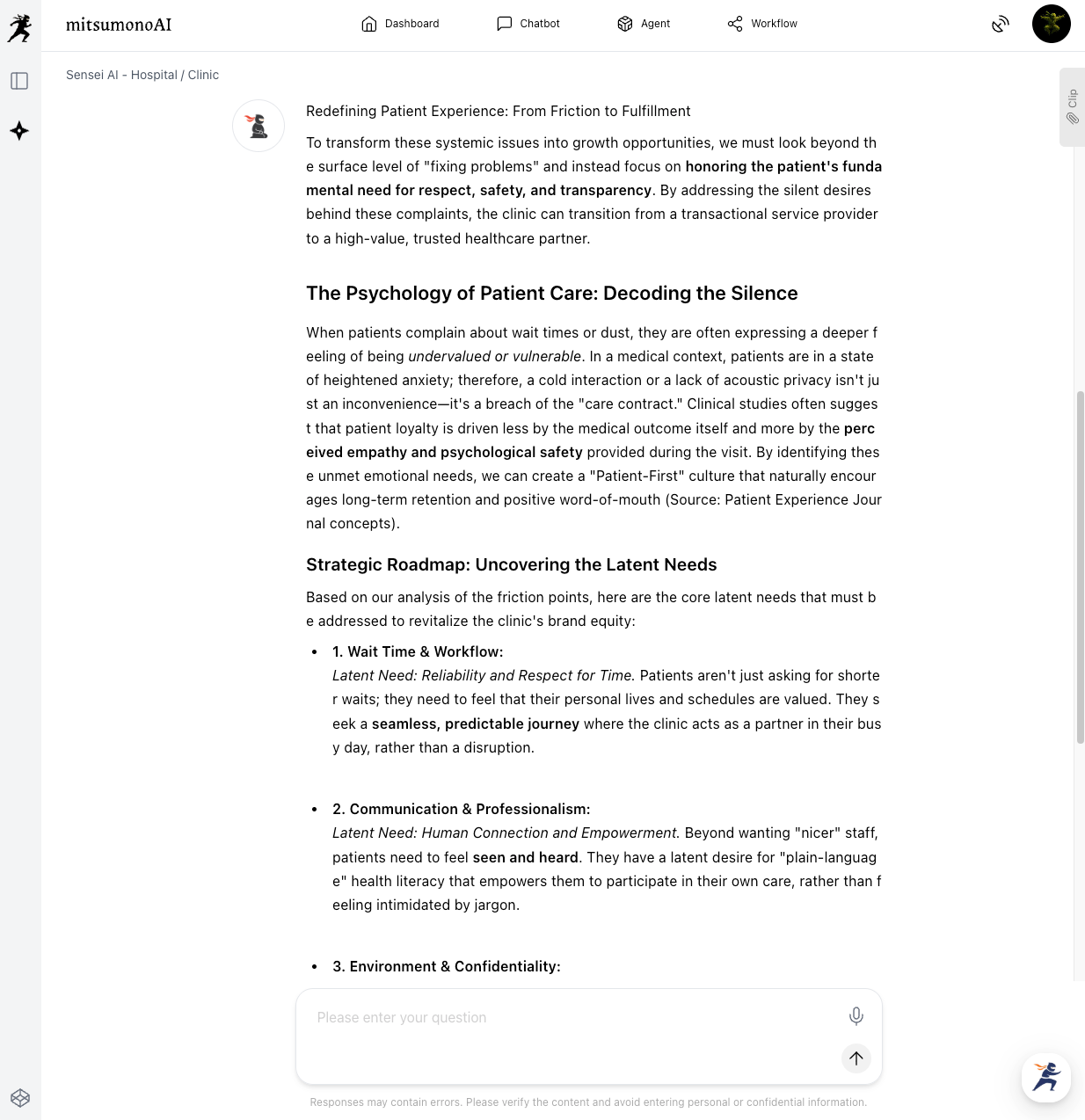
Explore the root causes of the dissatisfaction extracted by the AI. The key is to think about "what they truly want to be fulfilled" behind the surface-level words.
"(Paste the results generated in Step 1)
Based on the analysis above, please write out the latent needs for each complaint."
Step 3: Plan New Services Based on Latent Needs
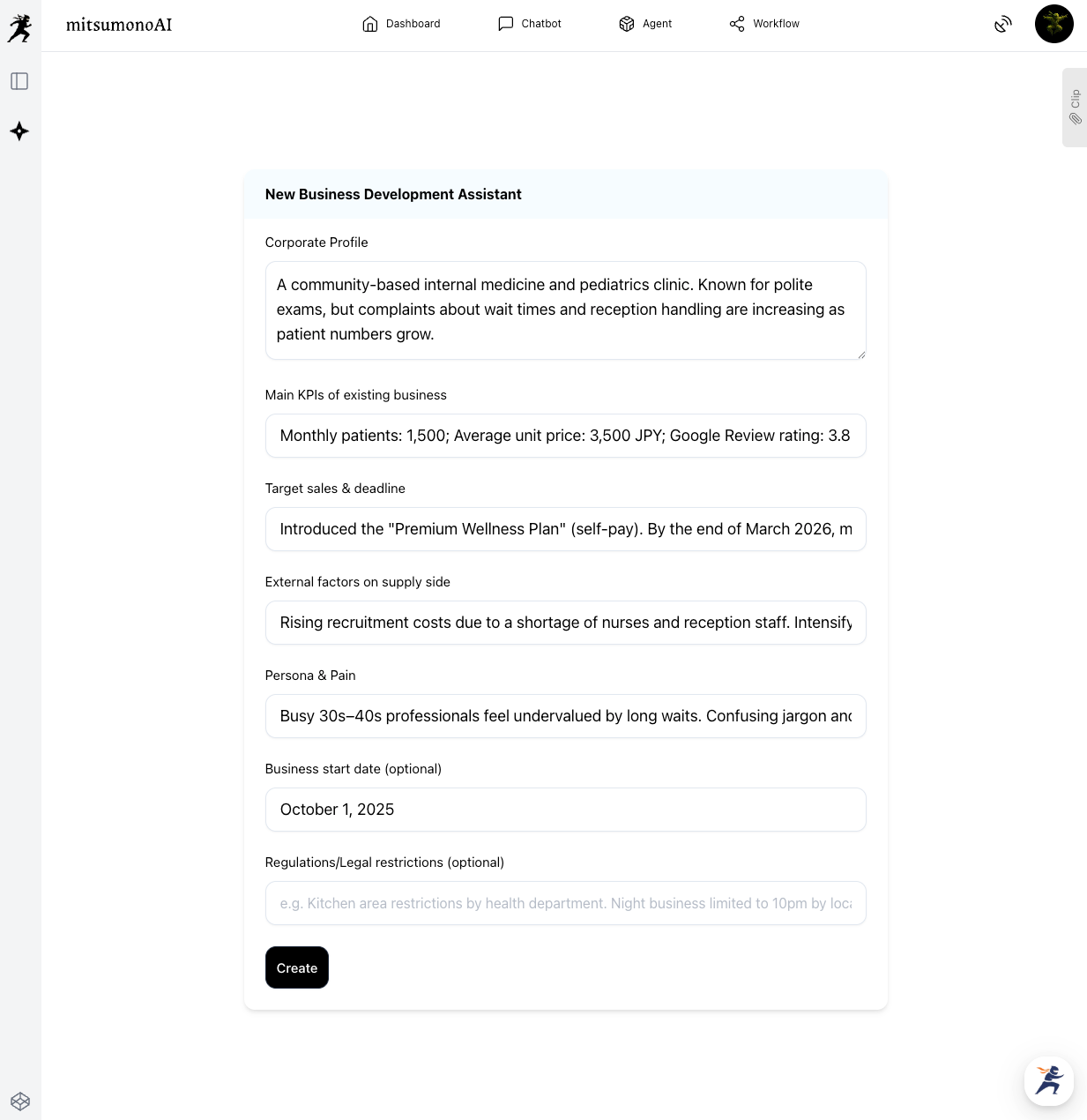
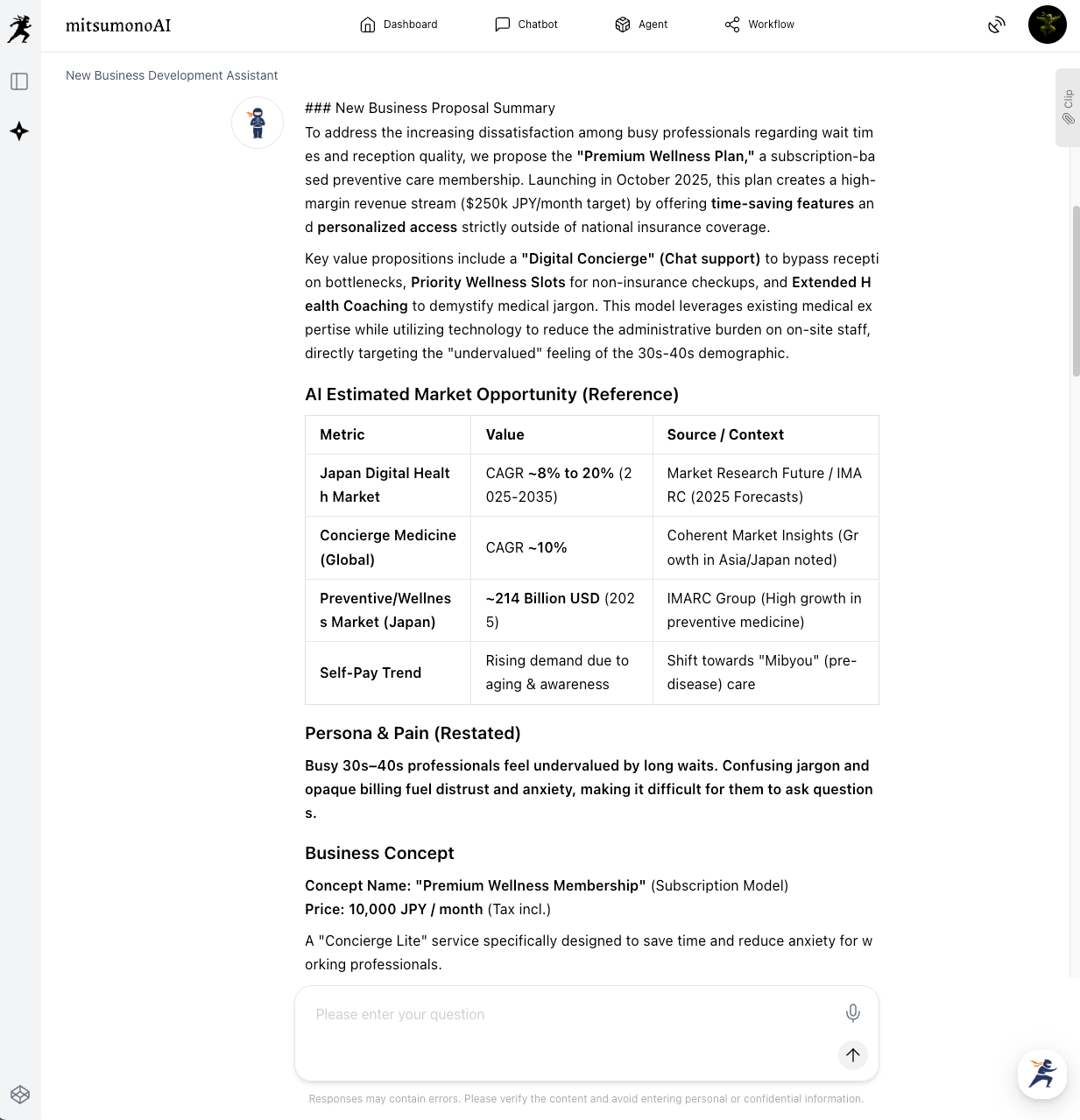
Finally, convey the latent needs to the "New Business Development Assistant" and have it propose multiple innovative self-pay service ideas.
Results Achieved (Examples)
- Improved Patient Satisfaction:
Service development based on patient feedback improves trust and satisfaction with the clinic. - Securing New Revenue Streams:
Establishing self-pay services that do not rely on insurance coverage builds a stable management foundation. - Reduced Staff Burden and Mindset Shift:
A culture where complaints are viewed as positive improvement activities is fostered, reducing the mental burden on staff. - Differentiation from Competitors:
By providing unique services not found in other local clinics, you become the clinic of choice.
Target Metrics (KPI/KGI)
KGI (Key Goal Indicator):
- Increase the ratio of self-pay sales to 10% of the total.
KPIs (Key Performance Indicators):
- Monthly usage of the new service: 30+ cases.
- "Satisfied" or higher response rate in patient satisfaction surveys: 90%+.
- Number of complaints: 20% reduction compared to the same month last year.
Summary: Turning Complaints into Value to Design the Future of Clinic Management
Complaints from patients are full of valuable hints for the clinic to grow further.
By utilizing AI as a new tool, you can transform what was once merely a burden into a strategic resource for simultaneously improving patient satisfaction and profitability.
Use AI not just as a tool for operational efficiency, but as a "strategic advisor" to solve management issues and design the future together.
That is the new form of clinic management required for the coming era.
For more use cases and the latest information, visit the mitsumonoAI blog site.