Identifying High-Value Customers Through AI Data Analysis and Boosting Purchase Intent on SNS
A practical guide to deeply analyze existing customer and sales data and boost the purchase intent of high-value customers through a personalized SNS strategy.


Tools Used
- File Analysis Assistant
- Persona Creation Assistant
- SNS Operation Strategy Planner
Strategy Creation and Execution for Attracting and Nurturing "High-Value Customers"
If you aim to "attract customers with a higher average purchase amount" or "increase sales per customer," knowing "what products are selling and how" from data is indispensable for effective strategy formulation.
However, many people feel they are not fully utilizing customer information, including POS data, from the marketing perspective of "identifying and nurturing high-value customers." In this situation, communication often remains uniform, failing to fully capitalize on opportunities to acquire high-value customers.
This article introduces a step-by-step guide on how our AI tool "mitsumonoAI" can break through the "under-utilization of customer data," leading to effective marketing measures that increase the average purchase amount of visitors and, ultimately, boost the overall revenue of the facility.
Specific Steps
Step 1: Preliminary Preparation
▶︎ Mission Registration
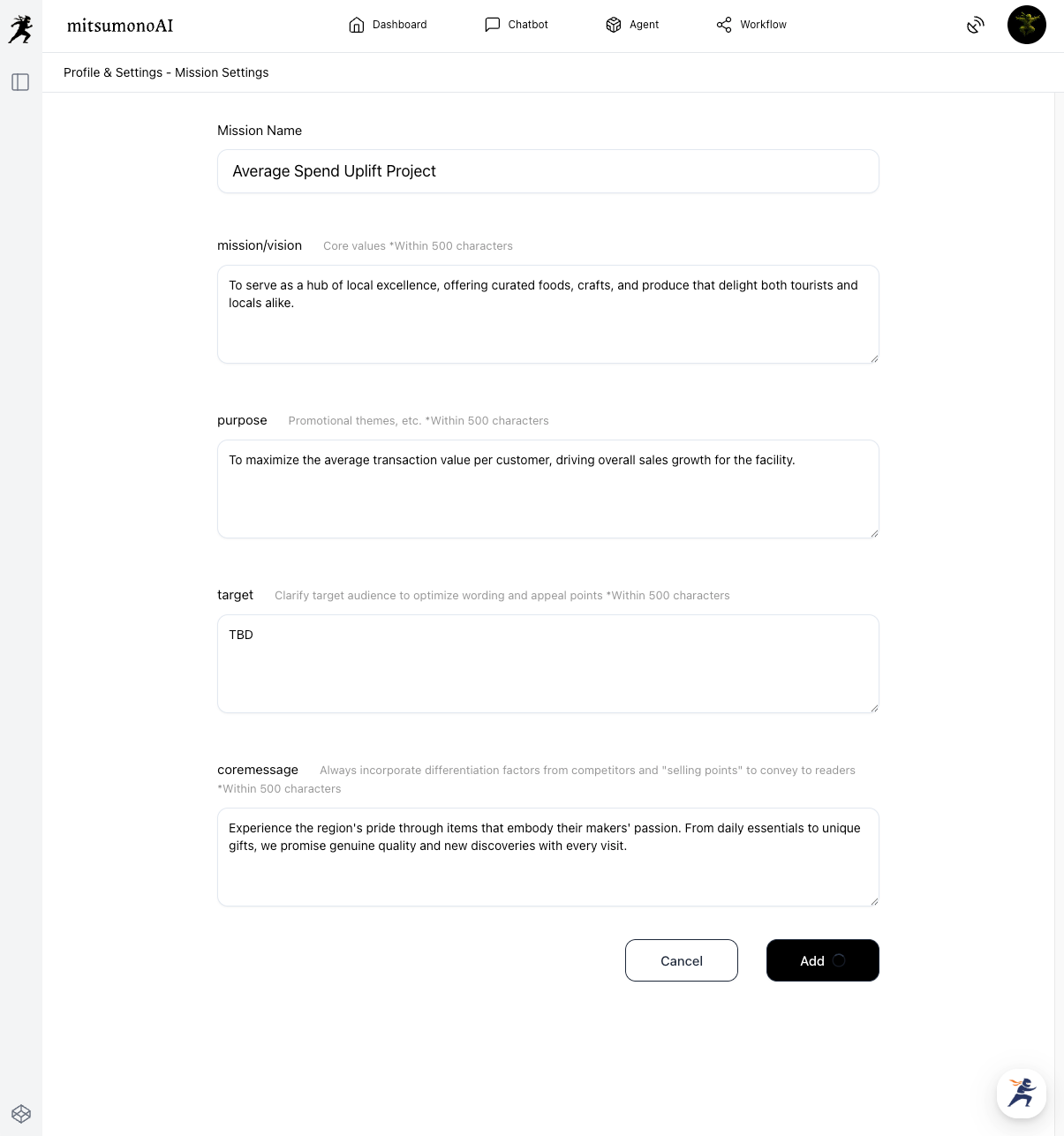
First, create a "Mission," which will be necessary later when using the Persona Creation Assistant.
This mission sets the project goals, vision, and core message. Since the target is not yet clear at this stage, register the "Target" field as "Undecided" for now.
Step 2: Customer Data Analysis and Understanding High-Value Customer Trends
▶︎ File Analysis Assistant
Begin by structuring your existing customer data into a usable form. The key to this step is identifying the behavioral patterns of customers with a particularly "high average purchase amount."
Upload data related to customer sales performance, such as sales history data and cashless payment data, to the "File Analysis Assistant."
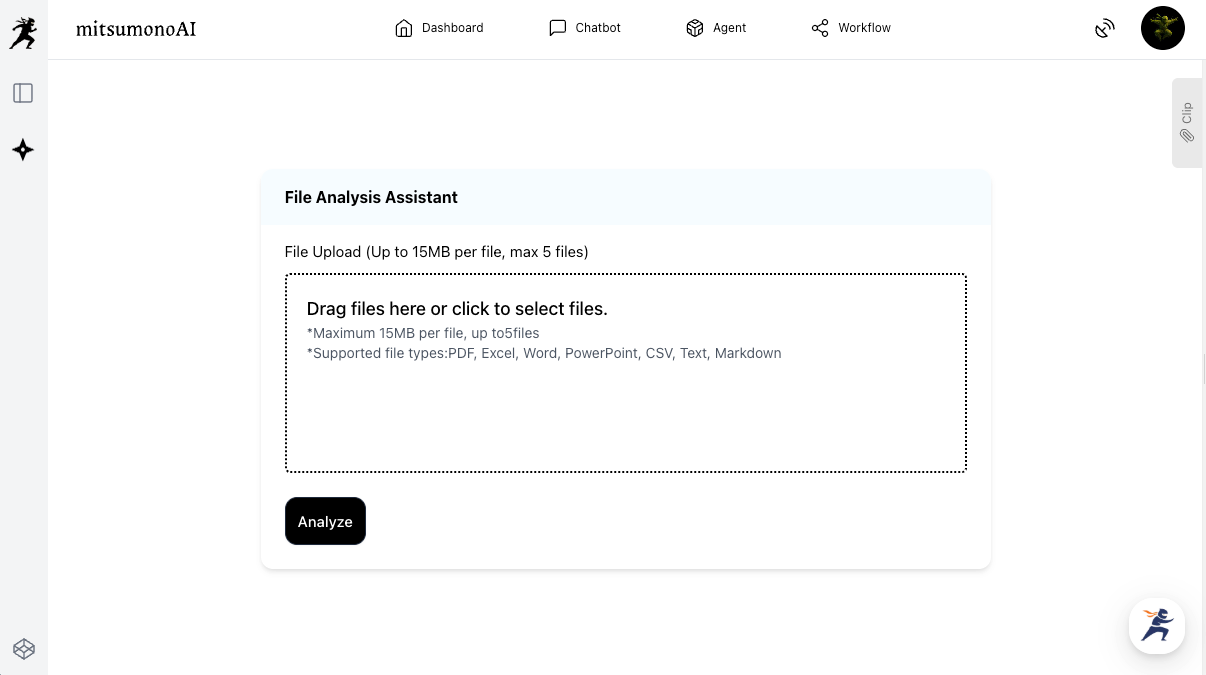
The "File Analysis Assistant" allows you to ask questions about the uploaded file, prompting the AI to extract and examine information from the data. For example, by asking questions like the following, according to the file content, you can learn about customer behavior patterns (purchase history, visit frequency, purchase category, time of use) and extract trends of high-value customers.
"What are the main characteristics of the customer segment whose average purchase amount is in the top 20% over the past year?"
"Customers who purchase a specific product (e.g., high-priced local specialties, gift items) tend to purchase what other products alongside it?"
"Which customer segments are expected to yield cross-sell/upsell opportunities to increase the purchase unit price, and what products are considered effective for them?"
The AI itself will perform the necessary data organization to get closer to the desired answer. *To enhance the accuracy of the answers, it is recommended to organize data categories and product names in advance.
Step 3: Customer Segmentation and Identification of High-Value Customer Segments
▶︎ File Analysis Assistant (Continued)
Next, through dialogue with the "File Analysis Assistant," strategically identify and visualize customer groups that are considered high-value or have high potential for increased purchase unit price.
"Identify multiple customer groups that can be specifically considered high-value or have high potential for increasing the purchase unit price based on their average purchase amount, and concisely summarize the characteristics of each."
In this way, you can identify specific and actionable high-value customer segments. This segment information is the foundation for a personalized marketing strategy aimed at stimulating the purchase intent of each customer segment and increasing the average purchase amount.
Step 3-2: Modifying the "Target" Field of the Mission
Based on the high-value customer segment information identified in Step 3, modify the mission registered in Step 1. In the "Target" field of the mission, organize and add information about the [Highest Potential High-Value Customers] identified this time, following the example below:
"High-value customer segment that purchases multiple high-priced goods/miscellaneous items during a single visit, achieving the highest purchase amounts. They value 'special value imbued with the creator's passion' and 'unique items only available here,' tending to buy for themselves as well as for gifts. They visit concentratedly from the morning to early afternoon, seeking encounters with high-quality items."
Step 4: Creating a Customer Persona to Embody the "High-Value Customer"
▶︎ Persona Creation Assistant
To gain a deeper understanding of the high-value customer segment clarified in Step 3 and translate it into specific measures, use the "Persona Creation Assistant" to create a customer persona.
Select the relevant mission in the "Persona Creation Assistant" and output the persona list.
A persona is a fictional character representing a specific customer segment. Setting a persona allows staff and stakeholders to share a common understanding of the target customer and concretely imagine their needs, purchasing motivations, and lifestyle.
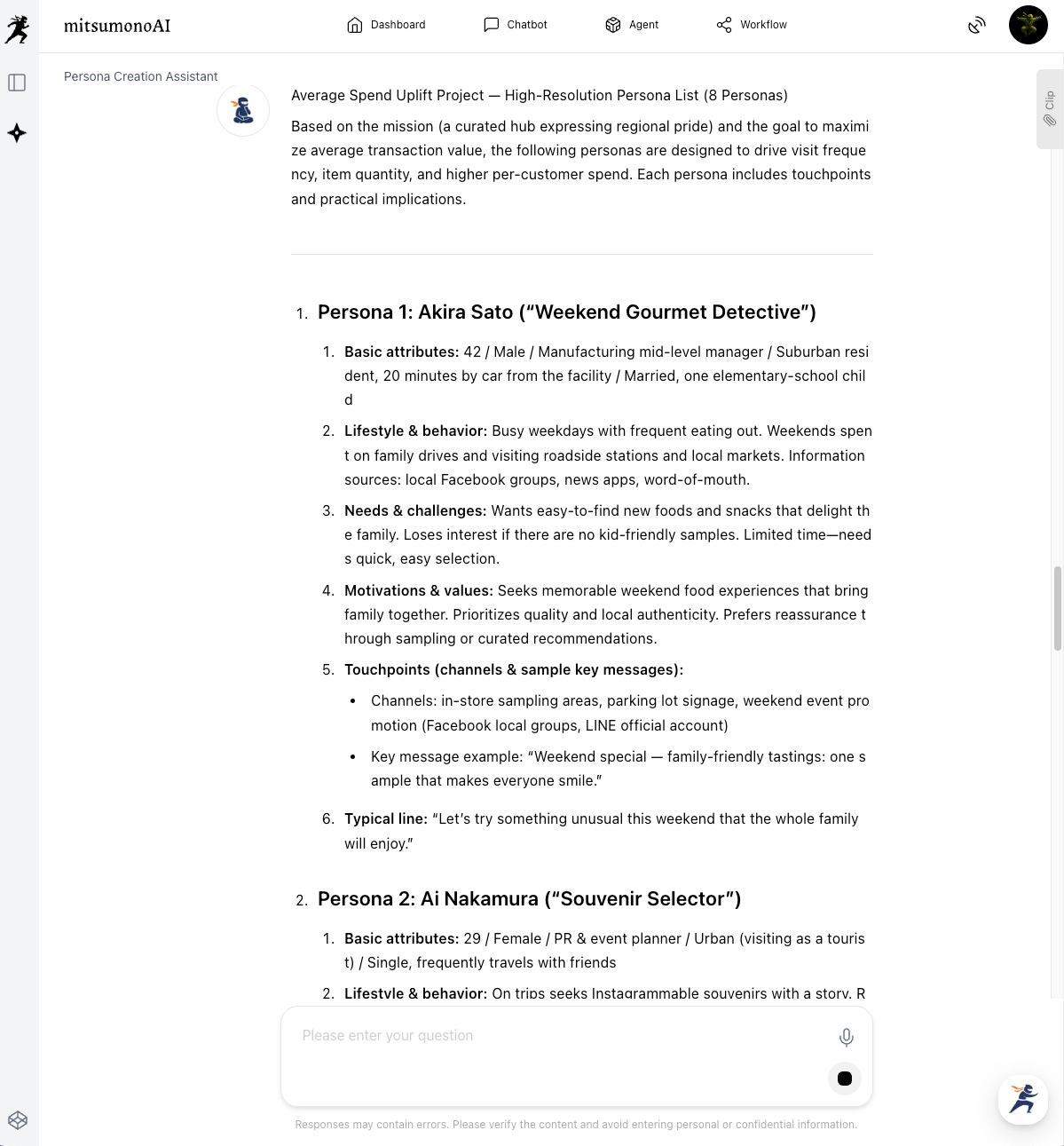
To maximize results in disseminating information on SNS aimed at high-value customers, as in this case, the key is how deeply you can delve into the persona of the "customer with a high average purchase amount."
Based on the target information set during mission registration, the "Persona Creation Assistant" generates a detailed persona as if they were a real person. The creation of this persona allows management and staff to consider marketing measures from a concrete perspective, such as: "What kind of information would 'Kazuya Sato' be interested in, and what high-priced products would increase his purchase unit price?"
Step 5: Planning and Executing an SNS Operation Plan Based on the Persona
▶︎ SNS Operation Strategy Planner
Finally, strengthen SNS information dissemination optimized for the high-value customer persona to encourage visits to the roadside station (michi no eki) and lead to an increase in the purchase unit price.
Input the designated items into the "SNS Operation Strategy Planner." The target information is already included in the mission. Input the platform to be used, the operation period, and the realistically executable number of posts, and then create the plan.
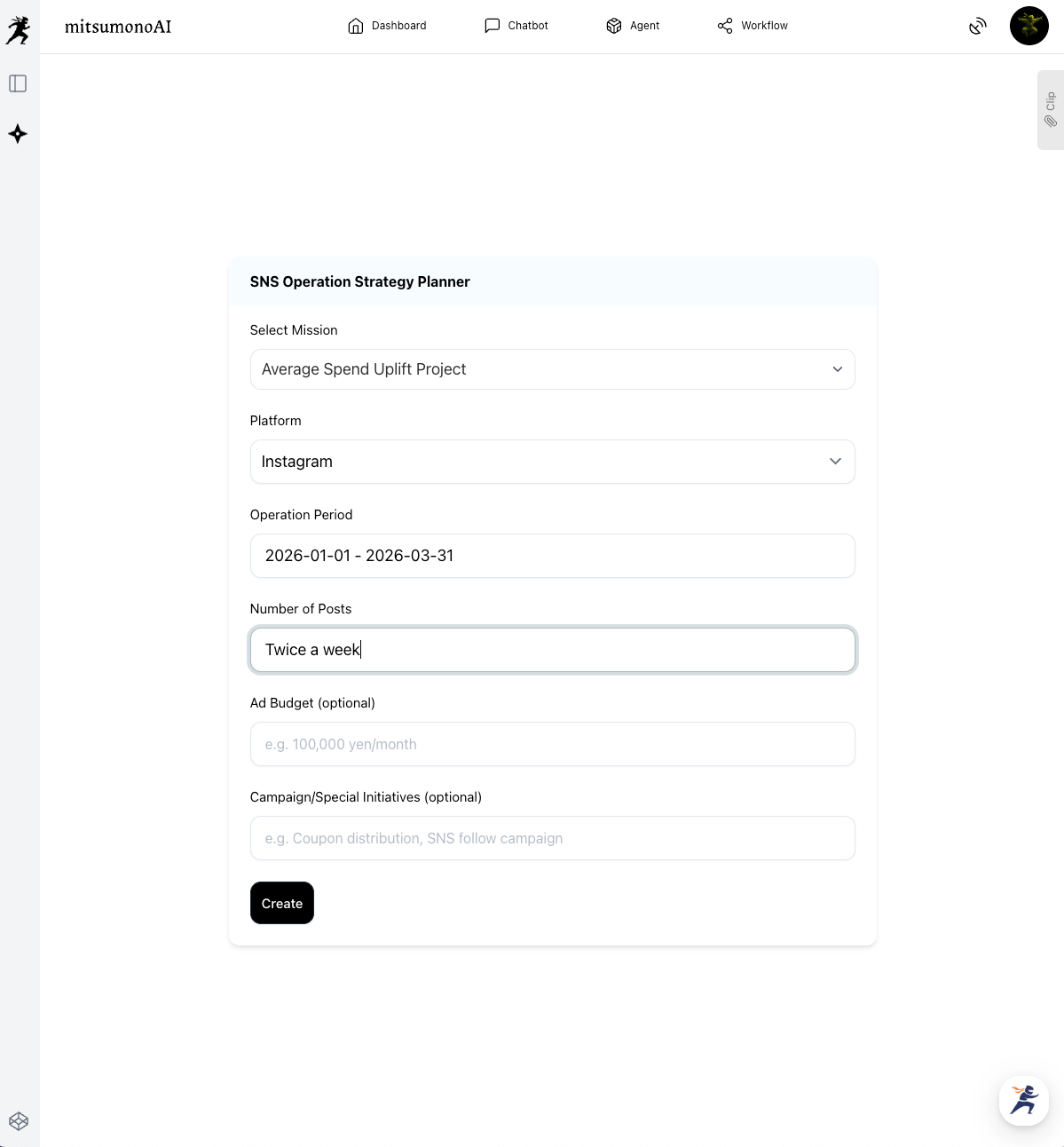
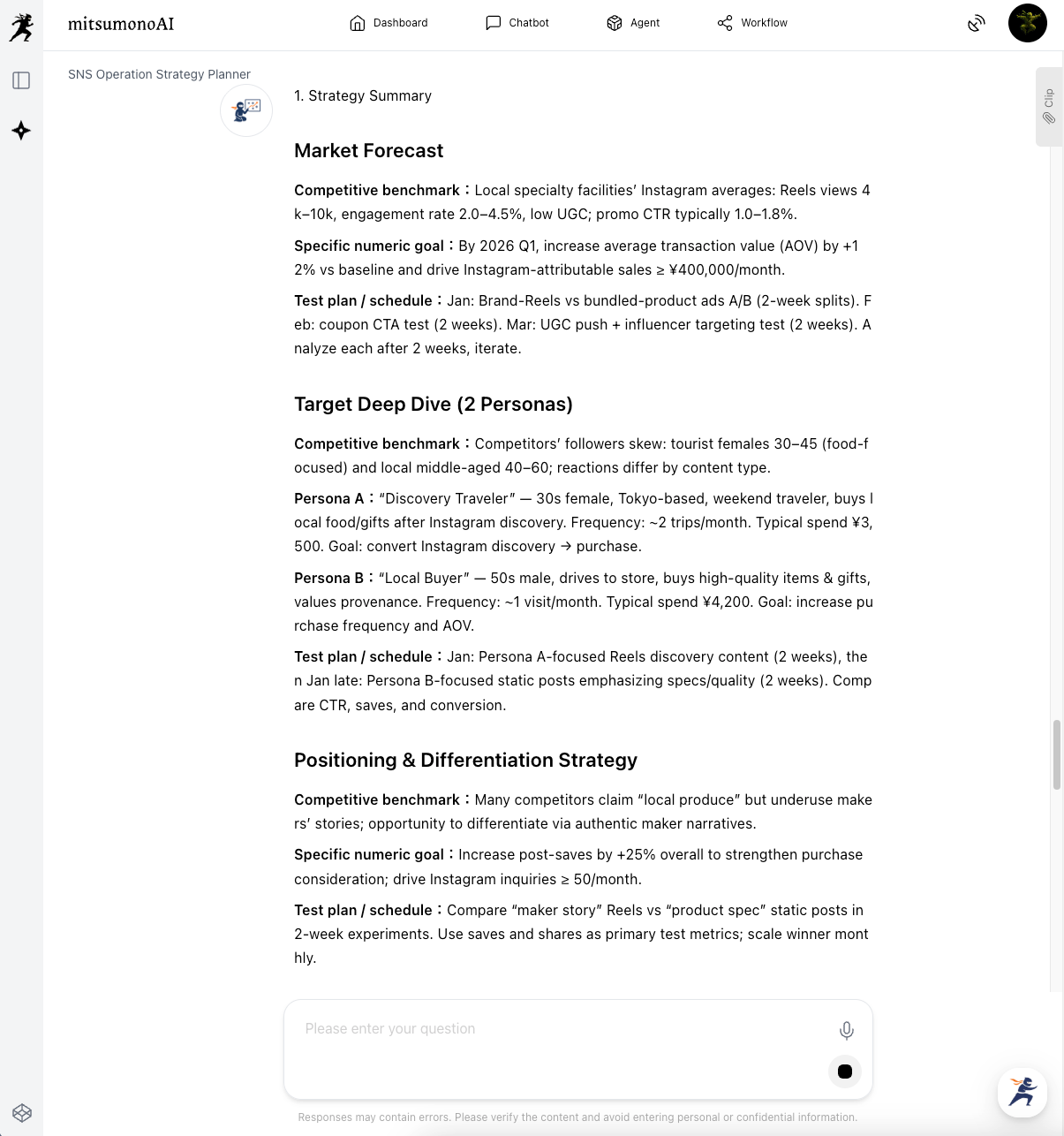
By providing the persona information created in Step 4 (e.g., details about Akira Sato (“Weekend Gourmet Detective”)) here, you can create a specific and realistically executable SNS operation plan that enhances appeal to the target audience.
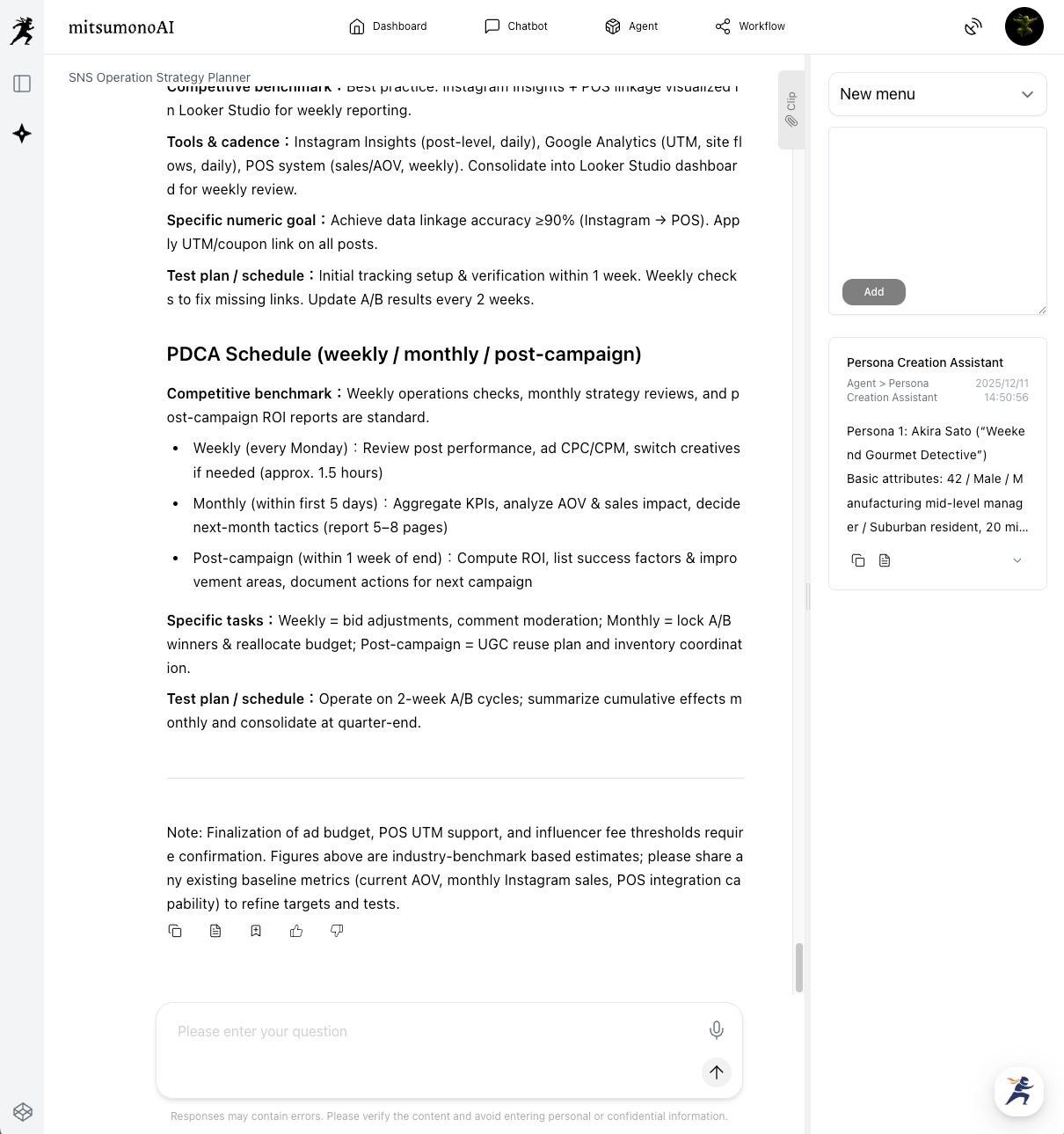
Then, by instructing the AI to "Create the posting schedule for January 2026," it can output the optimal content themes and schedule for the persona. Clearly defining the purpose, target, and content of SNS operation enables the identification of what and when to post, ensuring planned and continuous posting.
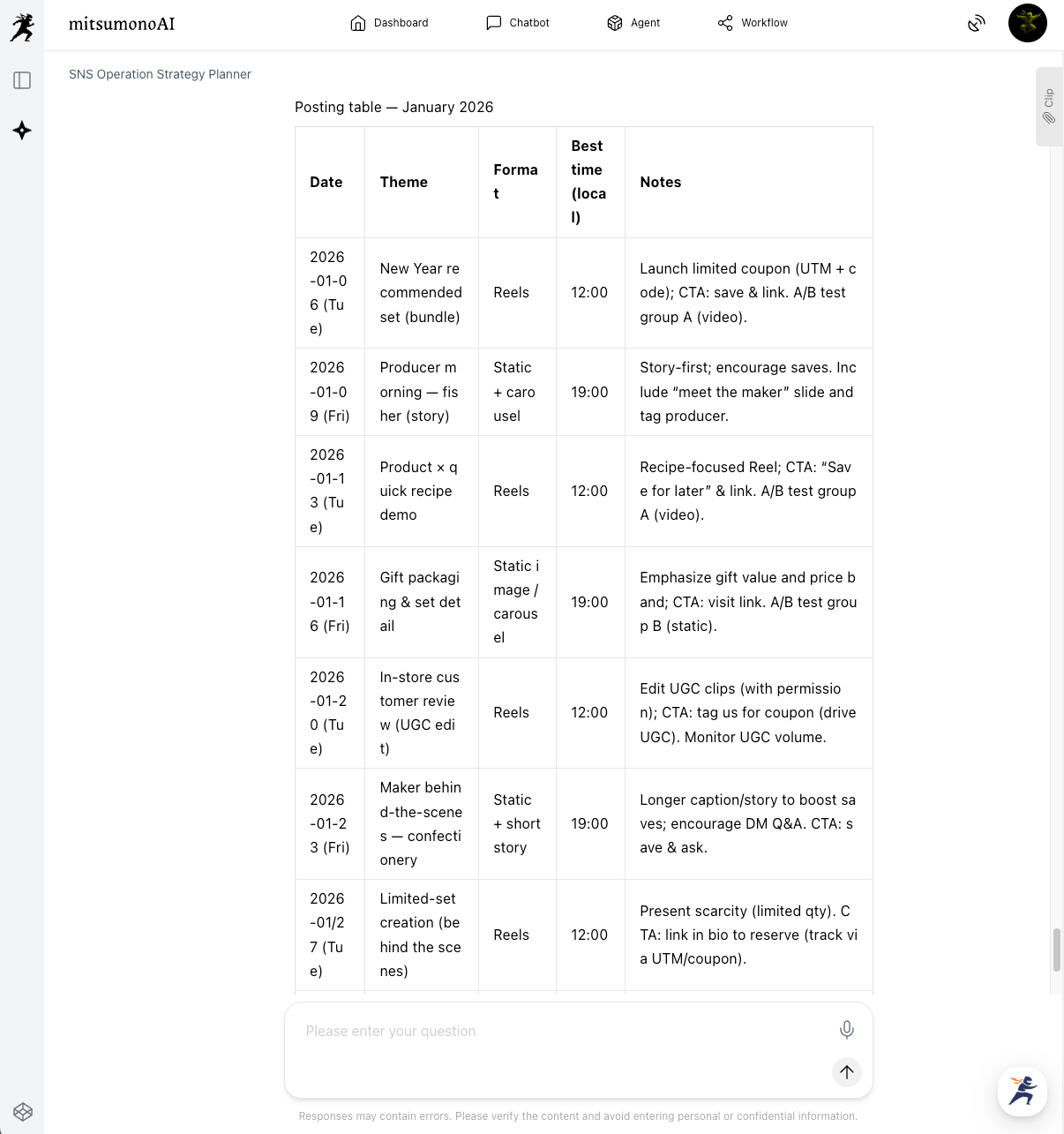
Expected Results and Goals (Reference Example)
Embodying the customer profile makes it possible to understand customer needs, purchasing motivations, and lifestyles in detail—things that were previously invisible through data analysis alone.
Since it becomes clear what information the target persona, "Akira Sato," is interested in, and what post designs, messages, and posting times would resonate, efficient information dissemination is possible. As a result, improvements in engagement rate, click-through rate, and conversion rate leading to store visits and purchases can be expected.
Target Metrics for the 6-Month Period
KGI (Key Goal Indicator):
- Monthly sales of the retail facility: 10% increase compared to the same month last year
KPI (Key Performance Indicators):
- Sales composition ratio of high-priced product Category A in merchandise sales: 5% increase from the current state
- Average engagement rate of SNS posts: 10% increase from the current state
- Number of high-value customers (top 20% in average purchase amount): 15% increase from the current state