Dealing with Emotional Complaints : How to Organize "Facts" and Accelerate Response
Dealing with long, emotional complaint emails can be mentally draining. Learn how to use the Text Summarization Workflow to instantly extract objective facts and customer demands, streamlining team communication and ensuring a swift, professional second-tier response.


A Calm Initial Response is the Shortest Route to Resolution
Receiving harsh criticism from customers—especially in long, emotional emails—is a significant burden for support teams. Staff can become mentally exhausted by the sheer intensity of the message. However, a more serious business risk is losing sight of the actual issues that need to be addressed.
- Becoming overwhelmed by emotional language, making it difficult to identify the true point of contention.
- Prioritizing "apology" and "appeasement" to the extent that root cause analysis and prevention measures are delayed.
- Inconsistent fact-finding among team members because it is unclear which parts of the long text are essential to read.
This mixture of "customer emotion" and "resolvable facts" acts as a major barrier to rapid and accurate problem-solving.
AI Extracts Only the "Facts to be Resolved" from Complex Complaints
AI brings objective analytical power to an information-organizing process that previously relied on the literacy and mental resilience of staff.
The Text Summarization Workflow on mitsumonoAI supports your team by structuring necessary facts from chaotic information, allowing everyone to grasp the situation calmly.
- Emotional Filtering:
It carefully removes emotional expressions to extract only objective "occurrences" and "requests." - Structural Organization:
It organizes information—who, what, when, where, and why—chronologically to prevent oversight. - Instant Reporting:
The AI automatically generates an objective report for team sharing, allowing everyone to understand the situation instantly.
You can significantly reduce the time spent organizing and summarizing information, allowing you to focus on the essence of problem-solving: cause analysis and solution planning.
Practice | Organizing and Sharing Facts of "Long Complaint Emails" with AI
Let’s walk through creating a primary summary using the Text Summarization Workflow on mitsumonoAI, using a hypothetical long-form complaint email received recently.
To: mitsumono Co., Ltd. Person in Charge and Management
Dear Sir/Madam, (...omitted...) As a long-time fan, I feel truly betrayed by this series of events. Beyond the product defect itself, I cannot help but question your corporate integrity given the insincere support system that fails to treat customers with respect. How do you intend to compensate for my lost time and these feelings of frustration? (...rest omitted...)
Step 1: Input the "Original Complaint Email" into the Text Summarization Workflow
First, launch the Text Summarization Workflow on mitsumonoAI and paste the full text of the customer's email into the "Original Text" field. Next, to create an objective report for team sharing, configure the items as follows:
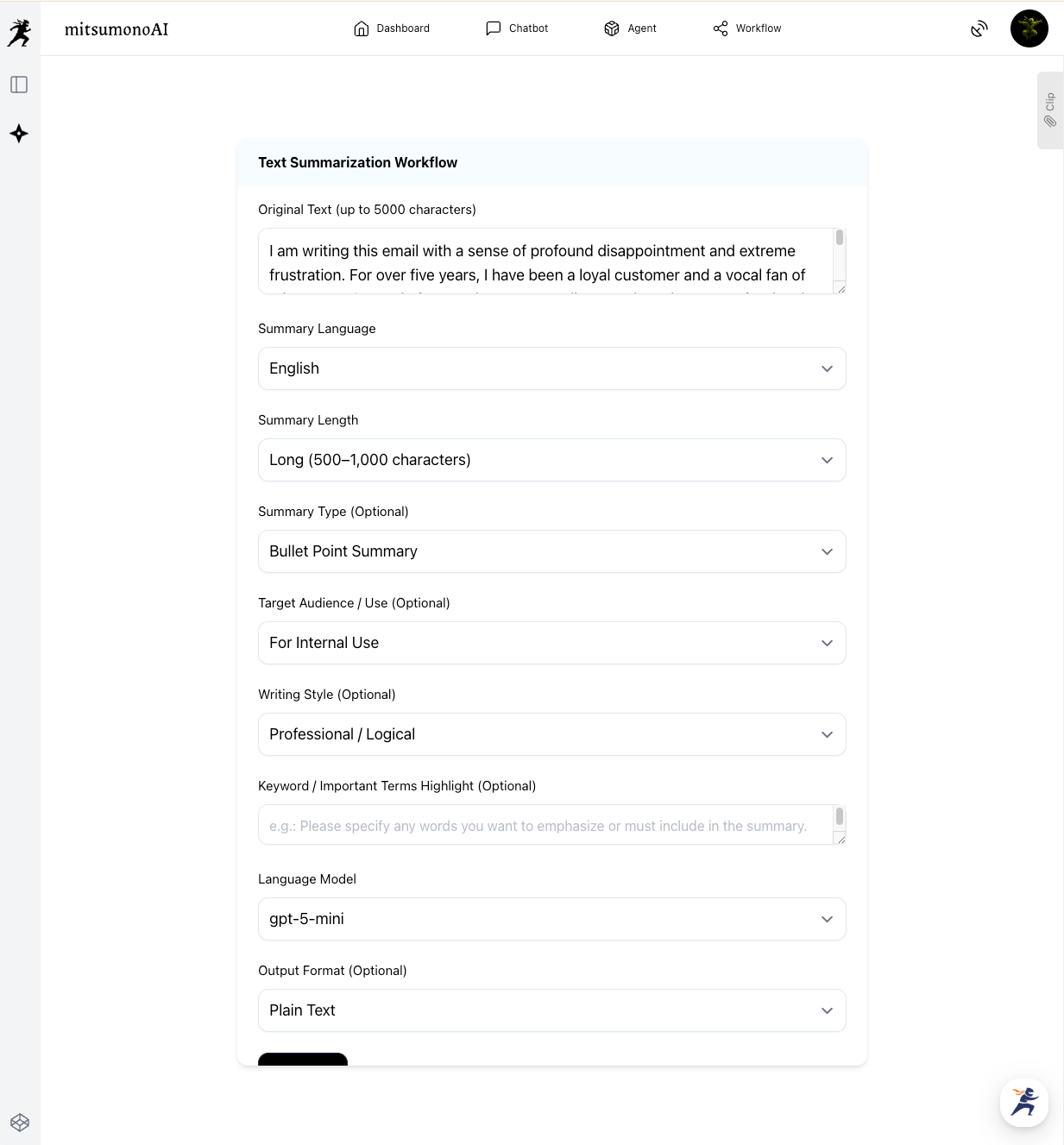
Once all settings are complete, click the "Summarize" button.
Step 2: Grasp Objective Facts via the AI-Generated "Primary Summary"
Upon execution, the AI filters out emotional expressions and outputs a primary summary structured with objective facts based on your settings.
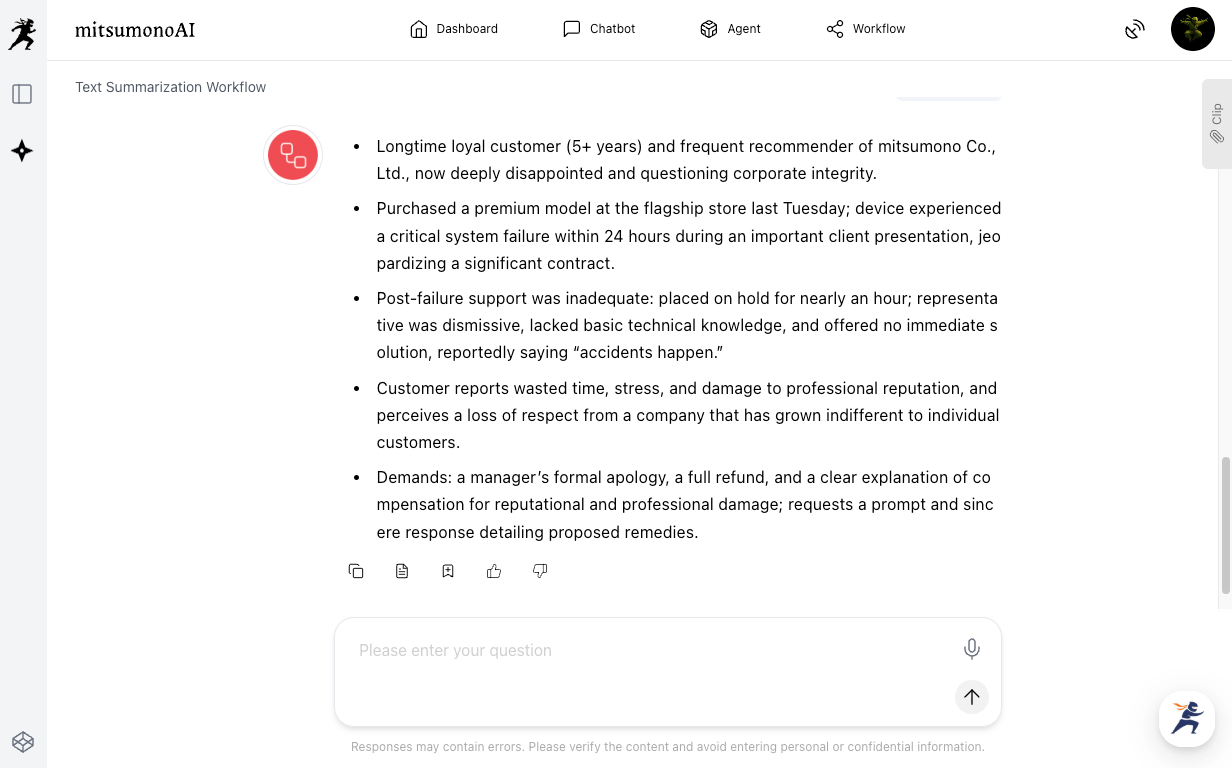
By having this common foundation of an objective primary summary, the team can stand on a clear starting line to begin discussions based on facts rather than being swayed by emotions.
Step 3: Organize "Response Strategy" and Create a "Reply Draft" through Dialogue with AI
Once the objective facts are organized, the next step is to finalize the response strategy and make the initial contact with the customer. Ask the AI about the next actions to be taken based on the outputted summary.
Based on the summary above, please propose three actions we should take next, listed in order of priority. Specifically, clarify the points for fact-finding with the relevant departments.
By giving this instruction, the AI supports your thought process as follows:
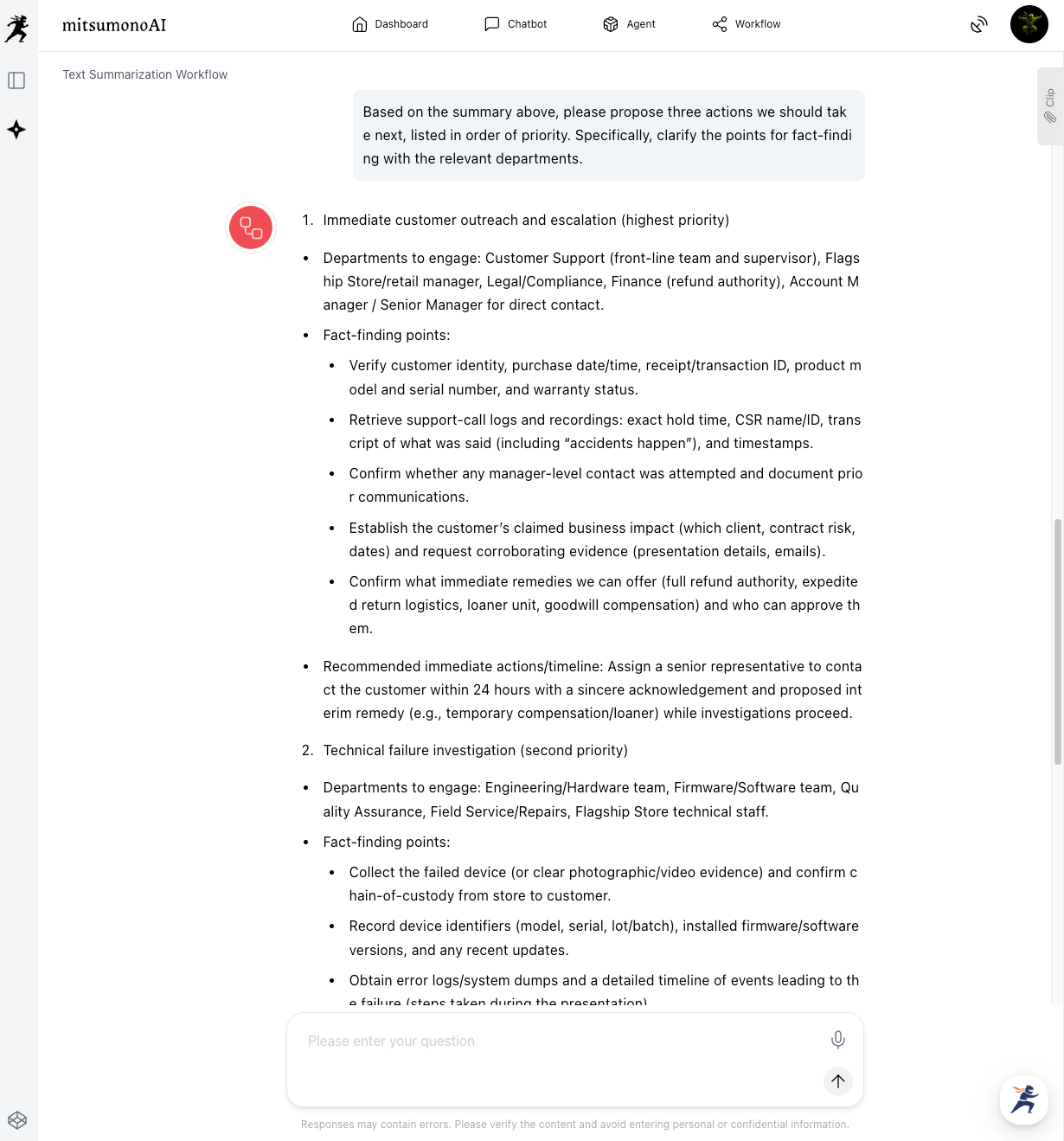
Next, in the same chat screen, request the AI to draft the email text.
Please create a draft email to the customer.
Ensure the following elements are included:
・Gratitude for reaching out and a sincere apology for the unpleasant experience caused by the series of events.
・State that we are currently conducting fact-finding with relevant internal departments.
・Inform them that we require X business days for a detailed investigation.
・State that once the investigation is complete, I (Customer Response Manager M) will contact them again.
With these instructions, the AI instantly creates a polite and sincere draft for the reply email.
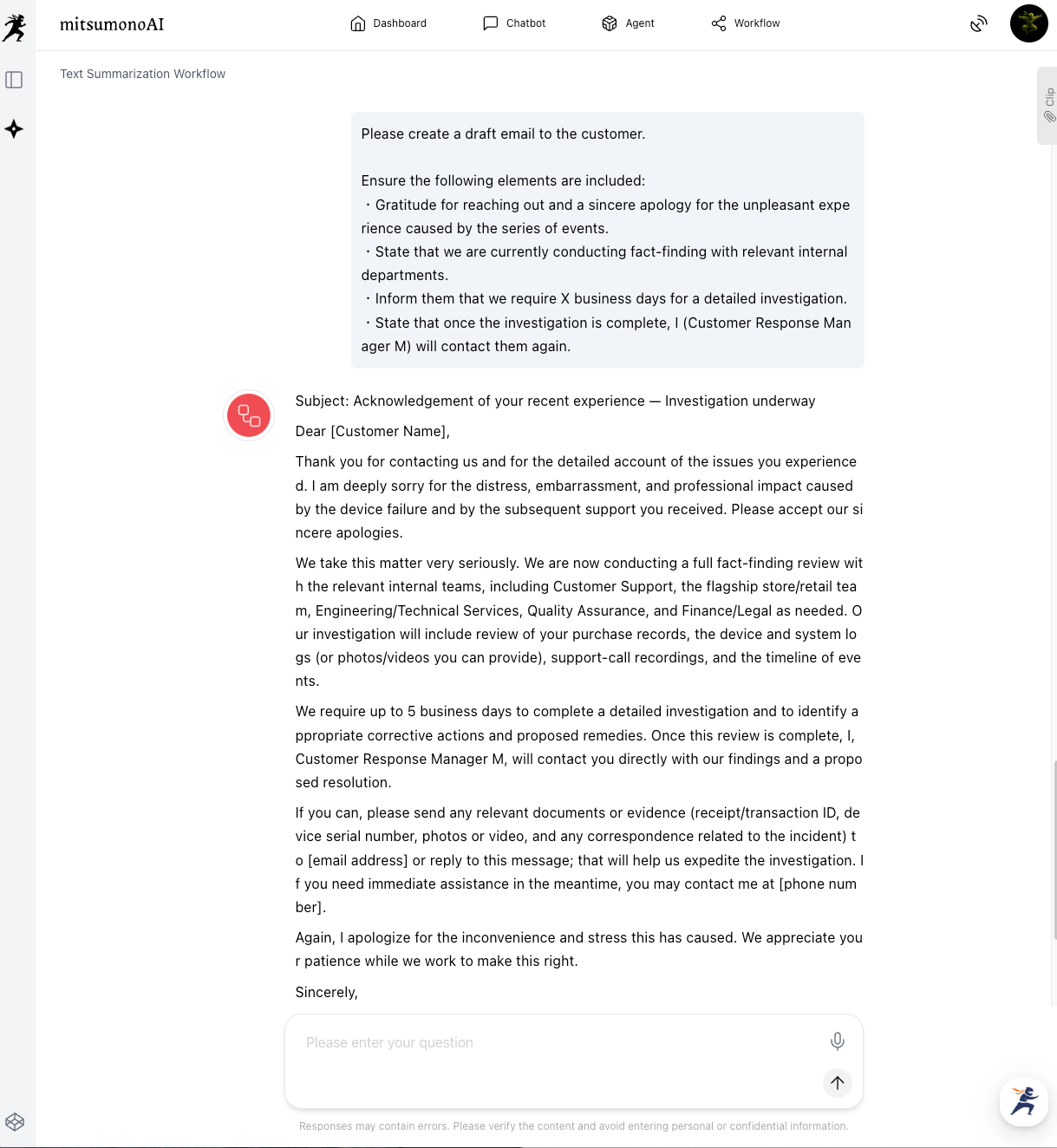
By simply adding the actual person's name and making final adjustments to match your company’s tone and manner, the initial response is complete. This significantly reduces the psychological burden and time spent drafting from scratch, allowing the person in charge to move quickly to the essential internal investigation.
Turning All "Text Information" into "Next Actions"
The approach of "extracting objective facts and key points from emotional, long-form text" can be applied to various tasks beyond complaint handling.
- Minutes of long meetings or logs of group chats
→ Organize "final decisions" everyone must know and "specific action plans" for each person. - Customer feedback from review sites or SNS
→ Discover common "product improvement requests" or "new needs" hidden behind individual opinions. - Long weekly reports or project progress reports from various departments
→ Create summaries of "key achievements," "arising issues," and "risks requiring action" for executives and managers to grasp situations quickly.
In this way, you can use this method as a powerful tool to connect the vast amounts of unorganized text information you receive daily to specific next actions.
Summary: Standardizing and Accelerating Initial Complaint Response through AI Collaboration
This article explained how to complete the entire initial response process—organizing facts, clarifying points of contention, and creating an initial reply—in three steps using AI for emotional, long-form complaints.
- Text Summarization Workflow extracts "objective facts" from chaotic long text.
- Dialogue with AI clarifies "what to do next" based on those facts.
- AI Drafts "Sincere Communication" following the established strategy.
This workflow enables a team to standardize the quality of complaint handling at a high level, which often fluctuates based on an individual's skills or mental state. By using AI as a partner in thinking and execution, you can take a calm and accurate first step toward rebuilding trust with your customers.
For more use cases of mitsumonoAI and the latest information useful for daily operations, please visit our official blog site.