[The Ultimate Comparison] GPT-5.1 vs. Claude Opus 4.5 Thinking | Which One Masters Complex Strategic Planning?
Tired of generic AI answers? It’s likely your chosen "brain," not your prompt. We put GPT-5.1 Thinking and Claude Opus 4.5 Thinking to the test in a strategy task, dissecting their unique strengths to help you pick the perfect AI partner for your business.

![[The Ultimate Comparison] GPT-5.1 vs. Claude Opus 4.5 Thinking | Which One Masters Complex Strategic Planning?](/content/images/size/w1200/2026/01/GPT-claude.png)
Have you ever felt that AI responses are "like a straight-A student, but ultimately boring"?
When you ask an AI for new business ideas or solutions to complex management issues, have you ever looked at the result and sighed, "Well, that’s technically correct... but if it were that easy, I wouldn't be struggling"? Anyone in a planning or management role has likely experienced this at least once.
Falling into "Shallow Thinking" by Choosing the Wrong Model
- Surface-level lists:
The AI only produces textbook generalities like "Use social media" or "Define your target audience." - Ignoring context:
It fails to grasp your company’s unique identity or the "gritty realities" of your specific industry, resulting in empty theories that can't be used on the ground. - Lack of debate:
The AI becomes a "yes-man" to your ideas, failing to act as a critical sounding board that points out risks or offers multi-faceted perspectives.
The root of this problem is that the "Thinking Depth" of the AI model isn't sufficient for the difficulty of the task, or you are using a model without understanding its specific strengths.
By reading this article, you will learn how to master the top-tier reasoning models available in mitsumonoAI and find the "ultimate sparring partner" to deepen your thinking.
AI Becomes Your "Strategy Consultant" and "Philosophical Advisor"
mitsumonoAI provides an environment where you can choose the best "brain" for your specific needs. For strategic planning, two "Thinking" (reasoning-specialized) models stand out as the top contenders.
- GPT-5.1 Thinking (The Strategy Consultant)
- Characteristics: Overwhelming logical structure and multi-step reasoning. It excels at breaking down complex issues into components and translating them into structured action plans. It is best for refining the "How" (execution).
- Claude Opus 4.5 Thinking (The Philosophical Advisor)
- Characteristics: Deep contextual understanding and the insight to read between the lines. Beyond just solutions, it shows its strength in defining the "Why" (significance) and building brand stories.
- Clip Function (The Hybrid Glue)
- This allows you to save the outputs of both models and combine them—for example, taking GPT’s "structure" and fleshing it out with Claude’s "depth."
It’s not about which one is better. It’s about whether your current task requires "structure" or "insight." Switching between them based on your needs is how advanced AI users win.
■ Practice | Step-by-Step Guide
Using the "Manufacturing" category found in Sensei AI as a theme, we will throw the following high-difficulty task at both models to verify the difference in their outputs.
[Verification Theme]
A 50-year-old metal processing subcontractor wants to launch a BtoC "luxury camping gear brand" utilizing its existing technology. What is their market entry strategy?
Step 1: [GPT-5.1 Thinking] Create a Structured "Execution Plan"
First, have GPT-5.1 Thinking draw the big picture of the strategy.
[Setup & Execution] Select "GPT-5.1 Thinking" from the model selection screen and send the following prompt.
"For the purpose of a business case study exercise, please analyze a hypothetical scenario of a traditional B2B manufacturer entering a new market.
Scenario: A medium-sized metal processing company with 50 years of history (Strength: precision cutting technology; Weakness: lack of B2C marketing experience) is planning to launch a luxury camping gear brand.
Task:
1.Conduct a SWOT analysis.
2.Develop a market entry strategy.
3.Provide a structured list of 'differentiation factors' and an 'initial 18-month roadmap.'
Please output the result as a professional strategic proposal."
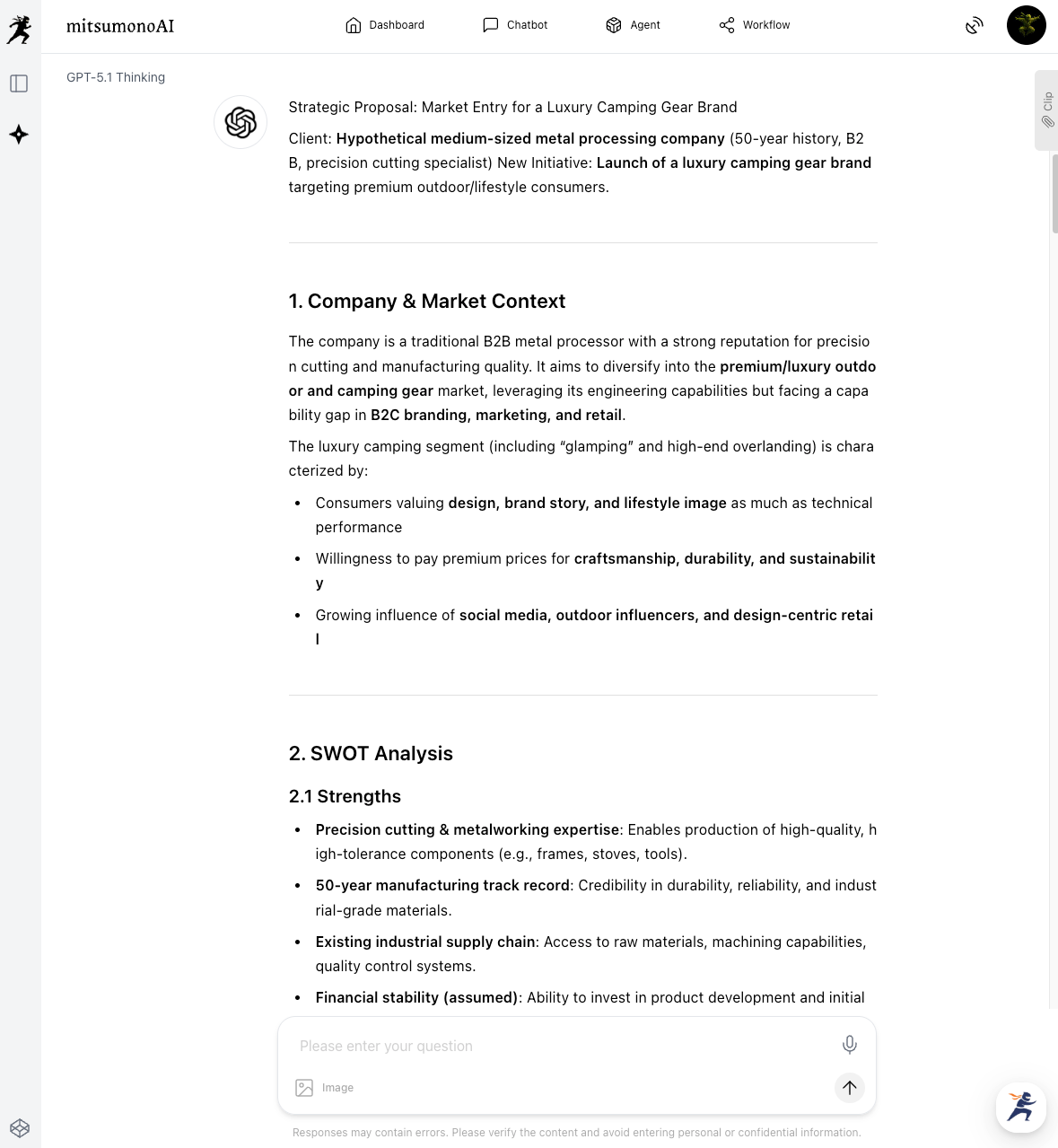
[GPT-5.1 Output Tendencies]
- Structure: Everything from "1. SWOT Analysis" to "3. Differentiation," "4. Roadmap," and "5. KPIs" is organized systematically based on business frameworks, moving from strategy to execution.
- Content: It translates the company's technical strengths into specific product specs, such as "solid engagement/tactile feedback" or "proprietary tool-less assembly mechanisms," and provides a month-by-month action plan for the first 0–18 months.
- Strengths: It doesn't stop at ideas; it covers marketing, manufacturing setup, and cash flow (CF), providing a level of detail and logical consistency that could be adopted immediately as the core of a business plan.
Step 2: [Claude Opus 4.5 Thinking] Breathe a "Soul (Story)" into the Brand
Next, send the same prompt (or a follow-up based on GPT’s output) to Claude Opus 4.5 Thinking.
[Setup & Execution]
Switch the model to "Claude Opus 4.5 Thinking."
"Let’s engage in a creative branding exercise. Imagine a hypothetical scenario of a traditional BtoB metalworking factory with a 50-year history pivoting to the luxury outdoor market.
Instead of professional consulting, I want to brainstorm the philosophical and emotional narrative for this brand. What kind of 'emotional value' could such a brand offer to a modern audience?
Please explore a 'brand story' and 'core philosophy' that connects the raw, industrial heritage of precision metalwork with the soul of a luxury camping experience. Focus on storytelling and the human element."
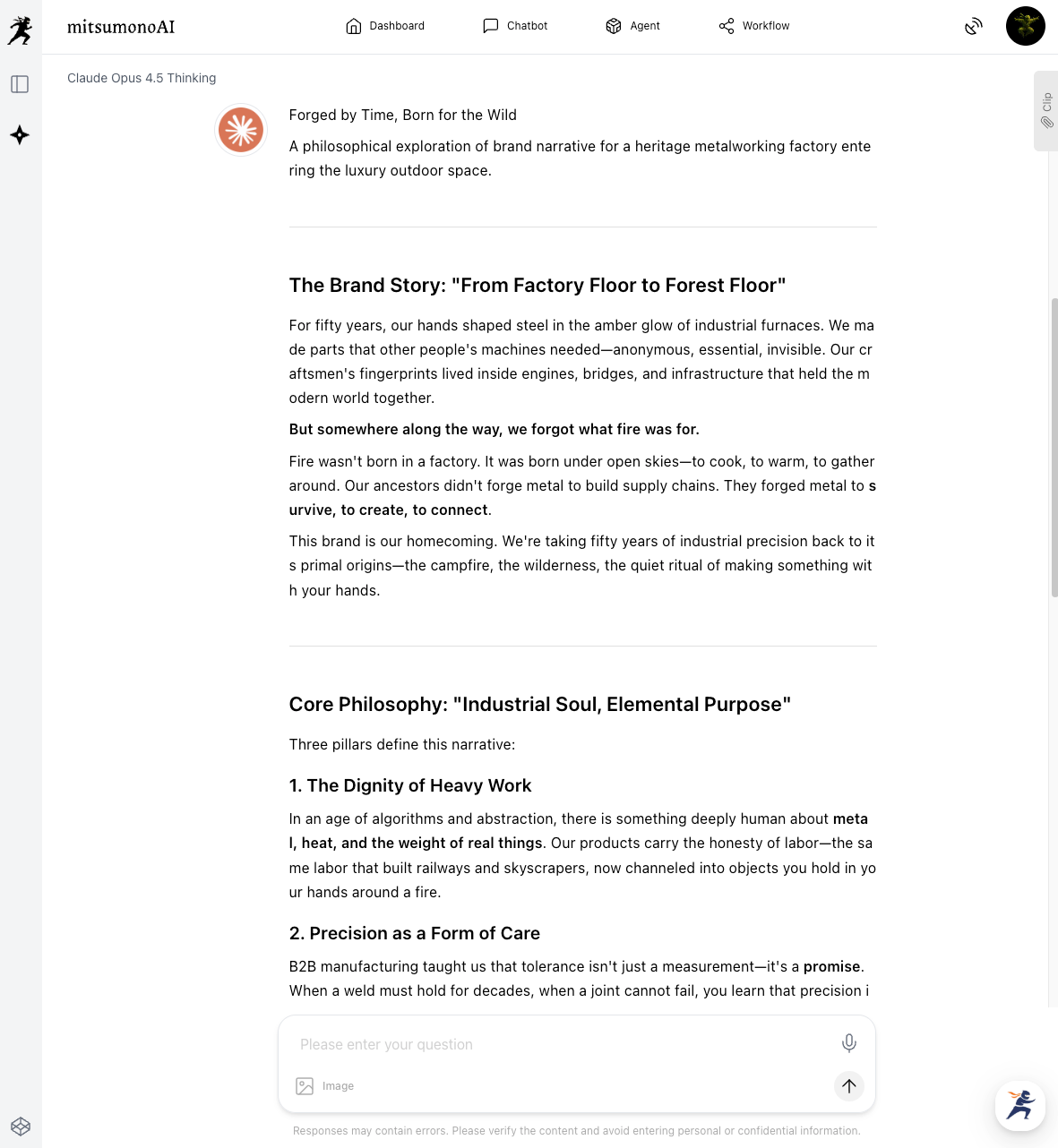
[Claude Opus 4.5 Output Tendencies]
- Insight: It interprets "50 years of working with steel" not just as data, but as an inevitable history required to create "tools that accompany life's most important moments," giving emotional context to the technical skill.
- Proposal: It suggests a poetic and philosophical concept like "Precision Lives in the Wild," presenting the brand's ideology as a "quiet resistance against a mass-consumption society" that transcends functional value.
- Strengths: It excels at storytelling that moves the reader—such as turning "craftsman's pride" into "user's pride"—and building a worldview that gives the brand deep meaning and a reason for being.
Step 3: Integrate the Wisdom of Both
Finally, merge GPT’s "structure" with Claude’s "narrative."
[Setup & Execution]
Open a new chat (a lightweight model like GPT-5-nano is fine) and paste the "Roadmap" from GPT and the "Brand Concept" from Claude with the following instruction.
"Incorporate this 'Brand Concept' into the following 'Action Plan' to create a presentation structure for investors.
[Action Plan]
(GPT generated results attached)
[Brand Concept]
(Claude generated results attached)"
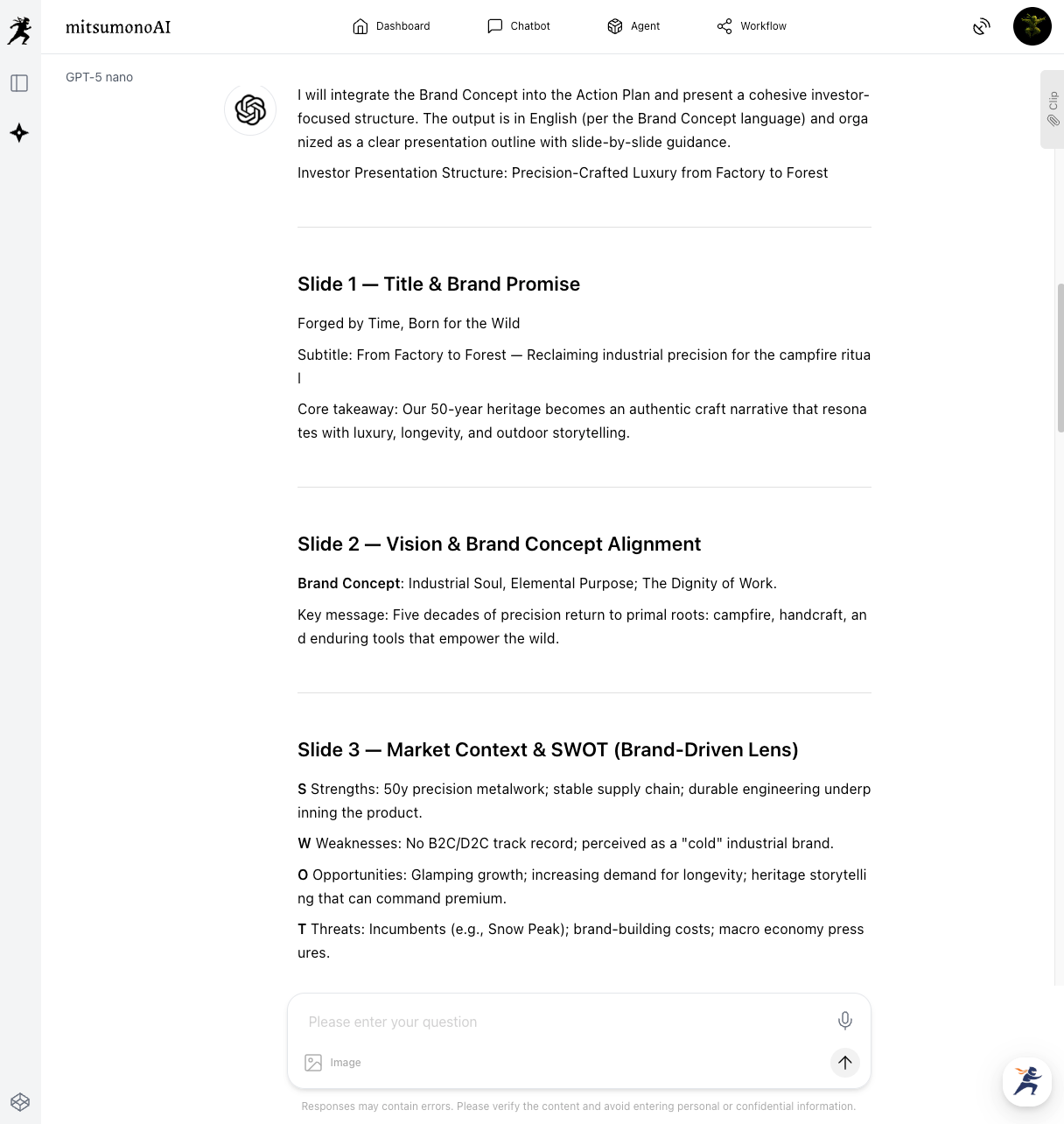
This results in a strategic document with the depth of a human-made plan—perfect logic backed by genuine passion.
■ Advanced Application (The Power Duo: Thinking + Sensei AI)
GPT for "thinking power," Claude for "expressive power.
" Where does Sensei AI fit in?
In short, Sensei AI is essential for "injecting on-site reality (constraints)."
While Thinking models are brilliant, they can sometimes produce "straight-A" answers that are logically sound but impossible to execute on the shop floor. This is where a hybrid strategy using Sensei AI becomes effective.
Three Scenarios Where Sensei AI Outperforms "Thinking" Models
1. Checking "Industry Norms and Taboos" (Manufacturing, Healthcare, etc.)
- The Issue: The "production efficiency plan" GPT-5.1 created might actually violate safety standards or the Subcontract Act (Shitauke-ho).
- Using Sensei AI: First, show the plan to "Sensei AI - Manufacturing" and ask, "As a factory manager, point out the concerns with this plan." By feeding that feedback back to GPT, you elevate it to an "executable strategy" rather than a pipe dream.
2. Defining "Operations" (Dining, Hospitality, etc.)
- The Issue: The "ultimate hospitality story" Claude wrote might ignore staff movement patterns (dosen) or the chaos of peak hours.
- Using Sensei AI: Throw the idea to "Sensei AI - Restaurants" and say, "Plan the operations to make this work during the lunch rush." It will break it down into a gritty but profitable manual that considers food cost ratios and turnover rates.
3. Translating "Jargon" and "Customer Psychology" (Real Estate, Legal, etc.)
- The Issue: General models might use unnatural terminology or lack empathy for the specific "pain points" of a customer.
- Using Sensei AI: Use "Sensei AI - Real Estate" or "Sensei AI - Legal." They know the anxiety of someone buying their first home in their 30s or the psychology of those in an inheritance dispute. Having them rewrite the Thinking model's structure into industry-specific language instantly boosts credibility.
[Conclusion: The Ultimate Workflow]
- Use Sensei AI to identify "on-site constraints" and "seeds of ideas."
- Use GPT-5.1 Thinking to build the "strategy and structure."
- Use Claude Opus 4.5 Thinking to instill the "soul and story."
This "three-tier approach" is a strategic planning method unique to mitsumonoAI that other tools cannot replicate.
Summary
In this article, we compared the two top-tier models in mitsumonoAI and introduced a strategy for linking them with industry-specific AIs.
- GPT-5.1 Thinking is the "Expert PM" who organizes and structures complex issues.
- Claude Opus 4.5 Thinking is the "Sage" who digs deep into meaning and value.
- Sensei AI is the "Master Craftsman" with real-world experience and specialized knowledge.
- And the Clip function is the "Glue" that brings them all to the round table.
Don't just rely on "High IQ"; make "Experience" your ally as well. By using general models and Sensei AI in the right places, your strategic planning will move beyond mere theory and become a real force that drives your business forward.
mitsumonoAI features not only the general models introduced here but also many "Agent functions" and "Workflows" specialized for specific tasks. If you're unsure which model to choose, starting with an Agent that matches your goal is a great first step.
Check the mitsumonoAI blog for more use cases and the latest information.