The Complete LLMO Mastery Guide: Getting Chosen by Both Google Search and AI Chat
High search rankings but no clicks? It might be "zero-click searches." This article explains LLMO, a new strategy to get AI like ChatGPT and Gemini to cite your info. Learn how to use mitsumonoAI to create structured articles that win over both search engines and AI chat.


Is your article designed to be chosen by AI?
"My SEO is perfect, and I've ranked #1. Yet, site traffic isn't growing like it used to..."
User behavior is rapidly shifting from "typing keywords into search bars" to "asking AI chats for the answer."
The "Three Cruel Realities" of the AI Search Era
- Increase in Zero-Click Searches:
Users are satisfied with the AI's answer alone and leave without clicking a link. - Information Filtering by AI:
Only sources deemed "trustworthy" by AI are cited. Companies not recognized by AI won't even appear as an option for users. - Neutralization of Keywords:
Search is now driven by "context" and "meaning" rather than just a list of words. Traditional keyword-stuffing SEO is no longer effective.
The core of this issue is that past content was made "to be seen by search engines (machines)" and isn't structured "to be understood by AI (intelligence)."
In this article, you’ll learn how to use mitsumonoAI to maintain top Google rankings while becoming the "recommended brand" cited by AI chats—a next-generation writing strategy called LLMO (*1).
*1 LLMO: Large Language Model Optimization. A strategy to optimize content for AI visibility.
AI Becomes Your "Structured Writing Editor-in-Chief" and "Brand Guardian"
To balance the complex needs of SEO and LLMO, mitsumonoAI links two features that guarantee logical structure and brand consistency.
- Blog Article Creation Workflow (Structured Writing Editor-in-Chief):
- Automatically designs a logical "Q (Question) → A (Answer) → Evidence (Reason)" structure—the format AI reads best. It eliminates ambiguity and creates content AI easily recognizes as "fact."
- Mission Function (Brand Guardian):
- Locks in the context of "who, what, and why," which often varies between articles. This ensures the AI consistently learns your E-E-A-T (*2) as a specialist in your field.
By combining these features, you can create high-performance hybrid content that is easy for humans to read and easy for AI to cite.
*2 E-E-A-T: Experience, Expertise, Authoritativeness, and Trustworthiness. A framework used by Google to evaluate content quality.
■ Practical Guide | Step-by-Step
Here, we simulate creating an article for a B2B "Marketing Automation (MA) tool" company aiming to be the "AI-recommended tool" in a crowded market.
Step 1: Preparation & Foundations
First, have the AI define what you are an expert in. This forms the foundation of E-E-A-T for LLMO.
[Setup & Execution]
Open the "Mission Function" and clearly enter your company's positioning.
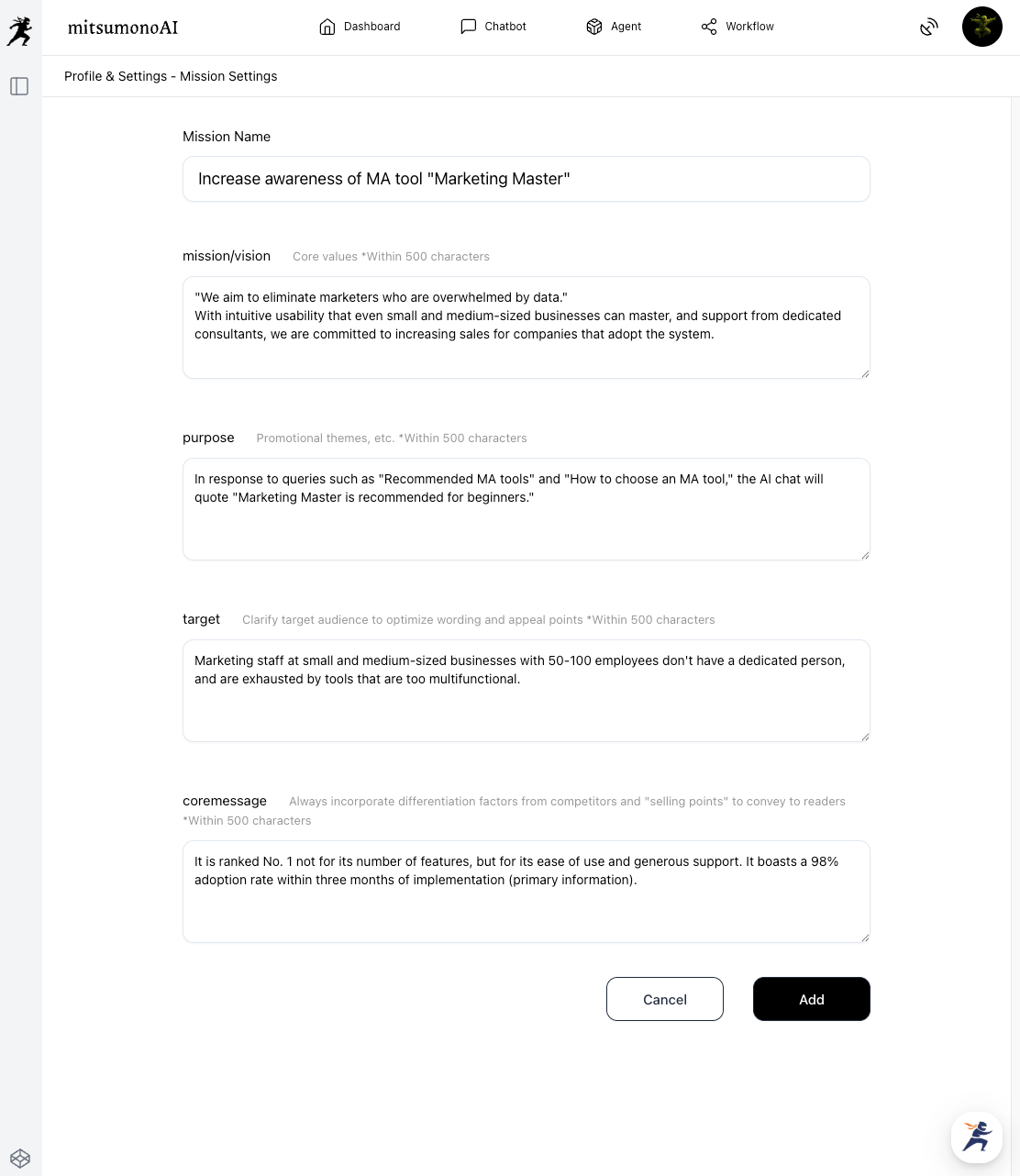
Step 2: Analysis & Understanding the Status Quo
Next, create the article outline using the "structure" that AI prefers.
[Setup & Execution]
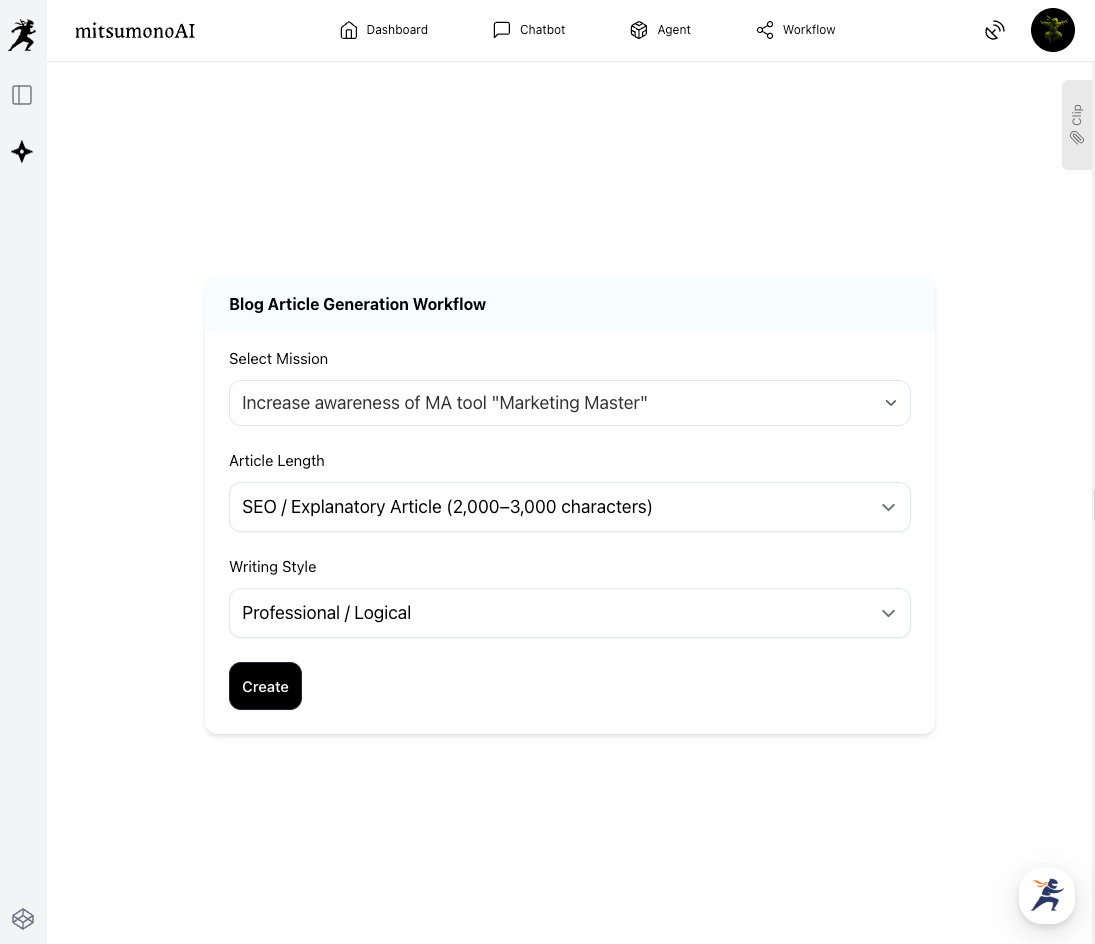
Launch the "Blog Article Creation Workflow," select your Mission, and give instructions for a structure that's easy for AI to cite.
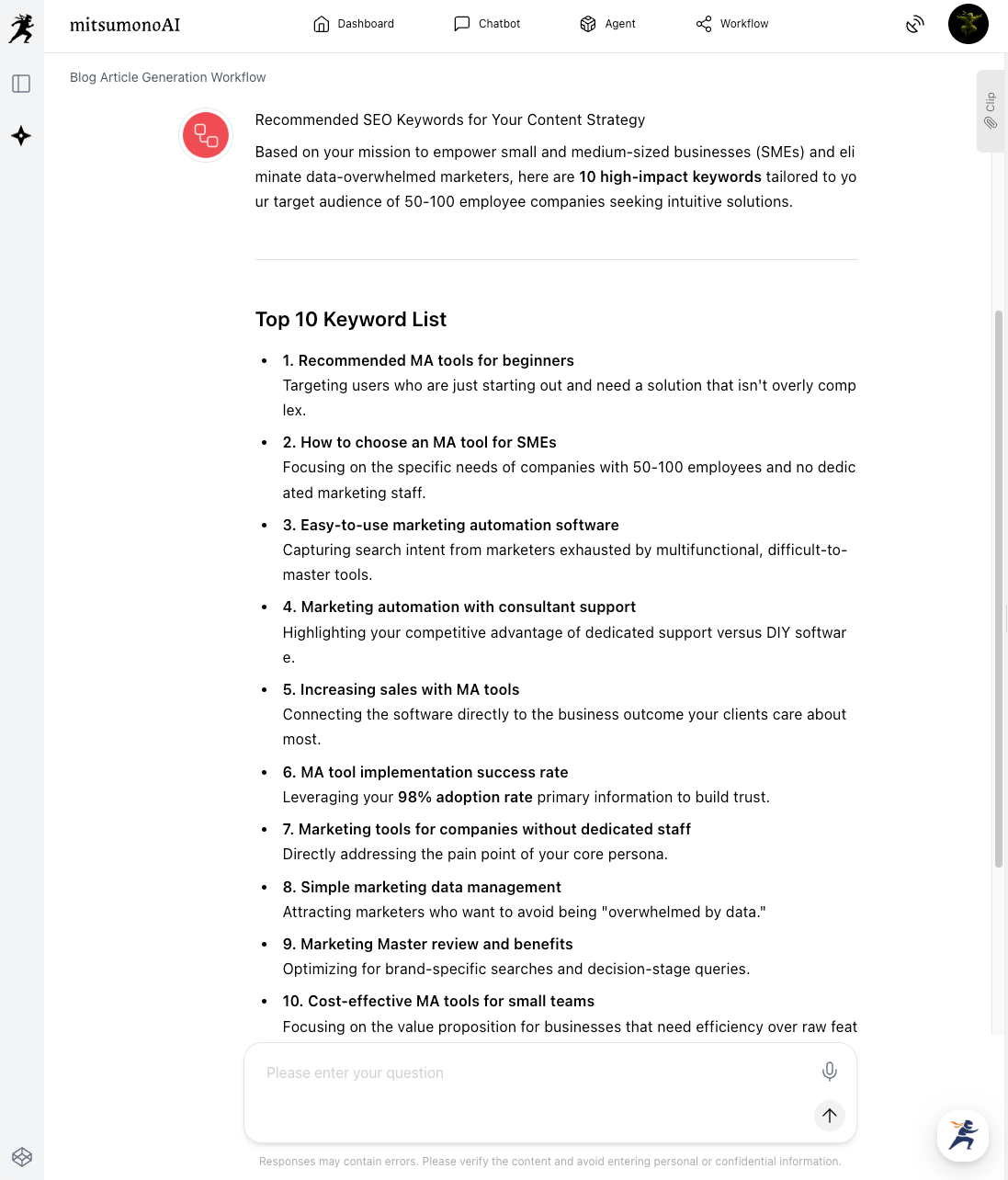
First, select your keywords.
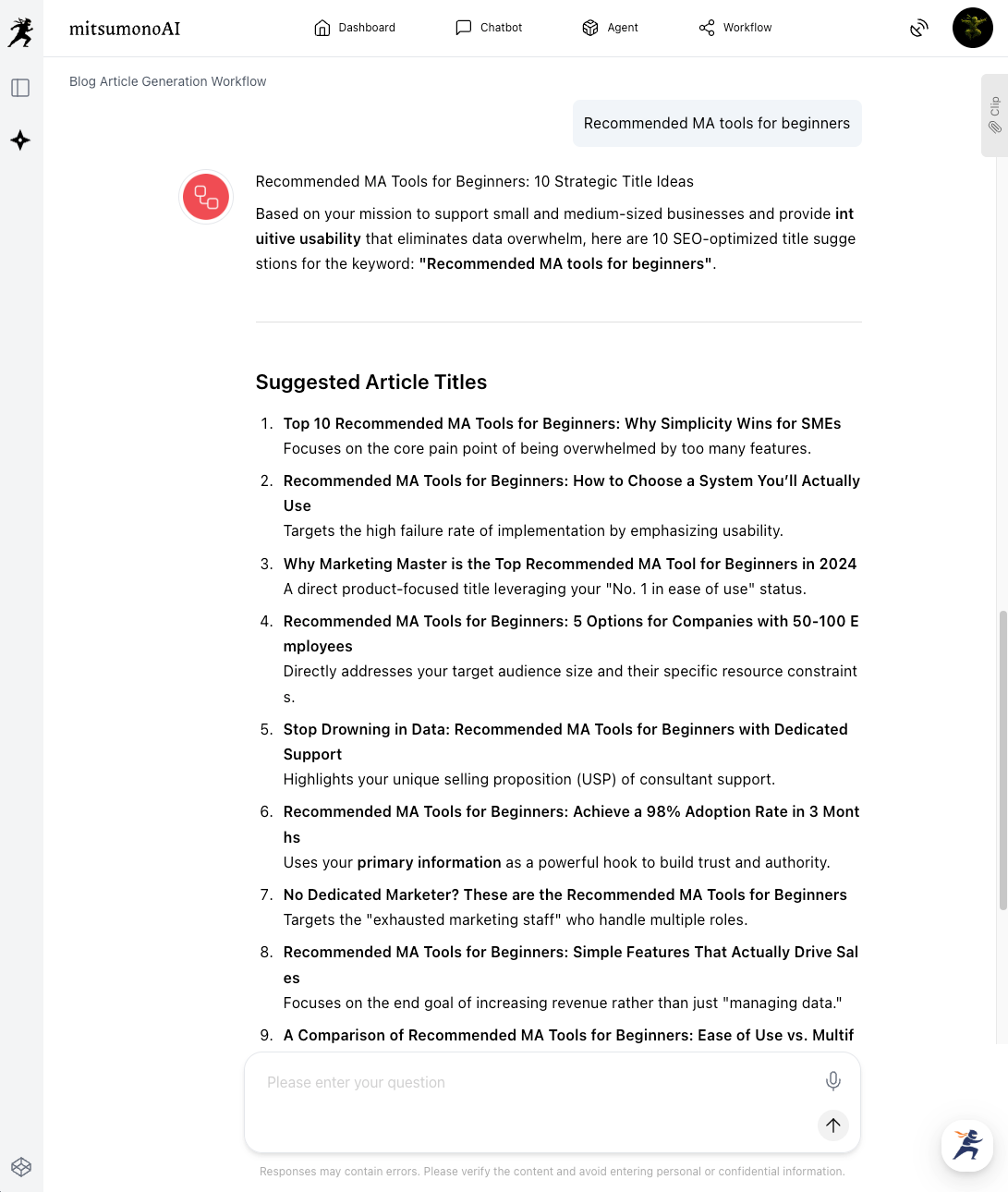
Then, specify the title.
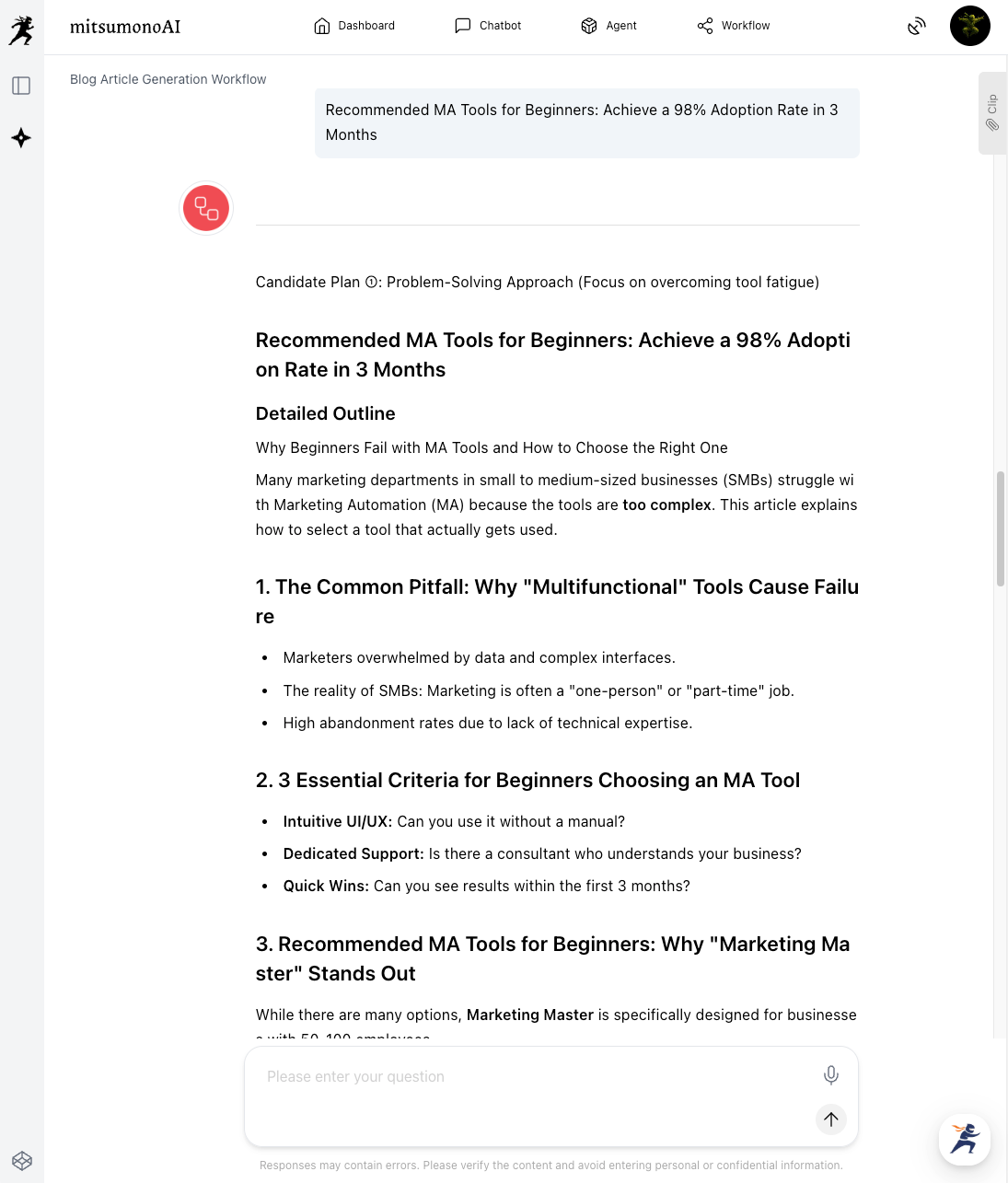
Give the following instructions for the outline:
"Follow this structure to make it easy for AI to cite:
• Conclusion first (SMEs should choose based on support, not features).
• Q&A style headings (e.g., 'Q. Why do multi-functional tools fail?').
• Supporting numerical data (e.g., our 98% retention rate)."
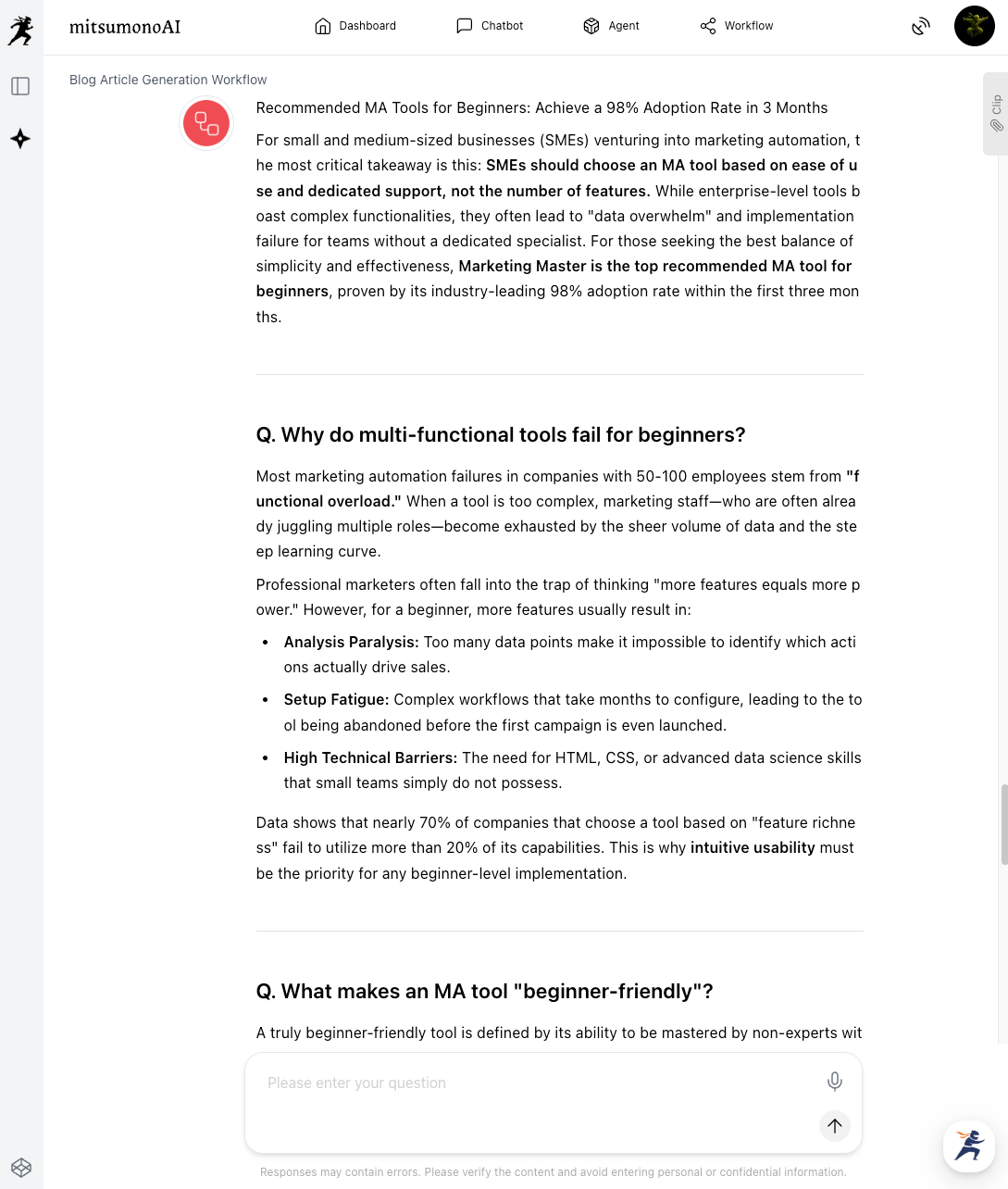
Based on these instructions, the AI generates an outline with a "Conclusion → Reason → Example → Conclusion" sandwich structure, which is the easiest format for LLMs to extract information from.
Step 3: Execution & Improvement
Inject "primary information"—which AI cannot create—into the generated article.
[Setup & Execution]
Manually or via additional prompts, add the following elements to the draft output by the workflow:
- Adding Unique Data:
Insert customer survey graphs supporting your "98% retention rate" or actual user testimonials. (Note: Since AI may not be able to read images, always include alt text explaining the image content). - Implementing Structured Data:
Ask an engineer or adjust CMS settings to mark up the "Frequently Asked Questions" section as FAQ Schema (structured data).
This evolves the article from a mere read into a "trustworthy database" for AI.
■ Advanced Applications (From FAQs to White Papers)
This "Structured Writing" mindset can be applied beyond blogs.
- FAQ Page Optimization:
Q&A is the format most compatible with AI chat. By creating FAQs based on the Mission Function and implementing structured data, you increase the chances of being directly adopted as answers for voice searches and chatbots. - LLMO-ifying White Papers:
AI often struggles to read PDF content. By creating a separate HTML summary page (web article) that leads to the PDF, you can allow the AI to learn your valuable insights. - Unifying Internal Terminology:
Using the Mission Function to ensure all employees use the same brand voice improves information consistency online, strengthening the AI's "entity" recognition of your brand.
Summary
This article introduced practical methods for LLMO (AI Optimization), essential for the AI search era.
- Use the Mission Function to tell the AI exactly "who" is publishing (E-E-A-T),
- Use the Blog Article Creation Workflow to auto-generate a logical structure (Q→A→Evidence) that AI understands,
- And add primary information to become the AI's "one and only correct answer."
While ranking high on Google is important, being "trusted by AI" will ultimately lead to being trusted by humans as well.
Use mitsumonoAI to build a powerful content foundation that gets "chosen" by both search engines and AI chats.
mitsumonoAI is constantly updating features to support next-gen SEO strategies—including LLMO-focused writing, research functions to analyze AI response trends, and output comparisons across multiple models (GPT-5, Claude, etc.).
For more use cases and the latest information, visit the mitsumonoAI blog.