AI Matches "In-House Technology" with "Hidden Market Needs" | New Business Development Techniques to Overcome Idea Exhaustion
We concretely explain the process of re-evaluating in-house technological assets using AI and discovering/combining them with hidden niche market needs, thereby creating new markets while suppressing development risk.


Tools Used
- In-house SWOT Analysis Assistant
- New Business Development Assistant
- Sensei AI - Manufacturing Industry
Rediscovering the Value of In-House Technology with AI
"Our technology here should be inimitable by other companies..."
"Despite market research, I only find conventional needs."
"I want to develop an entirely new product, but ideas have dried up."
Many manufacturers face the deep-seated challenge of development projects stalling because they cannot clearly see which market, whose problems (needs), and what kind of problems (needs) their proud, unique technology (seeds) should be linked to, even though they want to develop new products leveraging that technology.
This article introduces the specific steps for utilizing AI to objectively analyze and match your company's technological assets with potential market needs, enabling the rapid formulation of highly feasible new business plans.
Specific Steps
Step 1: Visualizing the Company's "Technological Assets" and "Hidden Market Opportunities" with AI
▶ In-house SWOT Analysis Assistant
The first important step is to objectively inventory your company's technological strengths while simultaneously discovering niche, unmet needs existing in the market.
[Tips for Input]
Input URLs of web pages explaining your company's technological capabilities, or URLs of industry media articles where your technology is evaluated. The AI will analyze your company's true strengths.
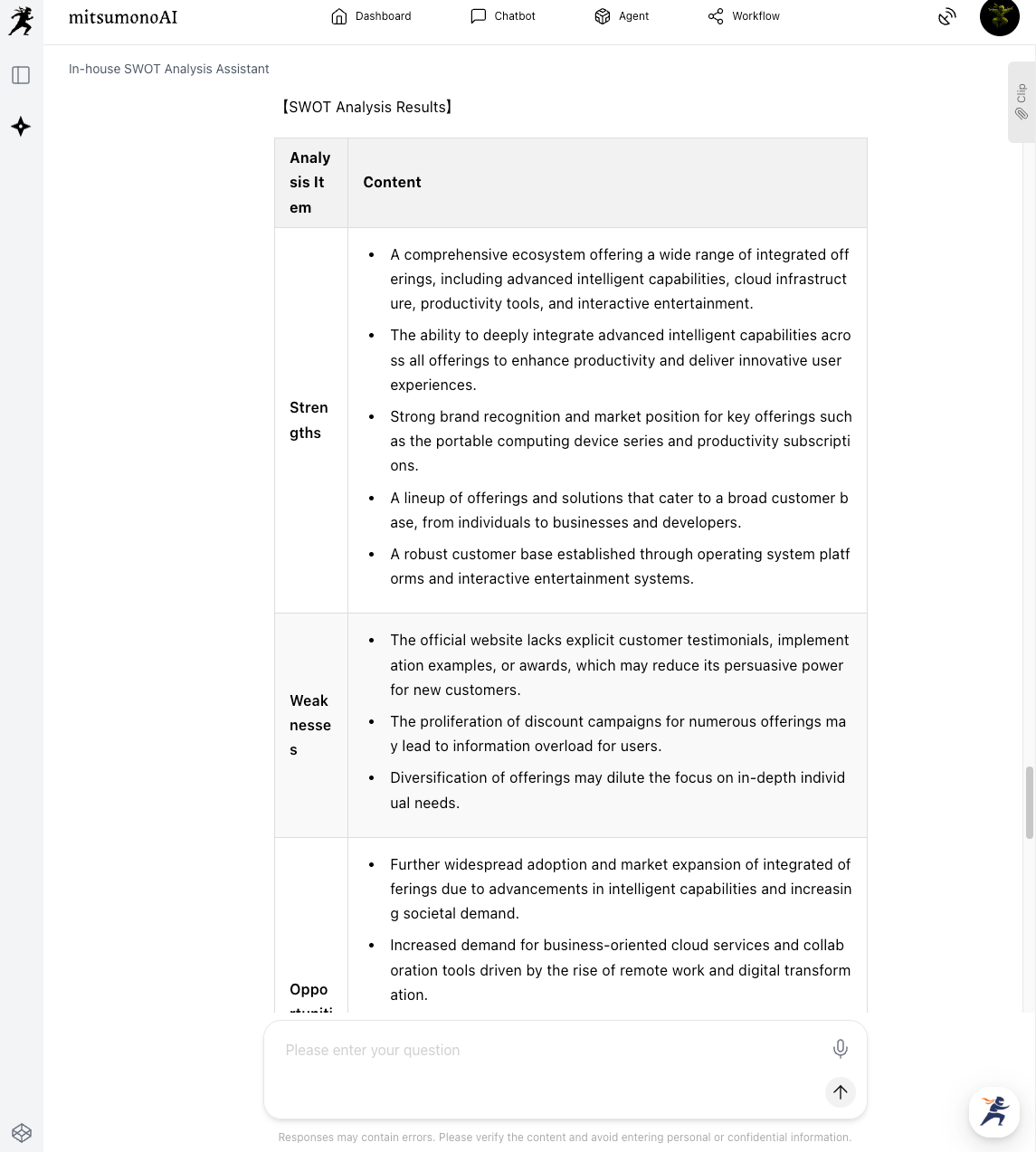
This analysis leads to core hypotheses for new businesses, such as: "Leveraging 'functional ingredients for health' and 'strong research and development capabilities' to provide personalized functional food ingredients and supplements based on individual health data (genetic information, lifestyle, gut environment, etc.)."
Step 2: Transforming "Seeds × Needs" into a Concrete "Business Plan" with AI
▶ New Business Development Assistant
Based on the hypothesis obtained in Step 1, the AI formulates a specific business plan. A highly precise business plan is devised, including market size, target audience, and revenue model.
[Tips for Input]
Specifically reflecting the "Strengths" and "Opportunities" obtained in Step 1 in the "Corporate Profile" and "Persona & Pain" fields is the key to enhancing the accuracy of the AI's proposals.
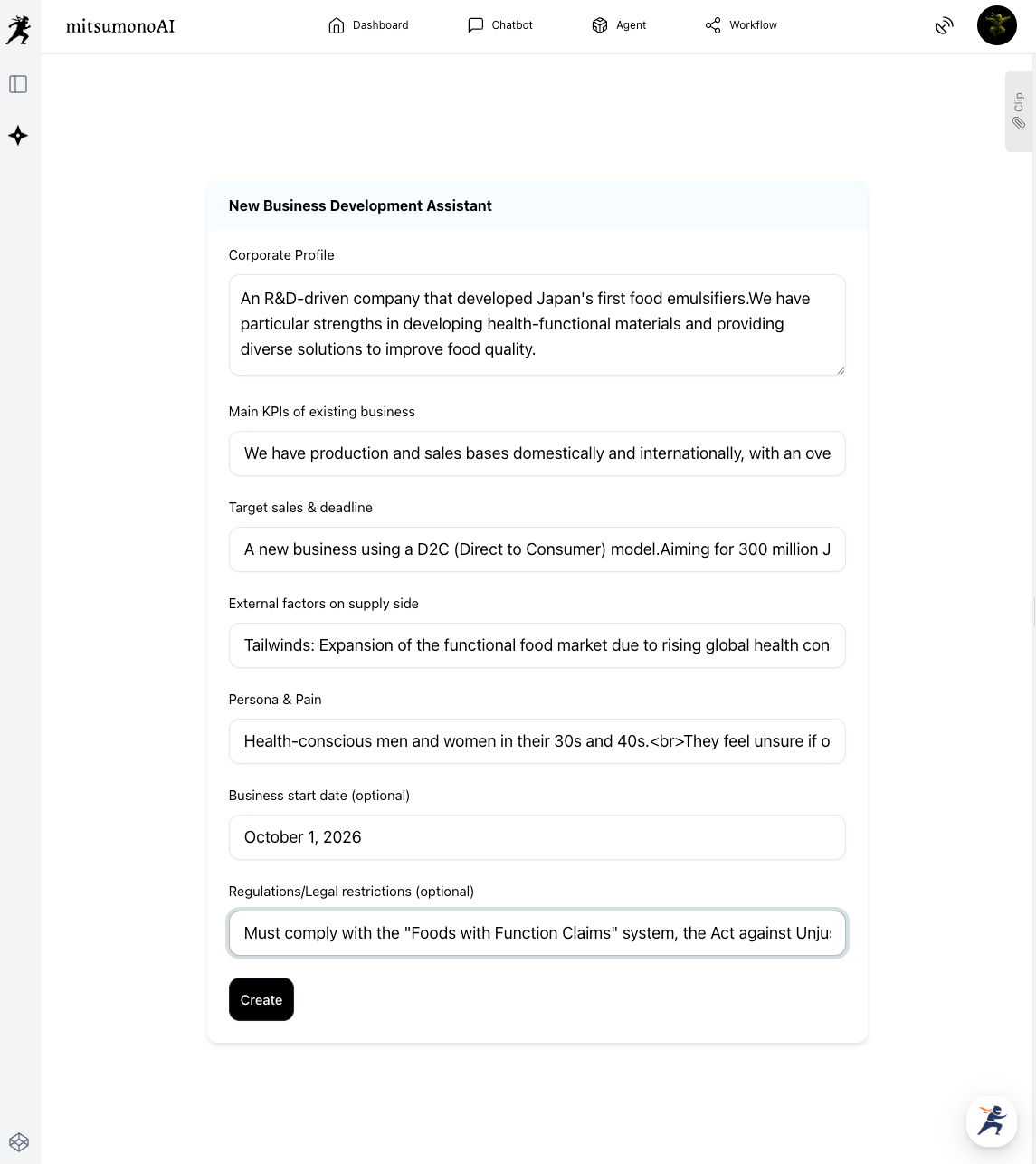
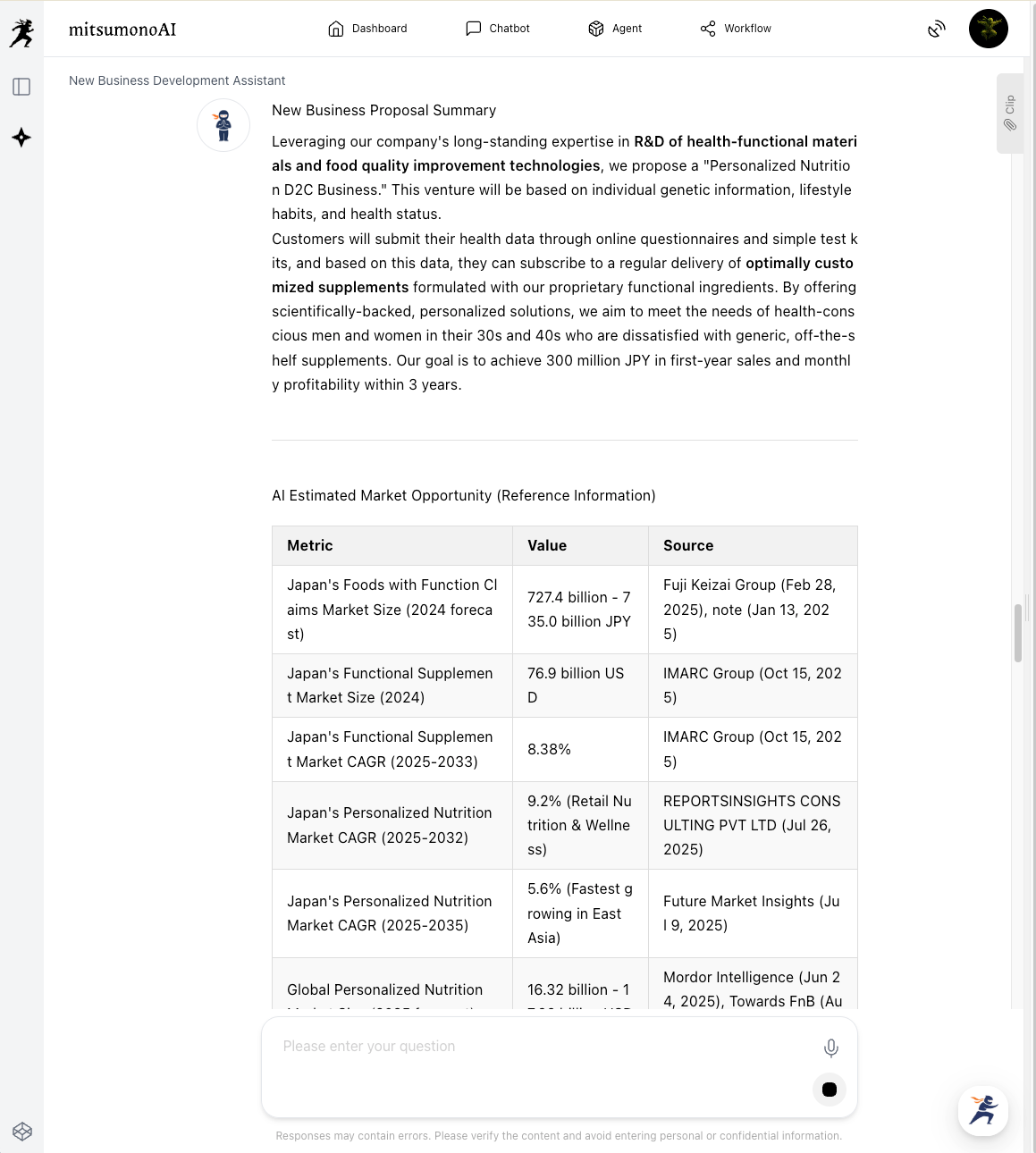
From this input, the AI generates a proposal covering the entire scope, including a concrete business plan like "Launching a D2C functional nutrition brand focused on personalization × high absorption," market opportunities, sales simulations, and an execution roadmap.
Step 3: Elevating the Resolution of the Business Plan through Dialogue with AI
▶ Sensei AI - Manufacturing Industry
Based on the generated business plan proposal, dialogue (a "sounding board" session) with the expert AI further raises the resolution of the plan and identifies potential risks.
"(Paste the business plan from Step 2)
Regarding the business plan above, please list the three maximum conceivable risks and countermeasures. Specifically, address the point of entering the B2C market, which is new to our company, and the perspective of regulations regarding food safety."
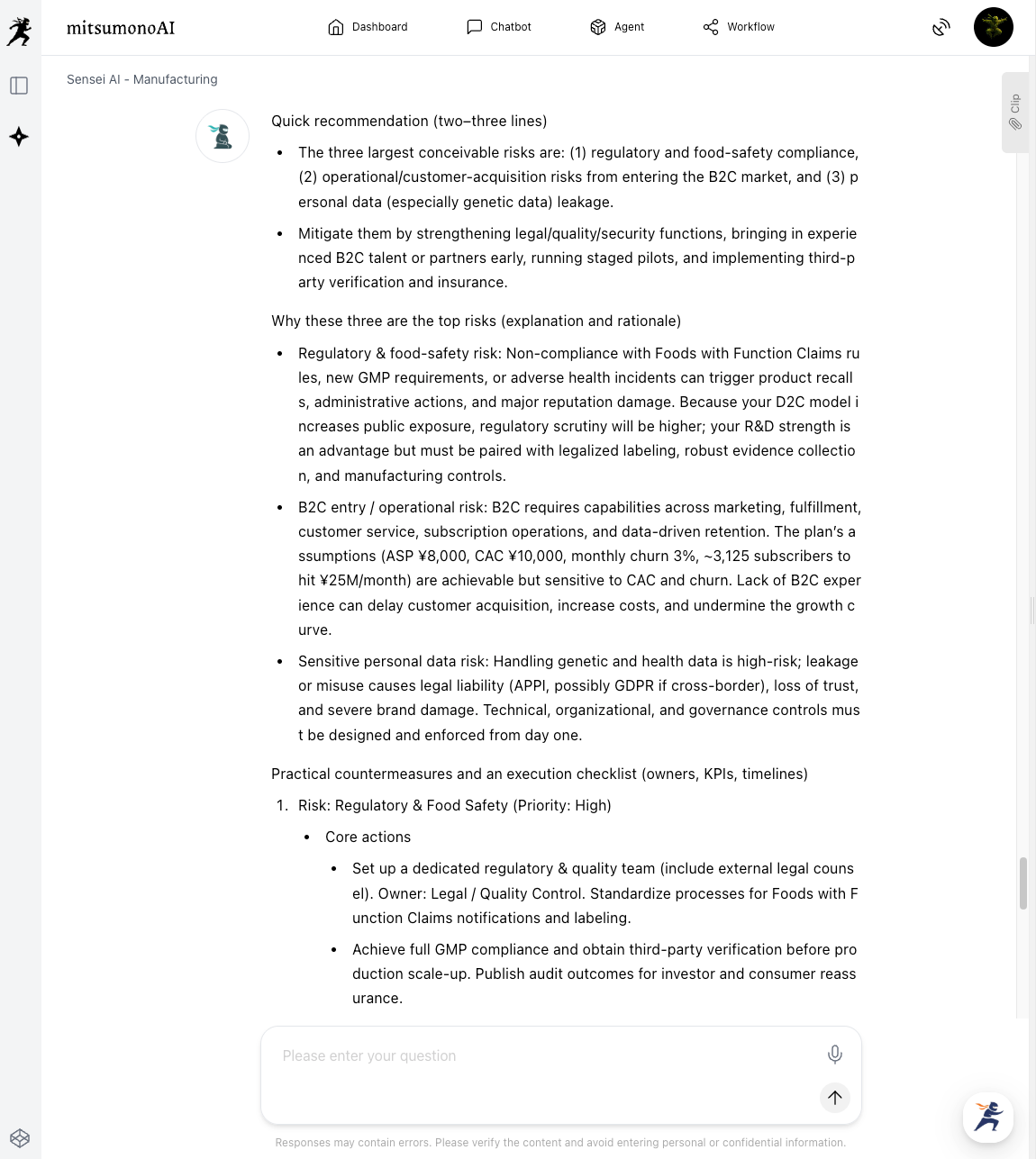
Through dialogue with the AI, you can reinforce the weaknesses of the business plan and dramatically enhance its feasibility.
Expected Results (Example)
- Speedy New Market Development with Reduced Development Risk
- By targeting areas where the company's strengths can be leveraged and where market needs definitely exist, the success rate of development significantly increases. The time spent on market research and idea generation is substantially reduced, making it possible to create and pioneer new markets ahead of competitors.
- Elimination of Individual Dependence and Systematization of Idea Generation
- A mechanism for generating new business ideas can be established through an objective, data-driven process, without relying on the experience or inspiration of specific development staff.
- Increased Persuasiveness for Management
- Business plans based on objective data and market analysis generated by the AI possess high persuasiveness in presentations to management, encouraging swift decision-making and investment judgment.
Target Metrics for the 12-Month Period
KGI (Key Goal Indicator):
- Ratio of ideas reaching business commercialization consideration: 50% improvement
KPI (Key Performance Indicators):
- Number of new business ideas generated: 300% increase
- Lead time for new product development: 30% reduction