Learning How to Design a New Revenue Model: A Case Study of a Bridal Facility’s “Non-Wedding Day Utilization”
We will introduce the process for outlining a path to profitability using the "New Business Development Assistant" to address the challenge of low operating rates on weekdays and during the off-season.


Using the Tool
- New Business Development Assistant
Generating Revenue Even on "Non-Wedding Days"
Due to the declining birthrate and the diversification of wedding styles, many bridal facilities face the business challenge of low operating rates on weekdays and during the winter season. While there is a certain demand for weddings on weekends, it is not uncommon for facilities and staff to remain idle and underutilized on weekdays and during the off-season.
Against this backdrop, this article presents a case study of a fictional bridal facility and explains how to use the "New Business Development Assistant" to design a new business that generates revenue even on non-wedding days.
Specific Steps
1. Organizing the Facility's Assets
First, identify the "available time slots," "unused spaces," and "usable equipment/fixtures" of your facility.
・Weekday afternoons (times when no ceremony or reception is scheduled)
・Winter off-season (periods with low visitor numbers, such as December to February)
Unused Spaces (Examples):
・Waiting rooms and changing rooms
・Outdoor garden spaces
・Chapel or Shinto ceremony halls
Equipment/Fixtures (Examples):
・Large screens and audio equipment
・Fixtures like table decorations and chairs
・Large artificial flower arrangements and arches
2. Inputting Information into the "New Business Development Assistant" to Output Ideas
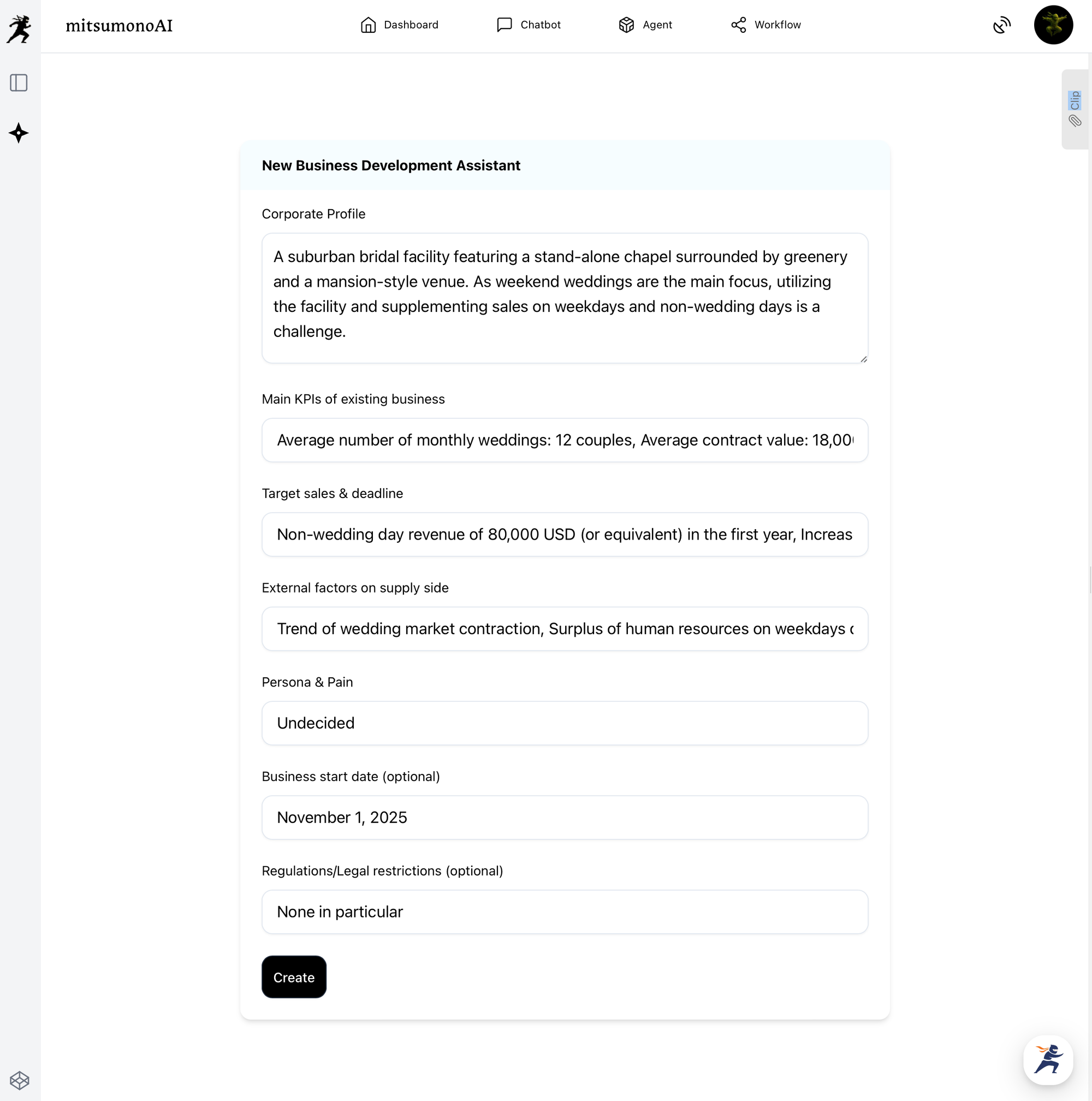
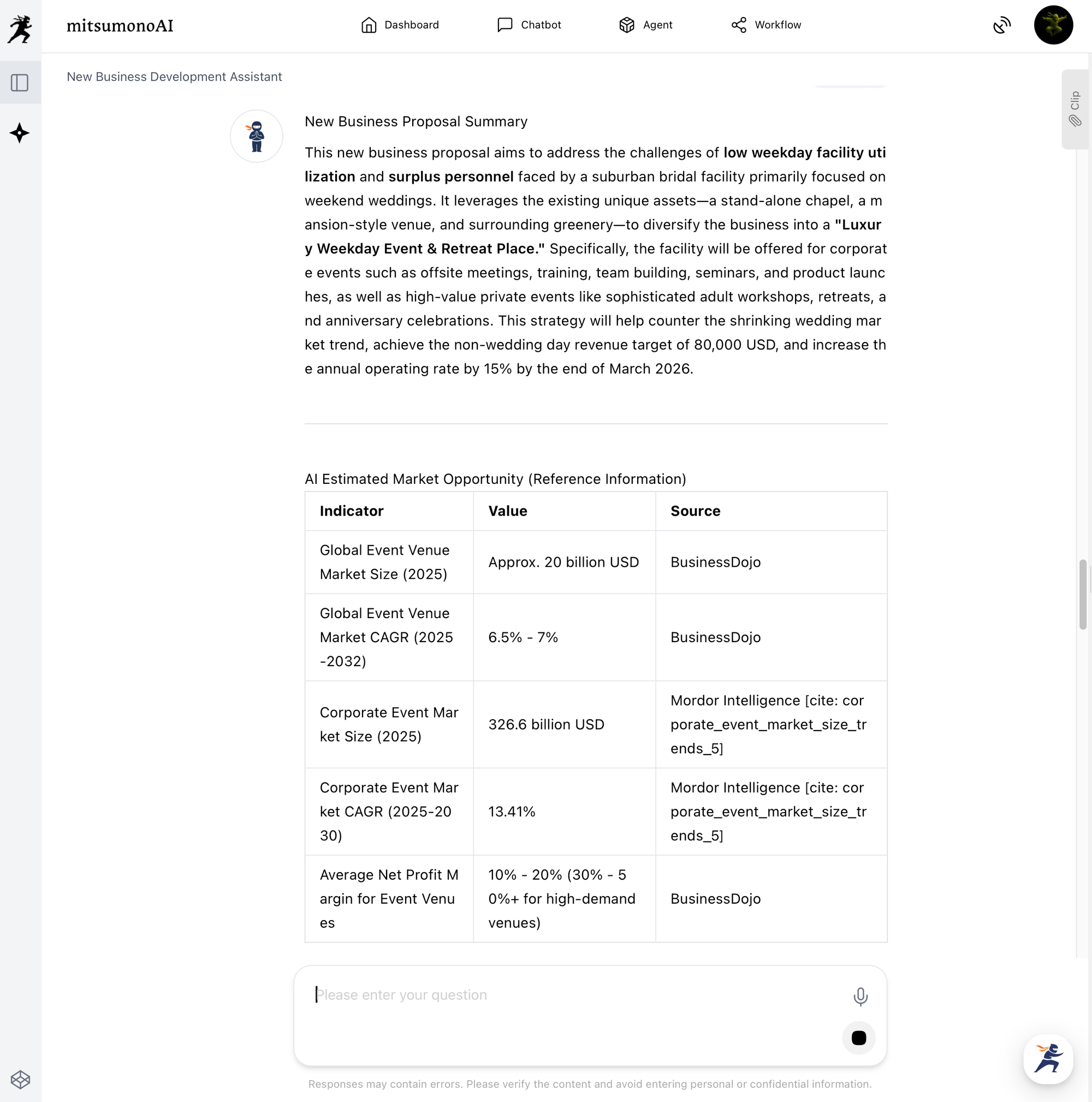
Next, input the facility's characteristics, usable assets, target sales, and other information into each input field of the tool, and then check the automatically generated ideas.
"Persona & Pain," which is not yet decided at this stage, should be set to "Undecided."
3. Refining the Outputted Ideas from a Field Perspective
The initial output provided suggestions such as "High-Value Event Space for Corporations," "Retreat & Experiential Programs for Local Community & Individuals," and "Creative & Art-Oriented Utilization."
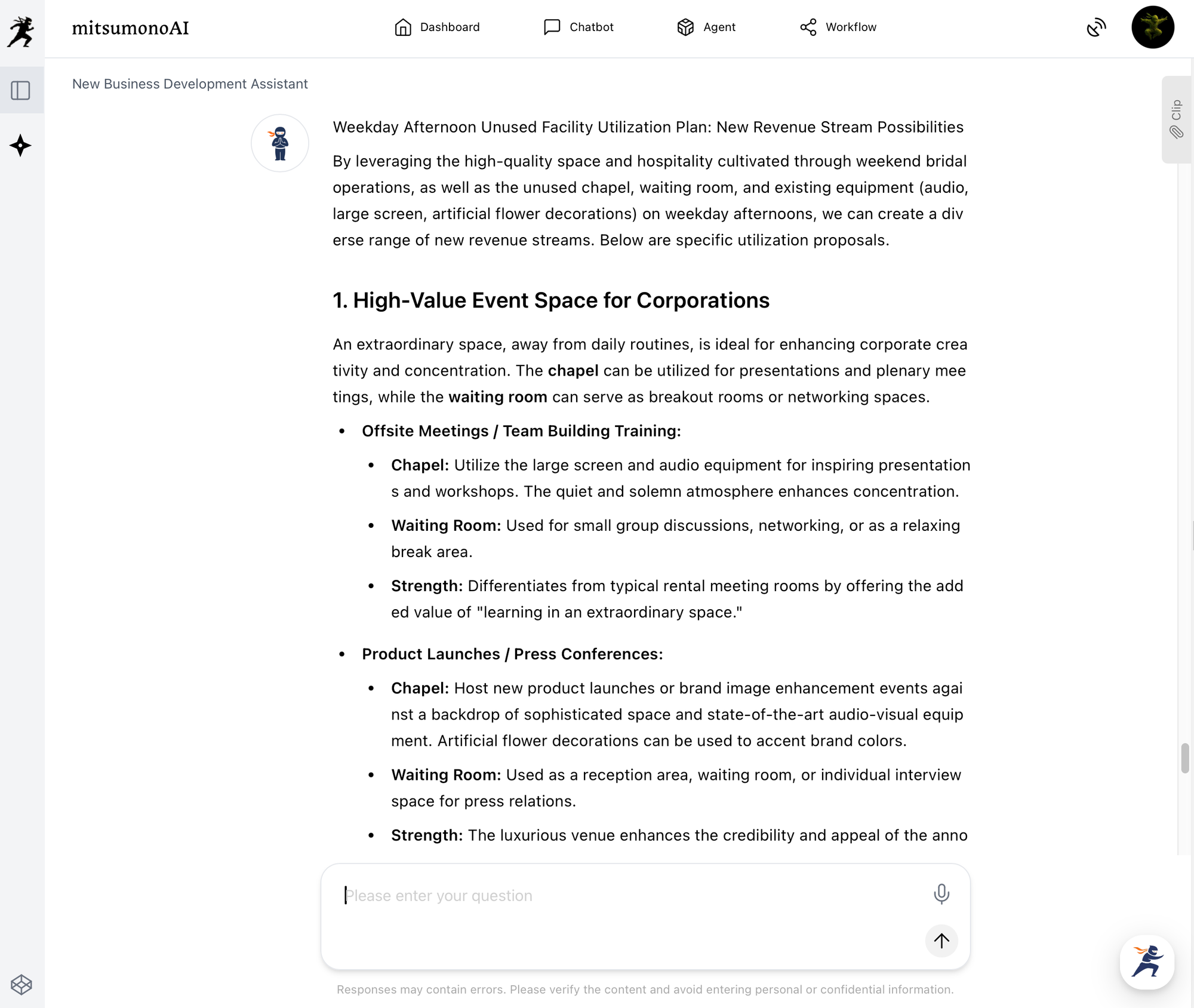
To customize these ideas according to the actual operational situation, you interactively provide information to the AI as follows:
Prompt Example:
"We have an unused chapel and waiting room on weekday afternoons. We can also use audio equipment, a large screen, and artificial flower decorations. We want to leverage this free time and equipment to develop a new revenue plan for weekdays. What kinds of uses are possible?"
4. Specifying and Executing the "Limited-time Pop-up Photo Studio" Plan
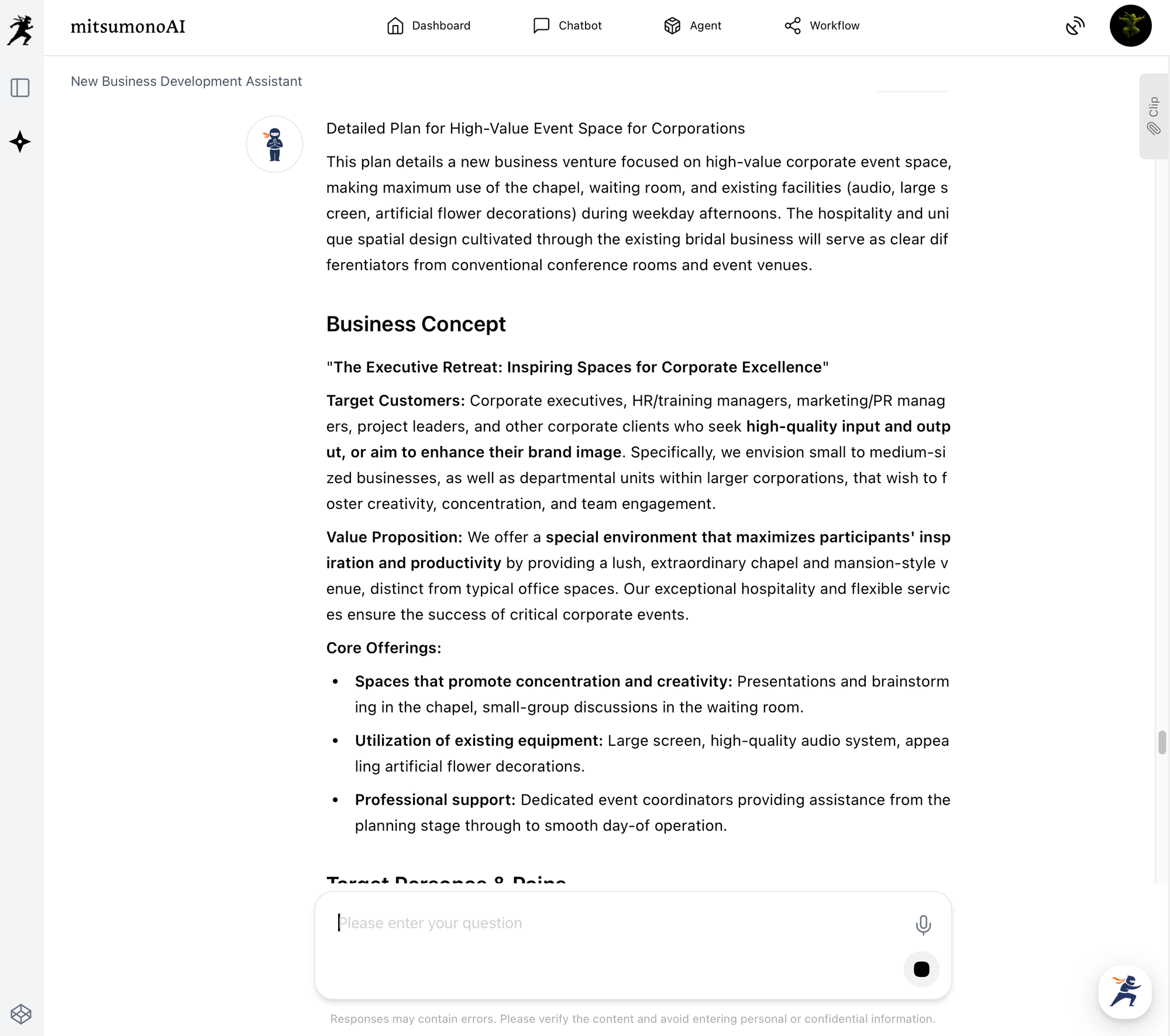
Among the multiple proposals, the "High-Value Event Space for Corporations" plan is suitable for weekday use and easily allows for the repurposing of wedding-specific production equipment the facility owns, such as the chapel, artificial flower decorations, and large screen.
We will create a more detailed version of this plan.
Prompt Example:
"Please create a detailed plan for High-Value Event Space for Corporations."
Even after this, by communicating the on-site operational conditions, you can have the AI propose specific specifications, thereby refining the plan into an executable and attractive business proposal.
Prompt Example:
"The background set can only be changed once every three months. Please set up a themed project for each season."
"The chapel will be used as the main photography space, and the waiting room will be utilized as a changing/waiting area. We want to use audio production and the artificial flower arch to create a 'special feeling.'"
"Please assume an operational flow that can be managed with a minimal staff structure, allowing it to run only during weekday afternoons."
Target Outcomes Achieved Through Utilization (Reference Examples)
The "Limited-time Pop-up Photo Studio" will begin operation as a seasonal photography service that addresses needs such as Shichi-Go-San, graduation, school entrance, and end-of-life portraits. The goal is to raise awareness mainly among local residents and establish it as a new revenue stream for non-wedding days.
By redesigning it according to local needs, a model that generates revenue on weekdays and during the off-season will be established.
Target figures for the first six months of the initiative
KGI:
New Revenue from Non-Wedding Days: Average $1 million$ JPY per month
KPI:
- Inquiries for Non-Wedding Day Use: 30 per month
- Contracts for Non-Wedding Day Use: 10 per month (Average unit price: $100,000$ JPY per contract)
- Reach of Online Advertising: $500,000$ reach per month