Elevating Decision-Making Quality : How Product Managers Can Leverage AI as a Strategic Advisor
Learn how Product Managers (PMs) can drastically improve decision quality using AI. By utilizing high-performance models for risk analysis and logic checks, PMs can eliminate internal bias, focus on core tasks, and increase product success rates by treating AI as a strategic advisor.


Is that decision truly logical? Let AI eliminate your cognitive biases.
As a Product Manager, you are forced to make countless decisions every single day. Prioritizing new features, determining the validity of pricing, and timing market entry—each of these judgments determines the success or failure of your product.
However, have you ever felt a lingering anxiety, wondering, "Is this truly the best path?" or "Am I being too influenced by internal politics or my own past experiences?"
By leveraging mitsumonoAI’s advanced models—such as GPT-5.1 Thinking and Claude Opus 4.5 Thinking—you can effectively eliminate these "decision-making biases." By utilizing AI not just as a "text generator" but as a "strategic advisor" that identifies logical contradictions and analyzes latent risks, PMs can make more objective, high-precision decisions.
Practice: Steps to Enhance Decision Quality with a Strategic AI Advisor
Step 1: Requesting a "Logical Contradiction" Check
First, provide the AI with the background information for the decision you want to verify (product status, market analysis, proposed plan, etc.). Include keywords like "objectively," "logical contradictions," and "risks" to guide the AI toward a critical analysis rather than a simple summary.
For testing logical consistency, choose "GPT-5.1 Thinking" or similar models capable of deep reasoning.
However, if your product is in a specialized field that requires consideration of specific regulations or business customs—such as medical, legal, real estate, or food services—we recommend selecting "Sensei AI" (e.g., Sensei AI - Medical, Sensei AI - Professional Services).
This ensures you receive sharp feedback grounded in the realities of your specific industry.
"Please point out any 'logical contradictions,' 'potential risks,' or 'weaknesses in data-driven evidence' regarding the following product strategy. There is no need to sugarcoat your feedback or worry about my feelings.
[Product Strategy Proposal]
(Describe the outline of the strategy you wish to verify here.)"
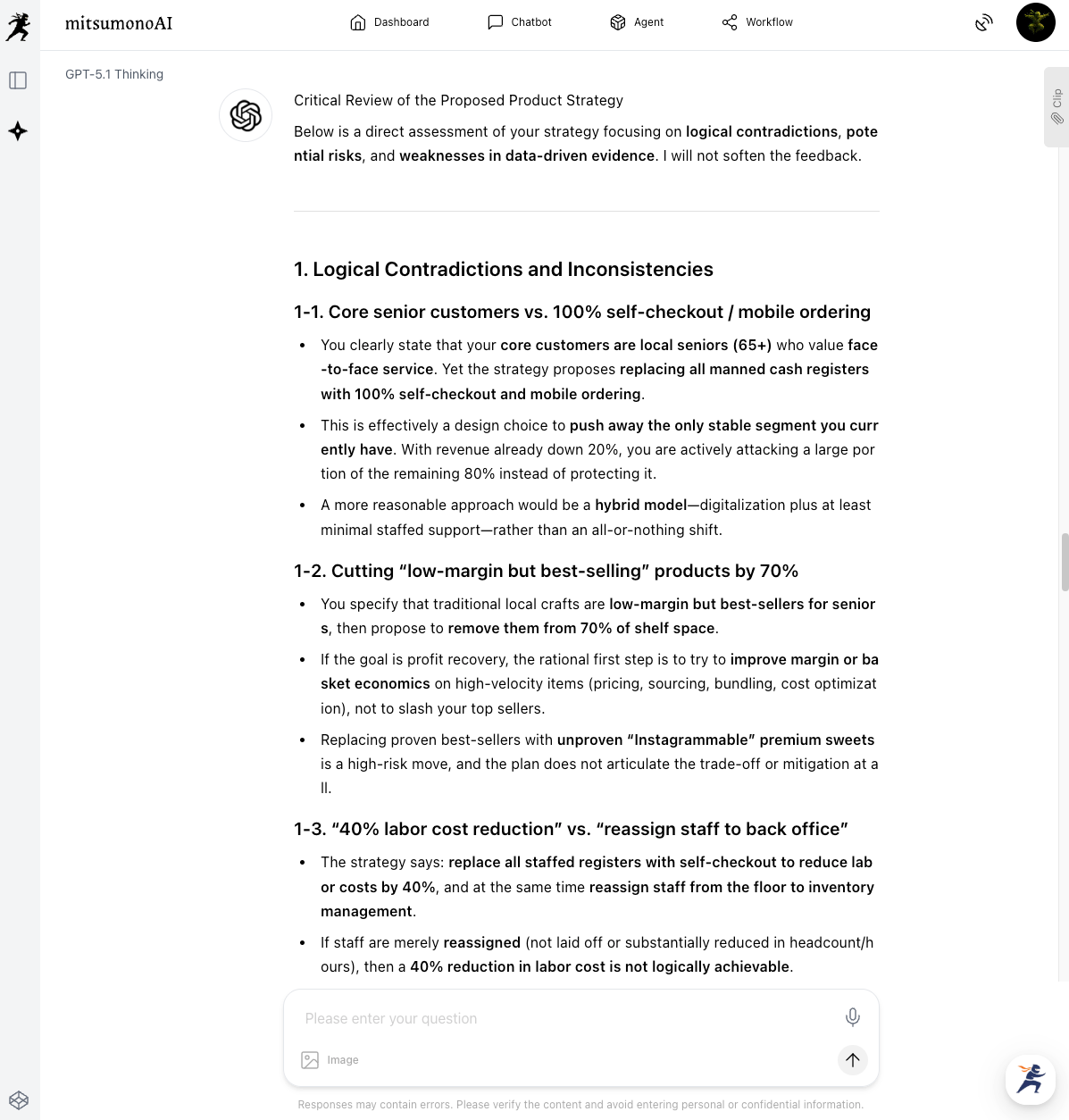
Step 2: Dialogue to Derive Actionable "Counterproposals"
Do not simply read the AI's harsh critique and stop there. After accepting the feedback, have the AI brainstorm constructive alternatives (pivot plans). Ask: "How can we achieve the objective while avoiding these risks?" This is the true value of using AI as a sounding board.
"Thank you for the sharp critique. Now, without changing my original goal of 'compensating for the revenue decline at the station-side shop and rebuilding the profit structure,' please propose three realistic alternatives (pivot plans) that resolve the risks you pointed out.
Conditions:
1.Do not abandon the existing customer base (seniors).
2.Do not place an excessive burden on on-site staff.
3.Keep initial investment low."
Instead of just telling the AI to "fix it," redefine the "constraints" and the "ultimate goal." This allows the AI to provide "usable strategies" rather than empty theories.
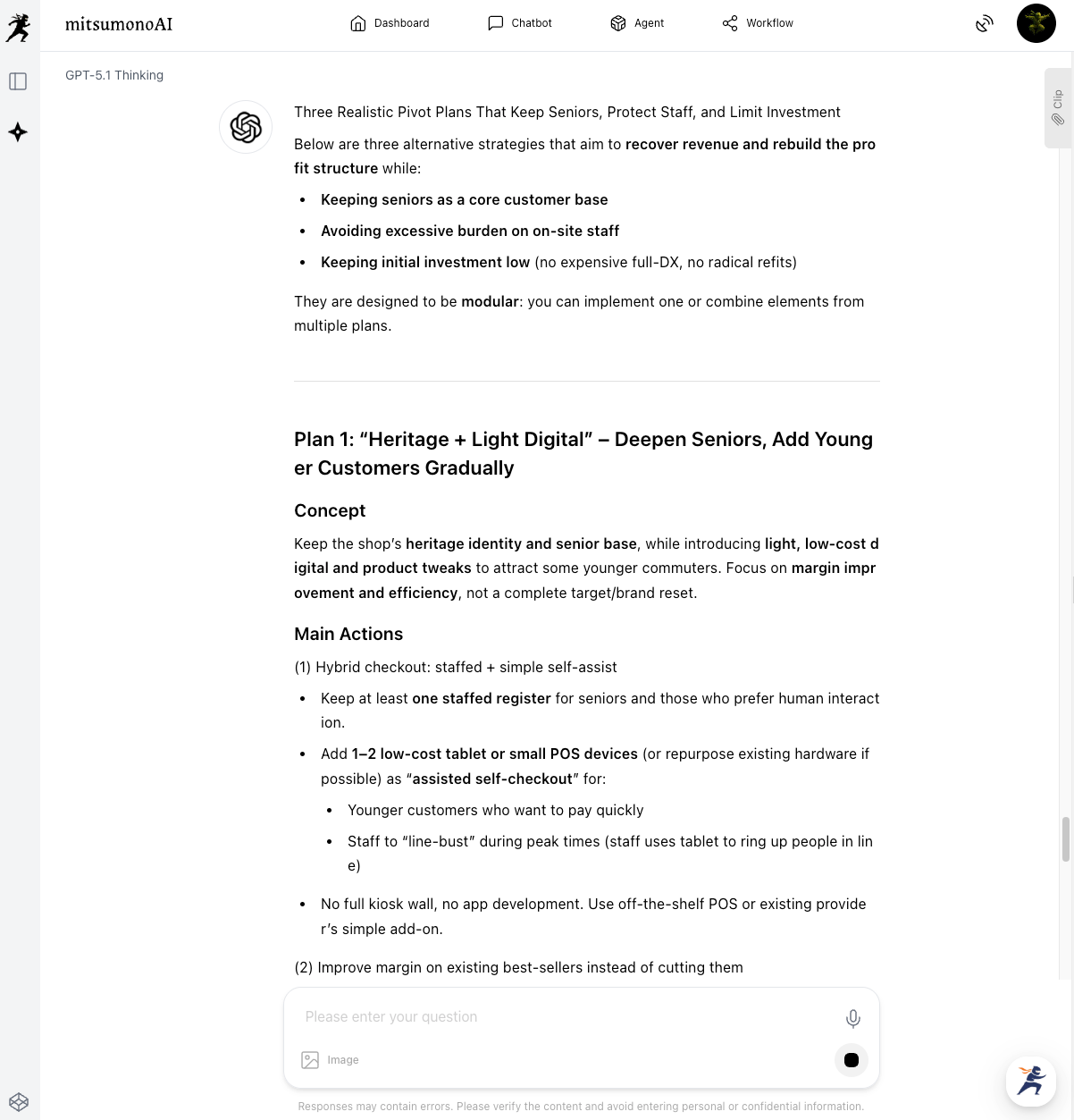
By having these options presented, you (the PM) can make the final decision (Human-in-the-Loop or HITL) on "which mountain to climb" with far greater confidence.
Step 3: Resolving Process "Flaws" Through AI Features
AI integration helps eliminate common flaws in the decision-making process.
- Flaw 1 (Information Delays via Manual Processes):
By linking professional tools like the "Pricing Strategy Analysis Assistant," you can quickly reference relevant data and increase analysis accuracy. - Flaw 2 (Reliance on Mediocre Drafts):
Having the AI identify logical gaps and latent risks moves the workflow beyond simple drafting and into high-level decision support. - Flaw 3 (Lack of Execution):
Based on the risk-mitigation measures and improvement suggestions generated by the AI, PMs can immediately translate strategy into a concrete action plan.
Expansion: Application to Other Tasks
- Risk Assessment and Compliance Checks:
For decisions involving legal or ethical risks—such as releasing new features or changing Terms of Service—you can have the AI predict "potential compliance violations" or "user backlash" to implement preemptive measures. - Deepening Market Research:
By asking the AI to analyze market research reports, you can extract insights that humans often overlook, such as "competitor weaknesses" or "untapped needs," allowing for a more effective product strategy.
Summary: Wiser Decisions, Powered by AI
- By using AI for "logical contradiction checks" and "risk analysis," you can eliminate human bias and increase objectivity in your decision-making.
- By mastering high-performance AI models as strategic advisors, PMs can focus on essential tasks and increase the probability of product success.
Start by presenting your current "decision-making dilemma" to the AI.
mitsumonoAI is not just for PM decision support; it is a platform designed to solve diverse business challenges, improve operational efficiency, and create new value.
Other use cases and the latest information can be found on the mitsumonoAI blog site.