Preventing Early Turnover: AI-Proposed "Effective Questions" and Method for Developing Objective Evaluation Criteria
Leveraging a Persona Creation Assistant and AI-suggested interview questions, this article explains how to define ideal talent and objectively assess candidates' digital literacy and adaptability to acquire high-retention, immediately productive personnel.


Using the tool:
- Persona Creation Assistant
Preventing Hiring Mismatches with AI
Are you experiencing hiring mismatches and subsequent turnover due to vague evaluation criteria in your interviews? If your ideal candidate profile is unclear and you are hiring based on intuition, it could lead to early turnover, delays in staff becoming fully productive, and even a decrease in the overall productivity of your organization.
This article will explain a concrete procedure for establishing non-subjective, scientific hiring standards by utilizing the "Persona Creation Assistant" to specifically define the ideal candidate profile and then having the AI propose interview questions and objective evaluation criteria. Let's aim to hire highly productive talent with minimal mismatches by leveraging AI.
Concrete Procedure
Step 1: Register the Mission
▶︎Add Mission
First, register a recruitment mission aimed at clarifying your ideal personnel. The subsequent persona creation and proposed interview questions will be based on the information in this mission.
Item | Example Input |
Mission Name | [HR/Recruitment] Acquisition and Retention of Highly Productive Front-Line Personnel |
Mission/Vision | To fuse the "traditional spirit of hospitality" with "digital technology for efficiency," providing customers with a step ahead in comfort and inspiration. All staff will pursue continuously evolving services by enjoying the acquisition of new knowledge. |
purpose | To reduce the early turnover rate due to post-hiring mismatches by 50% and secure personnel who can immediately adapt to new reservation and check-in systems. |
Target | Candidates in their late 20s to early 30s with customer service experience and low resistance to new technologies and tools. |
Core Message/USP (Unique Value Proposition) | Actively utilizing tools for operational efficiency and contributing to service improvement based on data, not just personal experience. Possessing both digital adaptability and hospitality. |
Step 2: Create a Persona of the Ideal Candidate
▶︎Persona Creation Assistant
To create an ideal front-line staff persona using the "Persona Creation Assistant," select the mission registered in Step 1 and click "Create."
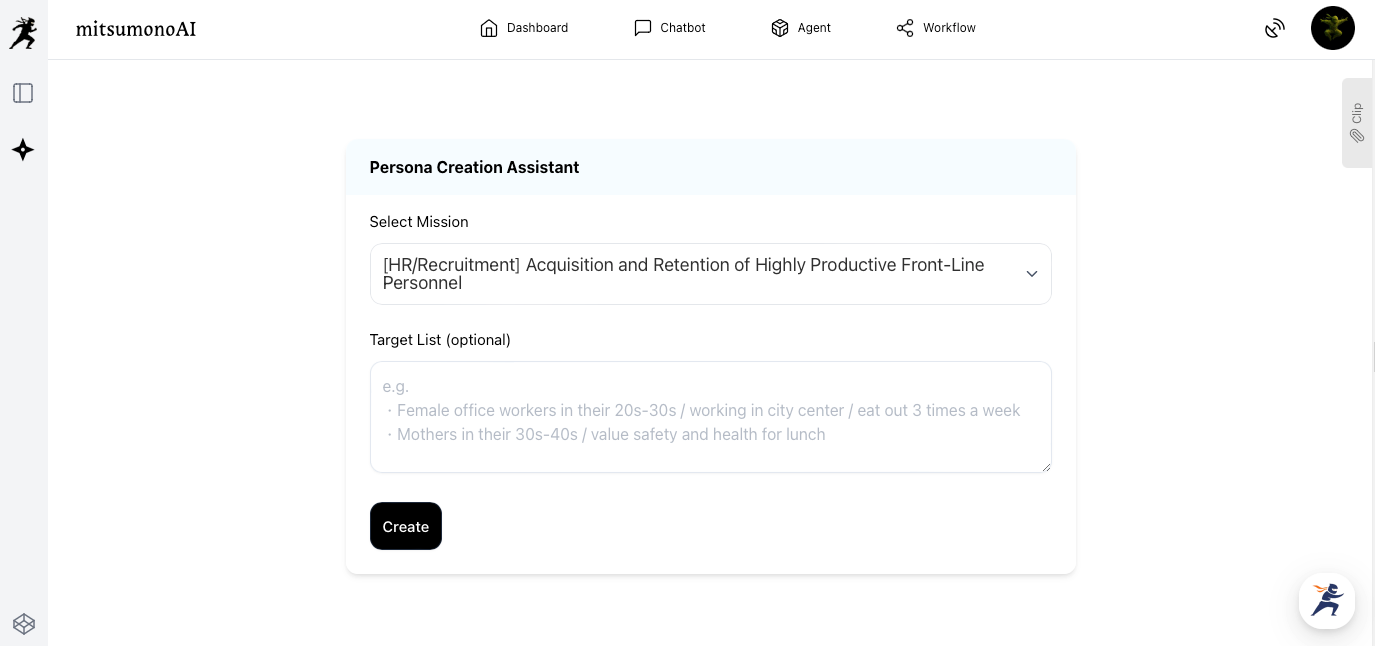
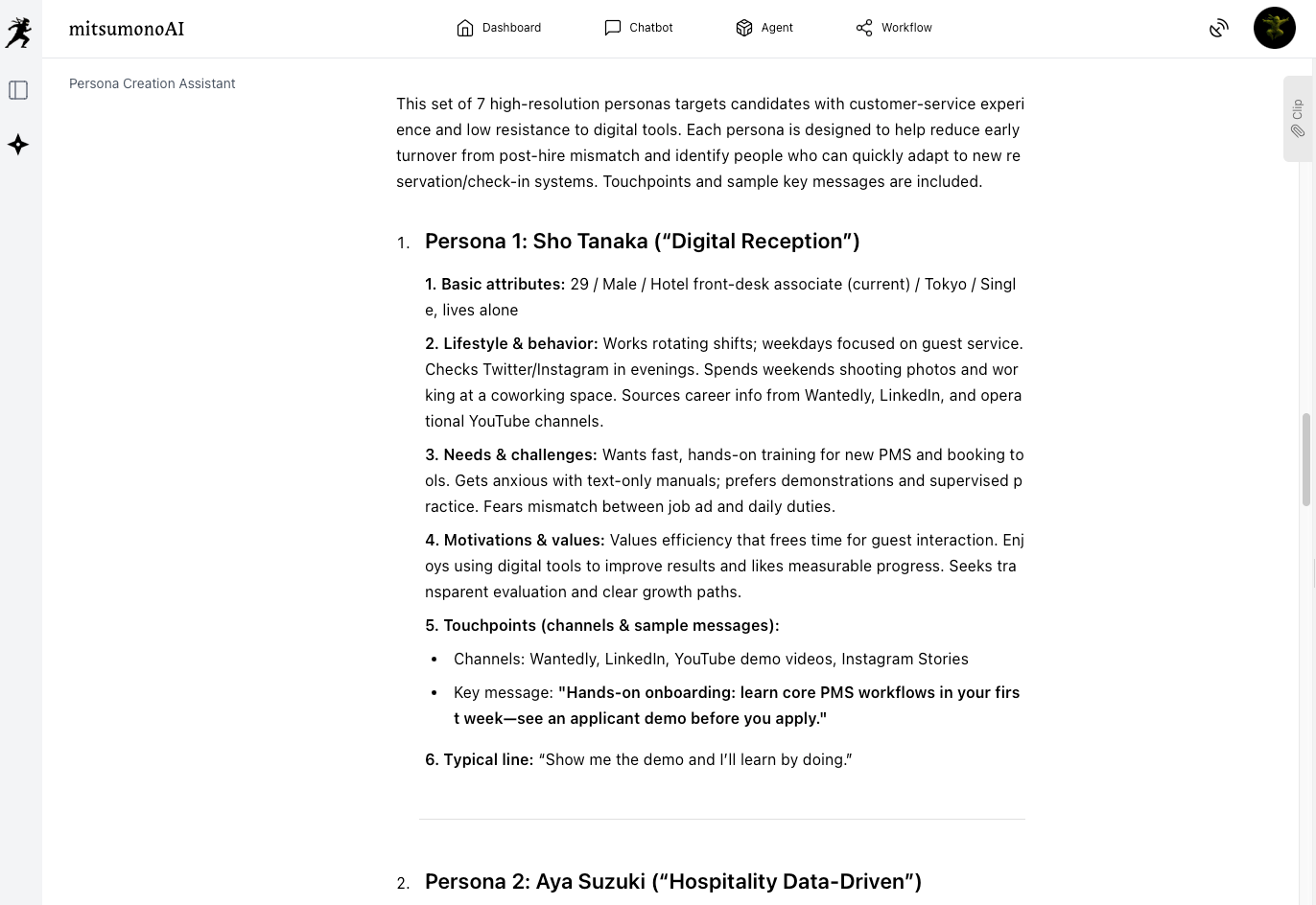
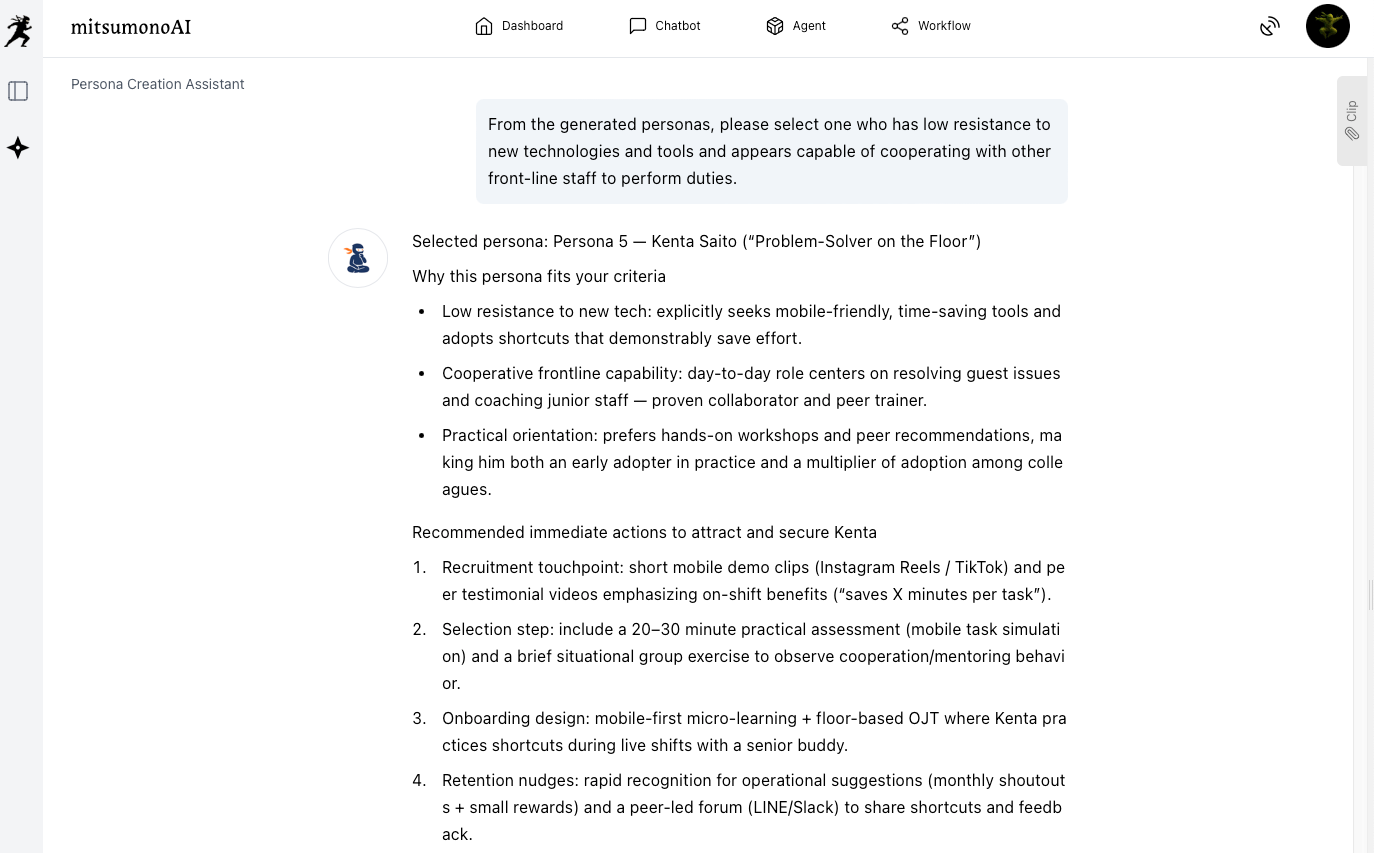
Once the persona list is generated, select the one persona considered most ideal for a front-line staff member. Alternatively, you can instruct the AI to make the selection.
for example:
"From the generated personas, please select one who has low resistance to new technologies and tools and appears capable of cooperating with other front-line staff to perform duties."
Step 3: Propose Interview Questions and Objective Evaluation Criteria to Measure Candidate Digital Literacy
▶︎Persona Creation Assistant (Continuation)
Based on the persona created in Step 2, you will have the AI propose interview questions and corresponding objective evaluation criteria. This is where you can generate questions to assess the candidate's digital literacy and suitability for the job.
Instructional Prompt (Example):
"To assess whether the candidate matches that persona in the interview, please propose interview questions to measure the candidate's digital literacy and adaptability to new tools, along with objective evaluation criteria for each question.Please present specific interview questions to evaluate these elements, along with the evaluation standards for each question (e.g., high rating if ** is possible, bonus points for ** experience, etc.).
- Digital Tool Usage Experience: Utilization of smartphone apps, understanding of online reservation systems, etc.
- Willingness to Learn and Adaptability: Motivation to learn new systems or tools and past experience.
- Problem-Solving Ability: Experience in troubleshooting in a digital environment, etc.
- Ability to collaborate smoothly with staff who are less comfortable with digital tools."
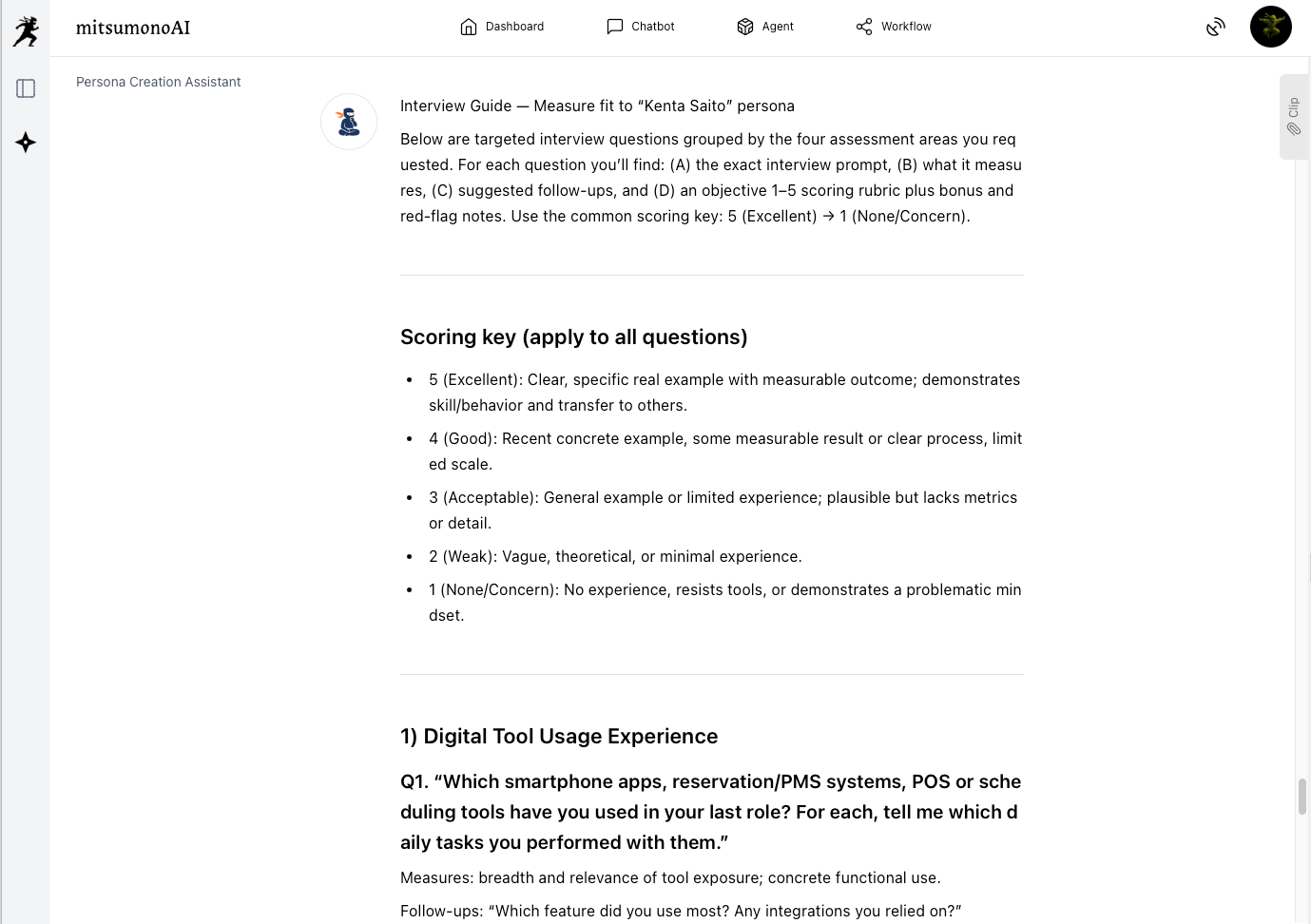
Using the proposed interview questions and evaluation criteria as a reference, you can then internally discuss and finalize your hiring standards, and create your interview and evaluation sheets.
Step 4: Optimize and Utilize Interview Questions and Evaluation Criteria in Actual Interviews
By using the interview process and evaluation criteria optimized based on the AI's proposal, you can move away from subjective, person-dependent evaluation and achieve a data-driven, scientific approach to hiring.
Specific Usage
- Creation of Interview Sheets: Create interview sheets based on the questions and evaluation criteria developed in Step 3, optimizing them to match the current situation. The evaluation criteria should be described by linking them to specific behaviors and responses for each item, allowing interviewers to evaluate objectively.
- Sharing with Interviewers: Share the created interview sheets and evaluation criteria with all personnel responsible for interviews to establish a common understanding, thereby minimizing variations in evaluation among interviewers.
- Utilization in Actual Interviews: During interviews, ask questions following the prepared interview sheet and evaluate candidates based on the established criteria. Questions regarding digital literacy should be probed in depth, focusing on specific tool usage experience and adaptation to new technology.
- Recording and Analysis of Evaluation Results: Always record the evaluations obtained during the interview and compare the opinions of multiple interviewers before making a hiring decision. Additionally, periodically review the effectiveness of the hiring standards by comparing them with the performance of hired staff.
In this way, you can reduce the risk of hiring mismatches and find candidates who better align with your desired profile.
Results Achieved Through Utilization (Example)
- Reduction of Hiring Mismatches and Improvement in Retention Rate: The clarification of the ideal candidate profile and the introduction of objective evaluation criteria reduce post-hiring mismatches, leading to the securing of personnel with high retention rates.
- Efficiency and Standardization of the Hiring Process: Leveraging AI streamlines the creation of interview questions and the unification of evaluation criteria, leading to the standardization and quality improvement of the entire hiring process.
- Data-Driven Recruitment Activities: By conducting recruitment activities based on objective analysis and proposals from AI, rather than relying on subjective intuition, it becomes possible to acquire personnel more effectively and with fewer mismatches.
Target Metrics One Year After Introduction and Recruitment
- KGI (Key Goal Indicator):
- Early turnover rate due to post-hiring mismatch: 50% reduction
- KPI (Key Performance Indicators):
- Average digital literacy evaluation score of hired candidates: 80 points or higher
- Recruitment process satisfaction based on hiring staff surveys: 15% improvement
Summary
AI proposes objective evaluation criteria based on the ideal candidate profile and the company's mission, significantly reducing the risk of post-hiring mismatches.
If you are looking to prevent early turnover and efficiently find personnel who will become valuable assets, we encourage you to consider this AI-driven, "scientific hiring approach based on personas."