Identifying Gaps in Customer Expectations with AI | Using High-Speed Analysis of Accommodation Reviews to Improve Service
A new standard for efficiently gaining objective and comprehensive customer insights. This article explains how to use AI to analyze vast amounts of online reviews, visualize the gap between "customer expectations" and "actual experience," and take practical steps to improve your service.


Three Reasons Why It’s Hard to Meet Customer Expectations
Despite your best efforts to create new menus and improve service quality, a "gap" often develops between what customers truly want and what you provide. This happens for three main reasons:
- Too much review data
Customer feedback is scattered across too many platforms in massive volumes. Whether it’s Google Maps, social media, or various booking sites, trying to listen to every individual voice manually makes it nearly impossible to grasp the full picture. - Unconscious "assumptions": Passion can narrow your vision
While it is important to take pride in your service, strong passion can lead to the unconscious assumption that "customers must feel the same way I do." These subjective expectations often cause you to overlook the improvements that are actually needed. - The long road from "feedback" to "improvement"
Identifying a problem in a review doesn't always lead directly to a solution. Moving from a comment like "the service was a bit disappointing" to an actionable plan—determining which staff member should take what action at what timing—requires deep insight and analytical skill.
The Impact of AI-Powered Review Analysis
By using AI for review analysis, you can immediately solve challenges that are impossible to handle manually.
- Solving "Too much data": Automated aggregation and high-speed analysis
Using Natural Language Processing (NLP), AI processes massive amounts of reviews from multiple sites simultaneously. It completes manual analysis that would take hours in just a few minutes, making it possible to grasp the entire dataset for the first time. - Eliminating "assumptions": Statistical objectivity
AI quantifies and visualizes trends across all reviews without being influenced by personal bias or emotion. Instead of the creator’s expectations, a clear image of the customer emerges based on actual data. - Moving from "feedback" to "improvement": Inferring cause and effect
Rather than just tallying numbers, AI identifies common issues across multiple feedback patterns and infers the underlying root causes. It turns abstract criticism into concrete, actionable steps.
[Practical Steps] Analyzing the "Gap Between Expectation and Reality" with AI
Using a local hotel as an example, here is the procedure for identifying service gaps using the "Review Analysis Assistant."
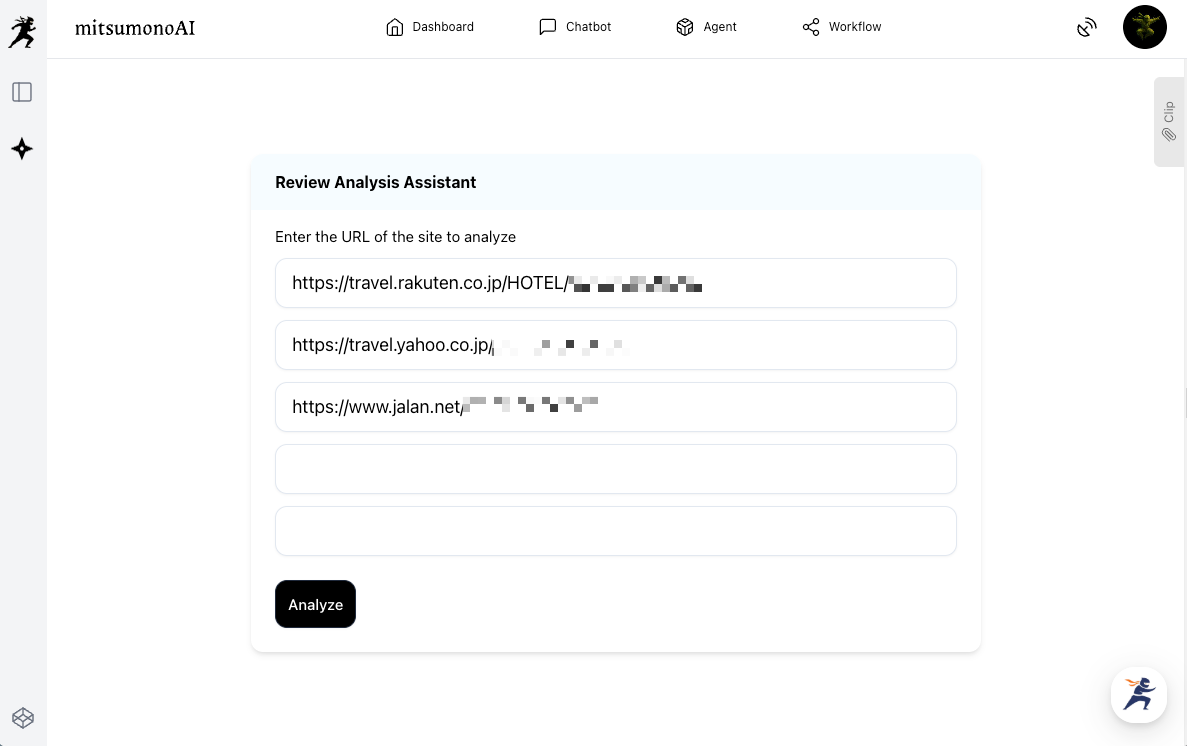
Step 1: Enter the target URLs into the Review Analysis Assistant
First, enter the URLs of the sites where your hotel’s reviews are posted into the "Review Analysis Assistant" and click "Analyze." You can input multiple URLs at once for a more comprehensive analysis.
・Booking sites like Rakuten Travel, Jalan, or Ikyu.com
・Travel review sites like TripAdvisor, etc.
Step 2: Instruct the AI to analyze the "Gap between Expectation and Reality"
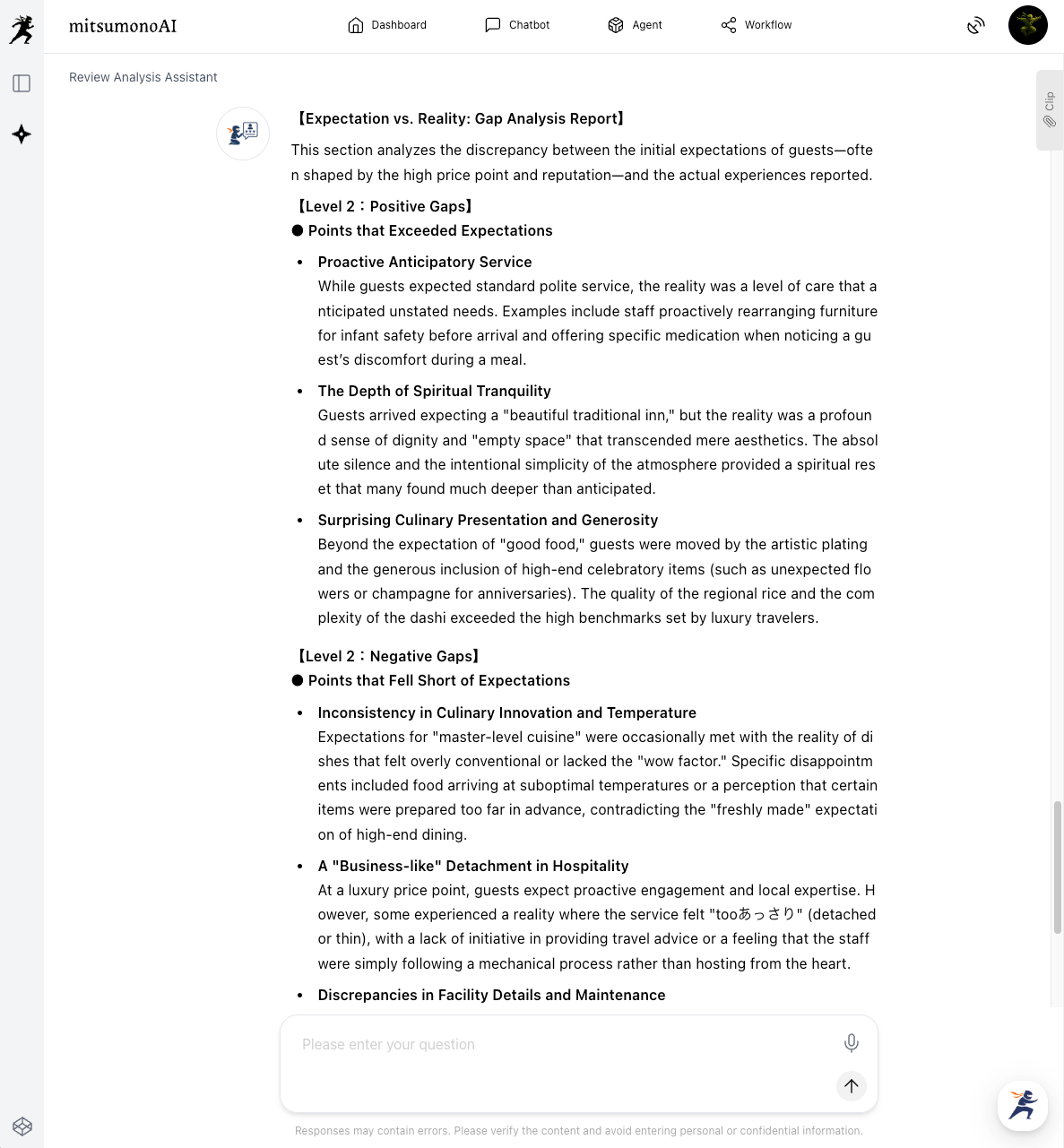
Next, give the AI the core instruction for the analysis. This is the most important step.
"Please specifically extract and analyze the gaps between the 'expectations' guests had before staying at our hotel and the 'reality' they experienced during their stay.
In particular, clearly separate 'positive gaps' (points that exceeded expectations) and 'negative gaps' (points that fell short of expectations), and report the top three representative examples for each in bullet points."
Step 3: Refine improvement actions through dialogue with AI
The value of AI is maximized when you don't just point out problems, but understand the root causes to implement real changes. In this case, we will dive deeper into the most serious "negative gap" found in the AI analysis.
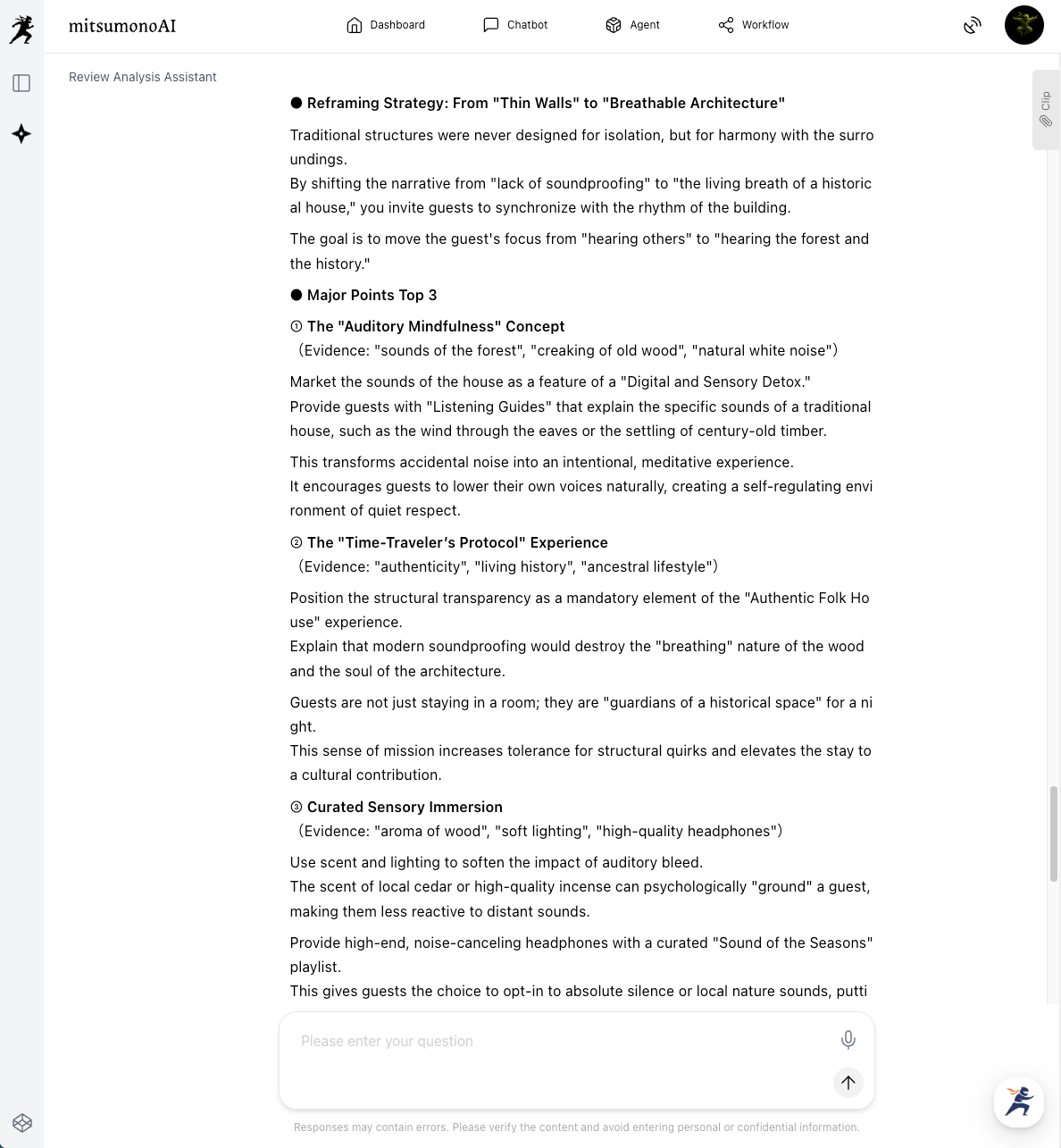
By engaging in a dialogue with the AI to turn challenges into opportunities, you can uncover practical and executable improvement measures.
✅ Checklist
AI analysis is not the goal in itself. The most important thing is to connect the objective data you've gained to specific improvement actions starting tomorrow. Aim to answer these five questions clearly as you dig deeper into your analysis results:
- Customer Expectations:
What was the primary thing guests were looking forward to before staying? (e.g., the view, the food, a special atmosphere) - Actual Value Provided:
What aspect of the value we actually provided was rated most highly? - The Largest Gap:
Where was the biggest "disconnect" between expectation and reality? - Identifying the Root Cause:
Why did that gap occur? What can we infer as the fundamental cause? - The Next Move:
What is the first specific action to take tomorrow to bridge that gap?
Summary: Leveraging the "Voice of the Customer" for Management through AI
This article introduced the steps to analyze the gap between customer expectations and reality using mitsumonoAI's "Review Analysis Assistant" to drive service improvements.
With AI, you can achieve:
- Objective analysis of vast review data
- Visualization of the "gaps" at the heart of the issues
- Development of actionable improvement plans
The "customer's voice," which used to be captured only by intuition, becomes a powerful guide for business growth. By sincerely addressing the "true feelings" of your guests, you can improve satisfaction and repeat rates, leading to sustainable growth.
mitsumonoAI can be used not only for the review analysis introduced here but also for solving various business challenges, improving operational efficiency, and creating new value.
For more use cases and the latest information, please visit our website.