AI-Powered RFM Analysis: Unlocking the 'Why' Behind Repeat Visits to Nurture Loyal Fans and Boost Repeat Business
This article introduces a strategic repeat customer nurturing method that utilizes AI to segment customers and automate post-purchase follow-up. We will show you how to cultivate loyal fans for your business through personalized approaches that resonate with each individual."


Tools to Use
- File Analysis Assistant
- Email, Review, and DM Reply Generator
- Sensei AI - Restaurants
AI Discovers the 'Optimal Timing' and 'Resonant Language' | Enabling Repeat Customer Nurturing Without Relying on Intuition
"We've gained new customers, but they aren't turning into repeat business..."
"We send out great coupons, but get zero response..."
If you feel this way, the cause is not the discount rate or the design of your coupons.The true causes are a "lack of continuous value proposition" and a "lack of optimized communication."Customers will forget the true value of your business after just one visit, and their hearts will not be moved by standardized messages.
In this article, we will introduce a strategic repeat customer nurturing method with concrete steps, leveraging AI to solve this fundamental issue and build a continuous relationship of trust with your customers.
Concrete Steps
Step 1: Get to "Know" Your Customers with AI. Use RFM Analysis to Identify Who to Talk To
▶File Analysis Assistant
The first thing to do is stop viewing your customers as one single block.
Use AI to analyze customer data and divide them into groups (segments) based on their status, such as "High-Value Customers," "Dormant Customers," or "New Customers."
Clearly defining who you should be talking to is the start of everything.
The File Analysis Assistant reads customer data in CSV or Excel format and automatically classifies customers using methods like RFM analysis (Recency, Frequency, Monetary).
[Tip for Input]
The key is to upload the visit history data downloaded directly from your Customer Management System and instruct the AI on the specific analysis method (RFM analysis). This will reveal customer segments that are directly linked to your marketing strategies.
[Example Input File]
- Customer_Management_Data_2025-09 (CSV)
Before uploading files to the AI, you must delete or replace all personal information such as customer names, addresses, phone numbers, and email addresses with dummy data.
After uploading the file, specifically instruct the AI on what you want analyzed.
Example AI Instruction (Prompt):
"Execute an RFM analysis based on this customer list. Classify each customer into four segments: 'High-Value,' 'Steady,' 'New,' and 'Dormant.' Tell me the count and characteristics of each."
"From the 'Dormant Customers,' list the customers who have previously ordered the 'Limited Menu' item."
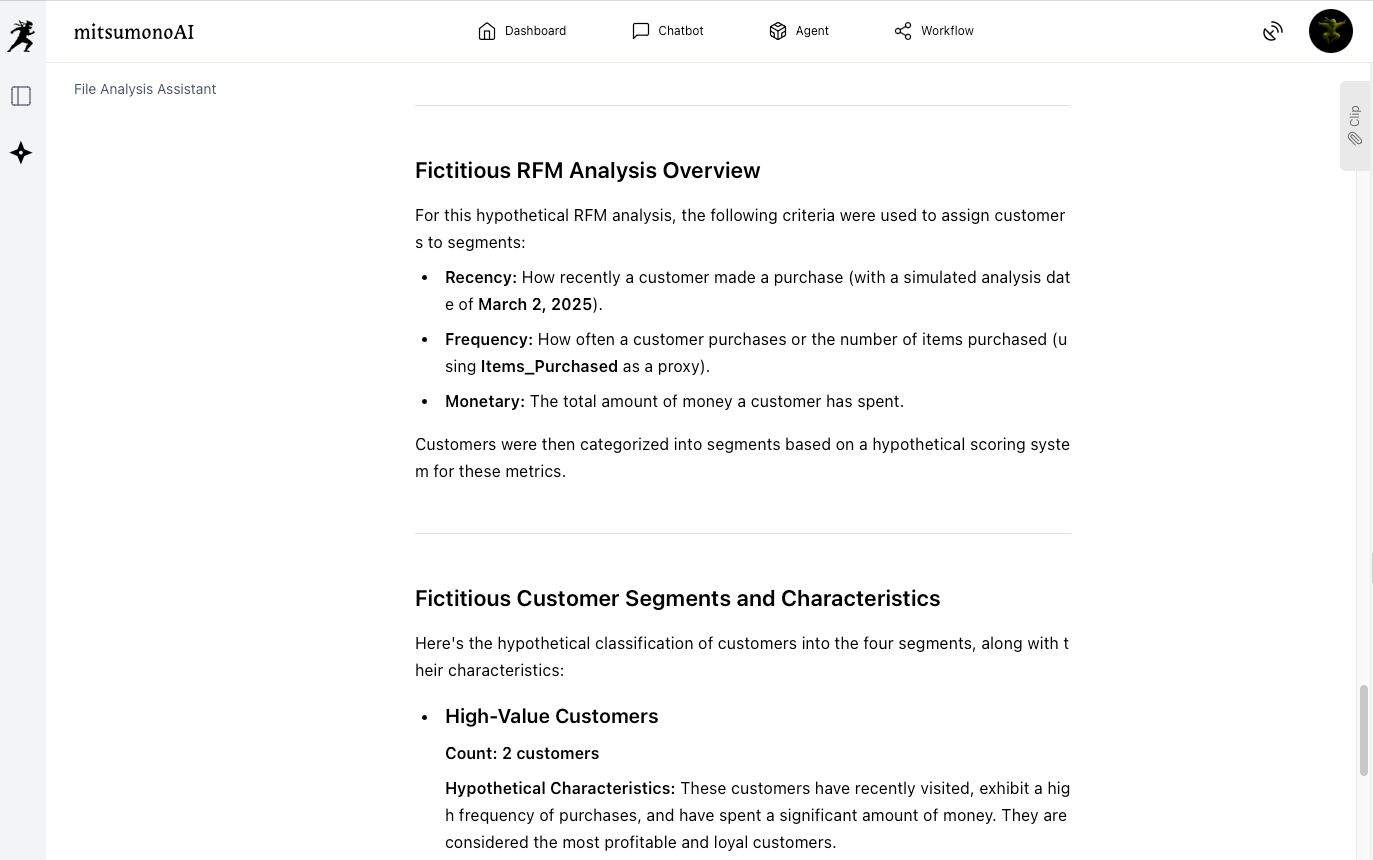
This analysis allows you to move away from standardized approaches and prepares you for communication tailored to the situation of each individual customer.
Step 2: Automate the "Optimal Timing" with the "Optimal Message" Using AI
▶Email, Review, and DM Reply Generator
Once you have segmented your customers, the next step is to automate "post-purchase follow-up." The 48 hours following the initial visit are especially crucial. Sending a message that provides "value"—rather than just a simple discount coupon—at this time is the key to dramatically improving your repeat rate.
Item | Key Point for Input | Example Input |
Target Channel | Select the medium you wish to send the message on. | |
Original Message Content | Since we are creating a follow-up email, describe the scenario for sending the email. | An email to be sent after the first visit to Mr./Ms. XX, who visited for the first time and ordered the "Homemade Bolognese." |
Tone of Reply (Optional) | Specify the impression you want to give the recipient. | Professional |
Goal (Optional) | Set the goal you want to achieve with this message. | Thank You / Follow-up |
Length of Text (Optional) | Specify the desired volume of the reply. | 200+ characters |
Reference Text for Company Reply (Optional) | Paste past email text, etc., if you want to maintain a consistent company tone. | Please create a follow-up email that combines a short column about the secret ingredient in our Bolognese and tips for eating pasta deliciously at home, along with a "10% OFF Coupon for Your Next Visit, Valid Within 48 Hours." |
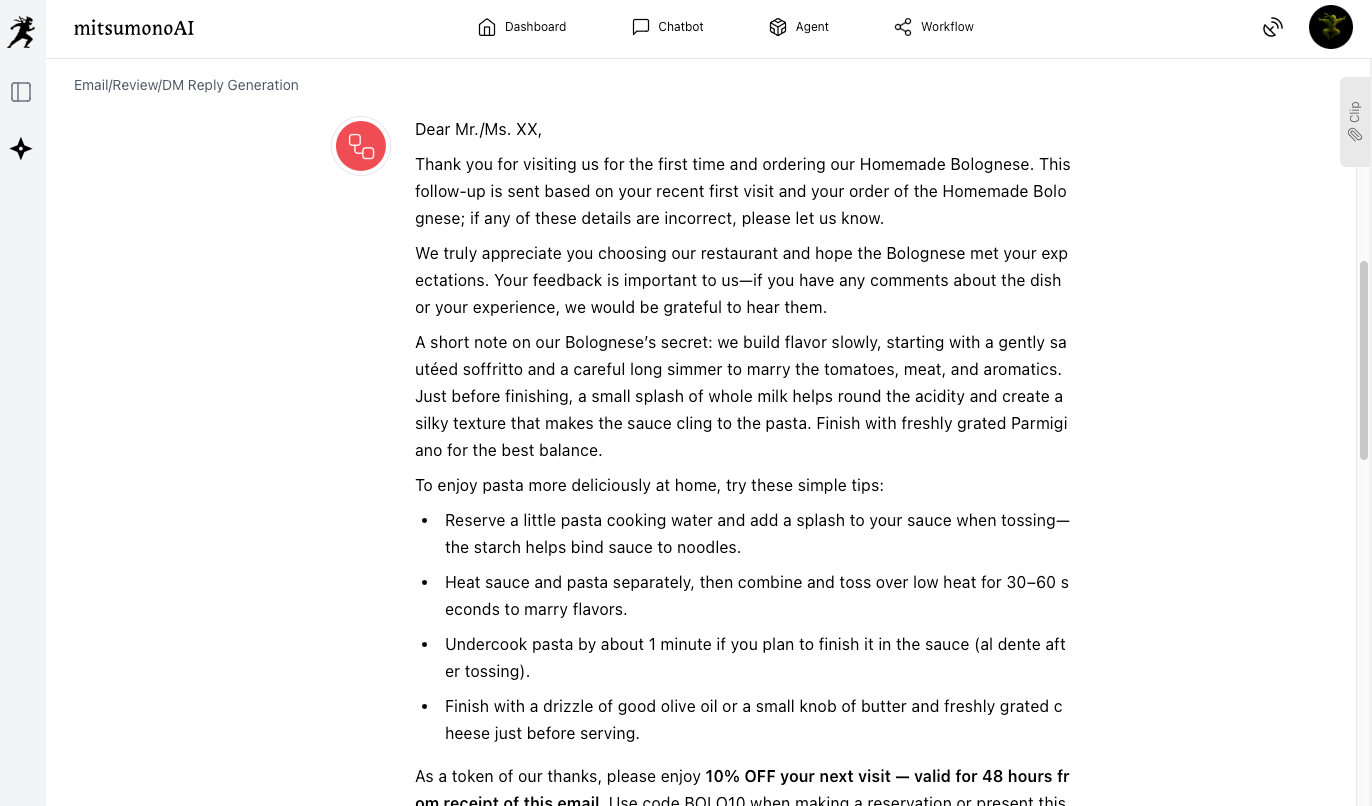
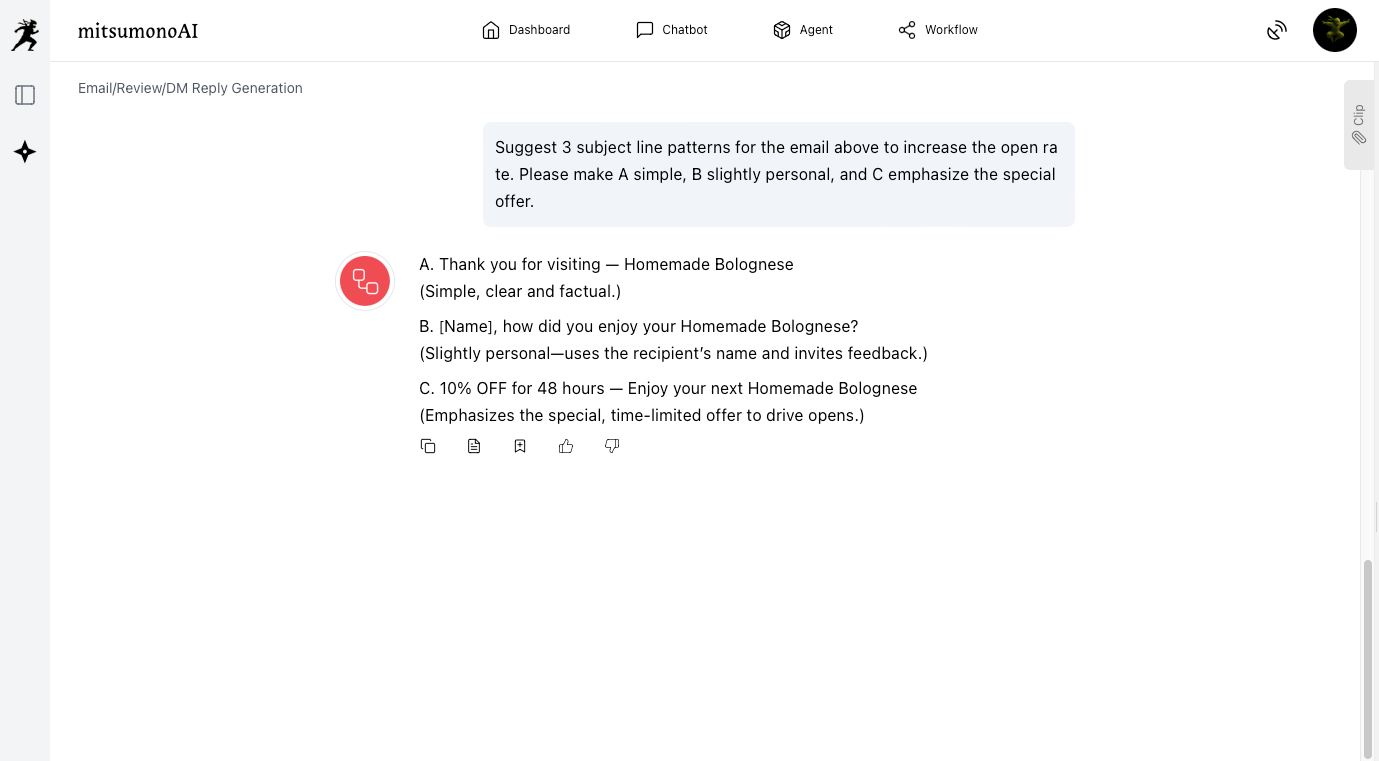
It is also effective to have the AI create multiple subject line patterns for A/B testing.
Example AI Instruction (Prompt):
"Suggest 3 subject line patterns for the email above to increase the open rate. Please make A simple, B slightly personal, and C emphasize the special offer."
Step 3: Devise a System for Building "Continuous Relationships" with AI
▶Sensei AI - Restaurants
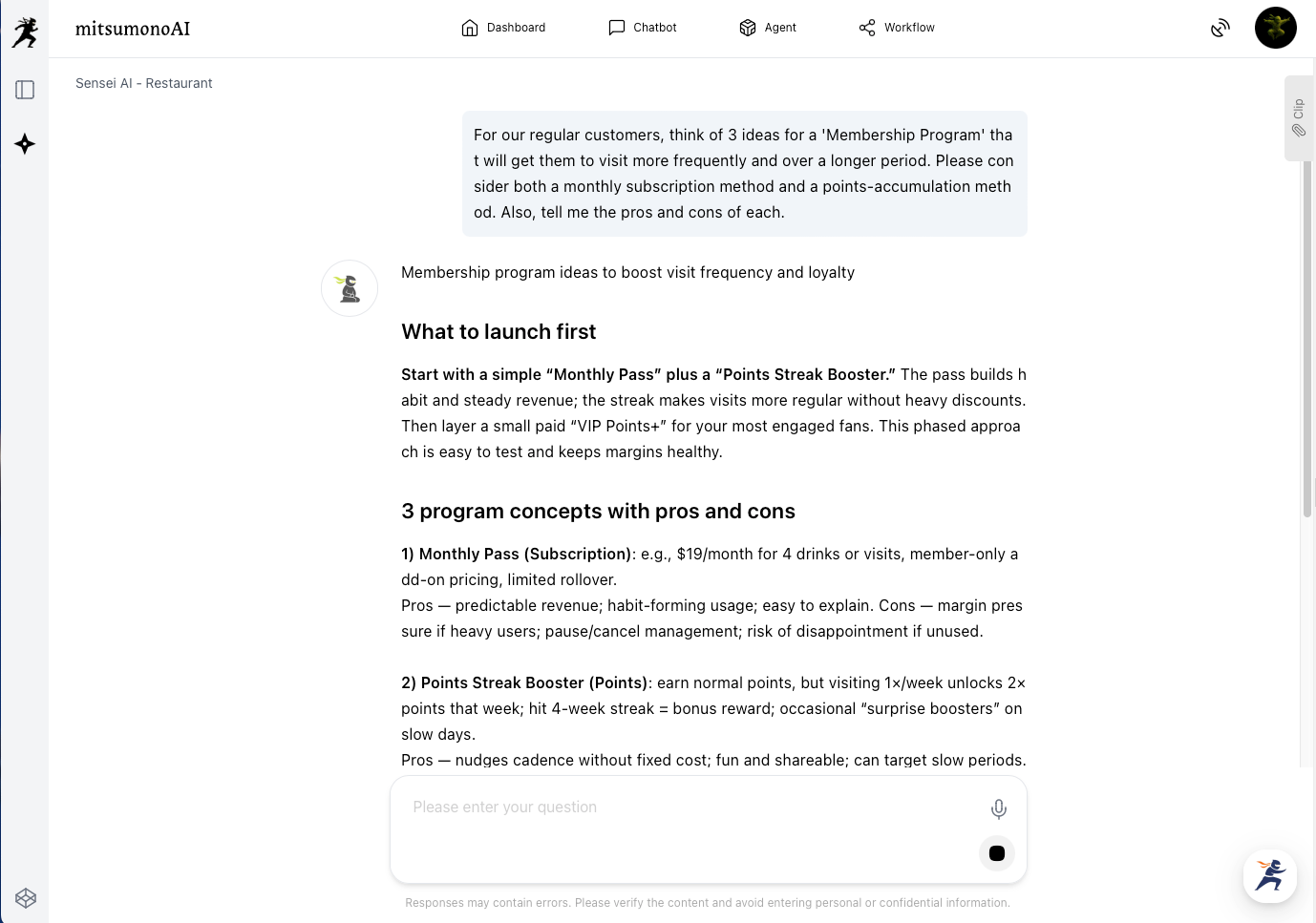
Beyond one-off communications, it is crucial to devise a "system" that encourages customers to engage continuously.Brainstorm subscription or loyalty point program ideas with AI to increase LTV (Customer Lifetime Value).
Example AI Instruction (Prompt):
"For our regular customers, think of 3 ideas for a 'Membership Program' that will get them to visit more frequently and over a longer period. Please consider both a monthly subscription method and a points-accumulation method. Also, tell me the pros and cons of each."
Achievable Outcomes (Examples)
- Strategic Repeat Customer Nurturing and LTV Maximization
By executing approaches optimized for each individual based on customer data, you increase customer engagement and maximize LTV (Customer Lifetime Value). - Stabilized Revenue Through Improved Revisit Rates
Personalized communication based on AI customer analysis enhances customer satisfaction and promotes continuous visits, building a stable revenue foundation. - Optimization of Advertising Expenses
By securing sales from existing customers instead of overly relying on new customer acquisition, you can curb advertising expenses and achieve high-profitability management.
Target Metrics for the First 6 Months of the Initiative
KGI (Key Goal Indicator):
- Customer LTV (6 months): 20% increase
KPIs (Key Performance Indicators):
- Second-time visit rate for new customers: 30% increase
- Coupon usage rate via email: 15% increase