A Guide to Creating a "20% Revenue Boost Strategy" with Sensei AI
Learn how to use "Sensei AI," an industry-specific AI tool, to develop concrete strategies for achieving a 20% revenue increase. Through a restaurant case study, we demonstrate how to transform real-time business data into a professional growth roadmap.


Tools Used
Sensei AI (Applicable to any industry; this guide uses a restaurant as an example)
Exploring Solutions for Management Challenges with an AI Consultant
As a business owner, strategic planning for growth is a constant priority. Especially for small to medium-sized businesses, many owners find themselves struggling alone with brainstorming and strategy development. Furthermore, the reality is that the high cost of professional consulting often makes it a difficult investment to justify.
In such situations, consider the option of using AI as your specialized consultant. This article introduces the process of using the industry-specific AI consultant "Sensei AI" to develop a concrete revenue-boosting strategy through a dialogue-like experience, using a restaurant as an example.
Identify solutions to management challenges through interaction with AI and create a clear path toward achieving your goals.
Specific Steps
Step 1: Consulting Sensei AI on Management Challenges
To start, treat Sensei AI as your strategic partner. Share your current goals and your business's unique strengths to set the foundation for a customized roadmap. Work together to develop a strategy aimed at the clear goal of a 20% revenue increase. First, send the following prompt to Sensei AI:
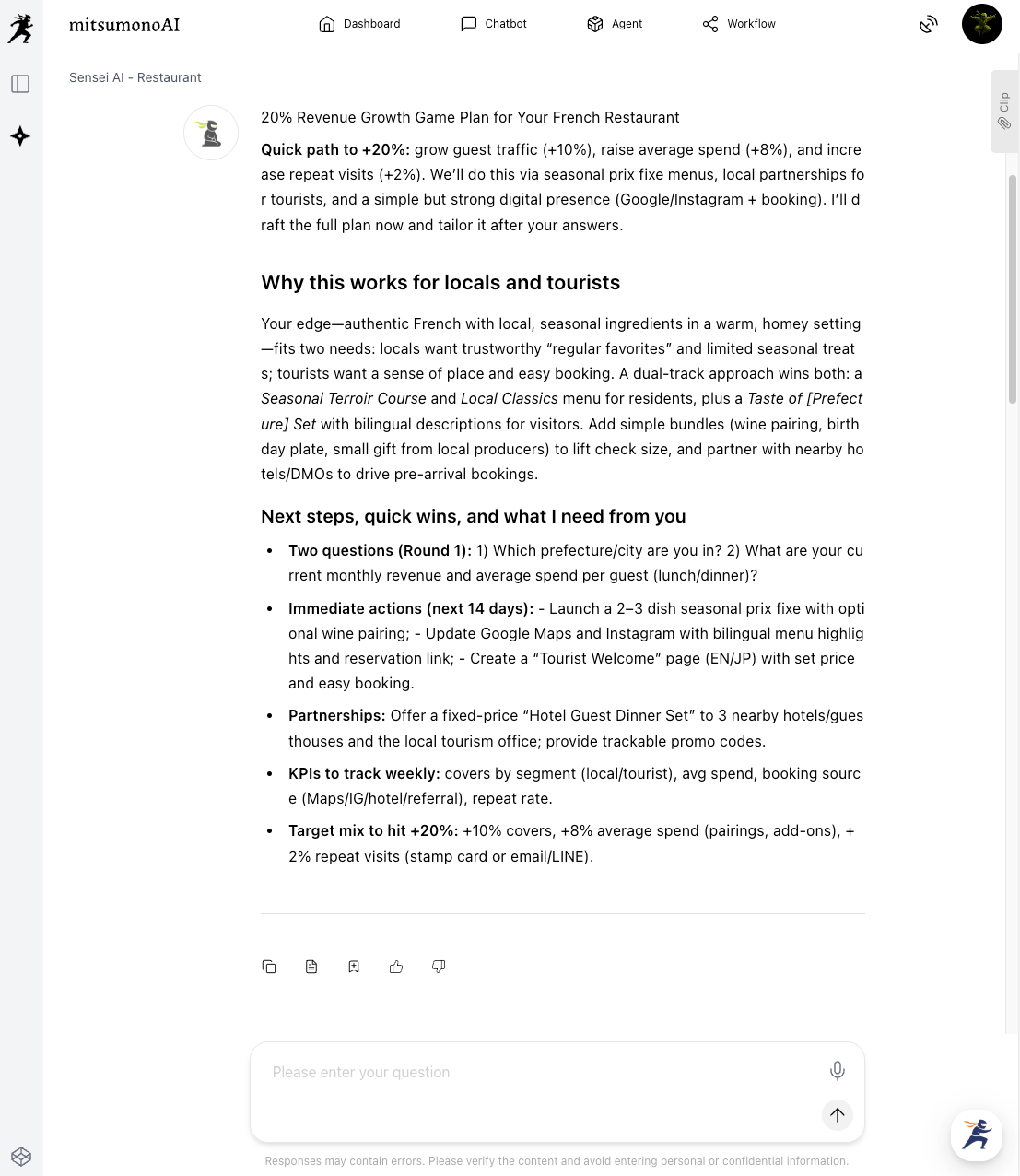
Step 2: Building the Strategy Through Dialogue
In this phase, providing concrete data is key. As you feed the AI specific numbers, the strategy transforms from a general idea into a surgical action plan.
During your interaction with Sensei AI, the more honest and detailed you are with your current figures, the more the AI can perform the "winning math" on your behalf.
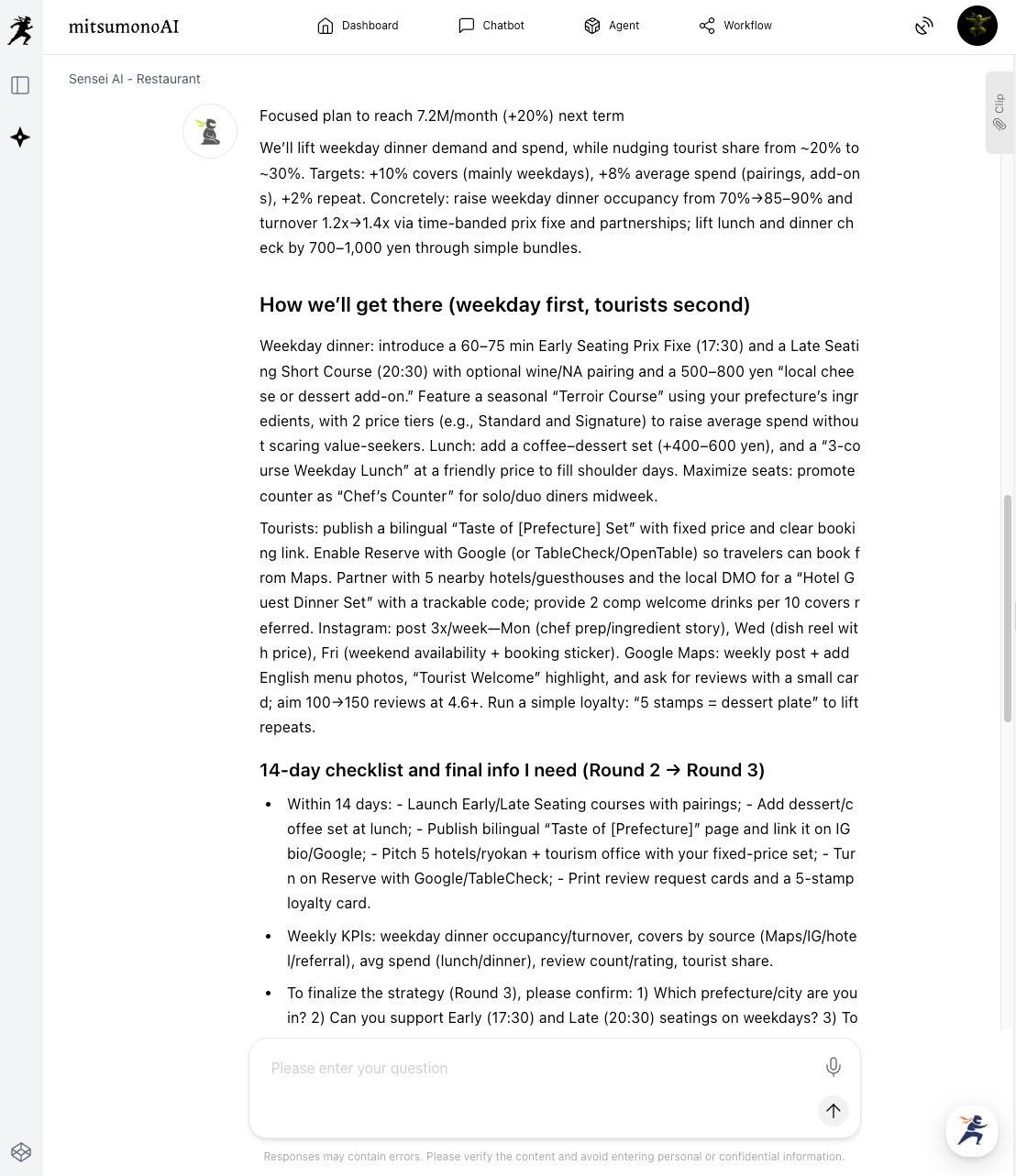
2.Monthly Average: Lunch approx. 450 guests, Dinner approx. 400 guests."
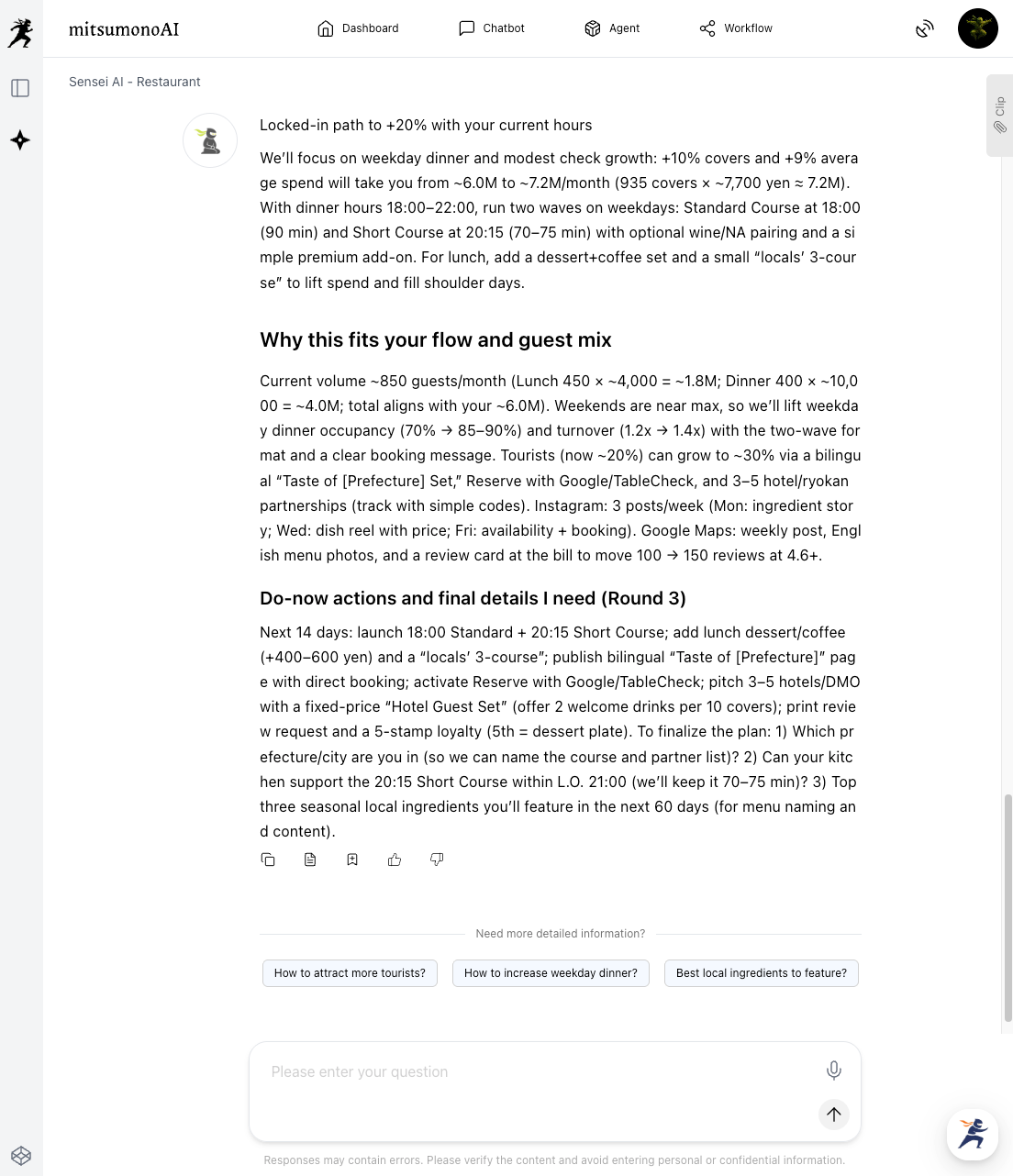
Step 3: Documenting the Strategy for Implementation
Since you need materials to share the strategy with staff and move toward implementation, instruct the AI to output the results in a document format.
Sensei AI will then organize the strategy into three main pillars and specific measures based on the analyzed strengths and challenges.
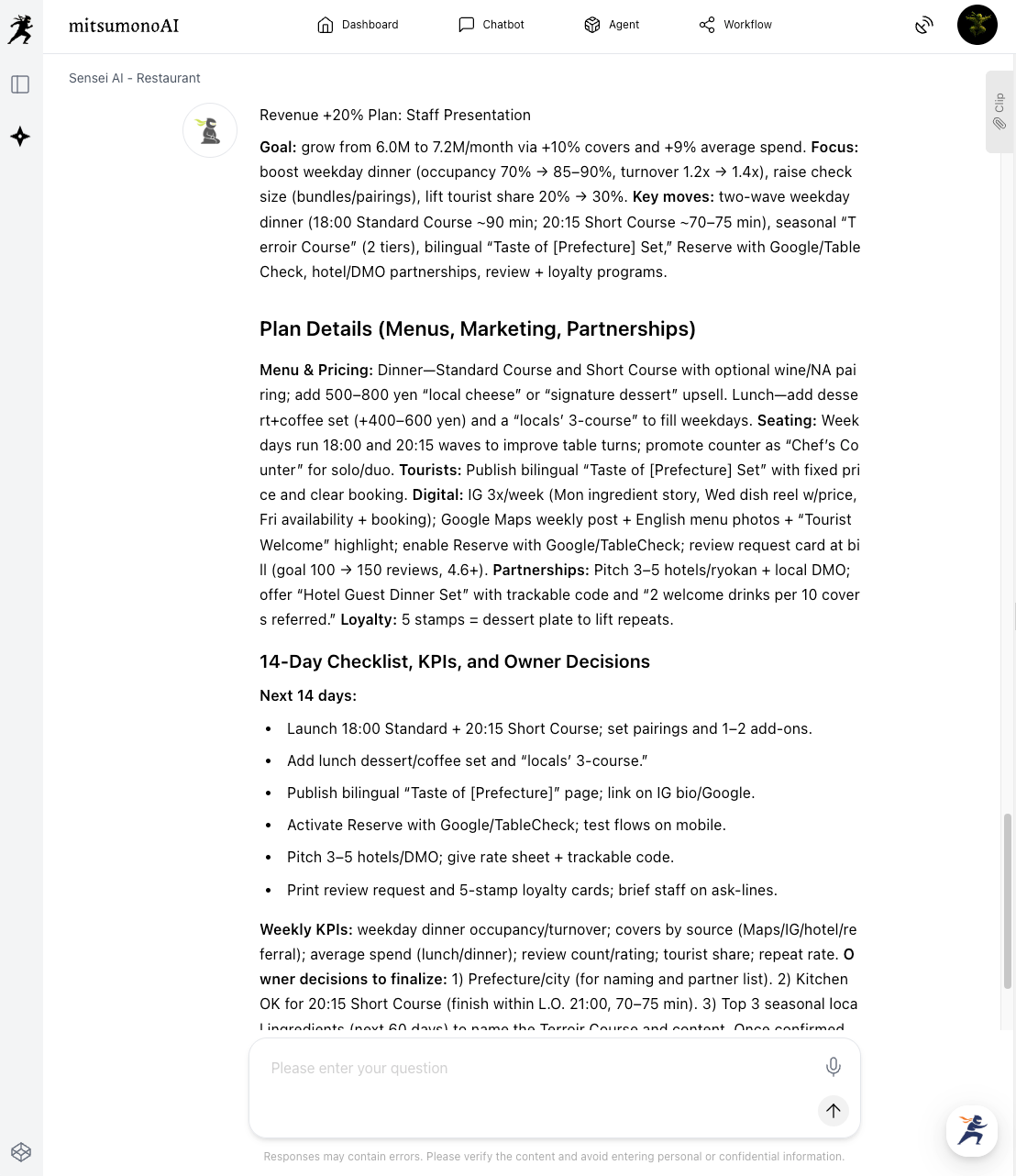
Step 4: Specifying Measures and Mapping Out an Action Plan
Once the strategy is set, move to the execution phase by breaking it down into an action plan.
Tailor the measures proposed by Sensei AI to your shop’s resources and situation, then set and adjust staff assignments, schedules, and KPIs.
By converting vague ideas into executable tasks, every staff member knows exactly what to do, making the path to the goal much clearer.
By linking this with other functions like the "Content Marketing Planner" or "SNS Strategy Planner," you can efficiently manage daily operations and content creation.
Expected Results
- Strategic Planning with Professional Expertise
- The high-quality proposals based on Sensei AI’s industry-specific knowledge and best practices are comparable to hiring a professional consultant.
- Clarification of Challenges and Direction for Solutions
- Through dialogue with the AI, you can organize management issues that are difficult to notice on your own and find a clear direction for solutions.
- Conversion into Executable Strategies
- Even vague ideas or visions can be hammered out through "wall-hitting" sessions with the AI into specific execution plans, clarifying the roadmap to success.
Target Metrics for Next Term-End
KGI (Key Goal Indicator):
- Total Revenue: 20% increase compared to the previous term.
KPI (Key Performance Indicators):
- Customer Spend Growth Rate: 5% increase vs. previous term.
- Retention Rate: 10% increase vs. previous term.
- New Customer Acquisition: 15% increase vs. previous term.
Empower Your Management with AI
In this guide, we showed how to use the industry-specific "Sensei AI" to draft a concrete, actionable revenue-boost strategy—just as if you had hired a professional consultant. The process of brainstorming and strategy development, which owners often carry alone, can produce high-quality results by leveraging Sensei AI’s industry knowledge. Make AI your powerful ally and accelerate your business growth.