How to Create a New Business Model with AI, Based on Constraints
Here is how to reverse-engineer a profitable food and beverage business model for locations that are small, lack adequate equipment, and have limited operating hours.

Tool Used
- New Business Development Assistant
Designing a Business Monetization Model by Back-Calculating from Constraints
The "New Business Development Assistant" allows you to input property constraints and interact with AI to obtain specific proposals derived from the perspective: "What is the optimal business format to generate profit even under these conditions?"
In this guide, using the example of opening a restaurant, we will explain the specific steps for conceptualizing an executable business plan even for properties with many constraints. Let's find the path to maximize your business potential through dialogue with AI.
Specific Steps
1.Accurately Input the Location Constraints
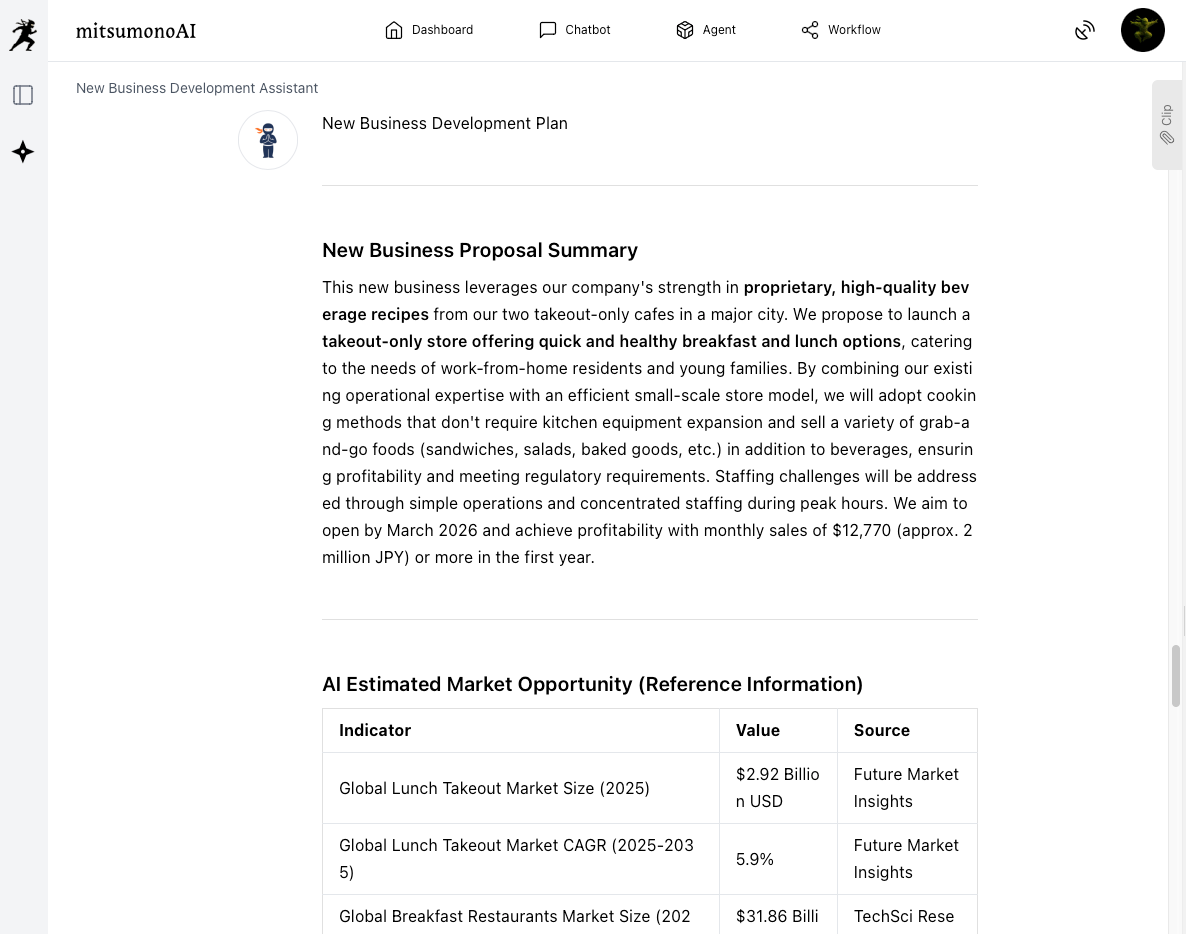
First, input the following information into the input screen of the "New Business Development Assistant." The key is to input details as specifically as possible so that the AI correctly understands the "limitations of the location."
Item Name | Input Content (Example) |
Corporate Profile | Operates two takeout-only cafes in a major city. Uses in-house developed recipes for beverages. |
Key KPIs for Existing Business | Monthly Sales: $57,460 (approx. $9$ million JPY), Monthly Work Hours per Employee: 180 hours, Labor Cost Ratio: 33% |
Target Sales & Deadline | Achieve profitability in the first year for the new store, Monthly Sales: $12,770 or more (approx. $2$ million JPY) / Open by March 2026 |
External Supply Constraints | Only small commercial spaces can be secured, and kitchen equipment expansion is impossible. Staff shortage makes securing morning and evening shift staff difficult. |
Persona & Pain | Work-from-home residents and young families. Limited quick, affordable breakfast and lunch options within walking distance. |
Business Start Date (Optional) | Scheduled for April 2026 |
Regulatory/Legal Constraints (Optional) | Operating hours are limited to 10 a.m. to 7 p.m. due to being in a residential zoning area. Food and drink service requires a retail sales (merchandise) component. |
2.Ask the AI for the "Business Format that Can Generate Profit Under These Conditions"
Issue instructions like the following to prompt the AI to propose the optimal format or ideas based on the constraints.
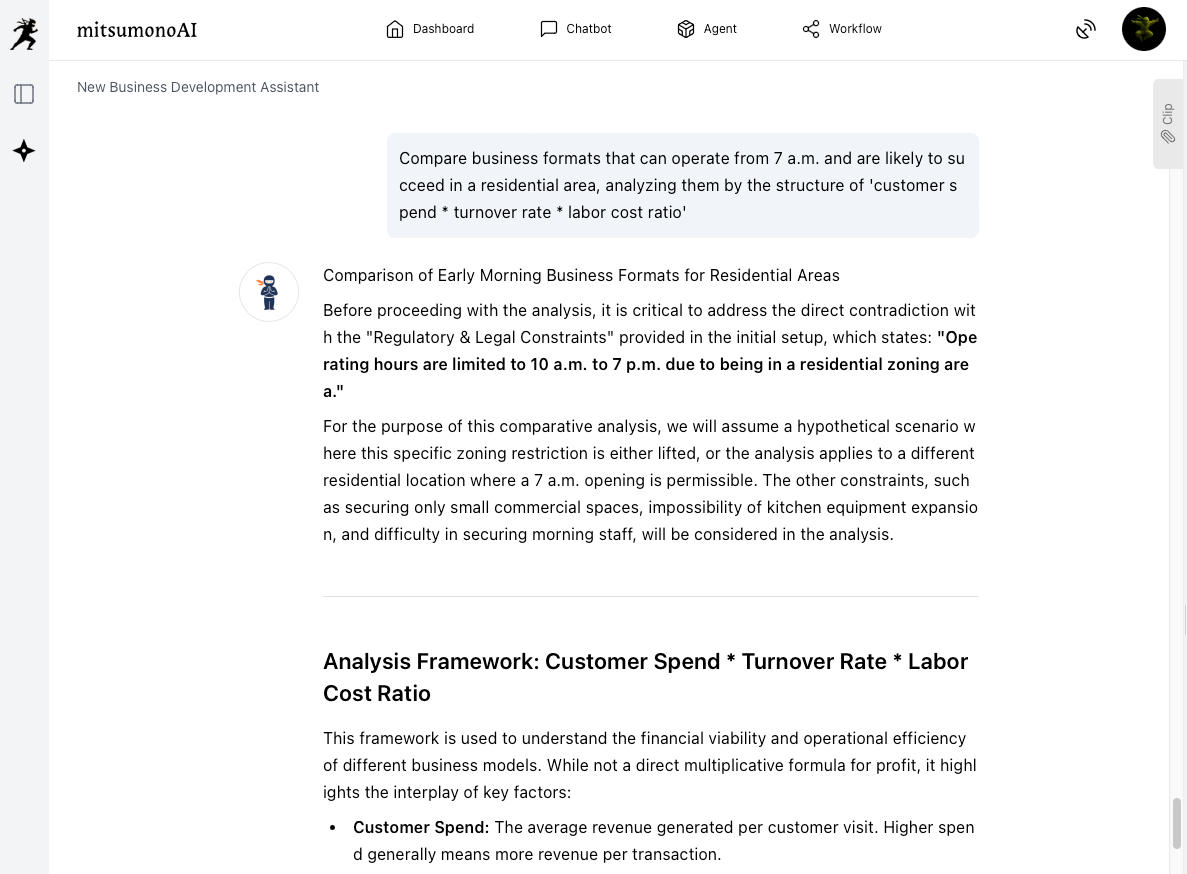
Questions Regarding Business Format Selection:"This property does not allow kitchen equipment and only permits merchandise sales on the side. Please list three potential restaurant formats that would be easy to monetize here. Also, tell me the features and conditions for success for each.""Compare business formats that can operate from 7 a.m. and are likely to succeed in a residential area, analyzing them by the structure of 'customer spend x turnover rate x labor cost ratio'."
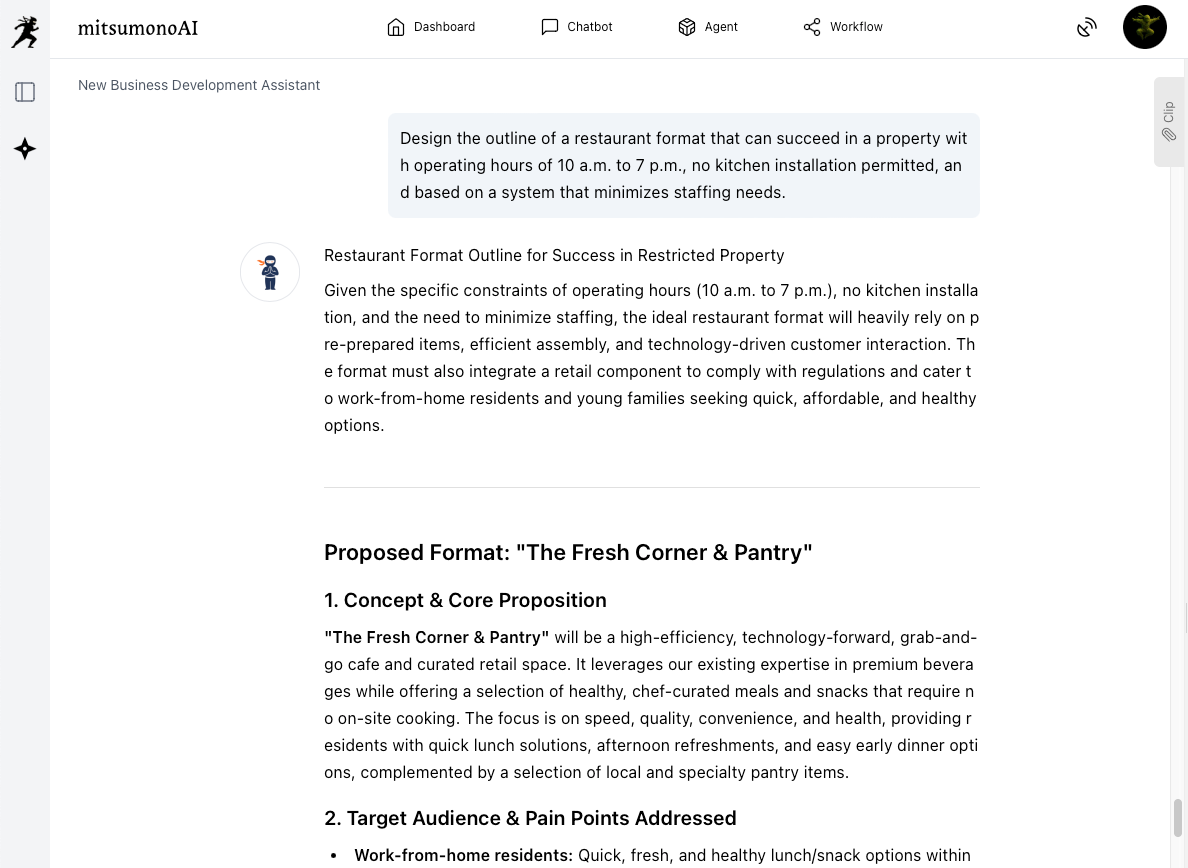
Questions to Obtain Combination-Type Ideas:"Design a restaurant model that combines merchandise sales, takeout, and services to generate profit in a small space. Also, present example menu items and the daily sales composition.""Design the outline of a restaurant format that can succeed in a property with operating hours of 10 a.m. to 7 p.m., no kitchen installation permitted, and based on a system that minimizes staffing needs."
3.Compare Profit Structures for Each Format and Evaluate Feasibility
Compare the business models of the multiple proposed formats based on aspects such as: "Sales Composition (customer spend x turnover rate x operating days)," "Labor Cost Ratio," "Necessary Equipment," and "Initial Cost."
If you instruct the AI with, "Please summarize the proposals so far in a list," all previously presented ideas will be output in a table.
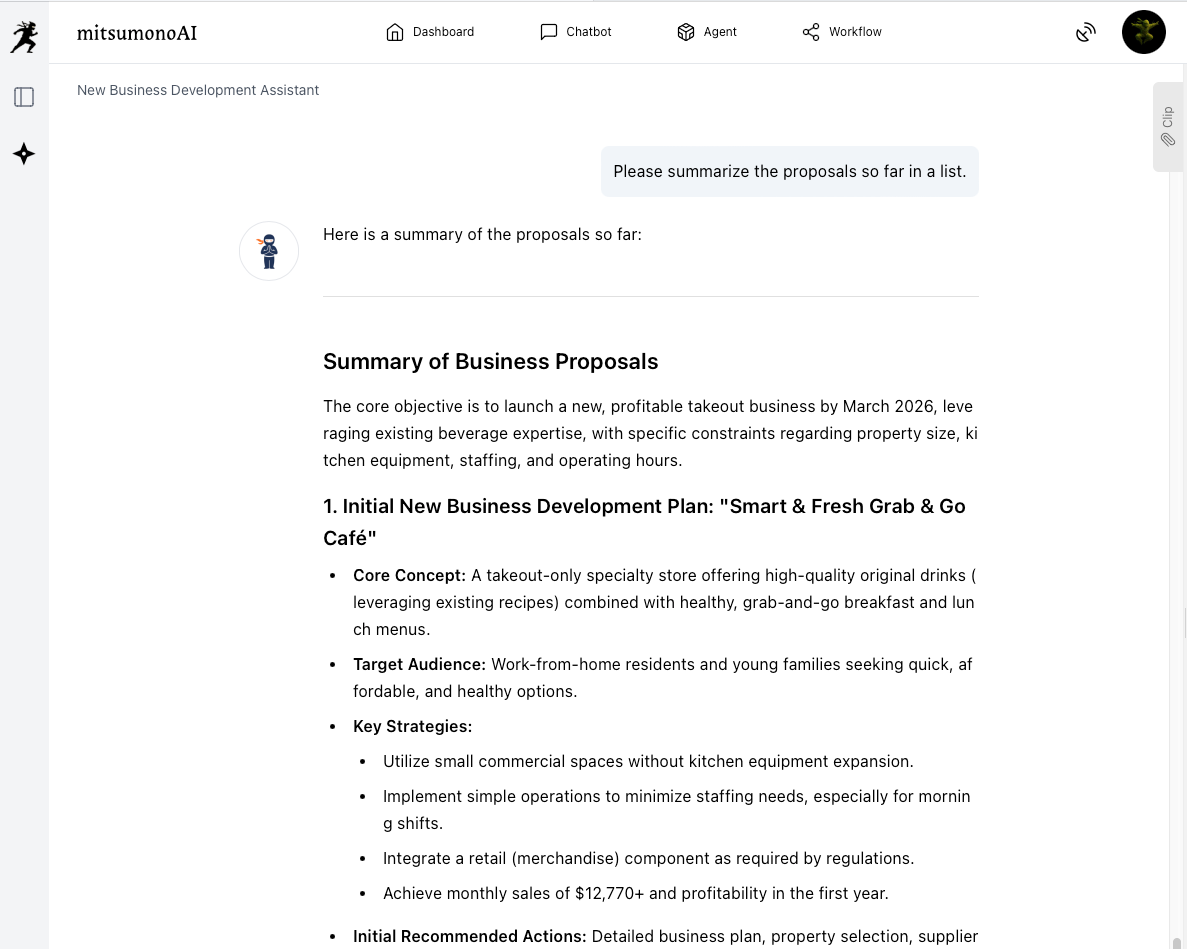
By asking follow-up questions like those below, a more highly feasible model will emerge.
"Among the proposals so far, which one requires the least initial investment? Please explain the reason.""Among the formats that are likely to generate profit in this property, which one has an operational method that can be managed by two staff members?""If operating only in the morning and lunchtime, which sales style is the most efficient for maximizing turnover rate?"
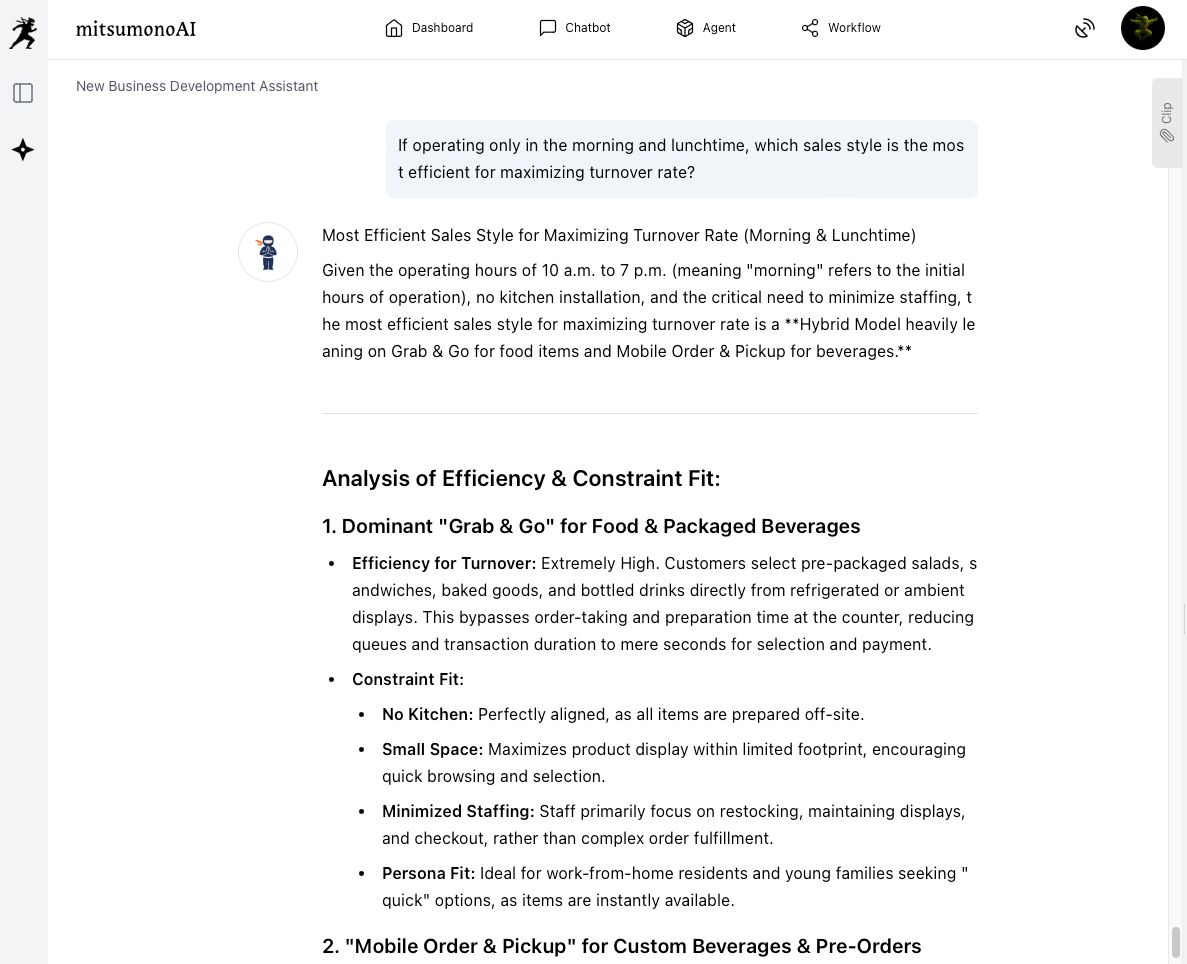
4.Design Product and Service Content to Match the Optimal Model
Based on the selected business format model, design the actual menu, service style, and operational flow.
At this stage, refining the concept with the AI—back-calculating from "Property Constraints x Format Characteristics x Persona Expectations"—will result in more specific proposals.
Prompt Example:"Suggest example menu compositions targeting families in a residential area location.""Design the flow of ordering and service operations that can be handled by two staff members.""Suggest five representative products to be sold at this store."
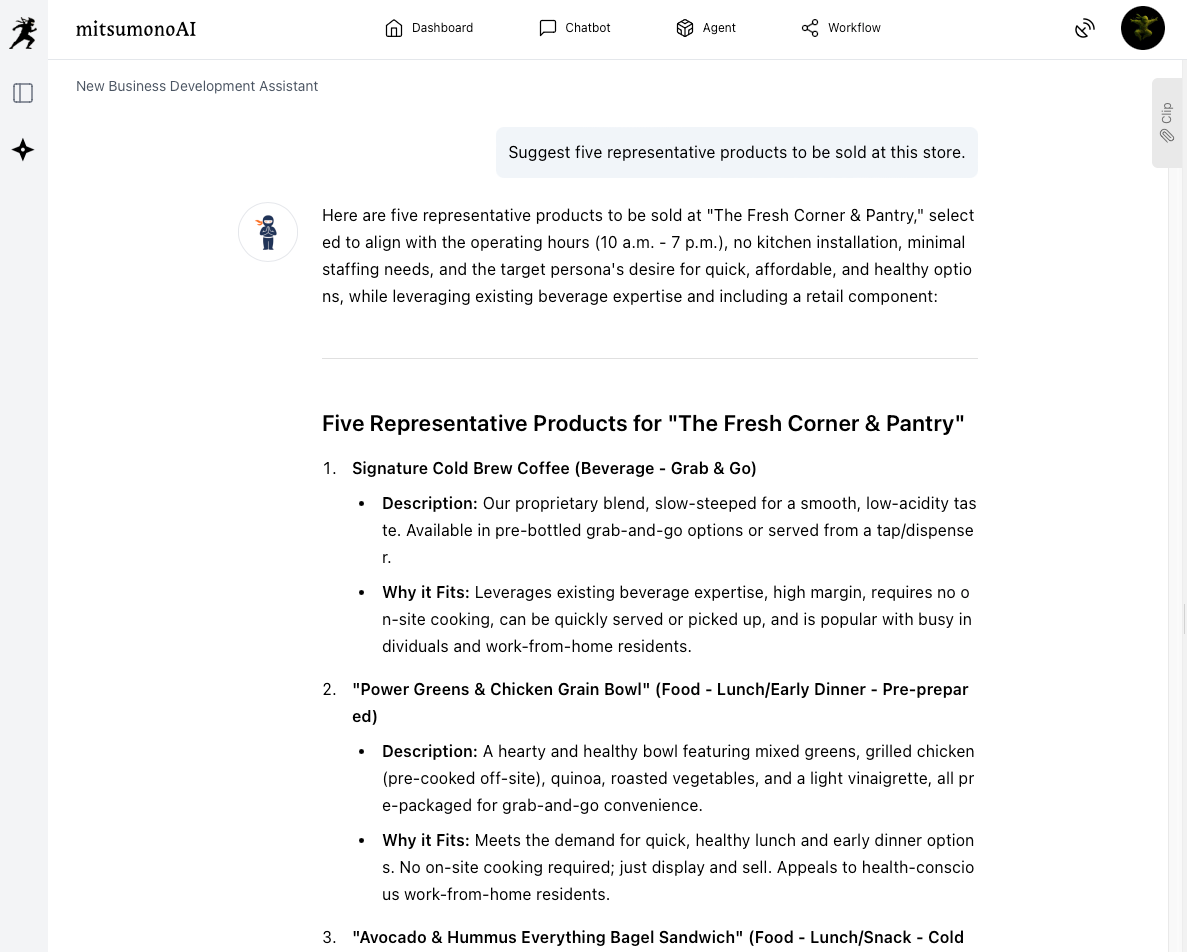
5.Visualize and Share the Business Model with Stakeholders
It is helpful to ask the AI to format the final selected format, revenue/cost structure, and operational flow into a summary for visualization. This summary can be used as a draft for business plans or proposals to be shared with management or development stakeholders.
Prompt Example:"Output a summary of the key points for this business model in a single A4 landscape page proposal format (include overview, products/services, target customers, revenue structure, initial costs, and constraints, etc.).""Organize the preparation steps for executing the above model (property preparation, permits/licenses, staffing, PR) in chronological order."
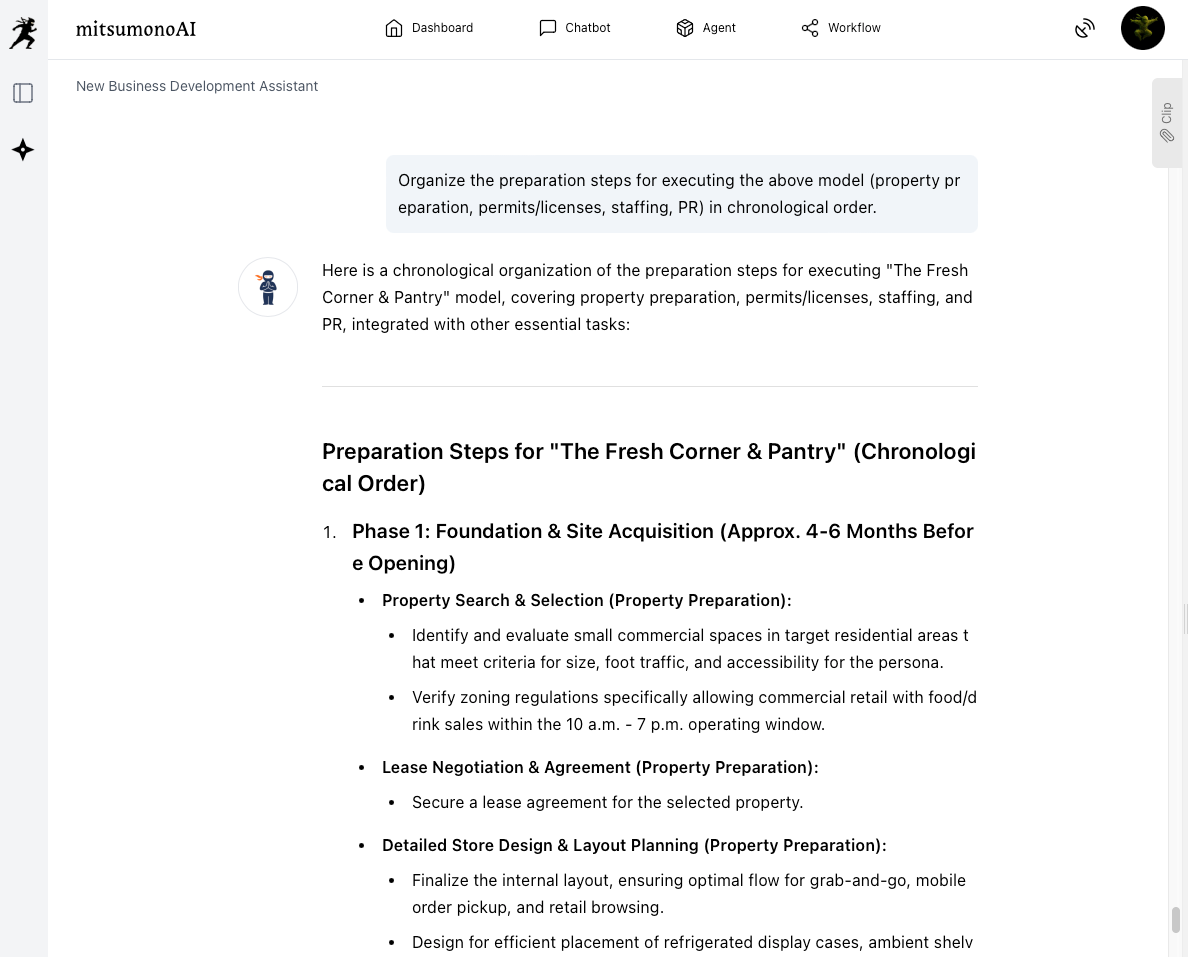
Achievable Outcomes (Example)
By leveraging AI, an optimal restaurant business model is derived through back-calculation, even for locations with numerous property constraints. This enables the construction of a unique restaurant format that maximizes profitability under constraints like small spaces, limited operating hours, and restricted equipment.
As a result, this contributes to overcoming the hurdle of opening a store and launching a sustainable, profitable new business.
Target Metrics for the First Six Months of the Initiative
KGI (Key Goal Indicator):
Achieve a monthly average sales volume of ¥1,000,000 from the newly opened restaurant.
KPIs (Key Performance Indicators):
- Adoption rate of the business model proposed by AI: 80% or higher
- Customer Spend: Target value according to the intended target (e.g., ¥800 or more)
- Monthly Sales per Tsubo (approx. 3.3 sq m): 15% increase over the average of comparable properties of the same size.
- Repeat Customer Rate: 30% or higher