In-house SWOT Analysis Assistant : Tips for Maximizing Strategic Impact
Discover how to transform standard SWOT analysis into actionable business strategies using the In-house SWOT Analysis Assistant. This guide covers basic operations and three essential tips—deep diving into factors, diversifying action plans, and executing Cross-SWOT—to unlock your "winning path."


AI-Enhanced SWOT Analysis: An Objective Approach to Your "Next Move"
The "SWOT Analysis" is a framework familiar to many business professionals as a powerful tool for organizing a company's current status and exploring strategic directions. However, many feel they are not fully realizing its potential due to common pitfalls:
- The analysis ends up being a collection of subjective internal opinions.
- The analysis becomes an end in itself, failing to produce a concrete action plan.
- The content remains the same every year, offering no new discoveries or insights.
The In-house SWOT Analysis Assistant from mitsumonoAI solves these issues by combining your company’s website data with third-party information, such as external review sites. This process reveals a "fact-based corporate profile" that is often invisible from the inside and provides practical suggestions for your next steps.
Basic Usage of the In-house SWOT Analysis Assistant
First, let's look at the basic functions and operation of this tool.
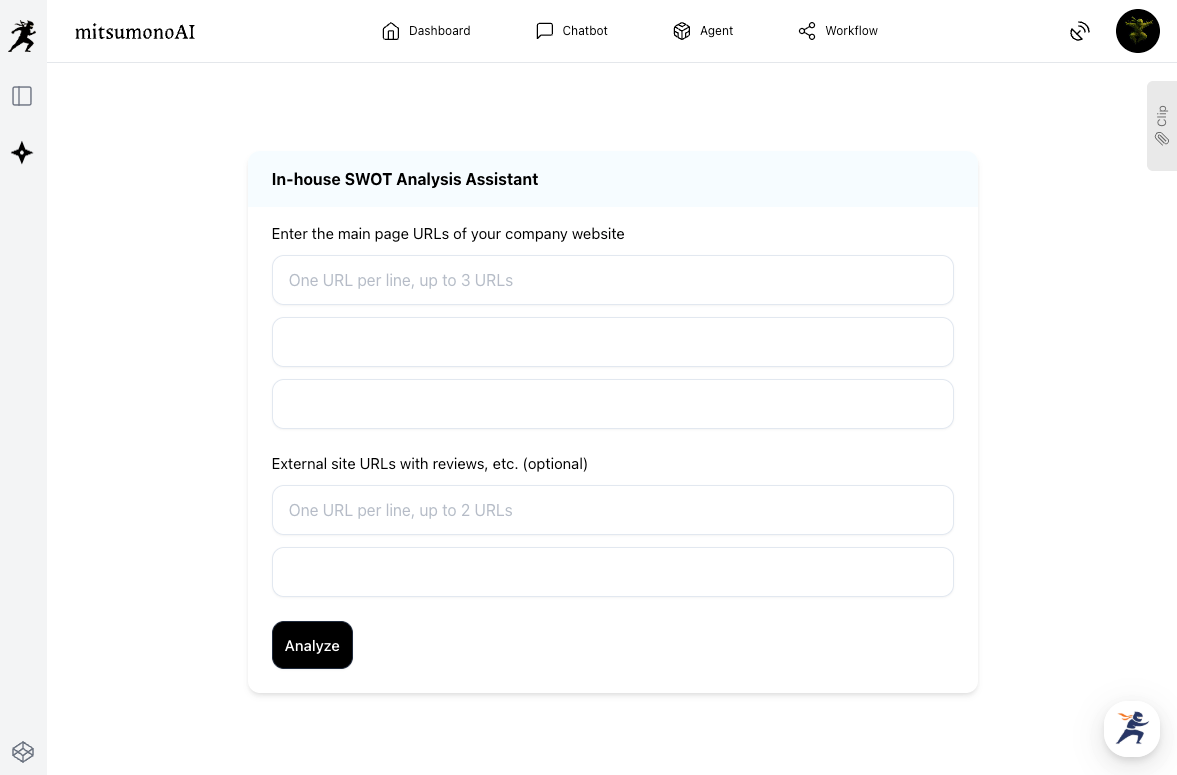
1. Input the URLs for AI Analysis
To help the AI learn about your company, input the website URLs that will serve as the basis for the analysis.
- Company Website URLs (Required, up to 3): Enter URLs for your main page or service pages, which form the core of the analysis.
- External Review Site URLs (Optional, up to 2): Enter URLs for review or rating sites to incorporate third-party evaluations.
2. Review the Analysis Report and Action Plan
Click the "Create" button, and the AI will collect and analyze the information from the provided URLs to automatically generate the following:
- SWOT Analysis Report: An objective analysis organized into four categories: Strengths (S), Weaknesses (W), Opportunities (O), and Threats (T).
- Concrete Action Plan: The "next moves" proposed by the AI based on the analysis results.

This completes the objective self-analysis process that previously required significant time and effort.
Three Tips to Maximize Analysis Effectiveness
The initial SWOT report and action plan are powerful starting points. However, this tool is not meant for a single output. By engaging in a dialogue with the AI and providing additional instructions (prompts), you can significantly increase the depth and practicality of the analysis.
Tip 1: Deep Dive into Specific SWOT Items to Clarify the "Why"
Ask the AI to dig deeper into any specific Strength, Weakness, Opportunity, or Threat from the initial report. This clarifies the "evidence" behind vague issues or strengths and increases confidence in the resulting actions.
Prompt Examples:
"Regarding the identified strength [AI-analyzed strength], please explain the specific reasons or background of why customers feel this way."
"Suggest three specific impacts that [AI-analyzed weakness] has on our business, using figures or examples."
"In which industries is [AI-analyzed opportunity] most prominent? Please deep dive into specific trends."
Tip 2: Expand Action Plans from Multiple Perspectives
While the AI suggests an initial action plan, adding conditions like "What if..." or "From a different perspective" helps you find more realistic and effective measures tailored to your resources and market environment.
Prompt Examples:
"Among the proposed action plans, suggest three low-cost measures to maximize the use of [Specific SWOT item]."
"If we focus on [New target segment], please propose an action plan with a different approach."
"Considering the trends of [Specific competitor], propose a new action plan that emphasizes our differentiation."
Tip 3: Use "Targeted Cross-SWOT Analysis" to Draft Strategic Outlines
Cross-SWOT analysis is an advanced technique that combines SWOT items to find practical strategies. In mitsumonoAI, you can execute this by simply asking the AI to "perform a Cross-SWOT analysis." Specifying which elements to combine based on your goals further streamlines the strategy formulation process.
Prompt Examples:
"Based on these SWOT results, suggest five specific strategic ideas to maximize 'Opportunities' by leveraging our 'Strengths'."
"Propose a risk management strategy to overcome 'Weaknesses' while minimizing 'Threats,' focusing specifically on [Specific Weakness] and [Specific Threat]."
"Propose a defensive strategy to protect the company from 'Threats' while utilizing 'Strengths,' incorporating examples from competitors."
Conclusion: Deriving "Future Strategies" through AI Dialogue
The In-house SWOT Analysis Assistant is a tool designed to unlock the full potential of SWOT analysis through the power of AI. By practicing these three tips, you can move beyond mere situational analysis to gain practical strategic hints.
- Enable corporate analysis based on "objective data" without being trapped by internal subjectivity.
- Deepen understanding by exploring the "root causes" behind surface-level issues through AI dialogue.
- Rapidly draft concrete strategic outlines without the time-consuming effort of manual Cross-SWOT analysis.
Start by entering your company's URL to see how the AI perceives your business. Then, use these three tips to discover the "next move" that will open up the future of your business.
In addition to the tips introduced in this article, the official mitsumonoAI blog site also introduces many other specific ways to use AI to streamline your daily work and further improve the quality of the services you provide.
You're sure to find some useful tips for your own business, so be sure to check it out.