Designing Social Contribution Tourism with AI : Sustainable Tour Planning Techniques to Save Rural Communities via Gibier
Could a single business model solve both wildlife damage and tourism stagnation? By using AI to transform "wildlife pest control" into "high-value-added experiential tours," we bridge social contribution and business. Discover three steps to turn regional challenges into sustainable resources.

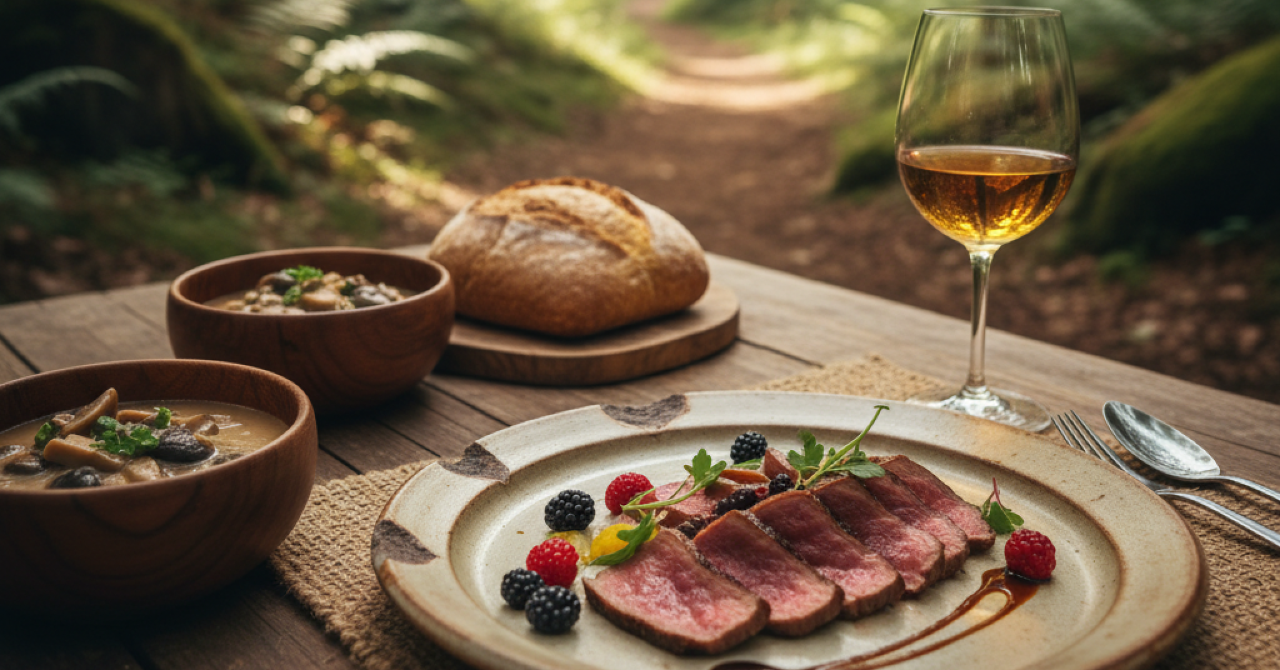
From "Disposal" to "Resource Creation"
Many mountainous regions are struggling with severe agricultural damage caused by an ever-increasing wild boar population. Meanwhile, local tourism often fails to break away from cliché offerings, leaving communities searching for a new star attraction to draw visitors. These two issues are frequently treated as separate problems.
However, in an era where these challenges are complex and intertwined, we have a unique opportunity to shift our perspective. By reframing these issues into a single narrative and transforming them into a sustainable tourism business, we can create new value that only these regions can provide.
Three Challenges Facing Mountainous Regions
- Challenge 1: Inefficient utilization of wildlife after culling
Despite the immense cost and effort required to cull wild boars, the reality is that most are discarded without being utilized. While the term "Gibier" (wild game meat) is widely known, many regions lack stable supply routes, processing technology, and, most importantly, the ability to tell the "story" behind it, preventing it from becoming a true regional resource. - Challenge 2: Low-value tourism content
Simply looking at beautiful scenery and eating delicious food is no longer enough. For modern travelers who prioritize experiential value, basic sightseeing is insufficient. Without providing "special experiences available only here," regions inevitably fall into price competition. - Challenge 3: The difficulty of balancing social contribution with business
Even with a strong desire to "help the community," designing a business model that remains profitable and sustainable is extremely difficult. Consequently, initiatives often end as one-off events reliant on subsidies. Yet, because these issues are so deeply linked, now is the time to rethink. By weaving these threads into a unified story, we can create unique regional value.
How AI Converts "Social Issues" into "Tourism Resources"
AI can objectively and structurally design business models that achieve both profitability and social impact. It re-envisions the "process of pest control" itself—something humans might overlook—as tourism content filled with learning and emotional resonance.
By using a "New Business Development Assistant," we can reframe wildlife damage—previously handled as a negative issue—as a regional resource. Instead of fragmented experiences without a narrative, we design experiential tours with a consistent storyline. Even businesses that were once difficult to monetize can find a clear path to the future through a systematically built sustainable model.
Three Benefits of Implementing AI
- Transforming Social Issues into Tourism Resources
Turn the negative issue of wildlife damage into positive tourism content rich with educational experiences. - Providing High-Value Experiences
Move beyond simply serving wild game dishes. By offering deep experiences where guests learn the meaning of "taking a life" and the current state of rural areas, you can create high-priced tours with high satisfaction. - Building a Sustainable Community Contribution Model
Design a model where all stakeholders—tourists, hunters, farmers, restaurants, and local governments—benefit, ensuring long-term community support.
Practice | The 3-Step Social Contribution Tour Planning Flow with AI
Let’s look at the process of planning a sustainable tour utilizing wild boar (gibier) set in a specific mountain town.
Step 1: Preparation and Foundation
First, input the tour concept, target region, and available regional resources into the "New Business Development Assistant."
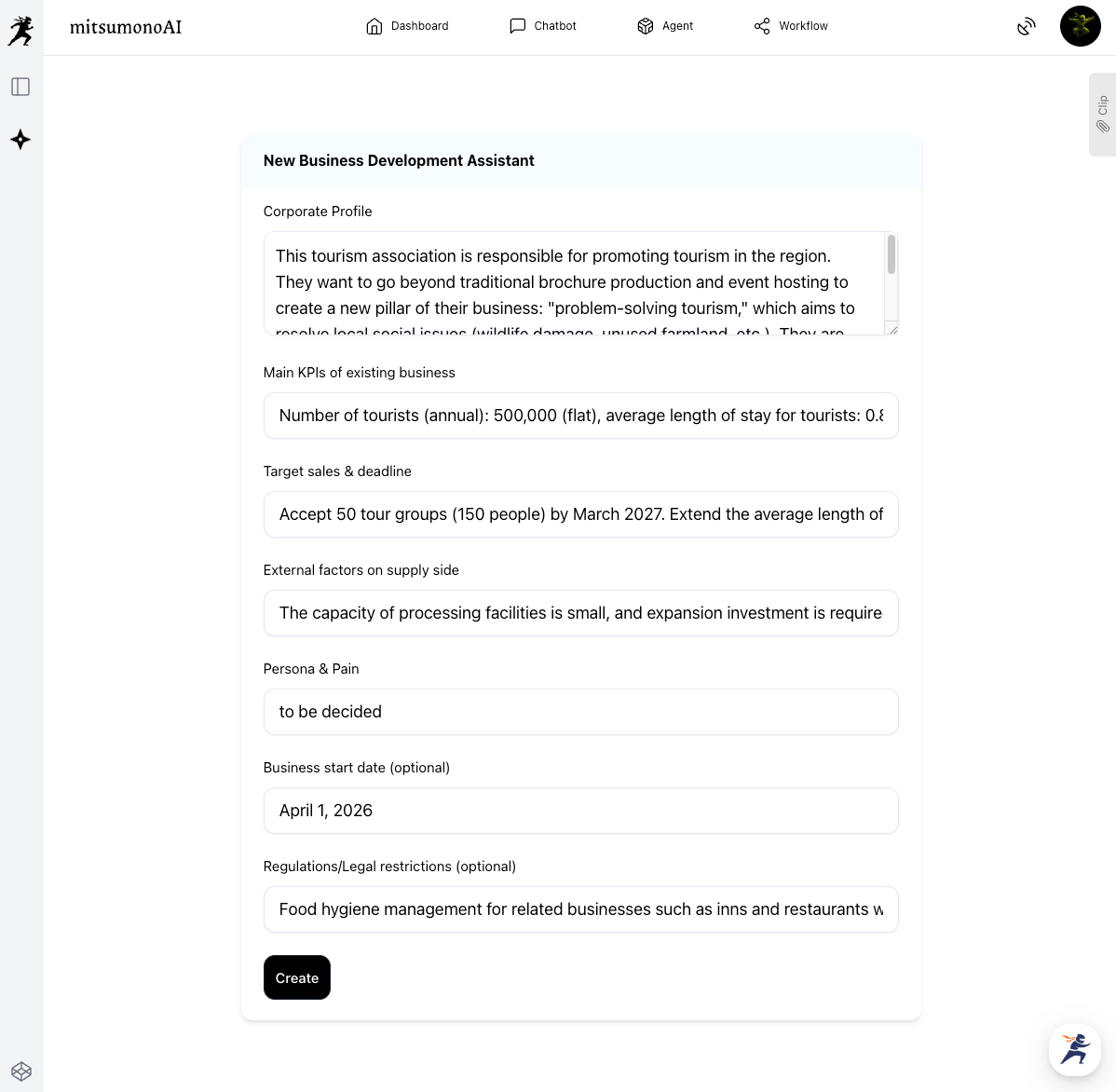
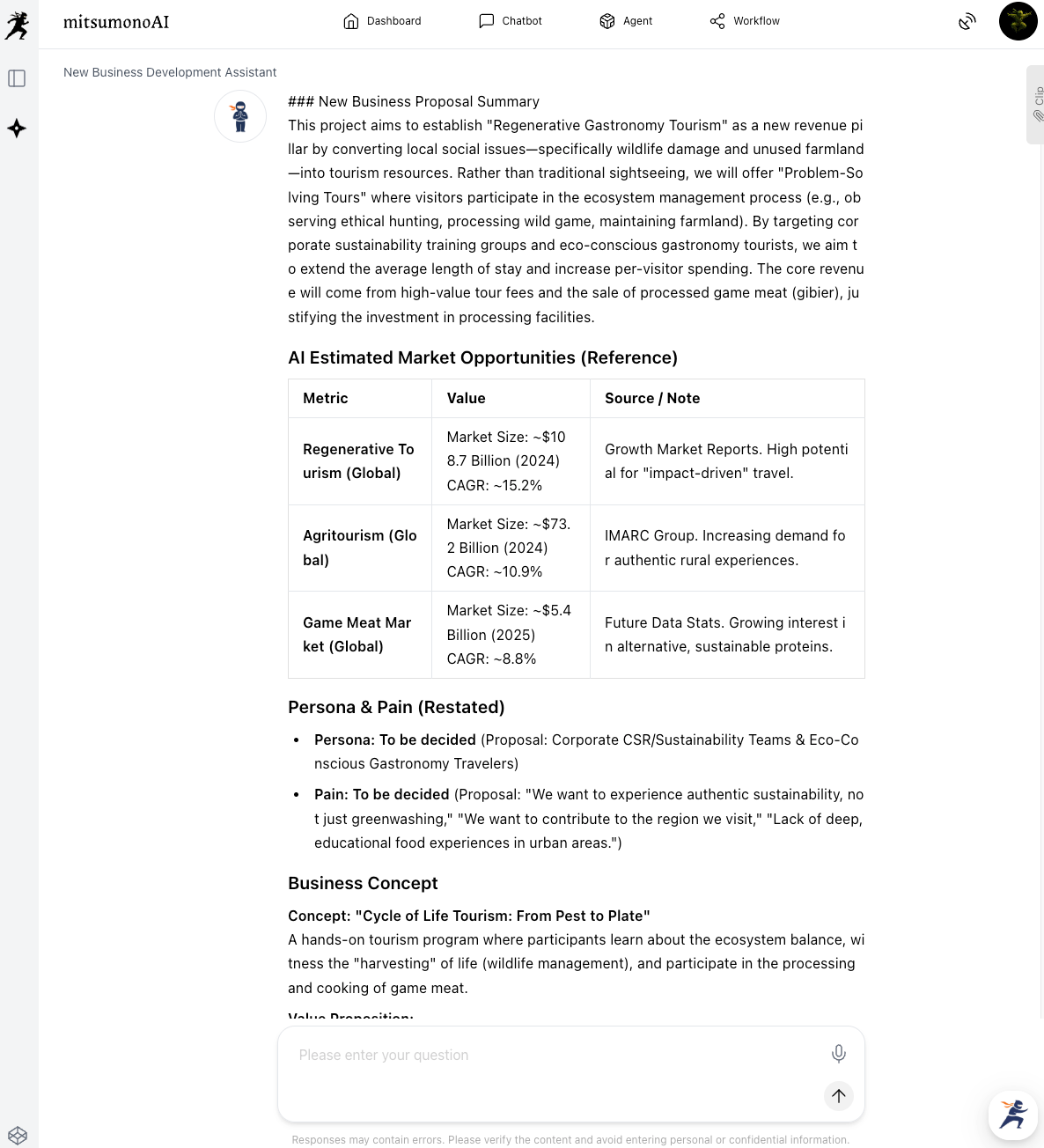
Review the "Business Concept" from the initial output.
Step 2: Analysis and Assessment (Business Model Design via AI)
If the initial plan isn't perfect, there’s no need to stop. From here, we build the specific tour plan. Use the chat interface to provide instructions for designing the overall business structure to revitalize the region.
Please design how this business will provide value, to whom, and how it will remain profitable and sustainable, focusing on:
1. Who is the target customer?
2. What is the "experiential value" they find most attractive?
3. How will we generate continuous revenue?
4. Who are the local partners and what resources will be used? "
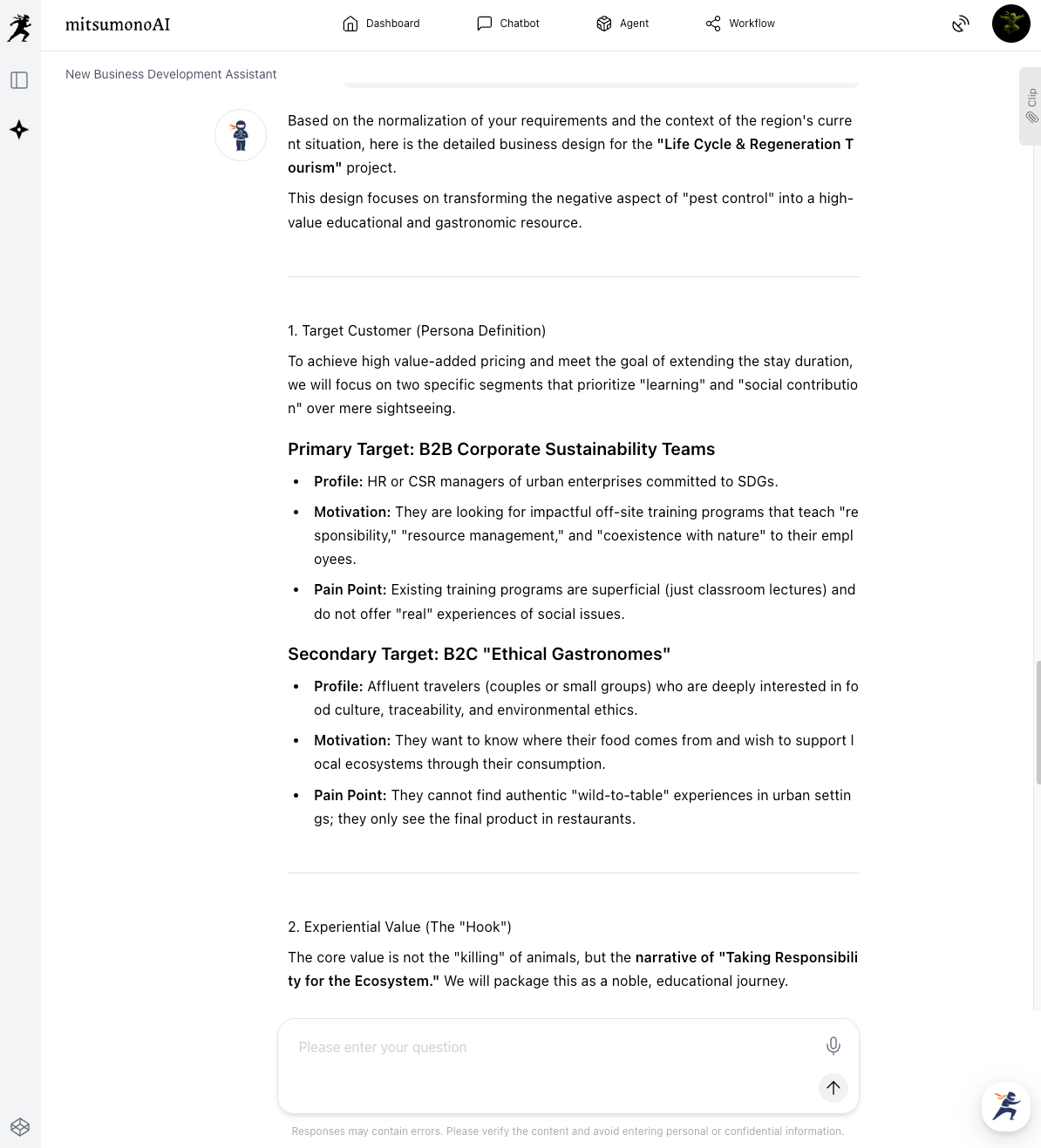
The AI will provide detailed answers to each. Once the target and value proposition are clarified, proceed to the next step.
Step 3: Planning Specific Tour Programs
Using the AI-designed "Value Proposition" as the core, have the AI plan specific programs that move participants' hearts. Translate the "value" defined by AI into a program that participants can experience with all five senses.
"Based on the value proposition, propose a specific 2-day, 1-night tour program that makes participants feel they had a 'special experience beyond mere sightseeing.'
Include a chronological narrative: orientation, accompanying a hunt (observing trap hunting), visiting a processing facility, a gibier cooking workshop, and a meet-and-greet with affected farmers. "
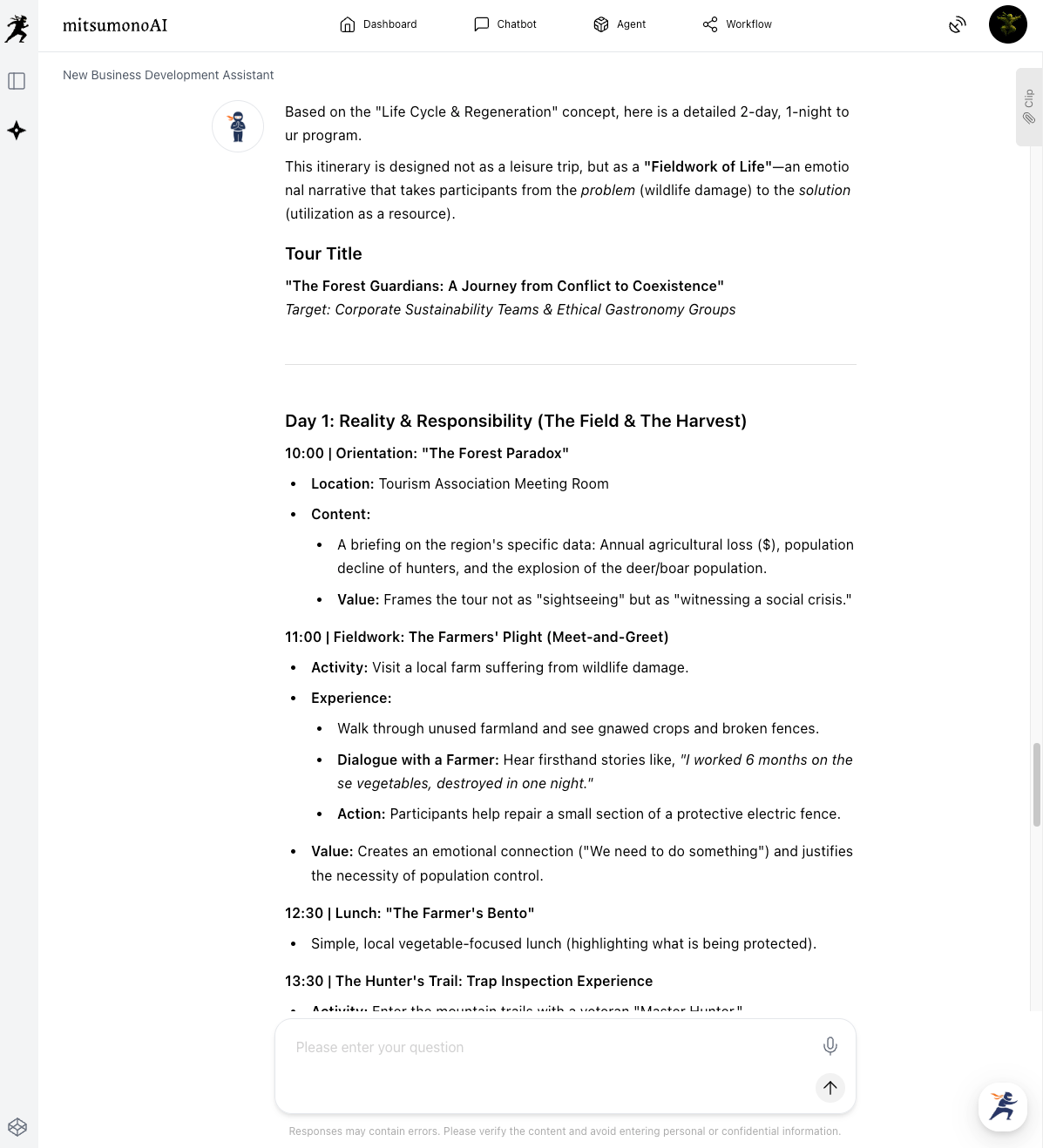
People who join this tour are no longer just consumers. They begin to see regional issues as their own, evolving into "Relational Population" for the area.
Even after the tour, they may buy products online or share their experiences on social media, creating a lasting relationship. This is the realization of a truly sustainable business model.
Scaling Success to Enhance Regional Value
The success of a gibier tour opens doors for further regional growth.
- Expansion to Other Regional Resources This business model serves as a template for other "challenges," such as deer, thinned timber from forests, or abandoned farmland, turning them into resources.
- Corporate Training and Educational Travel Market the program as corporate training or study tours for students focused on sustainability, the SDGs, and primary industries. This secures new revenue streams and increases weekday occupancy.
- Launching a D2C Brand With a base of enthusiastic fans from the tours, you can launch a Direct-to-Consumer (D2C) brand selling processed game meat online, creating new industries and jobs in the region.
Conclusion: Regional "Challenges" are the Best "Stories"
This article explained specific methods for using AI to turn the social issue of wildlife damage into a sustainable tourism business.
Key Takeaways
- Regional challenges (wildlife damage) can become unique tourism resources if you shift your perspective.
- AI is a powerful partner in designing sustainable models that balance social contribution and business.
- Narrative-driven experiences create high value and cultivate local fans.
By practicing this method, your region can evolve from a simple tourist spot into a "Stage for Co-creation" where visitors help build the future.
Why not transform your region's "hidden assets" into a business with AI?
mitsumonoAI can be utilized not only for new business development but also for solving diverse business challenges, improving efficiency, and creating new value.
Explore more use cases and the latest updates on the mitsumonoAI blog.