Restaurant Management Optimization : Saving Deficit Menus with AI—New Methods for Cost Control and Business Recovery in an Inflationary Era
Discover how to transform high-cost, low-profit dishes into "profitable favorites." This article explains a data-driven 2-step process using AI to analyze cost structures, refine recipes, and optimize pricing, helping restaurant owners overcome rising ingredient costs and emotional decision-making.


Is Your Signature Dish Creating a "Hidden Deficit"?
It is the centerpiece of your restaurant, a specialty that has supported your business for years. However, with the recent surge in ingredient costs, has it inadvertently become a burden that actually loses money with every order?
The "Vicious Cycle" of Deficit Menus
- Profit Squeeze:
Operating in a hand-to-mouth state where profits from other items are used to cover the losses of signature dishes. - Decision Paralysis:
The desire not to disappoint fans and the "sanctification" of long-standing items cloud rational management decisions, such as price hikes or menu revisions. - Internal Conflict:
Friction arises when the kitchen claims costs cannot be lowered further, while the front-of-house fears losing customers if prices rise. These emotional clashes prevent constructive discussion.
The root of this issue lies in the fact that discussions regarding "cost" and "value" are often based on personal experience and emotion rather than objective data.
By bringing AI to the table as a neutral partner, you can establish a data-driven menu improvement process that eliminates emotional bias.
AI as Your "Cost Management Consultant" and "Head of Product Development"
To solve this deep-seated issue, mitsumonoAI provides two powerful AI assistants that bridge the gap between recipe development and pricing strategy.
- Recipe Development Chef (The Product Development Role)
Suggests multiple specific recipe improvements—such as alternative ingredients or revised cooking processes—to improve prime cost ratios without compromising quality or your brand concept. - Pricing Strategy Analysis Assistant (The Cost Management Consultant Role)
Provides a comprehensive analysis of the refined recipe's cost, competitor pricing, and the unique value proposition (USP). It derives a strategic optimal price that customers will find acceptable, backed by logical reasoning.
By using these AIs as a "third party," you can avoid the typical emotional conflicts between management and the kitchen. This enables a constructive dialogue focused on a shared goal: "How can we delight our customers while securing the restaurant's profitability?"
Step-by-Step: A Recovery Plan for Deficit Menus
Here, we simulate the recovery of a "100% Domestic Beef Special Hamburger" struggling with rising costs.
Step 1: Use the [Recipe Development Chef] to generate cost-saving ideas without sacrificing quality.
First, share your current recipe and challenges with the Recipe Development Chef to receive creative yet feasible improvement plans.
[Preparation/Execution]
Launch the Recipe Development Chef and input the current menu status and specific pain points.
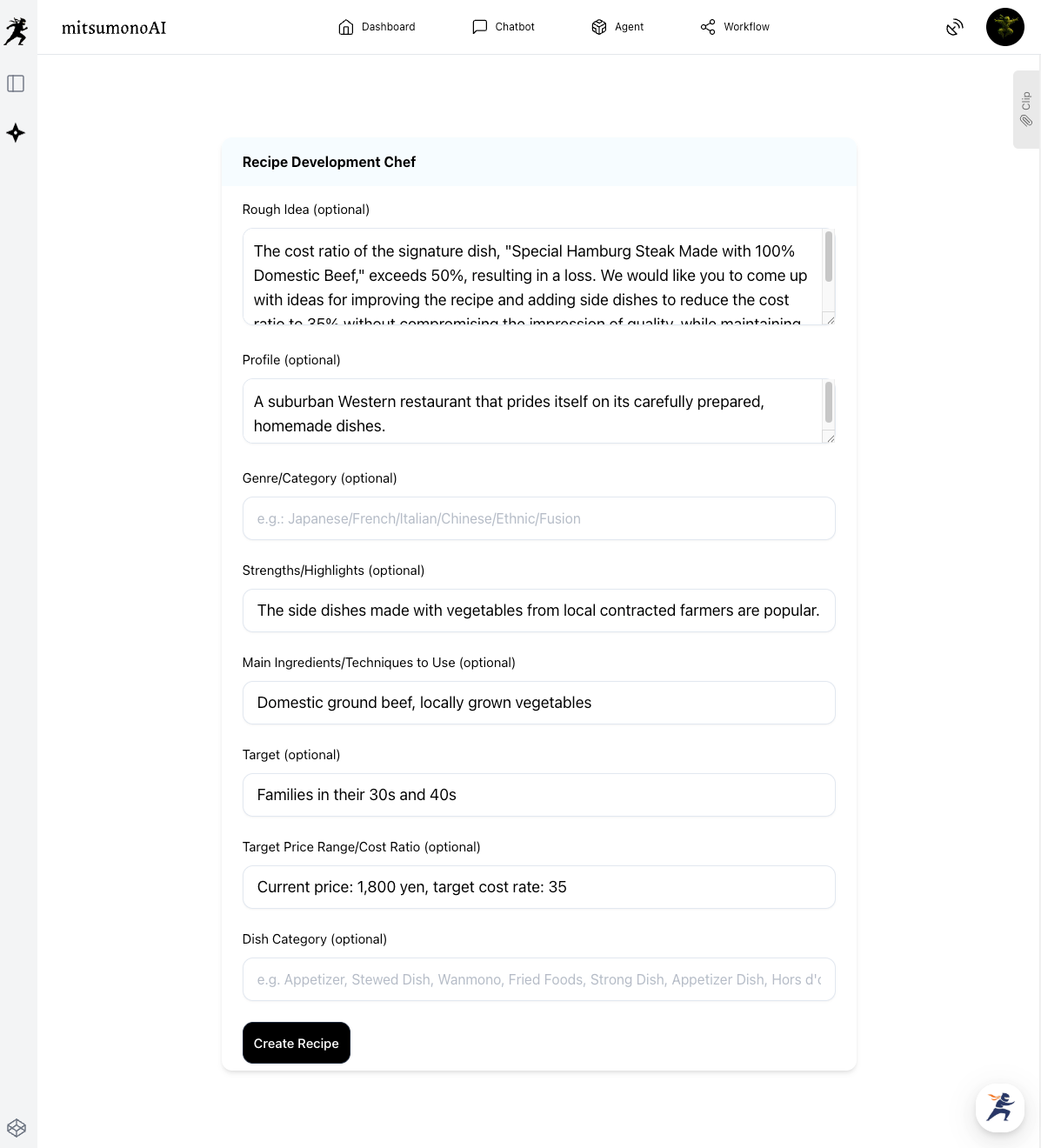
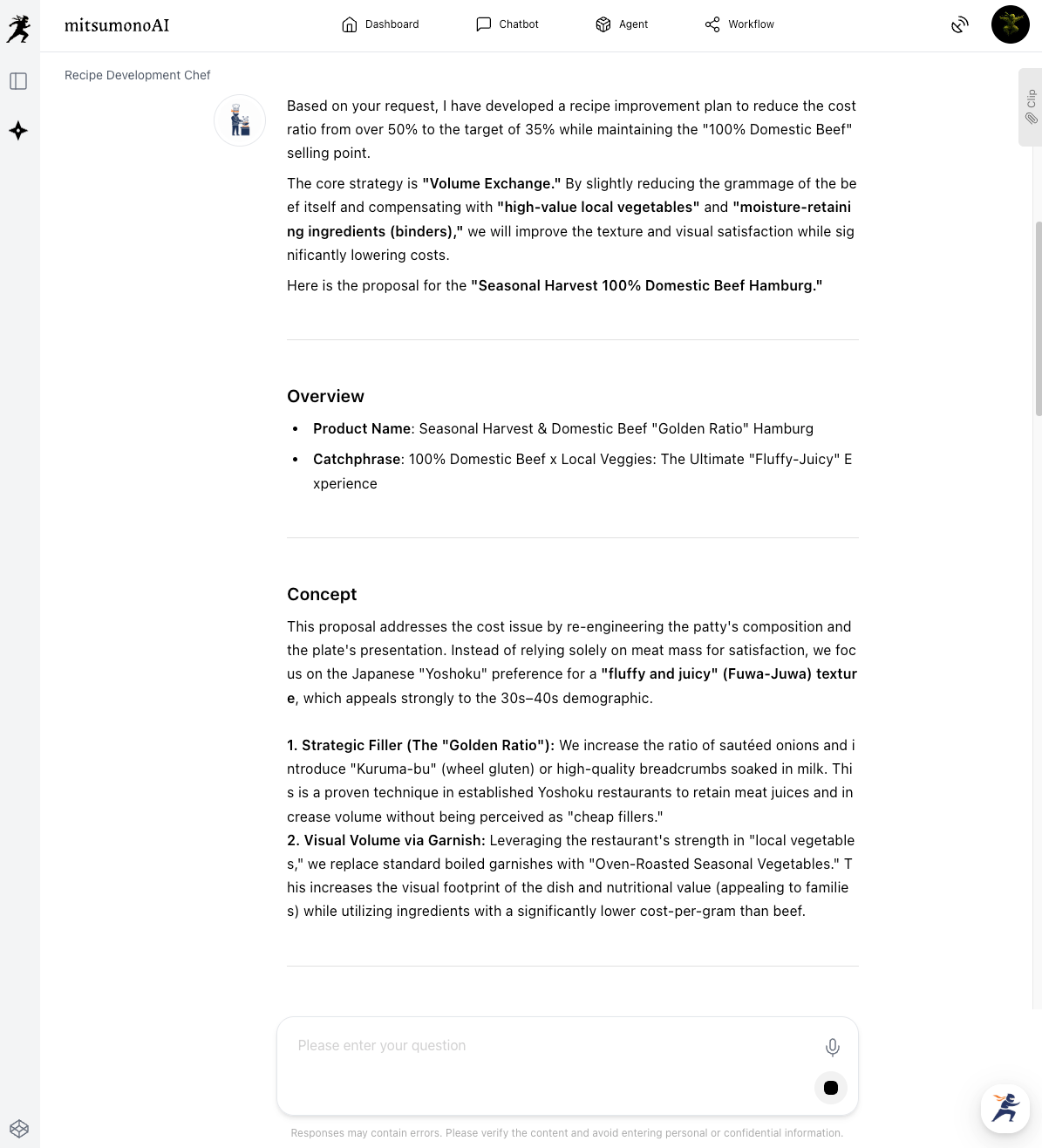
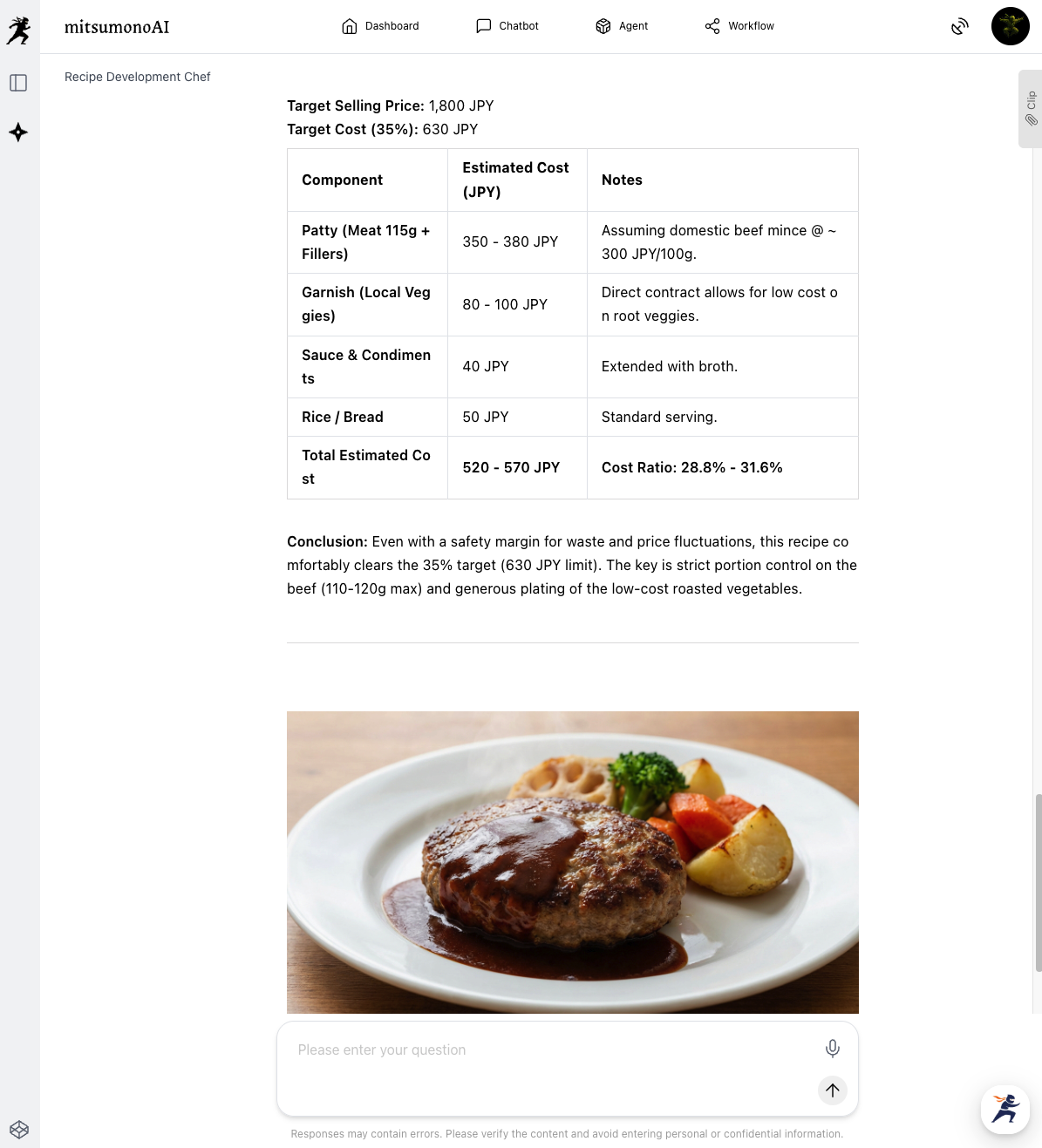
The AI will propose specific improvements while respecting your commitment to quality and premium ingredients.
Step 2: Use [Pricing Strategy Analysis] to verify "prices customers will accept."
Next, based on the estimated costs from Step 1, use the Pricing Strategy Assistant to determine an optimal price that ensures profitability while remaining fair to the customer.
[Preparation/Execution]
Launch the assistant and input the improved concept and competitor information.
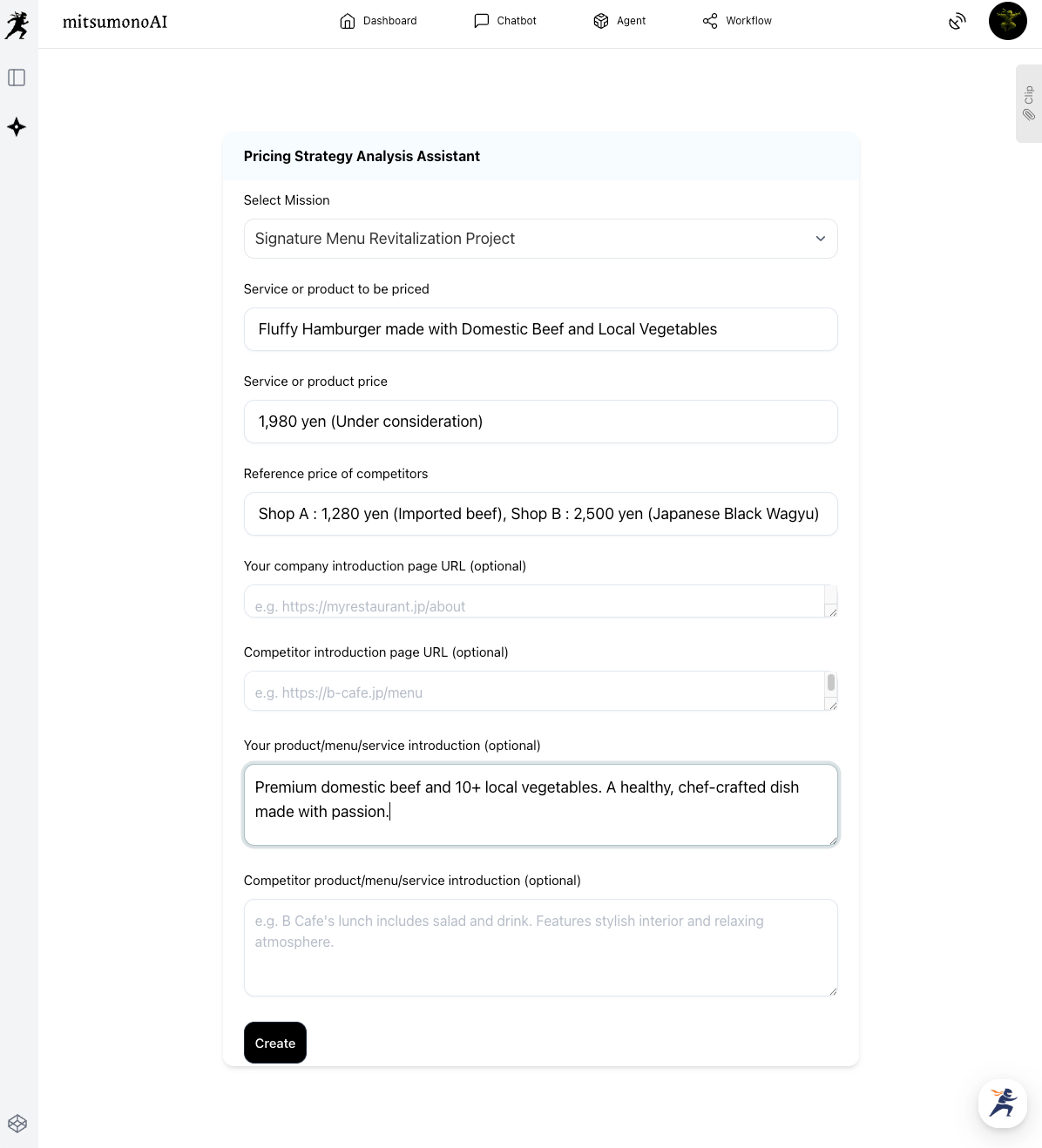
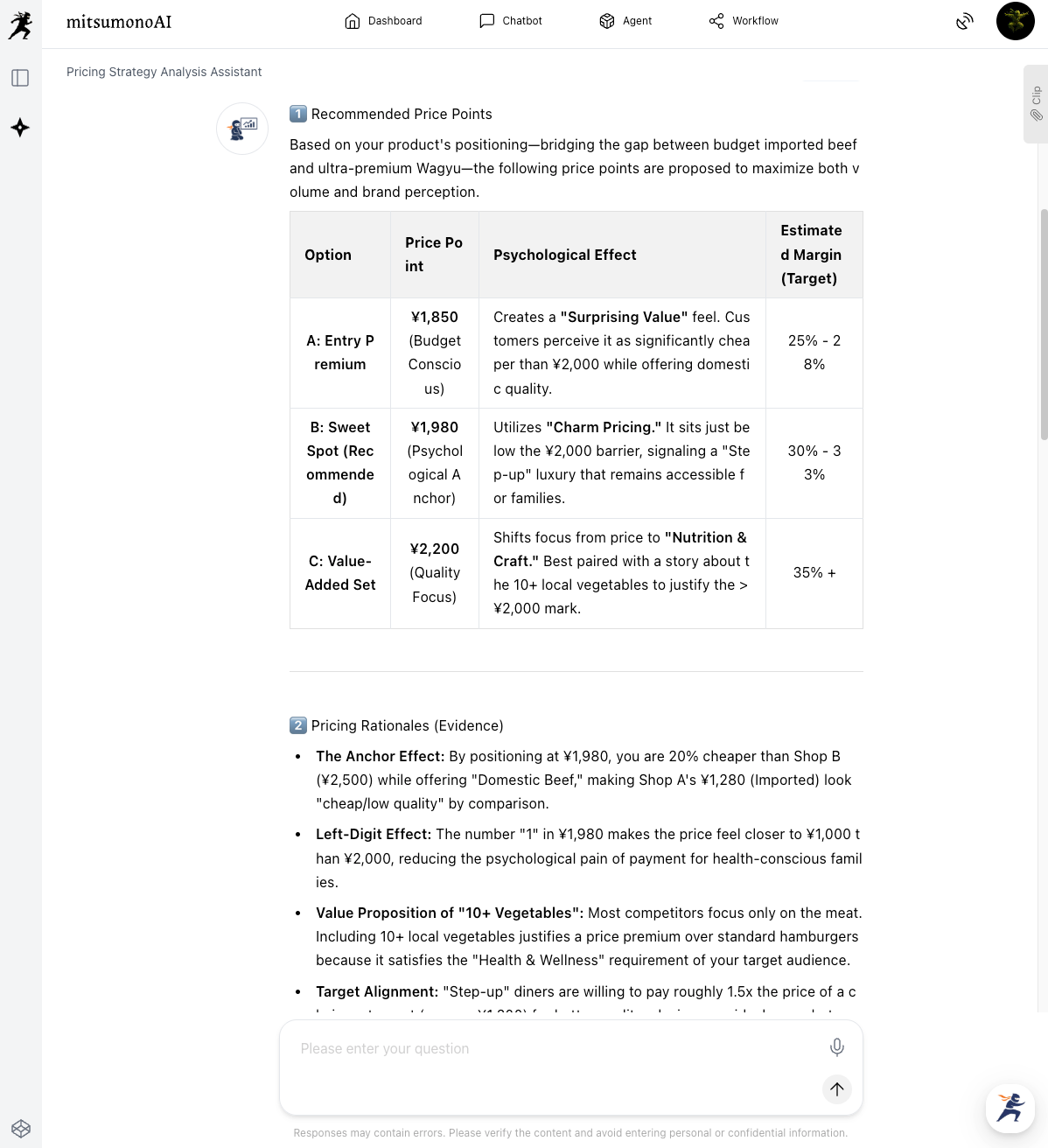
Through this step, the AI provides logical justifications and marketing angles, such as: "Differentiation is possible through 'Domestic Beef + Local Vegetables,' justifying a mid-to-high price range," or "Families in their 30s and 40s have a higher price tolerance for 'Safety and Health'."
Application and Expansion: Building a "Profitable Portfolio"
This process is not limited to improving a single item.
- Profitability Analysis of the Entire Menu:
Use similar methods to perform ABC analysis (sales contribution vs. profit margin) across your entire menu to rebuild a high-profit portfolio. - Application to New Product Development:
When developing new items, verify market acceptance with the Pricing Strategy Assistant from the start to reduce the risk of failure. - Aligning Team Vision:
Share the AI’s findings with your staff to explain "why this item is priced this way" and "the value we aim to provide." Understanding the pricing improves service quality.
Summary
This article introduced two specific steps to utilize AI in transforming deficit-heavy menus into profitable stars.
Key Takeaways
- Introducing an objective AI perspective prevents emotional conflict between the kitchen and floor staff, enabling data-driven discussions.
- The Recipe Development Chef finds the intersection of "Quality" and "Cost."
- The Pricing Strategy Assistant verifies the balance between "Value" and "Price."
AI is the most reliable partner to balance the "chef's passion" for the menu with the "owner's perspective" necessary for business survival.
It is time to move past the "sacred" items that drain your profits and start creating a sustainable signature menu loved by customers, owners, and staff alike.
mitsumonoAI is a specialized AI platform designed to simultaneously enhance work quality and speed.
Beyond menu optimization, it can be utilized to solve various business challenges, improve efficiency, and create new value across your operations.