Turning Food Waste into SDGs Products with AI | How to Create New Projects from Coffee Grounds
Reducing business waste is vital for CSR and achieving SDGs. Using spent coffee grounds as an example, we introduce the "Product/Menu Development Planner" to help transform food waste into new sustainable products, turning environmental responsibility into innovation.


4 Hurdles AI Overcomes in "Food Waste Repurposing"
While reusing food waste reduces environmental impact and cuts costs, several hurdles exist in bringing projects to fruition:
- Difficulty in Idea Generation
- It is challenging to conceive of what value-added products can be created from waste ingredients.
- Evaluation of Feasibility
- It is difficult to judge whether an idea is technically and economically feasible.
- Linking with SDGs
- It is hard to clearly articulate how an idea contributes to achieving the SDGs.
- Ambiguity in Target
- SettingThe customer segment to appeal to often becomes unclear.
3 Benefits of Food Waste Repurposing Projects Utilizing AI
- Creating Innovative Product Ideas that Contribute to the SDGs
- By inputting mission information, such as "contribution to the SDGs" and "environmentally conscious customers," along with food waste details into the AI, multiple unique and feasible product ideas are proposed. This increases the possibility of generating novel concepts that would be difficult to come up with using conventional thinking.
- Automated Generation of PR Copy that Resonates with Target Customers
- The AI simultaneously generates PR copy that effectively conveys the appeal of the proposed product idea. The text, which effectively incorporates contributions to the SDGs and a stance on environmental consideration, resonates with environmentally conscious customer segments and stimulates purchasing intent.
- Accelerating the Process from Project Planning to Execution
- AI supports everything from idea generation to PR copy creation, significantly reducing the time required for planning. This shortens the time-to-market, allowing for the faster deployment of new products and services than competitors.
[Practical Steps] Planning Food Waste Projects with the "Product/Menu Development Planner"
Using spent coffee grounds as an example, we explain the concrete procedures for planning and executing a food repurposing project using the "Product/Menu Development Planner."
Step 1: Request Food Waste Repurposing Ideas from the AI
First, input information about the food waste into the "Product/Menu Development Planner" and request product ideas. Input as follows and check the output:
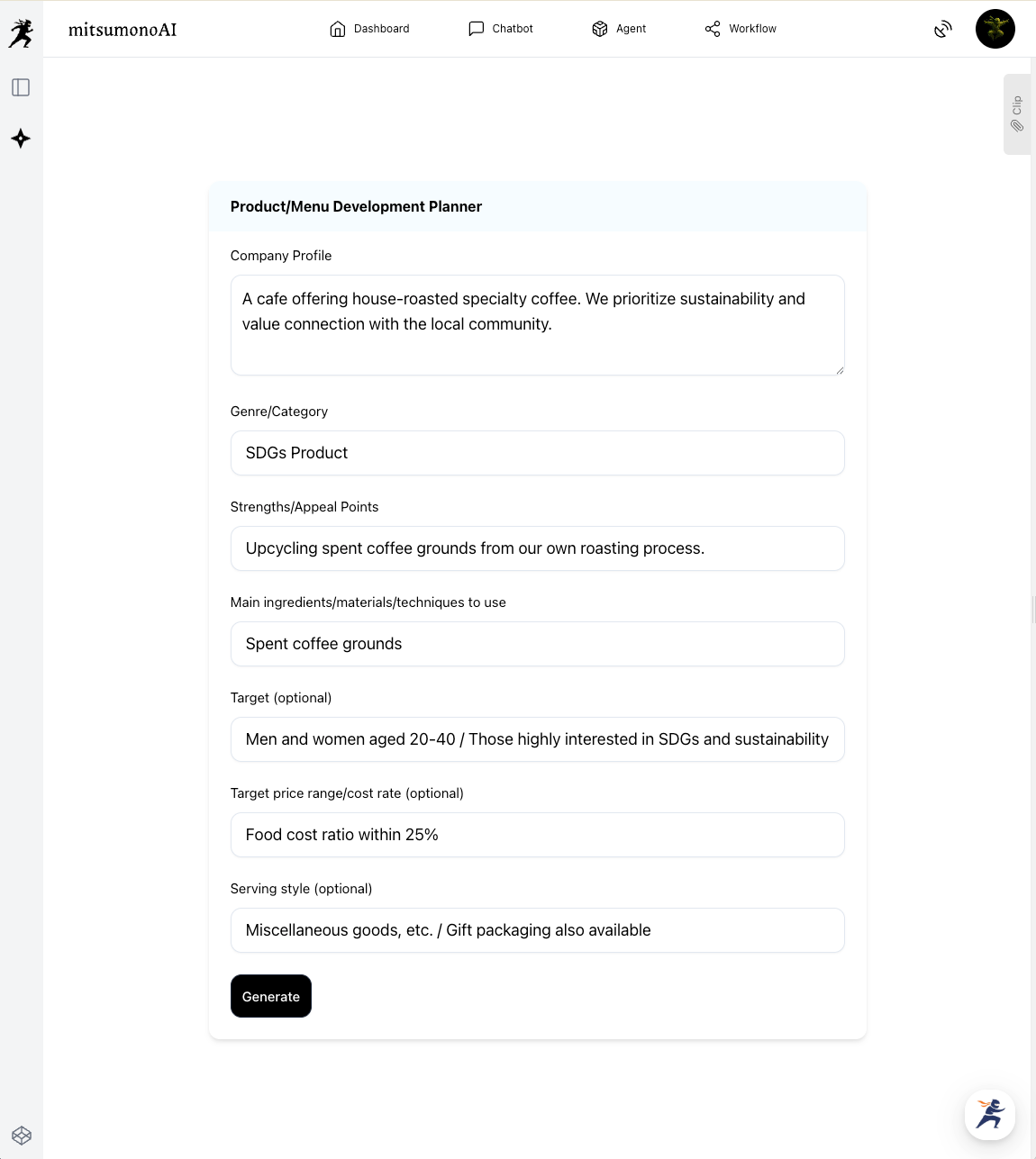
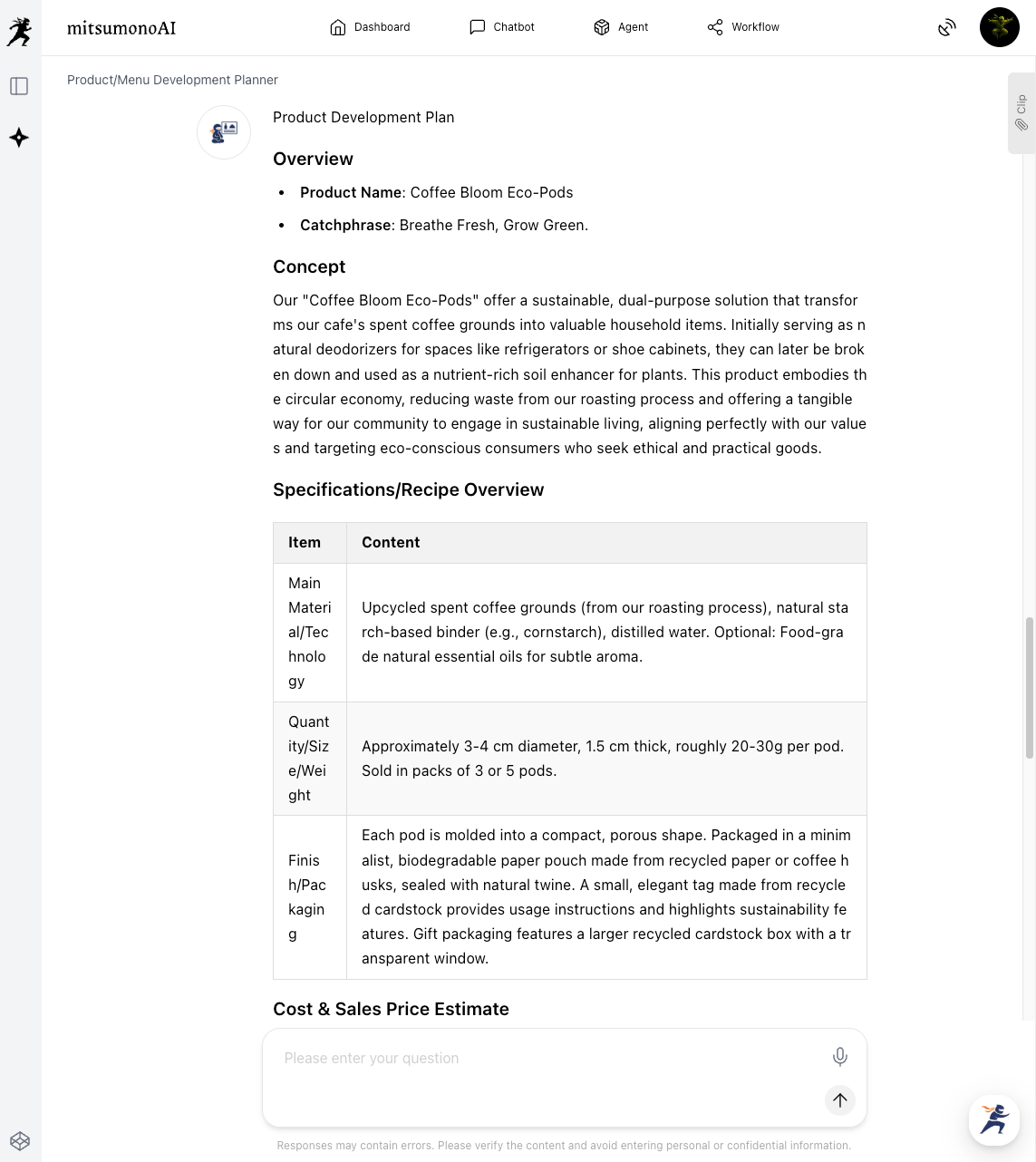
The AI will propose feasible product ideas based on the input information.
Step 2: Idea Selection and PR Copy Creation
Review the multiple product ideas and PR copies generated by the AI, and select the optimal one considering feasibility, marketability, and consistency with the brand image.
Then, have the AI create catchphrases and PR copy tailored to different media for the selected concept.
"Product Idea B: Grow Your Own Coffee Booster Seed Kit
Please create multiple catchphrases and PR copies for different media."
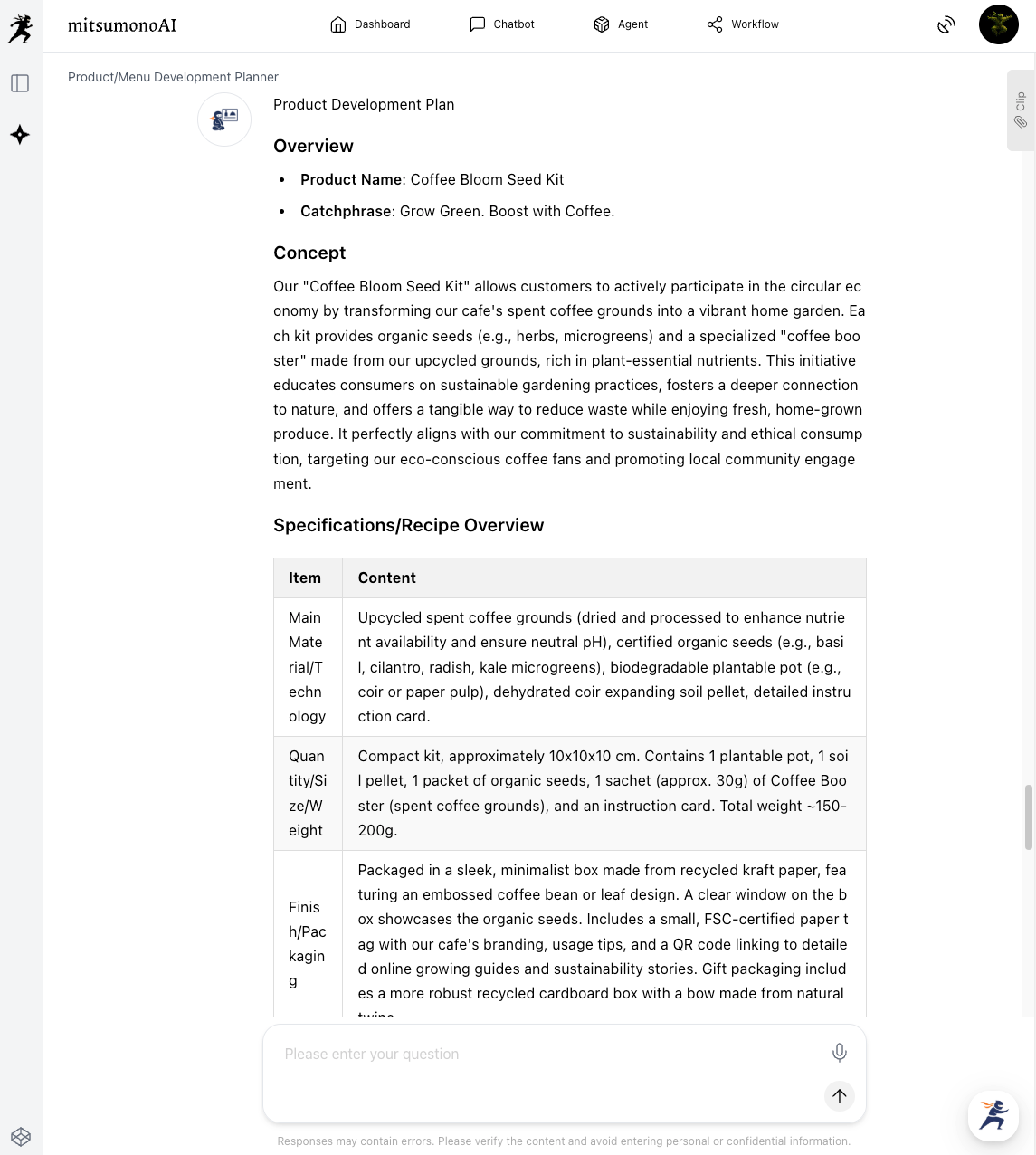
While the PR copy generated by the AI effectively conveys the contribution to the SDGs and product features, revising and adding to it to align with your company's current situation and brand story will result in a more persuasive message.
Step 3: Commence Deployment into SDGs Activities
Once preparations for prototyping and sales are complete, utilize the AI-generated and adjusted PR copy to effectively promote the company's SDGs activities.
Procedure
- Once the prototype is finished, create marketing materials such as in-store posters, press releases, and social media posts based on the PR copy.
- Clearly communicate the story behind the product and the company's efforts, for example, "This product contributes to SDG Goal 12, 'Responsible Consumption and Production,' by repurposing food waste."
- Collect customer feedback to lead to further product improvement and the creation of new ideas.
✅ Completion Checklist
Ensure the following state is achieved by completing these steps:
- Has an idea for repurposing food waste that contributes to the SDGs been generated?
- Has PR copy that resonates with the target customers been generated and adjusted by the AI?
- Has the process from project planning to execution been streamlined?
- Are the company's efforts towards the SDGs being effectively promoted?
- Is the reduction of waste being balanced with the creation of new revenue streams?
Summary: Turning Food Waste into Valuable Resources with AI
This article introduced the specific steps for utilizing mitsumonoAI's "Product/Menu Development Planner" to elevate food waste into product ideas that contribute to the SDGs.
The use of AI is expected to significantly improve operational efficiency by supporting creative idea generation, creating content that resonates with the target audience, and assisting strategic decision-making.
mitsumonoAI's blog features numerous examples of how to use AI to solve various business challenges, streamline operations, and create new value, not just for food waste repurposing projects.
Find the optimal way to utilize AI for your business at the following URL: