Breaking Free from Intuition : Establishing a Data-Driven Content PDCA to Become the "AI's Choice"
"I have a feeling this topic will be popular." "Let's just aim for two articles a week." Is your content marketing still relying on experience and intuition? This guide explores how to use Sensei AI and data-driven PDCA cycles to ensure your brand is consistently cited and recommended by AI.


Breaking Free from "Experience and Intuition" : The 3 Risks of Traditional Measures
- Loss of Exposure Opportunities: Content that does not align with AI evaluation criteria is excluded from search results and AI-generated answers, rendering production time wasted.
- Decrease in Customer Touchpoints: Information that fails to cater to users who "ask AI to solve problems" will be dropped from the selection process.
- Obscured Added Value: Unless unique strengths are digitized and verbalized, your business risks falling into price competition with major retailers.
Data-Driven Differentiation with Sensei AI
Adopt Sensei AI - Shop as a strategic planner to drive data-based operations. Verbalize unique services in AI-friendly formats to maximize your "AI Citation Rate." By using conclusion-first and Q&A structures, you boost AI recommendations and target latent demand. This approach backs owner experience with data, creating a distinct, competitive "reason to be chosen."
Recommended for those facing these challenges:
- Customers are drifting toward nearby large malls or online supermarkets.
- A desire to avoid price competition and clarify the store's unique added value.
- A need to increase existing customer loyalty and build long-term relationships.
- A need for specific strategies on how to communicate unique strengths.
[Practical Section] Step-by-Step Operational Procedures
The data-driven PDCA cycle utilizing mitsumonoAI is a systematic approach to break away from rule-of-thumb methods and establish a content strategy selected by AI. Here, we explain three steps to accelerate the PDCA cycle through human-AI collaboration.
Step 1: Setting KPIs and Strategic Theme Design
First, utilize the Content Marketing Planner and Blog Title Creation functions to set KPIs essential for the AI era and build a foundation for strategic theme design.
[Preparation & Execution]
Launch the Content Marketing Planner on mitsumonoAI.
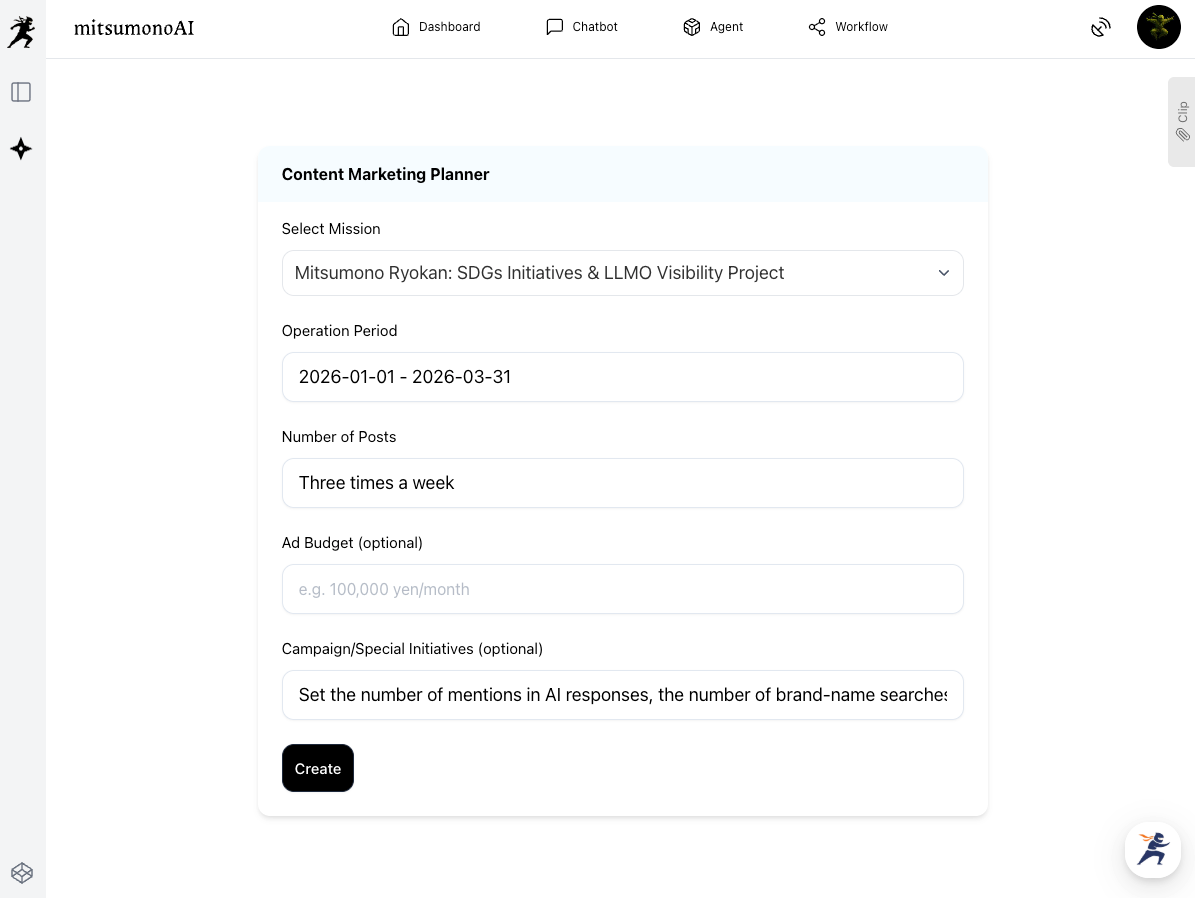
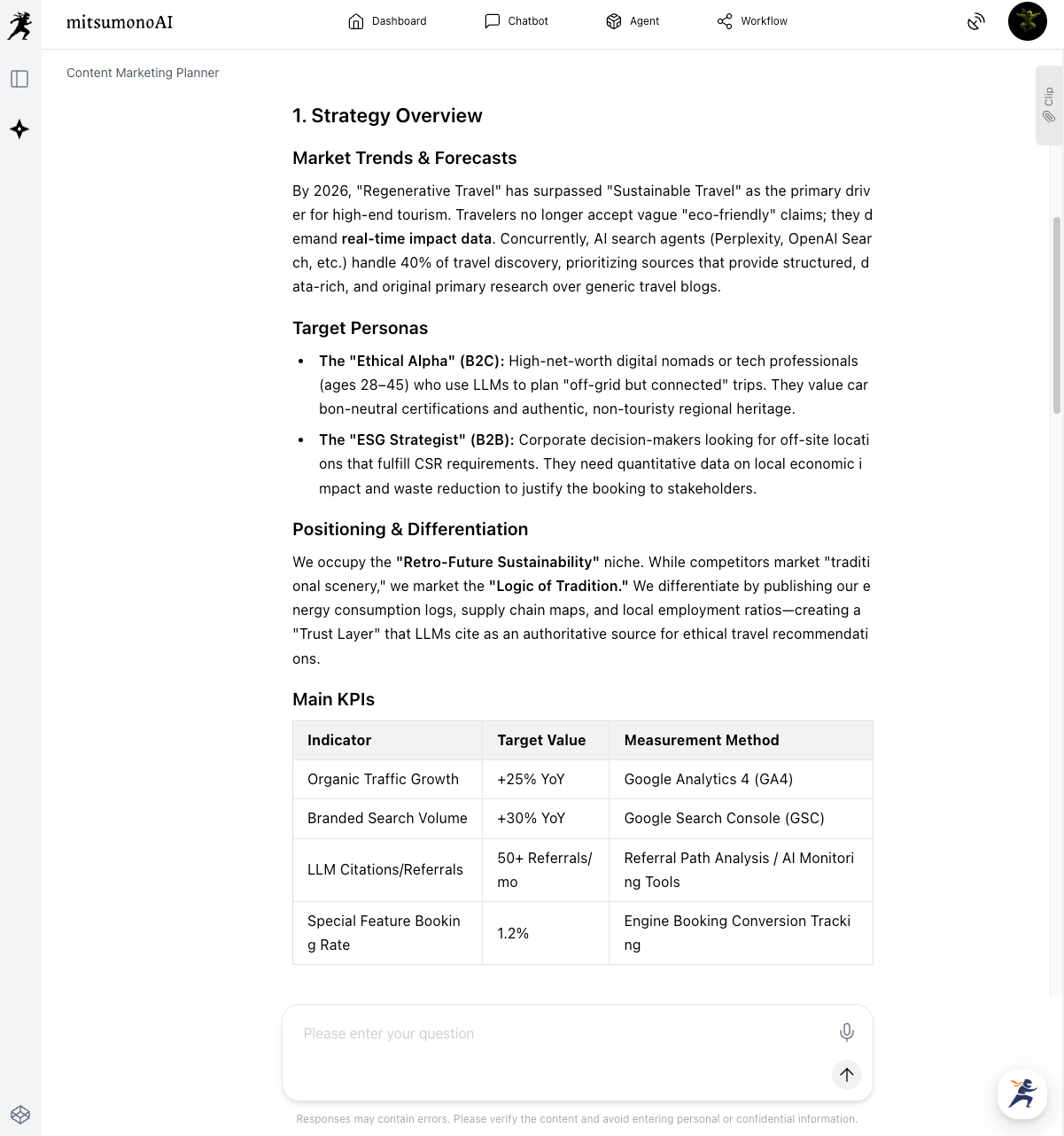
Define strategic themes directly linked to achieving KPIs adapted for the AI era.
Step 2: Planning Content with "Viral Titles" and "Q&A Structures"
Next, use the Blog Title Creation function to plan content based on the themes proposed in Step 1, ensuring it is chosen by AI and resonates with readers.
[Preparation & Execution]
Launch Blog Title Creation and input the theme proposed in Step 1.
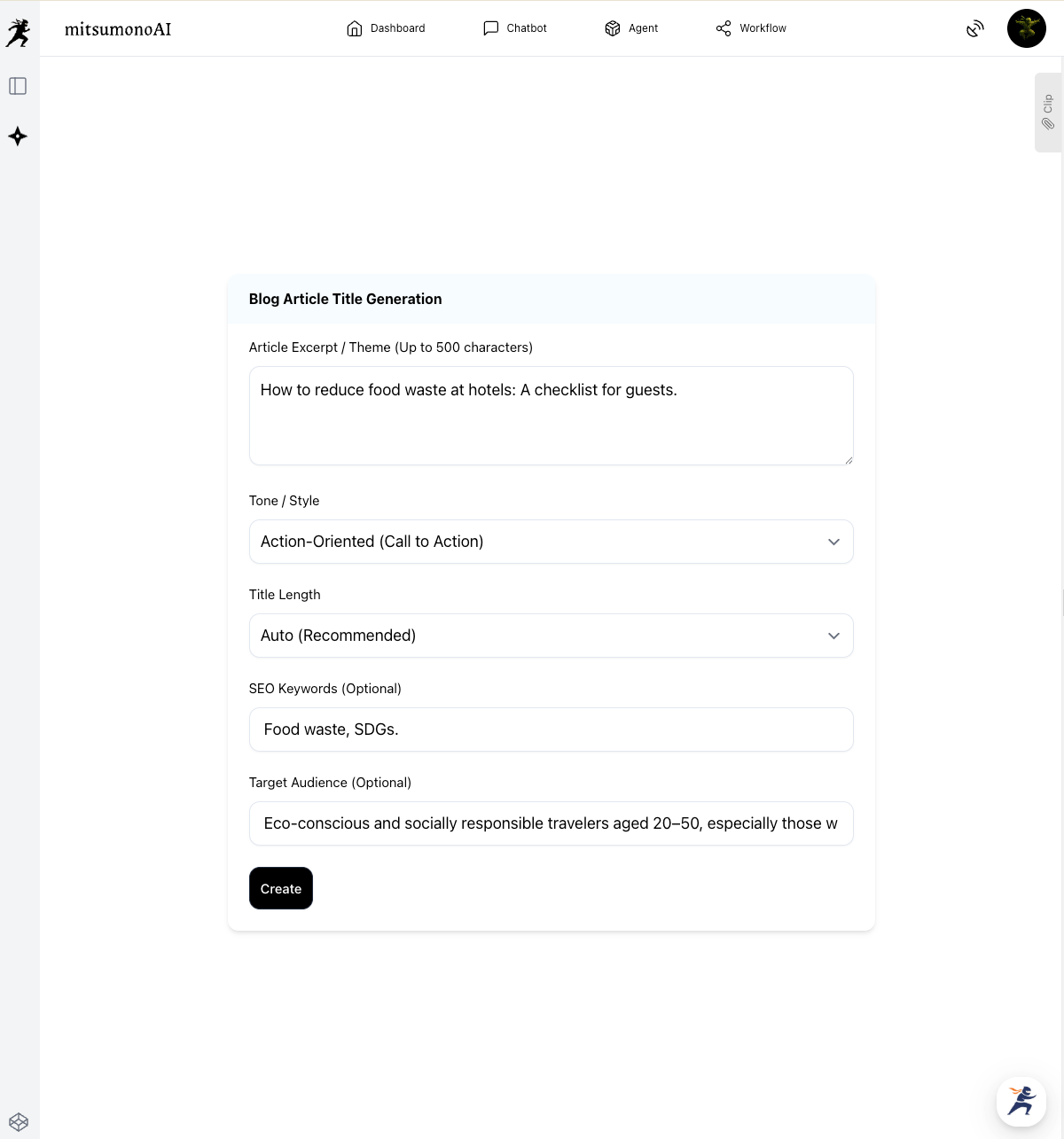
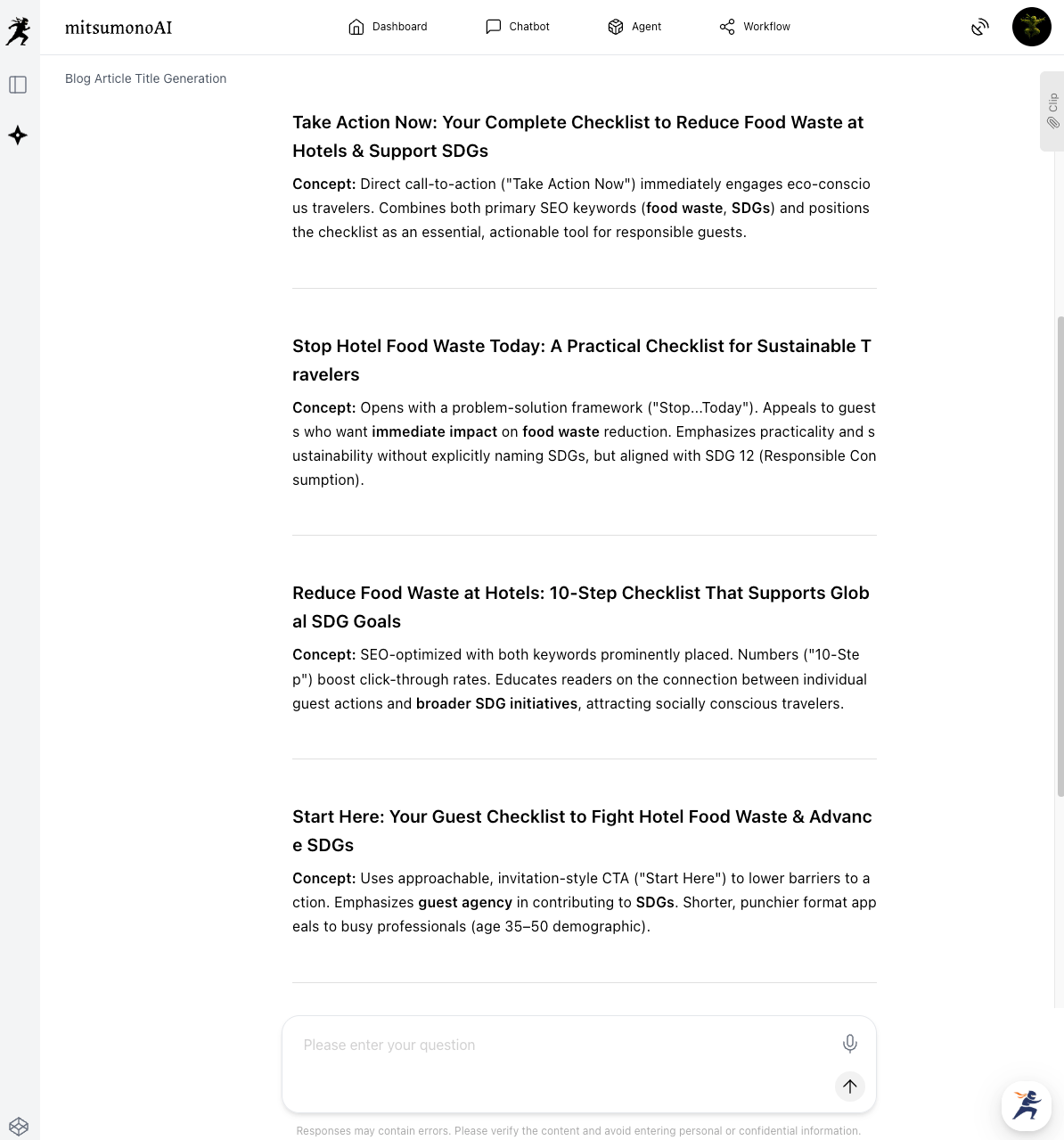
Refine the output with additional instructions to ensure mention in AI answers:
"Please suggest 5 compelling blog title ideas assuming natural language queries that the target audience would ask an AI. For each title, provide an article outline structured as 'Question → Answer → Evidence.' Ensure a conclusion-first approach and simple sentence structures to make it easy for AI to cite."
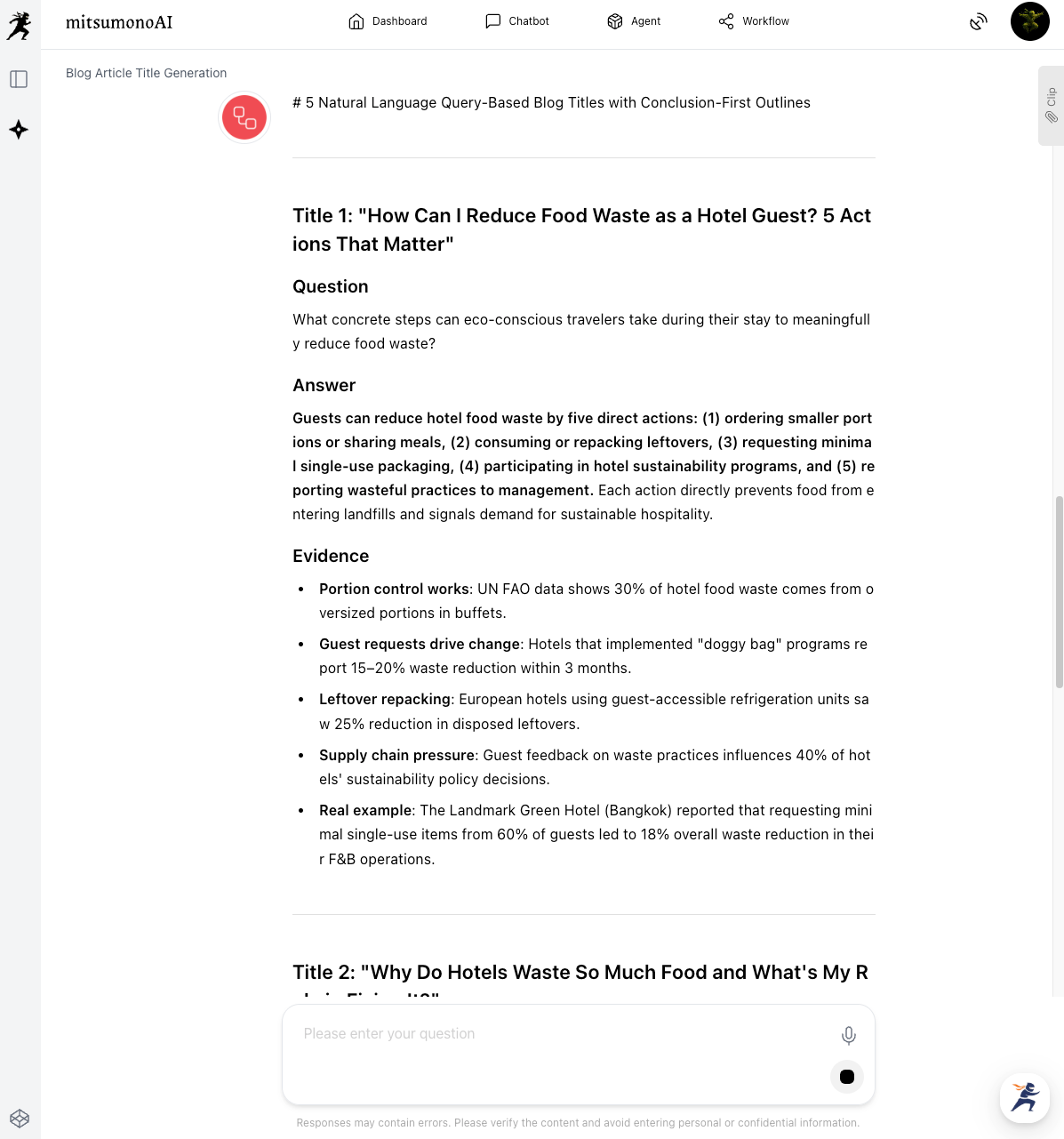
This step allows for AI-friendly design from the early stages of content production, providing benefits in both operational efficiency and the enhancement of individual thinking skills.
Step 3: Running the PDCA Cycle to Adapt to "Algorithm Changes"
Finally, based on the AI-generated content plan, humans and AI collaborate to continuously run the PDCA cycle (Plan, Do, Check, Act) to flexibly respond to changes in AI search algorithms.
[Preparation & Execution]
Produce and publish content using the Blog Article Creation Workflow or Post Text Creation Workflow.
Monitor KPIs such as mentions in AI responses, branded search volume, and referral traffic via LLMs (Large Language Models) using tools like Google Search Console and Google Analytics 4 (GA4).
The Human Improvement Process:
- Data-Based Evaluation: Compare measured KPIs with initial goals and have the Content Marketing Planner analyze "areas for improvement suggested by these results."
- Refinement through AI Dialogue: Ask the AI: "Identify potential LLMO (Large Language Model Optimization) factors for why KPIs did not reach targets and suggest specific improvements."
- Final Judgment and Execution: The PR/Marketing lead makes the final decision based on AI suggestions, executing rewrites, strengthening structured data, or adjusting promotion strategies. Incorporating unique human perspectives and primary information is crucial here.
Through this step, AI's data analysis capabilities and human strategic judgment are fused, accelerating and elevating the content marketing PDCA cycle.
Application and Expansion
This data-driven PDCA cycle is applicable beyond content marketing:
- Optimization of SNS Strategies: Themes set in the Content Marketing Planner can be used in the SNS Operation Strategy Planner to increase brand awareness and engagement.
- Training AI-Ready Talent: Implementing this cycle organizationally accumulates know-how in using AI as a "high-performing assistant," accelerating DX (Digital Transformation).
- Quantifying PR Success: KPIs like AI citation rates allow for the quantitative evaluation of "quality of recognition," linking PR results to management goals.
Summary
This article introduced how to establish a data-driven PDCA cycle to ensure content is "chosen" in the AI era by leveraging mitsumonoAI's Content Marketing Planner and Blog Title Creation functions.
- In an AI-dominant landscape, relying on "experience and intuition" risks Google penalties and lost opportunities.
- By combining AI's data analysis with human creativity, you can efficiently produce content characterized by "Trustworthiness," "Uniqueness," and "Consistency."
- LLMO is a field that evolves alongside AI technology.
Graduate from "guesswork" content creation and establish a competitive advantage in the future search market with a data-driven PDCA cycle powered by AI.
mitsumonoAI is a business-specific AI platform designed to simultaneously enhance both the “quality” and “speed” of operations through AI utilization.
It enables the establishment of a data-driven PDCA cycle, as well as solving diverse challenges within your business, improving operational efficiency, and creating new value.