Systematically Analyzing Guest Complaints to Achieve Fundamental Service Improvements
AI efficiently analyzes past complaint records, clarifying frequent causes and areas for improvement. This supports service quality enhancement based on data.


Tool Used
- File Analysis Assistant
Turning "Dissatisfaction" into "Trust": Service Improvement Learned from Complaints
In the operation of accommodation facilities, customer complaints are inevitable. However, managing and analyzing them involves many challenges. Due to circumstances like "being preoccupied with handling individual cases and lacking the time to identify root causes" or "inconsistent recording methods among staff members making systematic analysis difficult," similar complaints may occur repeatedly, leading to an accumulation of customer dissatisfaction and a risk of lower repeat business and a damaged reputation.
In the "File Analysis Assistant" explained in this manual, AI analyzes the content of complaints from this massive data, extracting and analyzing frequently occurring causes, keywords, and trends. It allows for the identification of fundamental issues based on objective data, rather than relying on intuition or experience, and also enables the consideration of specific countermeasures and improvement plans.
We encourage staff who are "not just focused on handling complaints, but want to fundamentally improve service" to try this utilization method.
Specific Steps
Step 1: Preparing Past Complaint Records
Prepare records related to past complaints (customer reports, response records, free-text responses from surveys, etc.) as CSV data. (Word, PDF, etc. are also acceptable.)
Step 2: Systematic Analysis of Complaint Content and Root Cause Extraction
▶︎ File Analysis Assistant
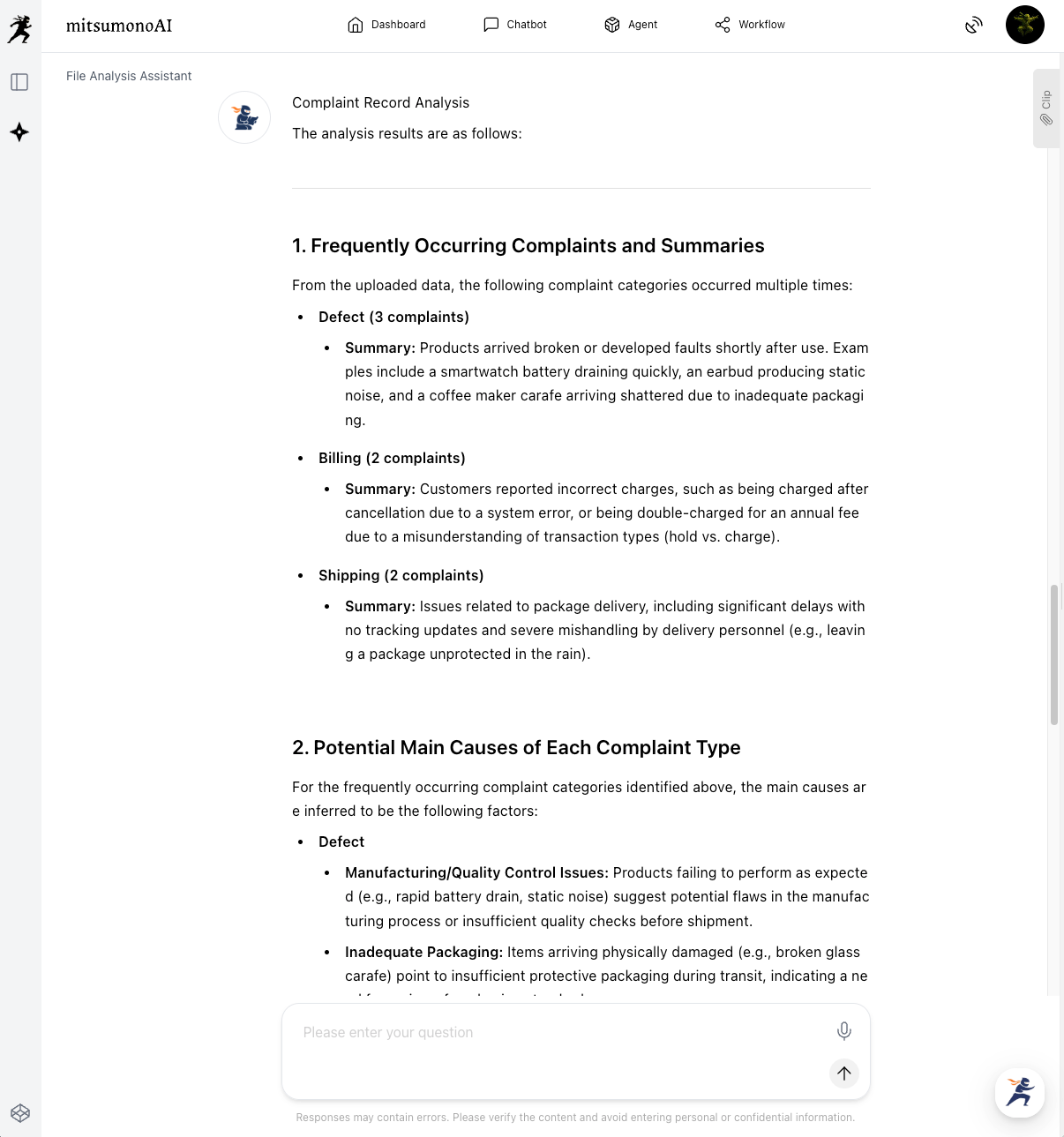
Launch the "File Analysis Assistant" and upload these complaint record files by dragging and dropping or clicking. After uploading the files and clicking "Analyze," the screen will switch to the chat interface. Give the following instructions to conduct a systematic analysis based on the uploaded complaint record data.
1.The types of frequently occurring complaints and a summary of each.
2.Multiple potential factors that are likely the main causes of each complaint.
3.The top 3 complaints considered to be particularly urgent or to have a significant impact on customer satisfaction, along with the reasons.
4.Extract any trends, such as the day of the week, time of day, or location of complaint occurrence."
Step 3: Considering Service Improvement Measures Based on the Extracted Information
▶︎ File Analysis Assistant
Continue in the "File Analysis Assistant" chat screen to instruct the AI to consider fundamental service improvement measures based on the complaint analysis results extracted in Step 2.
"Based on the complaint analysis results above, propose 3 specific improvement measures to enhance our service quality. For each improvement measure, please specify its expected effect, estimated cost, implementation period, and responsible department. Also, indicate which measure should be prioritized and the reason why."
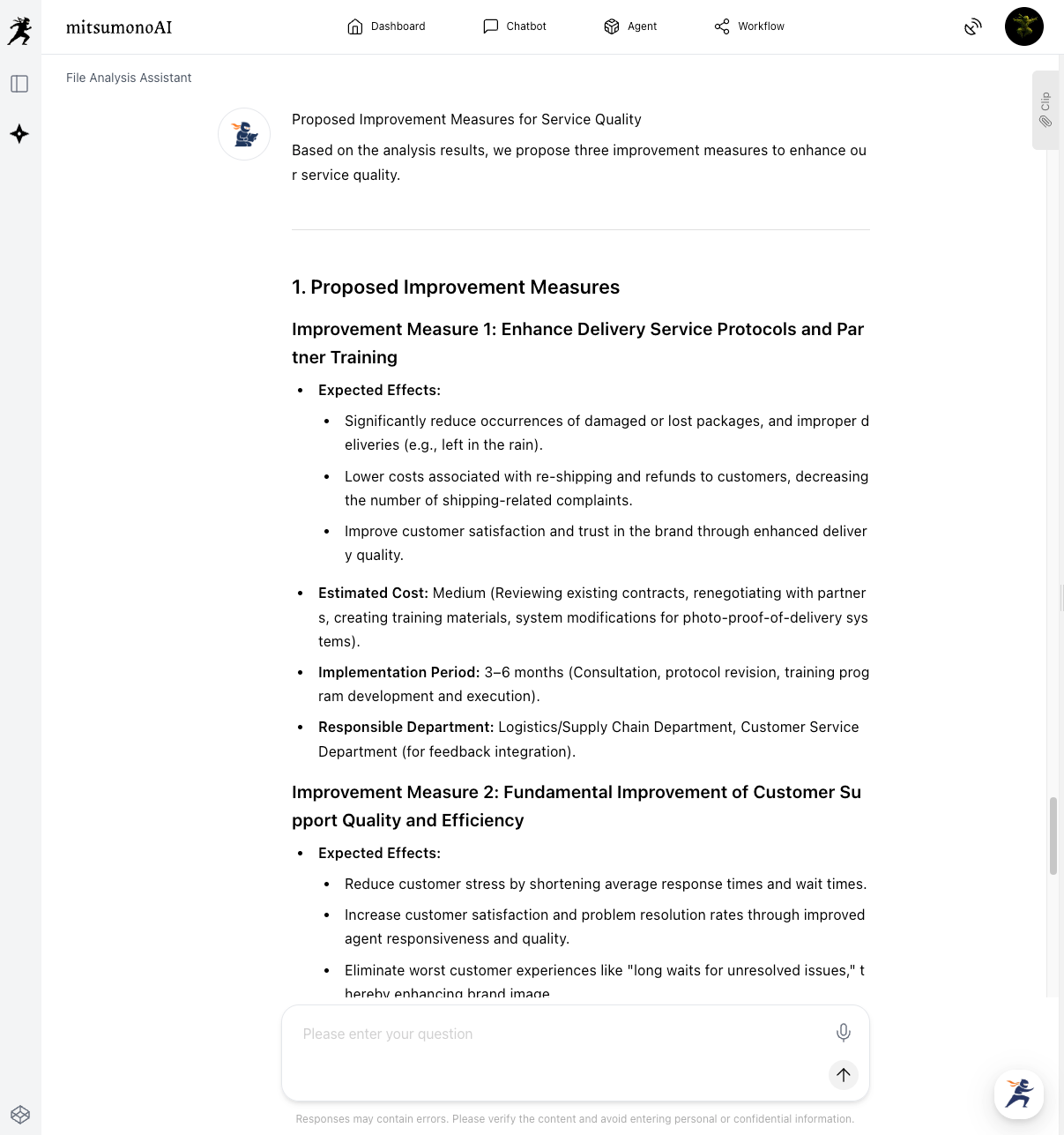
Compared to conventional complaint handling, analysis, and plan formulation, you can quickly and efficiently devise fundamental improvement measures. Following this, by formulating and executing a specific implementation plan internally based on the improvement measures proposed by the AI, you can reliably reduce the number of complaints and improve customer satisfaction.
Expected Results and Goals (Reference Example)
By efficiently and systematically analyzing customer complaints based on data rather than intuition, it becomes possible to identify the root causes of complaints and consider/implement effective service improvement measures, without being limited to just handling individual cases.
As a result, this contributes to preventing the recurrence of similar complaints, improving customer satisfaction, and increasing repeat business. Furthermore, the time and effort spent on complaint analysis can be reduced, improving the work efficiency of the staff in charge.
Target Metrics for the 6-Month Period
KGI (Key Goal Indicator):
- Number of complaints after 6 months: 20% reduction
KPI (Key Performance Indicators):
- Recurrence rate for key complaint items identified by the File Analysis Assistant: 30% reduction compared to conventional methods
- Customer satisfaction score related to "Service Quality" in customer surveys: 0.5 point increase compared to the previous year