Discovering Differentiation Factors for Accommodation Facilities Using SWOT Analysis and Sensei AI
We introduce the steps to verbalize differentiation factors using Sensei AI, which possesses industry-specific expertise, based on the results of a SWOT analysis, and how to utilize them for effective promotion.

Tools Used
- In-house SWOT Analysis Assistant
- Sensei AI - Accommodation
Verbalizing Differentiation Factors is Essential to Be "Chosen"
In any industry, amidst intensifying competition, companies face the questions of "How can we be chosen?" and "What are our company's unique strengths?" Even if you understand the importance of a SWOT analysis, objectively identifying strengths and weaknesses or accurately grasping market opportunities and threats is not easy. As a result, companies may offer services similar to competitors, become caught in price wars, or fail to fully convey their own appeal.
This is where the collaboration between the "In-house SWOT Analysis Assistant" and "Sensei AI - Accommodation Industry" proves useful.
In this article, we introduce the steps from conducting an objective SWOT analysis based on information from the company's own website and external review sites, to how Sensei AI utilizes its specialized knowledge of the accommodation industry to verbalize unique differentiation factors from the results, and finally applying them to promotion strategies.
Specific Steps
Step 1: Conducting the SWOT Analysis and Extracting Key Points
▶︎ In-house SWOT Analysis Assistant
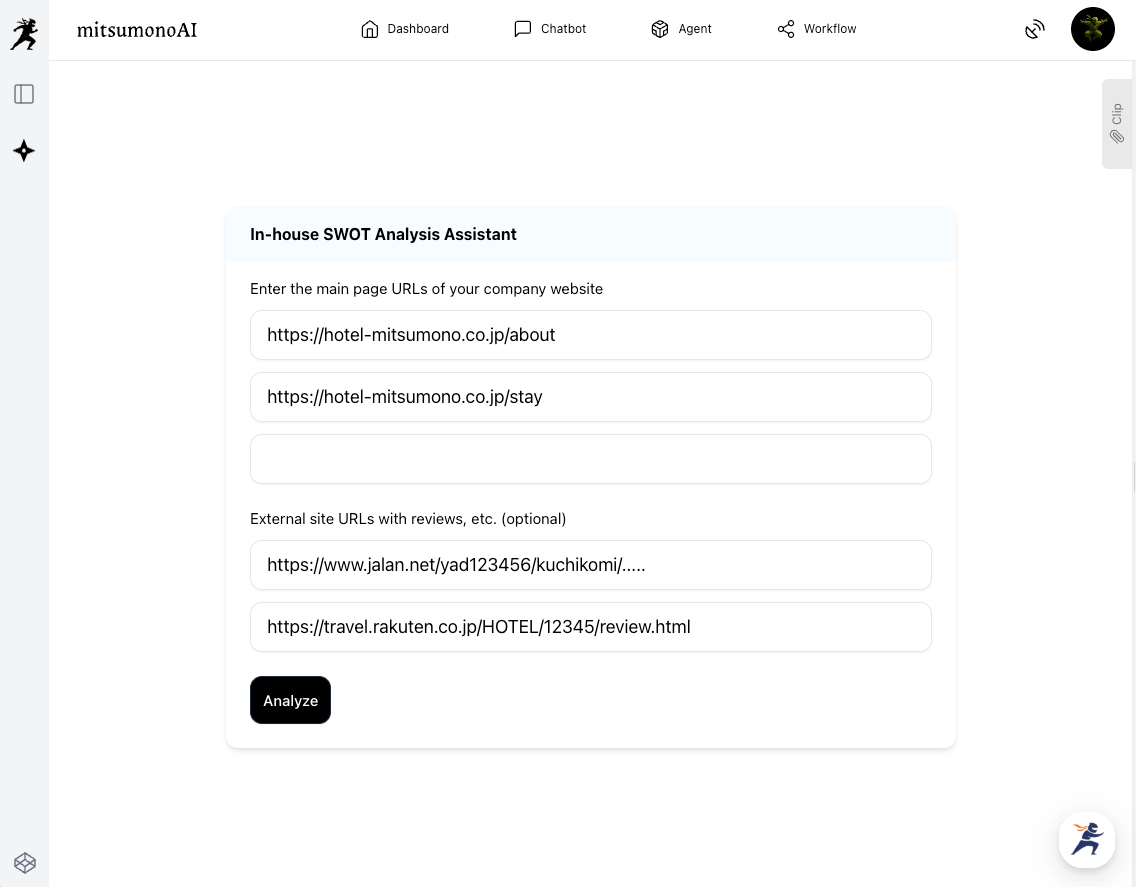
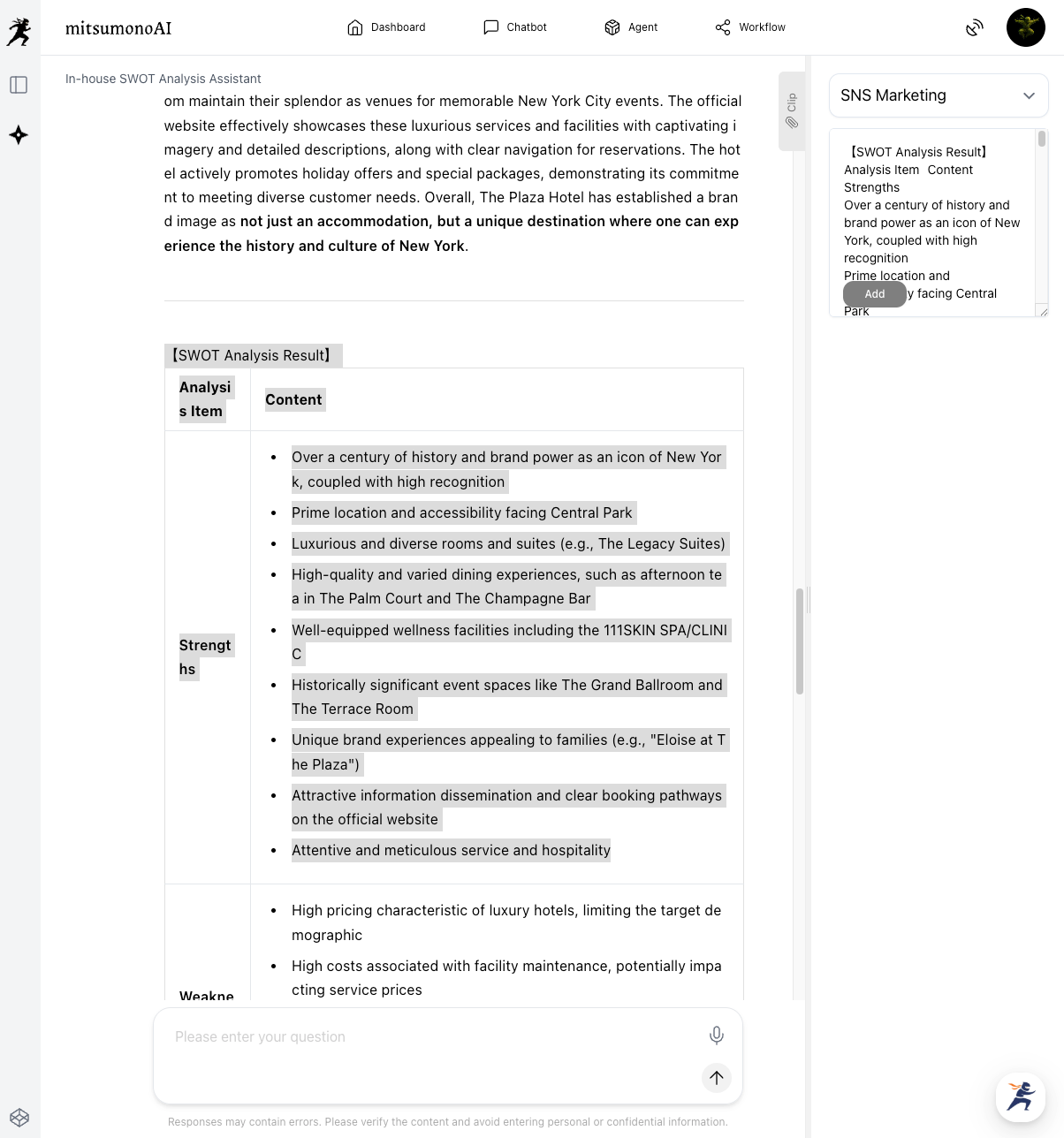
Enter the URL of your company's website and the URL of external sites where reviews are posted (e.g., travel booking sites). After clicking "Analyze," the SWOT analysis results will be output. Review the results and save them in the clip.
Step 2: Consulting on USP Verbalization and Utilization Strategy
▶︎ Sensei AI - Accommodation
Start a chat with Sensei AI by sending the following instruction:
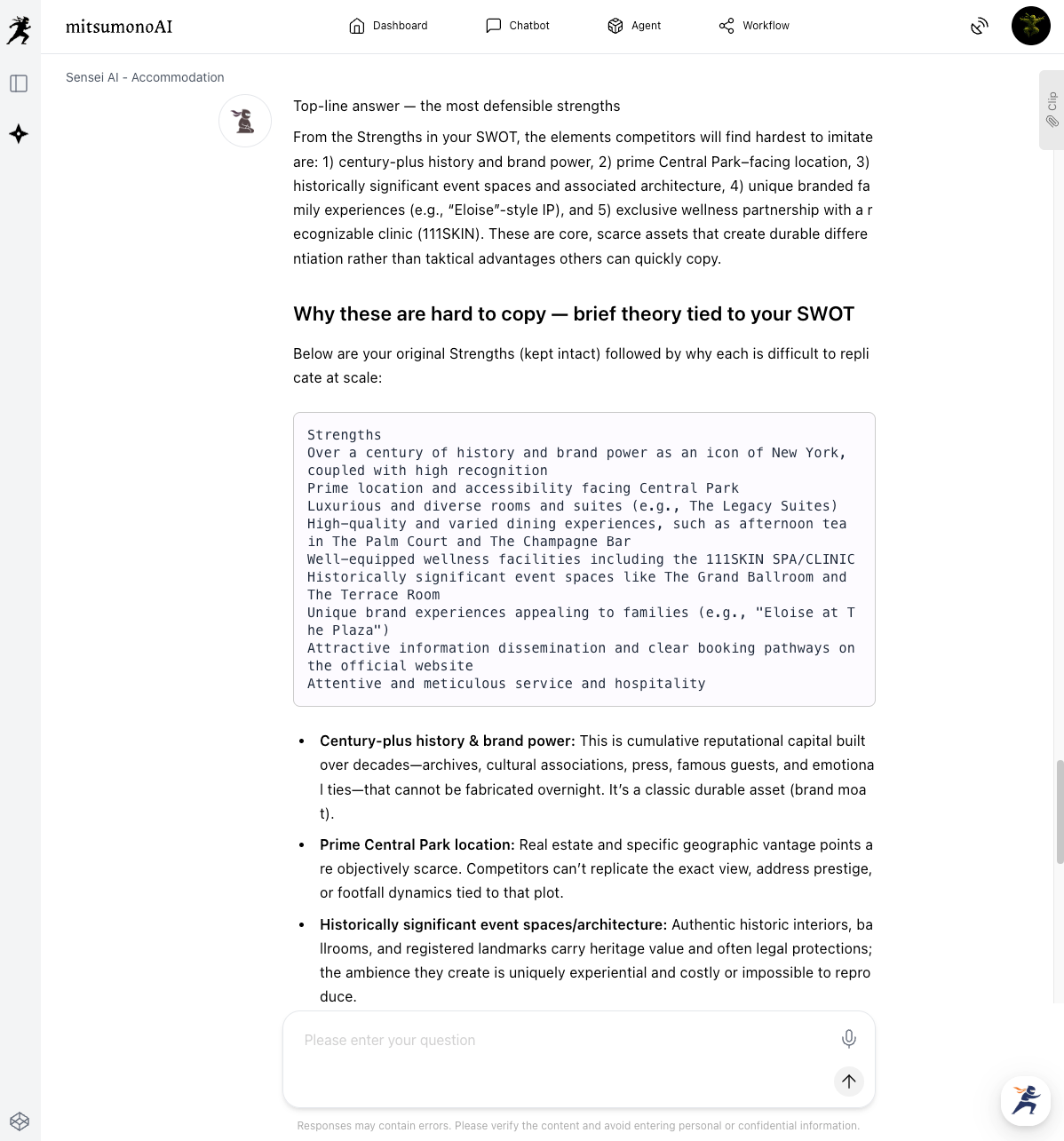
Once the chat screen appears, send the SWOT analysis results that you saved in the clip earlier. Sensei AI will extract unique differentiation factors based on its specialized knowledge of the accommodation industry and the analysis results.
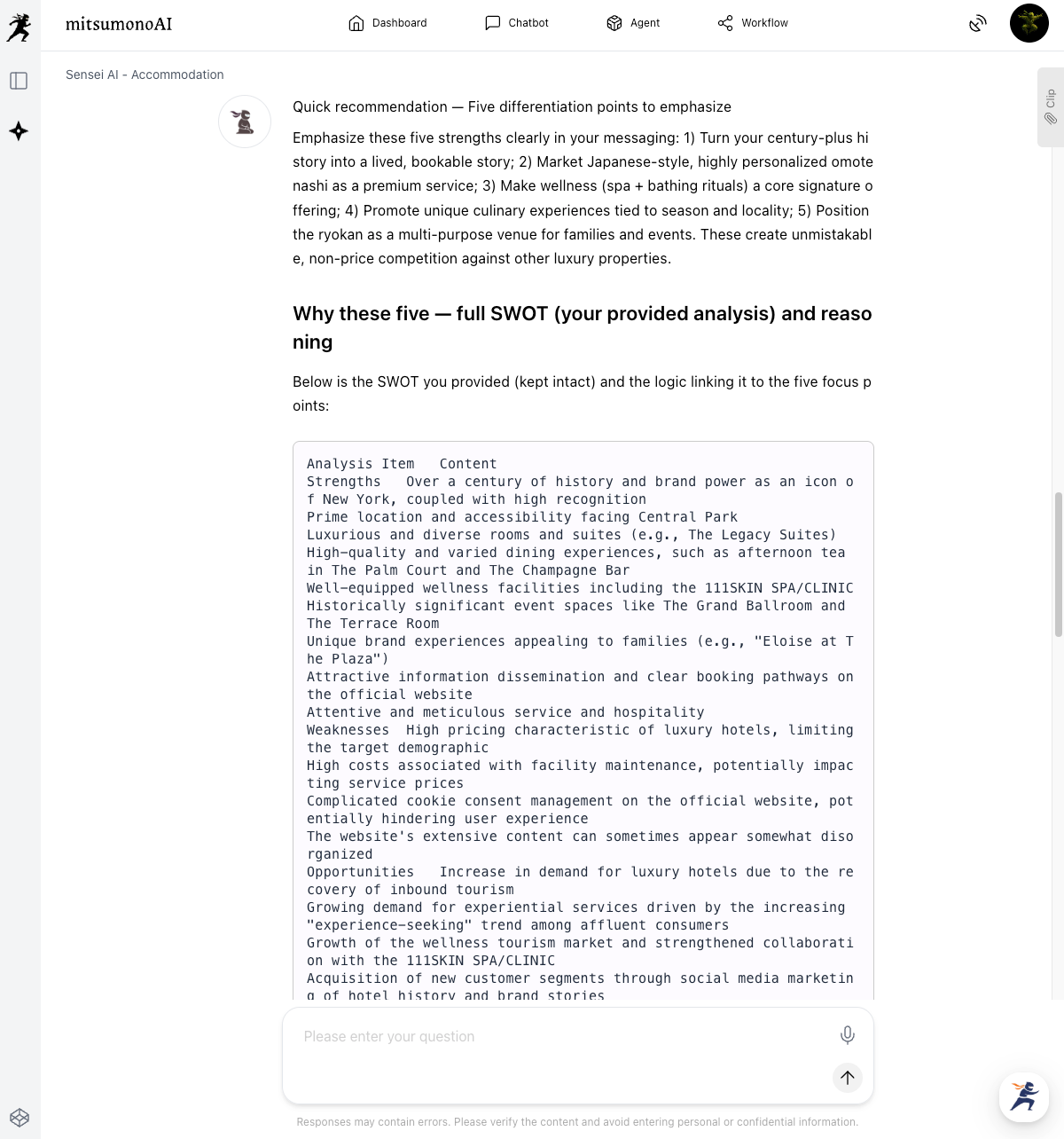
By asking further additional questions, you can find more precise differentiation factors.
"Among the 'Strengths' extracted in the SWOT analysis, which elements are difficult for competitors to easily imitate?"
"Are there any elements of our 'Weaknesses' or 'Market Threats' that can be turned into strengths?"
"When combining 'Market Opportunities' and our 'Strengths,' what is the most unique and feasible value proposition?"
Step 3: Deploying USP into Promotion and Measuring Effectiveness
The USP (Unique Selling Proposition) derived with Sensei AI will be reflected in the following measures:
- Website renewal
- SNS content creation
- Advertising campaigns
- Refresh of brochures and in-house guides
After implementing the measures, key performance indicators (KPIs) (e.g., search traffic volume recalling the differentiation factors, booking conversion rate from the campaign, etc.) will be regularly monitored to measure and improve effectiveness.
Expected Results and Goals (Reference Example)
By objectively grasping the company's strengths and market opportunities, and verbalizing a unique value proposition (USP) that sets it apart from competitors, the appeal to target customers dramatically increases. This makes it possible to shift from intuitive promotion to a data-driven, effective marketing strategy. As a result, the following effects can be expected: Reduction in new customer acquisition costs Increase in existing customer loyalty Establishment of a revenue base not susceptible to price wars Improvement in employee motivation
Target Metrics for the 6-Month Period
KGI (Key Goal Indicator):
- Number of accommodation bookings from the primary target segment: 15% increase compared to the previous year
KPI (Key Performance Indicators):
- Web search traffic volume for keywords recalling differentiation factors: 20% increase compared to the previous year
- Number of visitors to site pages introducing the USP: 25% increase compared to the previous year
- Engagement rate of SNS campaigns utilizing the USP: 18% improvement compared to the previous year