How to Conduct "Questionnaire Analysis" and Formulate Improvement Measures to Increase Customer Satisfaction at Accommodation Facilities
Based on open-ended responses from accommodation facility questionnaires, you can identify issues and formulate feasible on-site improvement measures with AI, without relying on experience or intuition.

Tools Used
- File Analysis Assistant
- Sensei AI - Accommodation
Deriving Specific Improvement Points from Questionnaire Data
Open-ended comments submitted via questionnaires are a valuable source of information for understanding customers' true needs and dissatisfactions. However, many staff members struggle with issues like "finding specific improvement points is difficult due to vague opinions" or "objective analysis is tough because personal subjectivity tends to creep in, making it hard to link to improvements."
We introduce a method for quickly analyzing large amounts of free-text data, extracting specific improvement points from that data, and collaborating with Sensei AI to consider feasible on-site measure proposals. Questionnaire analysis, which previously required significant time and effort, will be dramatically streamlined, enabling objective, data-driven decision-making.
If you feel you are "not fully utilizing customer feedback," please try this method.
Specific Steps
Step 1: Preparing the Questionnaire Data
Prepare files containing the customers' open-ended responses from the questionnaires.
⚠️*From the perspective of personal information protection, it is recommended that any items constituting personal information be removed or anonymized from the data beforehand.
Step 2: Analyzing the Questionnaire Data
▶︎ File Analysis Assistant
Drag and drop or click to upload the prepared questionnaire files, and click the "Analyze" button.
Once the upload is complete, the screen will switch to the chat interface. Give the following instruction regarding the content you wish to analyze.
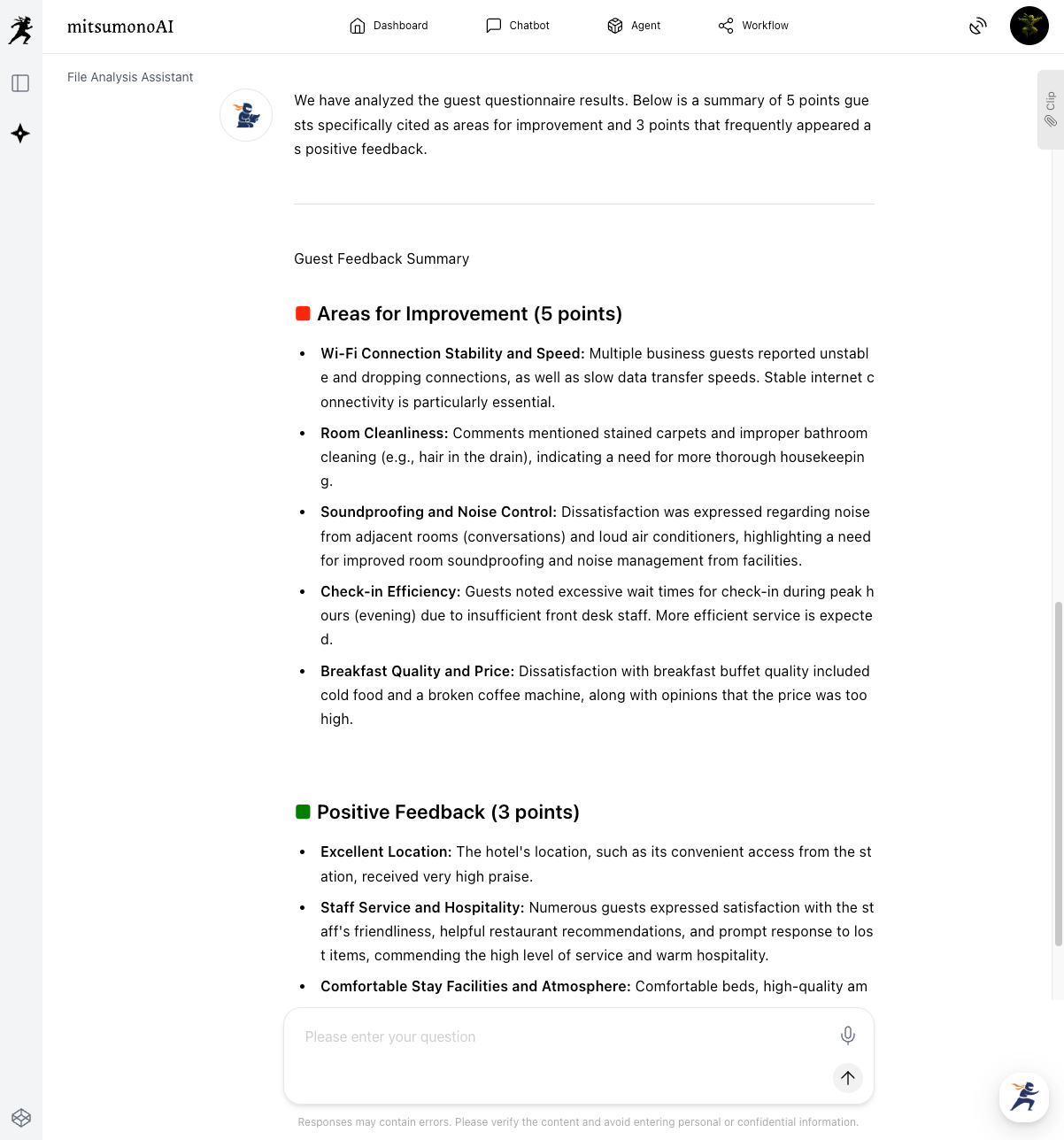
Once the AI's analysis results are displayed, identify the areas specifically cited for improvement and save them using the clip function.
Step 3: Jointly Formulating Improvement Measures with the AI Consultant
▶︎ Sensei AI - Accommodation
Next, switch to "Sensei AI - Accommodation Industry." Send the following message to start the chat.
Then, send the information about the "areas cited as improvement points" that you saved in the clip earlier. Sensei AI will begin proposing specific improvement measures based on its specialized knowledge of the accommodation industry.
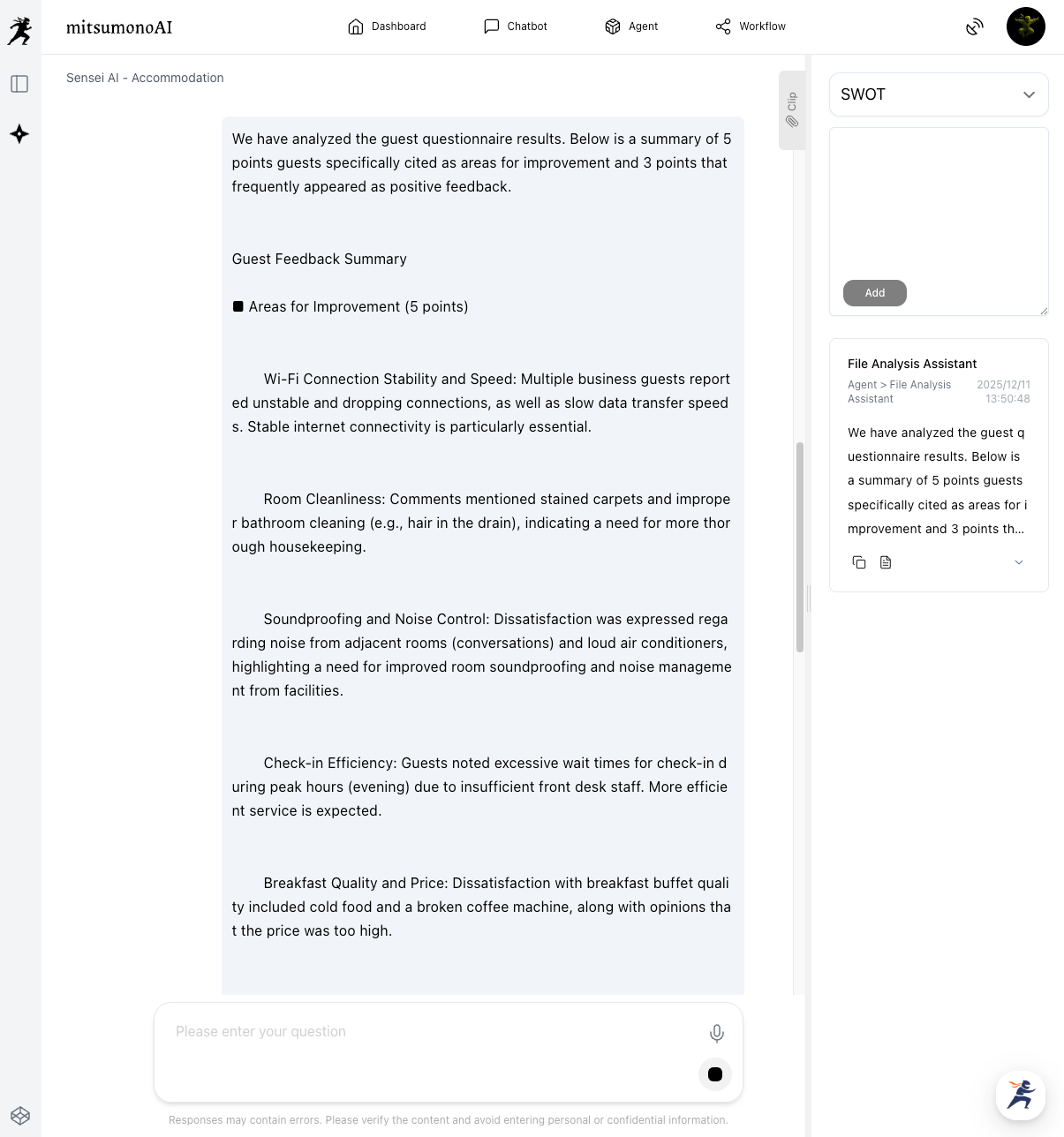
If there are services proposed as improvement measures for which a budget cannot be immediately secured, or which are difficult to implement due to facility constraints, you can flexibly modify the improvement proposals by providing specific information to Sensei AI.
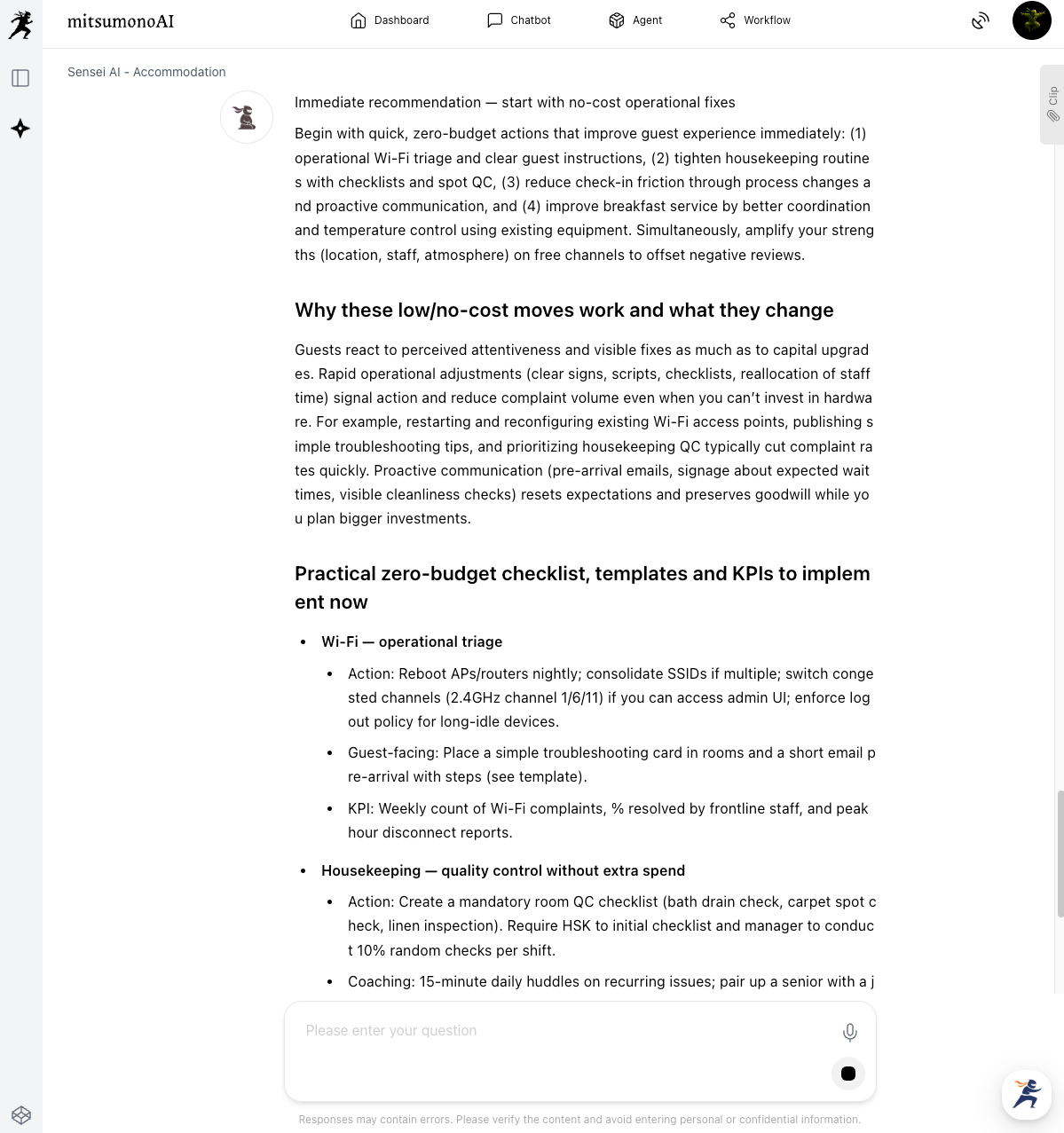
For example, provide the following additional instructions. Sensei AI can consider these constraints and adjust realistic alternatives or priorities.
"Expansion of the parking space is impossible. Are there any other suggestions?"
Step 4: Implementing the Improvement Measures
Based on the improvement measures obtained from Sensei AI, execute the measures with a planned approach across different phases and measure the effects.
Expected Results and Goals (Reference Example)
By implementing this method, open-ended comments from customers will lead to specific improvement actions, directly linking to higher customer satisfaction. Staff who previously spent vast amounts of time on analysis can now formulate improvement measures based on objective data in a shorter time, significantly improving operational efficiency.
Furthermore, utilizing the specialized knowledge of Sensei AI provides deep insights into issues specific to the accommodation industry and concrete, feasible on-site measure proposals. This promotes data-driven decision-making that reflects the "authentic voice" of the customer in business strategy. As a result, it will contribute to increased customer loyalty, a higher repeat rate, and the acquisition of new customers.
Target Metrics for the 6-Month Period
KGI (Key Goal Indicator):
- Repeat customer rate after 6 months: 5% increase
KPI (Key Performance Indicators):
- Response rate to "Would you like to use our services again?" in customer questionnaires: 85% or higher
- Average online review score after implementing improvement measures: 4.5 points or higher
- Number of customer complaints: 20% reduction