Building a Communication Strategy for Repeat Customer Acquisition Guided by Accommodation Data and Sensei AI
We introduce the steps to analyze your existing guest data to find the key to acquiring repeat customers and executing effective outreach.


Tools Used
- File Analysis Assistant
- Sensei AI - Accommodation
The Key to Repeat Customer Acquisition Lies in Utilizing Customer Data
Past accommodation history and customer data are truly a "treasure trove." However, are you making use of the valuable insights that should be derived from the data, such as "What kind of guests are becoming repeat customers?" or "Conversely, what kind of guests are not returning?"
In fact, this accumulated customer data holds the key to acquiring repeat customers. In the current era of surging new customer acquisition costs, valuing existing customers and increasing the repeat rate are essential for revenue stabilization and business growth. Analyzing customer data allows for a deep understanding of repeat customer characteristics, enabling the execution of communication strategies that resonate with individual guests.
This article introduces the specific method of combining mitsumonoAI's "File Analysis Assistant" and "Sensei AI - Accommodation Industry" to analyze customer data and find the key to repeat customer acquisition. Let's achieve tangible results by grasping repeater trends from the accumulated data and executing effective outreach.
Specific Steps
Step 1: Preparing the Customer Data File
Prepare a file (such as CSV format) summarizing past accommodation history and customer data. Including the following information allows for more detailed analysis.
⚠️However, be extremely careful to exclude any personal information.
・Customer ID or reference number
・Address location (up to prefecture or municipality name)
・Last stay date
・Number of stays
・Plan used
・Room type
・Questionnaire responses (e.g., satisfaction level, intent to repeat)
*Items such as addresses, email addresses, and phone numbers are considered personal information and should be excluded.
Step 2: Analyzing the Customer Data
▶︎ File Analysis Assistant
Upload the customer data file prepared in Step 1 to the "File Analysis Assistant" and start the analysis.
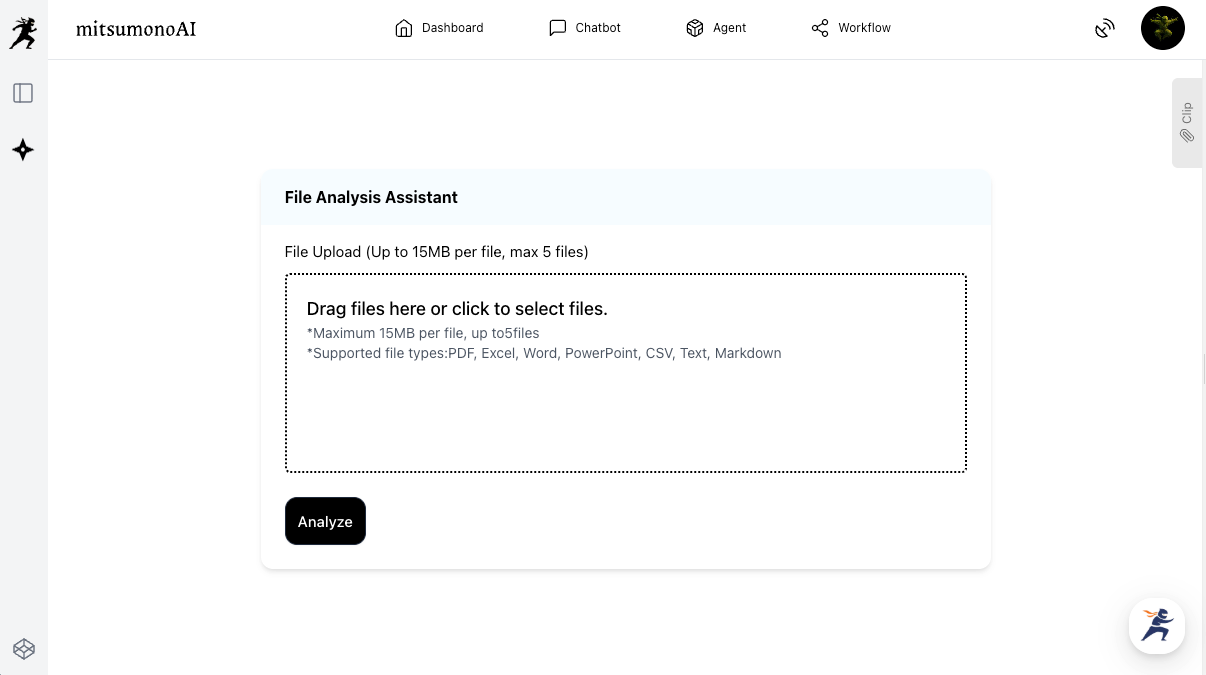
Specify the items you want to analyze (e.g., number of stays, days elapsed since the last stay, trend of plans used) and execute the analysis. Identify the characteristics of potential repeat customer segments based on the following instructions.
The results of the analysis to be performed will be used to identify repeat customers and propose communication measures for our hotel.
Please output the following items in a summary format.
・Main characteristics of customer segments with a high number of repeat stays (e.g., age group, gender, plans used, frequency of stay)
・Difference in repeat rate by age group and gender
・Trend analysis of customers who repeatedly use specific accommodation plans (e.g., standard plan)
Save or copy this output as it will be used in the next Step 3.
Step 3: Considering Measures to Increase Repeat Customers
▶︎ Sensei AI - Accommodation
Share the analysis summary from the "File Analysis Assistant" with "Sensei AI - Accommodation Industry" to identify potential repeat customer segments and consider individualized approach methods and communication measures.
Start the conversation with Sensei AI by sending the following instruction along with the summary text related to repeat customers outputted in Step 2, which you saved or copied in the clip.
[Paste the repeat customer-related summary text outputted in Step 2 here]
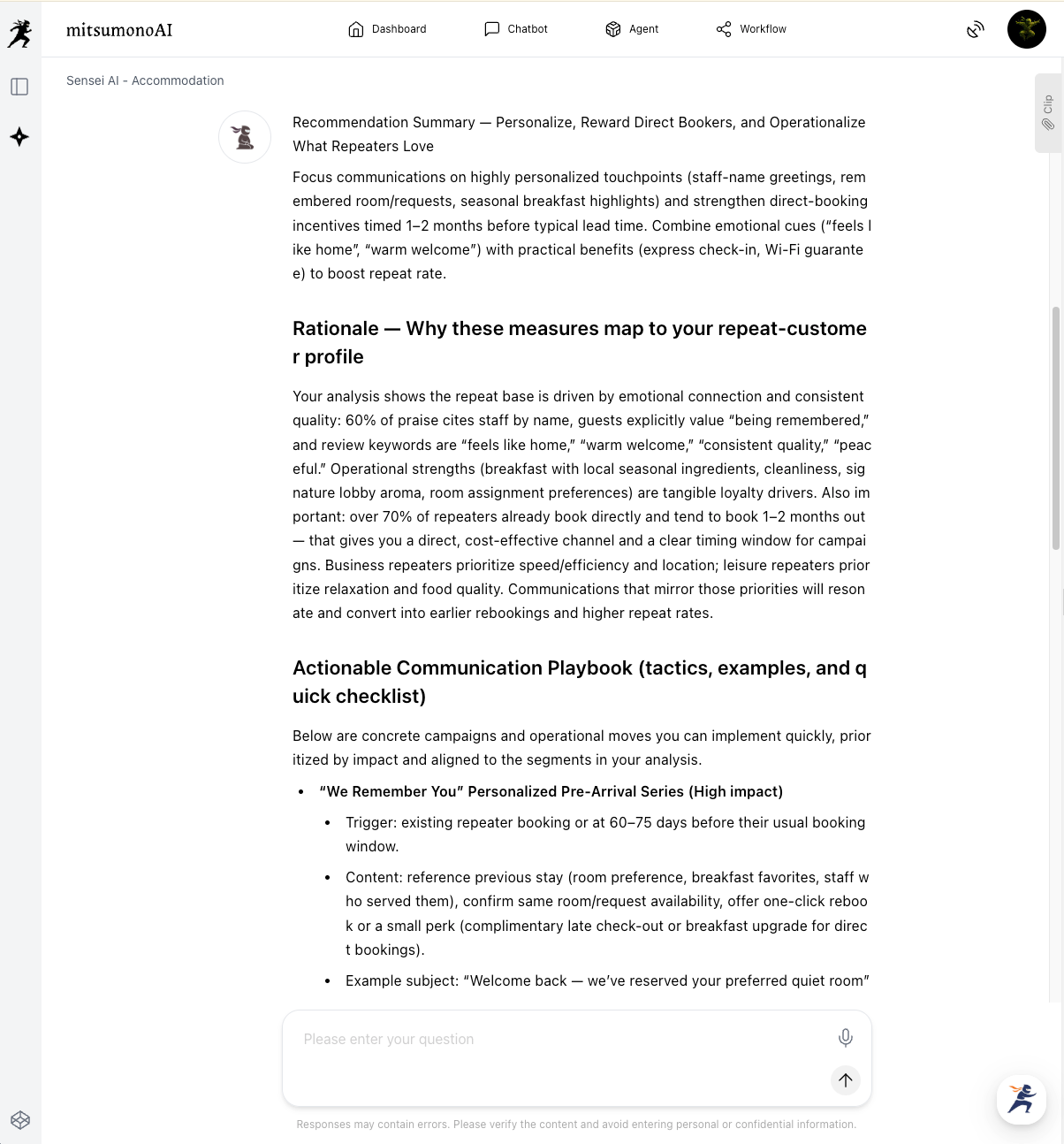
Step 4: Specifying AI's Proposal and Formulating an Execution Plan
▶︎ Sensei AI - Accommodation (Continued)
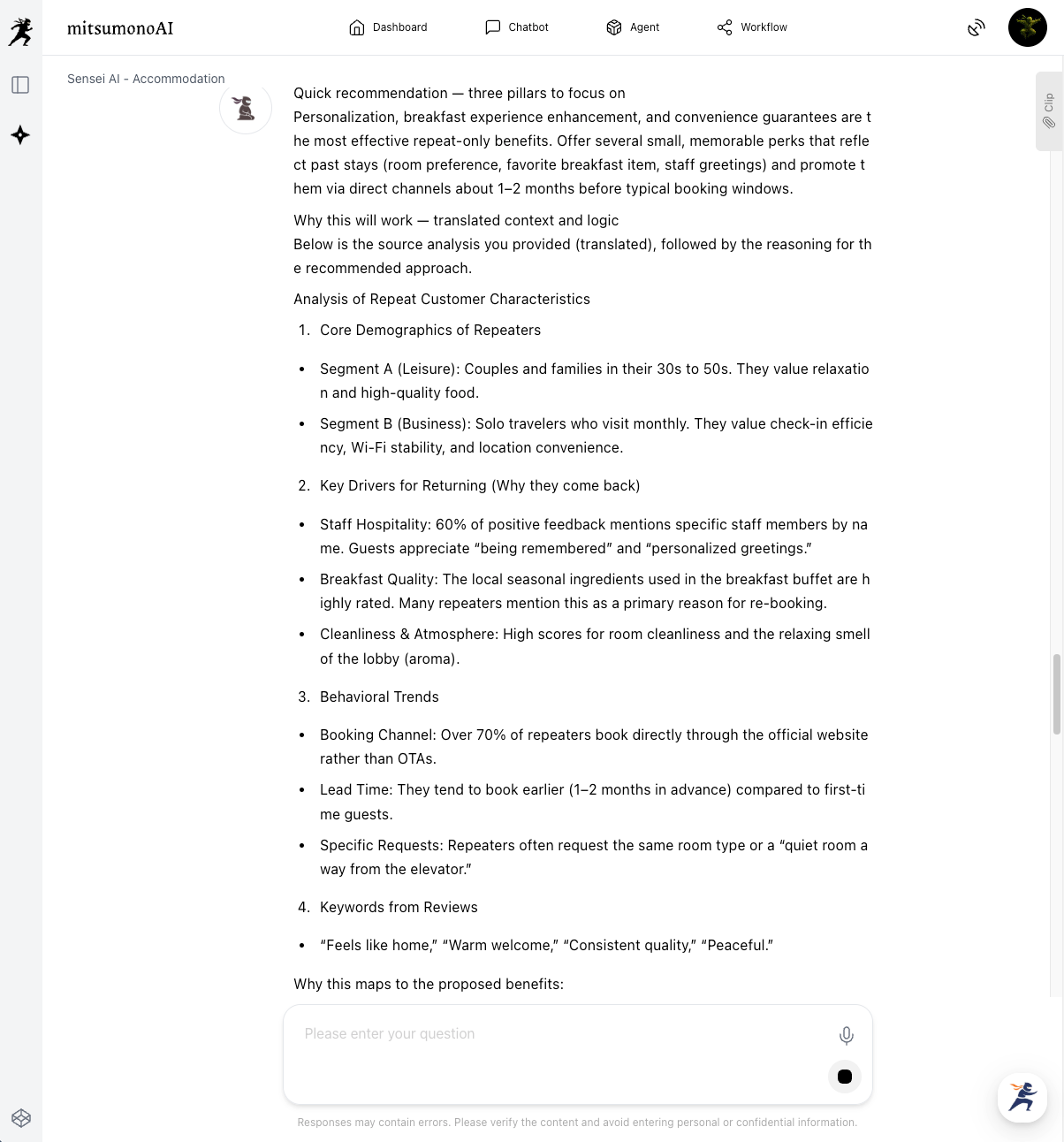
Based on the measure proposals from "Sensei AI - Accommodation Industry" (e.g., email notification for repeat-customer-only special plans, birthday benefit announcements, information dissemination tailored to customer interests), refine them into concrete action plans, considering realism and feasibility. Through chat (conversation) with the AI, clarify the necessary elements for measure execution, such as the following:
Specific Content of the Measures
- Target Customer: Which customer segment (e.g., potential repeaters, customers at risk of churn) to approach.
- Communication Channel: Which channel to use (e.g., email, SMS, LINE, SNS ads, phone).
- Message Content: Specific benefits, discount rates, key appeal points, and how to personalize information (past usage history, birthday, etc.).
- Creative: Mail subject line, body text, SNS ad copy, and the image/video concept to be used.
Execution Plan
- Person in Charge: Who is responsible for execution.
- Schedule: What actions will be taken by when (e.g., draft email text by [Date], launch delivery on [Date]).
- Required Resources: Budget, personnel, and tools confirmation.
"Regarding the proposed repeat-customer-only special plan, please suggest several ideas for specific benefit content. Also, propose specific catchy copy ideas that would resonate with the anticipated target customers."
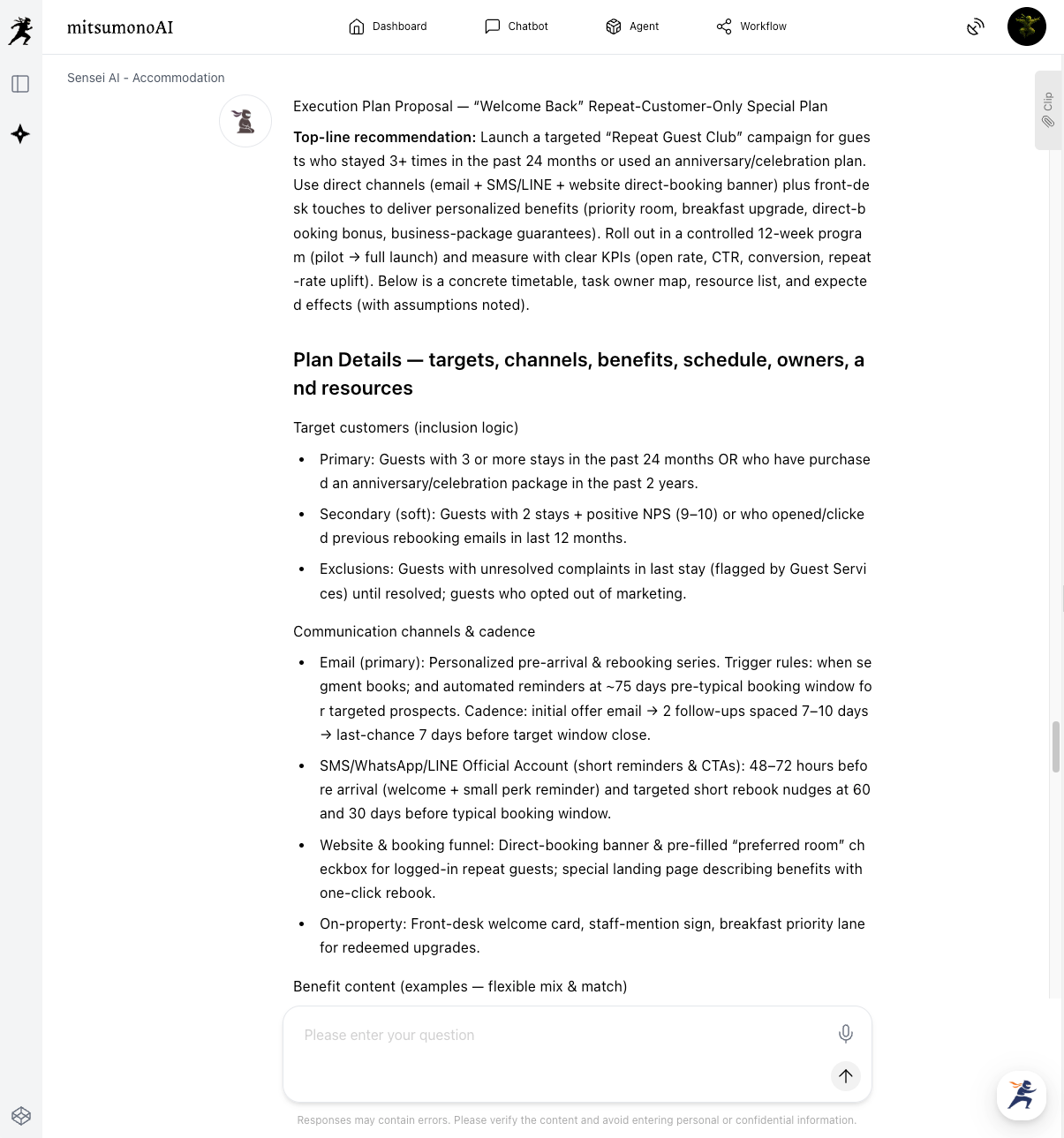
"Please create a concrete execution plan proposal for the proposed repeat-customer-only special plan. This should include the following elements:
・Target Customer (e.g., customers who have stayed 3 or more times in the past 2 years and used an anniversary plan)
・Communication Channel (e.g., email distribution, LINE Official Account)
・Benefit Content (e.g., discount coupon usable on the next booking, priority access to exclusive activities)
・Schedule (e.g., plan content finalized by [Date], notification launch in the week of [Date])
・Person in Charge (e.g., Marketing Staff, Reservation Staff)
・Required Resources (e.g., email distribution system, LINE Official Account operation costs, cost of providing benefits)
・Expected Effects (e.g., email open rate, click-through rate, number of bookings from the special plan)"
Step 5: Effect Measurement and Continuous Improvement
The effects of the implemented communication measures (changes in open rate, click-through rate, booking rate, repeat rate, etc.) are regularly measured and analyzed.
Based on those results, the measures for repeat customer acquisition and nurturing are optimized by discussing improvement points and subsequent approach methods through dialogue with the AI.
Expected Results and Goals (Reference Example)
By utilizing AI for customer data analysis, previously dormant customer information can be linked to concrete actions for "repeat customer acquisition." Accurately grasping customer attributes and usage trends with the File Analysis Assistant and obtaining personalized measure proposals from Sensei AI - Accommodation Industry enables effective communication.
This method contributes not only to increasing the repeat rate by enhancing the satisfaction of each individual customer but also to maximizing future LTV and stabilizing revenue.
Target Metrics for the 6-Month Period
KGI (Key Goal Indicator):
- Repeat customer rate after 6 months: 3% increase
KPI (Key Performance Indicators):
- Creation of personalized communication measure proposals for repeat customer nurturing by "Sensei AI - Accommodation Industry" (email, SNS ads, exclusive plan proposals, etc.): 10 items
- Execution of high-priority measure proposals (3 email distributions, 1 SNS ad campaign, etc.): 4 items
- Open rate for implemented email measures: 30% or higher
- Click-through rate for implemented email measures: 5% or higher