Knowledge DX : Automating Training by Transforming Dormant Meeting Records into the Ultimate Textbook via 3-Step AI Operations
Revive forgotten meeting minutes where valuable insights often go unnoticed. This article explains three specific steps of "Knowledge DX," using AI to extract critical expertise from records and automatically convert them into "Training Manuals" that turn new staff into immediate assets.


Transforming Records into "Living Manuals": Accelerating
Knowledge DX with AI Transcription data from regular meetings or improvement brainstorming sessions is packed with frontline expertise that rarely makes it into formal manuals. However, reviewing and organizing vast amounts of text is a daunting task.
This article explains how to use mitsumonoAI to automatically structure dormant records and convert them into practical checklists. By condensing manual creation—a task that previously took several days—into just three AI steps, you can simultaneously reduce organizational training costs and achieve service standardization.
[Recommended for those facing these challenges]
- Meeting recordings and transcriptions are accumulating, but the content is unorganized and underutilized.
- Lack of time for manual creation leads to reliance on oral tradition from veterans or person-dependent training.
- Errors or troubles previously addressed in past meetings continue to recur on the frontline.
- A desire for a specific flow to externalize internal implicit knowledge into explicit knowledge quickly and at a low cost.
Below, we simulate a case where a long-established Japanese inn (Ryokan) creates a "Greeting Manual" for new staff based on raw data from a "Service Quality Improvement Meeting" captured via external recording and transcription tools.
Step 1: [File Analysis Assistant PRO (without guardrail)] – Discovering "Master Skills" within Disorganized Records
First, upload your transcription data (PDF/Word files created via Zoom or transcription apps) to the File Analysis Assistant PRO (without guardrail).
[Key Point] The secret is to load the "Full Transcription Data" rather than concise "Minutes." This allows the AI to capture the subtle nuances and specific attention to detail from veterans that are often omitted in summarized documents.
Prompt Example: File Analysis Assistant
"Please analyze the uploaded transcription data. Specifically, extract concrete expertise regarding 'timing for greeting guests' and 'initial response during troubles' mentioned by the Proprietress (Okami) or Manager, prioritizing the authentic language used on-site."
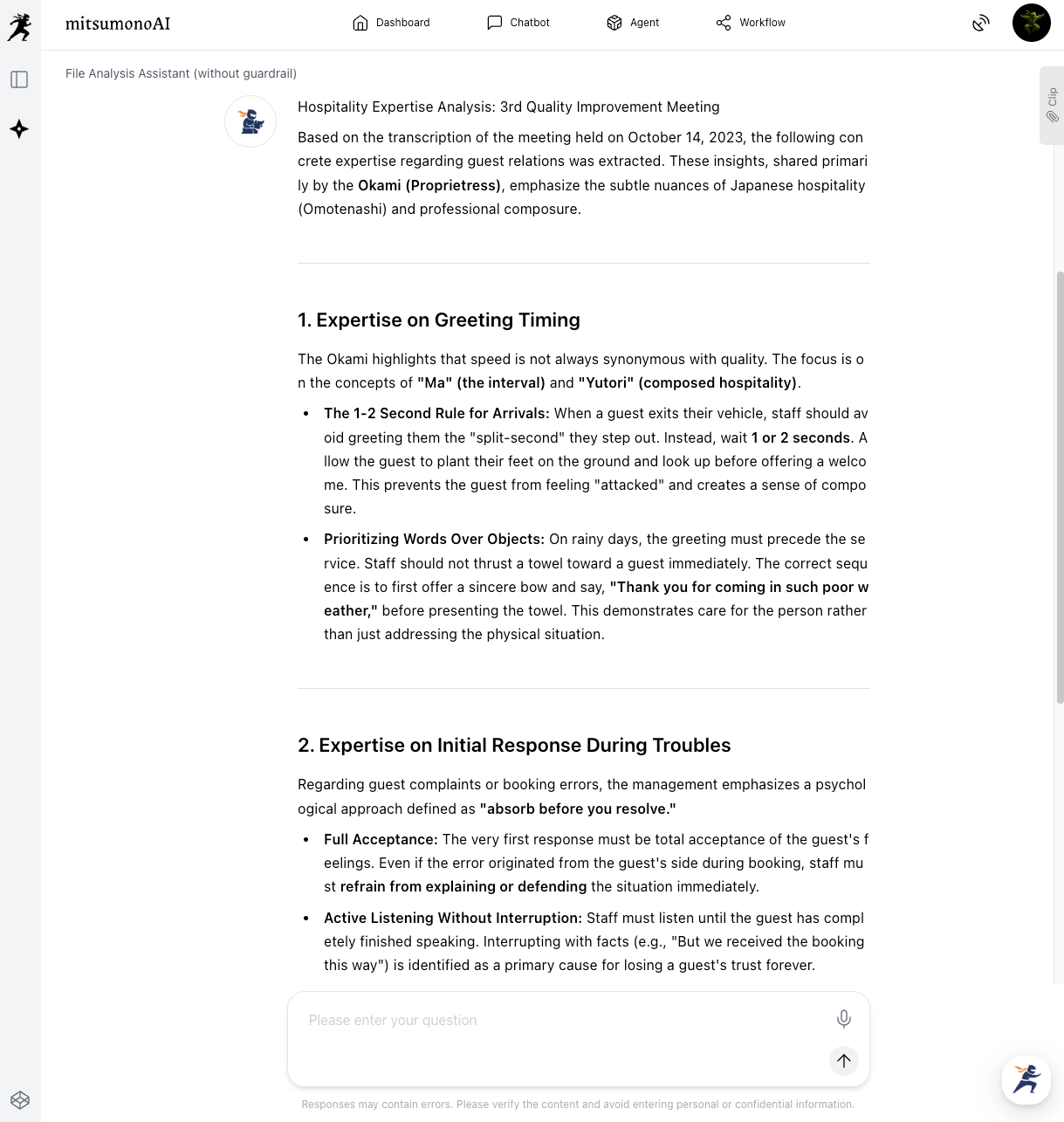
The AI filters out small talk and administrative updates, extracting only lived wisdom, such as: "When greeting guests on a rainy day, before handing over a towel, always start with a brief word: 'Thank you for coming in such poor weather...'"
Step 2: [Text Summarization Workflow] – Refining Accuracy by Stripping Information Noise
Next, process the information extracted in Step 1 through the "Text Summarization Workflow."
[Key Point: Why is this step necessary?]
You might think, "Why not just turn the extracted data into a manual immediately?" However, data immediately following AI extraction often contains redundant contexts or unnecessary expressions. By inserting a "Summarization and Structuring" stage, you can thoroughly eliminate noise and refine the core essence of the manual. This single extra step determines the final manual's "usability."
[Preparation & Execution] Launch the Text Summarization Workflow and paste the output from Step 1 (or the relevant sections of the minutes) into the original text area.
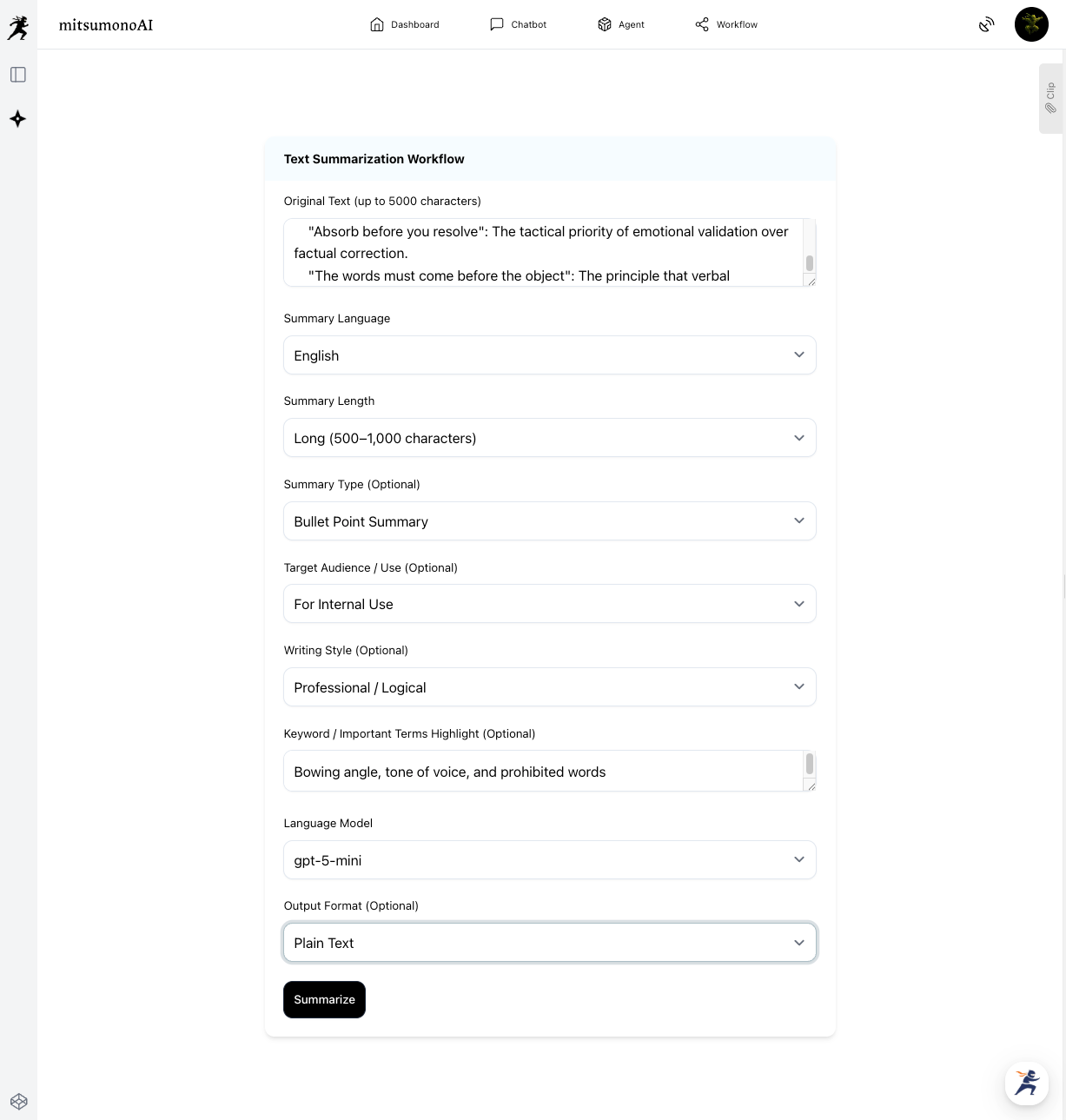
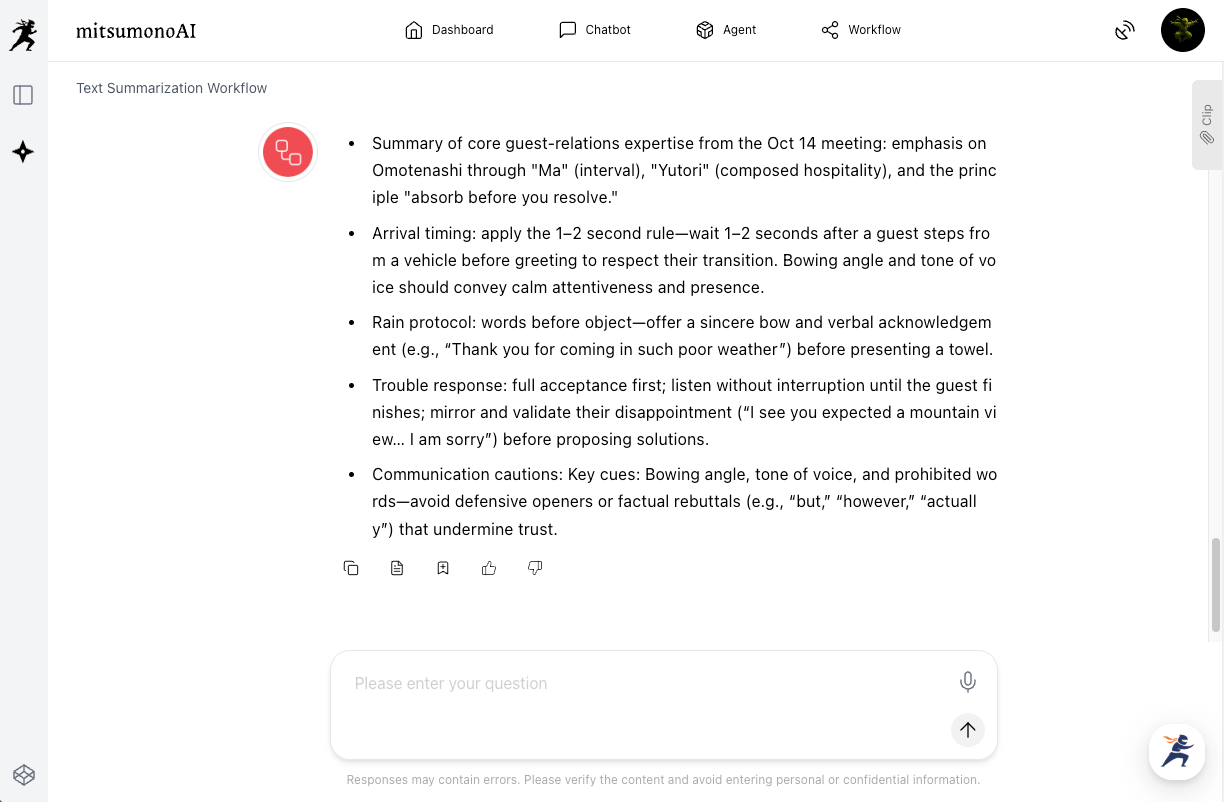
By simply pasting the data, the AI organizes it into a logical structure, such as "Basic Actions," "Points of Caution," and "Prohibited Actions."
Step 3: [Manual Generation] Transforming Data into Foolproof "Standard Operating Procedures"
Finally, feed the refined essence into a general-purpose model (such as GPT-5-nano) to finalize the content into a format that newcomers can put into practice from day one.
[Preparation & Execution]
Open the chat interface for the general-purpose model (GPT-5-nano), paste the output from Step 2, and enter your instructions.
Prompt Example: nano-banana-pro
"Based on the [Organized Key Points] below, please create an 'Arrival & Greeting Manual' that new staff can implement starting on their first day.
Please use a step-by-step format and include the 'Why' (the rationale) for each step. The tone should be warm and supportive, yet encourage a high level of professionalism.
[Organized Key Points]
(Paste the results from Step 2 here)"
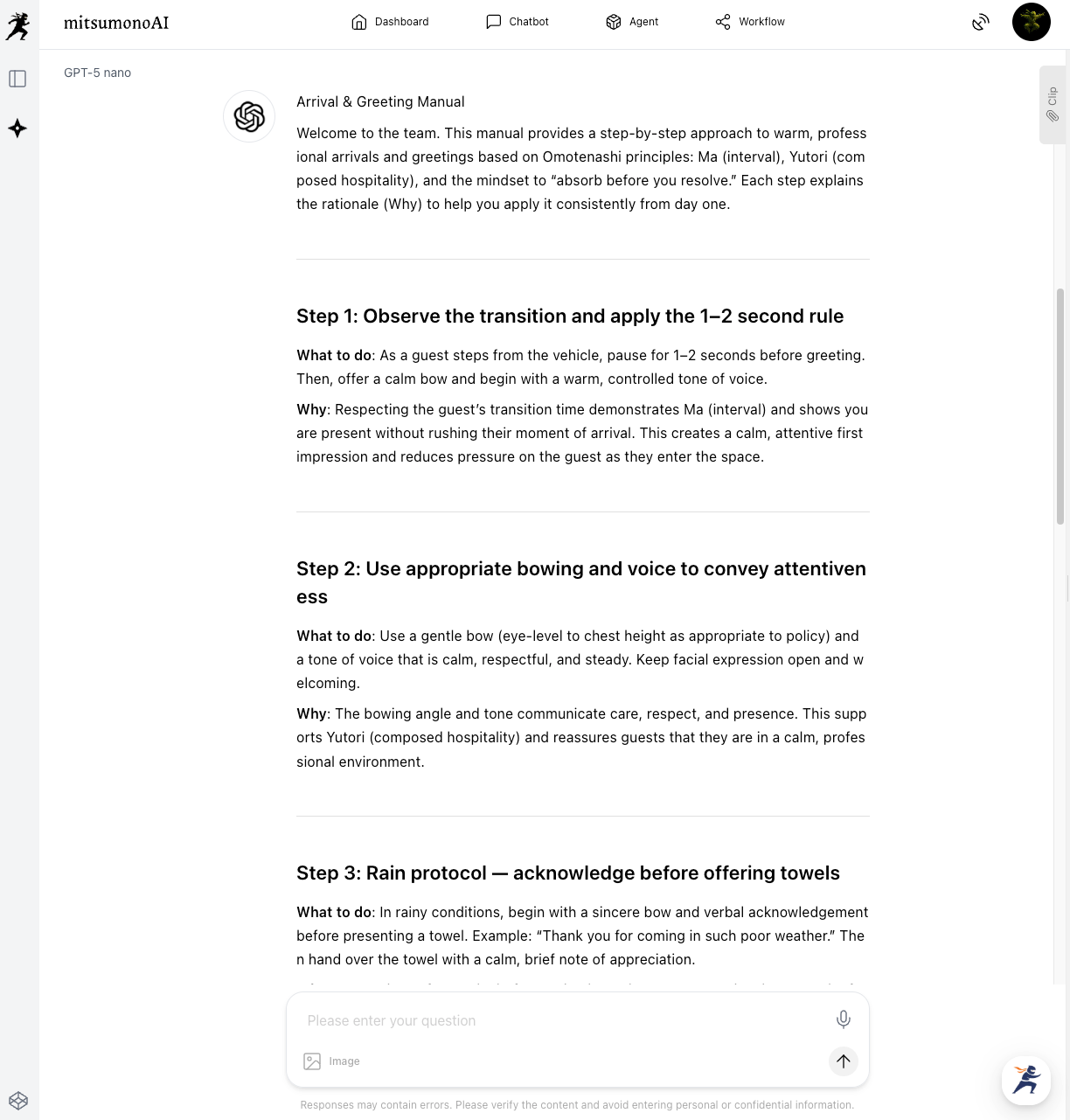
This instantly generates a specific, actionable manual, such as: "When a guest exits the vehicle, do not speak immediately; wait for a pause of 1–2 seconds."
■ Applications and Expansion (From Sales Talks to FAQs)
This "Minutes x AI" scheme can be applied widely beyond training manuals:
- Scripting Sales Roleplays: Analyze recordings of top-performing sales meetings to create "Killer Phrase Collections" or "Objection Handling Manuals."
- Customer Support FAQ Creation: Summarize daily support logs or morning briefing updates to automatically generate and update "FAQs" for customers or internal use.
- Knowledge Sharing via Daily Reports: Analyze daily reports from all employees to distribute a "Weekly Knowledge News" summary focusing only on the week's troubles and their solutions.
Summary
In this article, we introduced a specific 3-step process to regenerate buried meeting minutes into "living manuals" using AI:
- Discover "Valuable Expertise" from vast records with File Analysis Assistant PRO (without guardrail).
- Extract and structure only the "Essence" needed for education with the Text Summarization Workflow.
- Output into a "Manual Format" quickly and at low cost with a General-Purpose Model (nano).
Meeting minutes are not merely records of the past. They are unique textbooks for nurturing future employees. End the era of "learn by watching" and start "Knowledge DX" today to utilize organizational wisdom as a true asset.
mitsumonoAI offers various features to enhance organizational productivity, including document organization, workflow standardization, and knowledge management promotion.
For more use cases and the latest information, please visit the mitsumonoAI blog site.