Leveraging the "Review Reply Creation Workflow" to Restore Trust through Low-Rating Review Responses
We introduce how to use the "Email/Review/DM Reply Creation Workflow" and how to efficiently draft replies that include the necessary elements for responding to especially low-rated reviews.


Tools to Use
- Email/Review/DM Reply Creation Workflow
Restoring Trust with Review Replies
Online reviews can significantly impact the reputation of a business, regardless of its type. For a restaurant, for instance, failing to respond appropriately to customer dissatisfaction with the food, service, or hygiene—things customers have experienced firsthand—can damage the store's credibility.
"I don't know how to respond to a low-rated review," or "It takes too long to reply." This time, we will introduce how to use the helpful "Email/Review/DM Reply Creation Workflow" and how to quickly create sincere responses to negative reviews.
Specific Procedures
Step 1: Input into the Workflow
▶︎ Email/Review/DM Reply Creation
Copy and paste the customer's review content (e.g., from Google Maps, Tabelog, Retty, etc.) into the "Email/Review/DM Reply Creation Workflow."
We will proceed using the following low-rating comment as an example.
Post Title: The food is delicious, but the service is a shame...
Rating: ★★☆☆☆ (2.0)
I visited with a friend the other day. The specialty fried chicken was very tasty, but the staff's service was unfriendly throughout, which was disappointing. It felt difficult to call them to order anything, and they never smiled. Since the food was so good, I left feeling very disappointed.
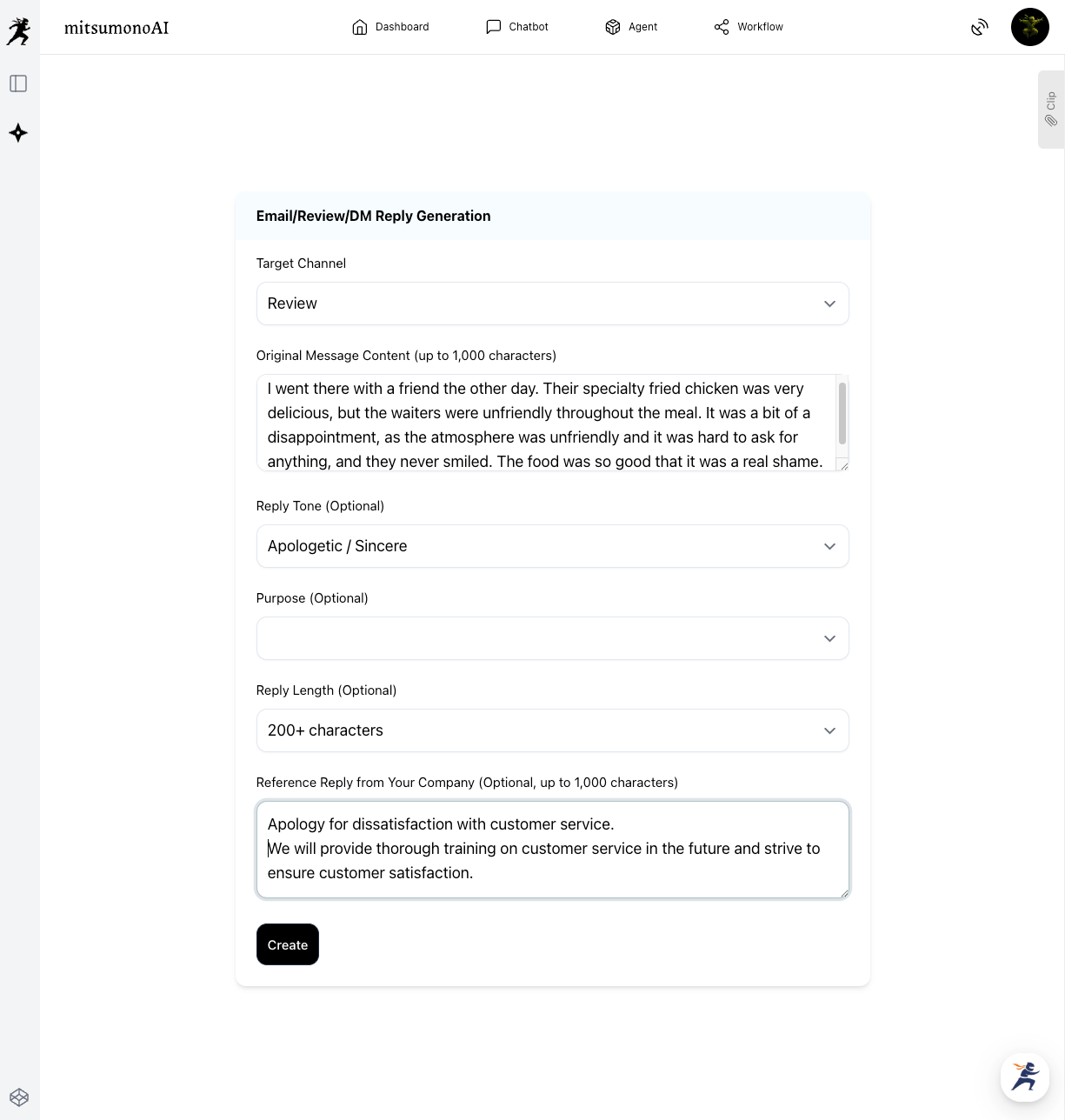
Example Input:
・Apology for dissatisfaction with the service.
・Commitment to thoroughly educate staff on service and strive for customer satisfaction in the future.
Step 2: Generate a Draft Reply Including an Apology and Improvement Measures
▶︎ Email/Review/DM Reply Creation
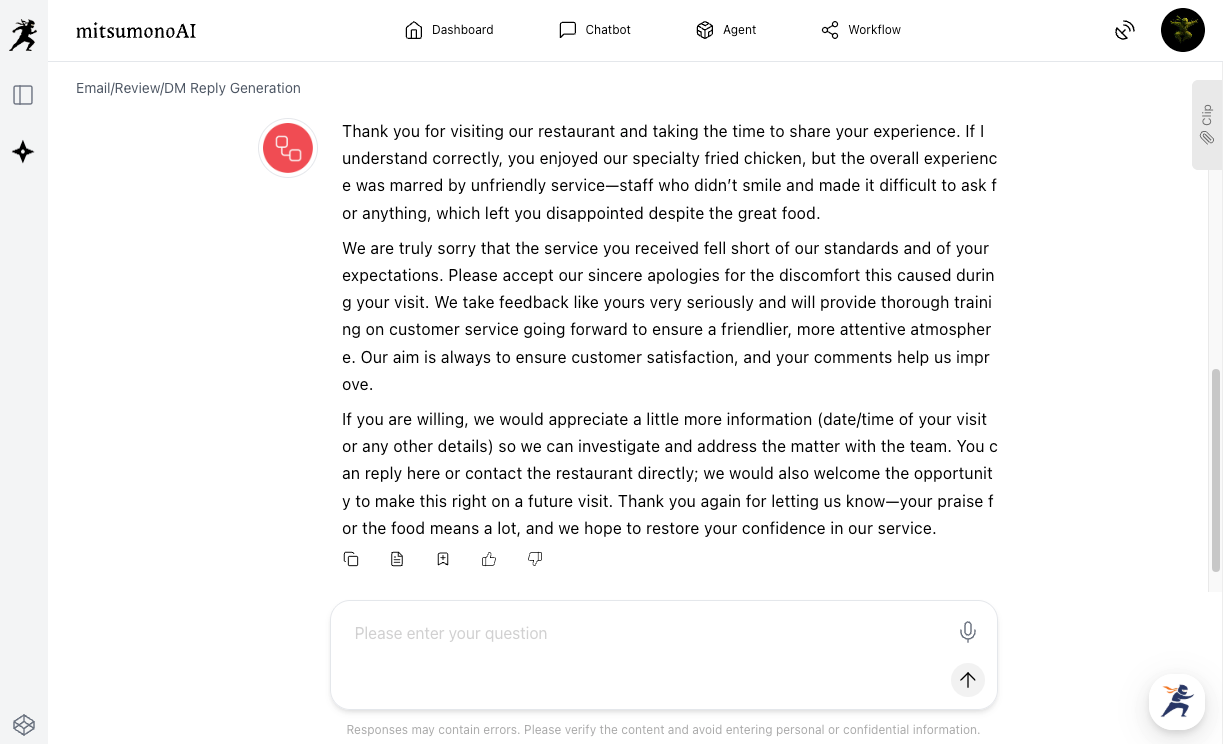
When responding to low-rated reviews, it is crucial to include the following three elements to restore customer trust:
- Sincere Apology to the Customer
Express gratitude for the feedback and apologize for causing a negative experience. - Specific Acknowledgment of the Pointed-Out Issue
Show that you have thoroughly read the review and clearly recognize what the problem was. - Future Improvement Measures
Explain specifically what steps you will take to resolve the issue.
Based on the inputted review content, the AI will output a draft reply that includes these elements.
Step 3: Individual Reply, Internal Sharing, and Accumulation
Referencing the generated reply draft, reply individually and promptly.
It is important to share the contents of the reply to customer feedback not just with the person in charge, but internally within the company. This enables not only the short-term goal of "preventing the same issue from being pointed out again," but also the establishment of a long-term future, such as:
- Standardization of Response Quality
- By sharing examples of good replies, all staff can learn the appropriate way to respond and the correct language to use with customers. This reduces inconsistencies in handling among staff members and helps maintain a consistent service quality.
- Improvement in Operational Efficiency
- By accumulating examples of replies to common issues (e.g., "service attitude," "serving speed"), staff no longer need to draft a response from scratch when a similar review comes in. This significantly reduces the burden on the staff member in charge, allowing them to focus on other tasks.
- Enhancement of Organizational Improvement Capability
- Sharing and analyzing "raw customer feedback" through reviews across the entire organization clarifies on-site issues and leads to fundamental service improvements. This is a valuable asset that goes beyond mere response management, promoting the growth of the entire business.
Outcomes Achieved Through Utilization (Examples)
- Acceleration of Response Time and Reduction of Staff Burden
- The AI instantly generates drafts tailored to the review content, significantly cutting down the time required to respond to low-rated reviews, allowing staff to concentrate on other tasks.
- Improvement in Reply Quality
- Enables appropriate and polite responses that include an apology and improvement measures, effectively conveying sincerity to the customer. Furthermore, the accumulation of reference examples standardizes the quality of replies, reducing variation among staff members.
- Improvement in Business Reputation and Restoration of Trust
- Prompt and sincere review replies resolve customer dissatisfaction, turn the business's reputation positive, and contribute to building trust with new customers.
- Promotion of Customer Communication
- Constructive replies on the review platform foster a positive relationship with customers.
Target Values for One Year (Reference Example)
- KGI (Key Goal Indicator):
- Average online review rating: Increase by 0.2 points or more compared to the previous year (e.g., 3.8 points $\rightarrow$ 4.0 points)
- KPIs (Key Performance Indicators):
- Average time to first reply for low-rated reviews: Within 24 hours
- Utilization rate of AI-generated or past reply examples: 80% or more
- Percentage of replies including specific improvement measures: 80% or more