A Guide to Creating "Role-Playing Scenarios" to Enhance the Quality of New Staff Training Using Operational Manuals
We introduce how to convert existing manuals into practical role-playing scenarios, simultaneously achieving new staff readiness and improved training efficiency.


Tool Used
- File Analysis Assistant
Acquire On-site Skills with "Role-Playing" Created by AI
In new staff training, the challenge that on-the-job training (OJT) and classroom learning alone do not lead to sufficient practical skills is common across many companies. Especially in the customer service and hospitality industries, role-playing simulating actual customer interactions is crucial, but concerns include "scenario creation is time-consuming" and "the burden on OJT supervisors is significant." Furthermore, translating a manual into practical training also takes time.
This time, we will utilize the "File Analysis Assistant" to automatically generate role-playing scenarios from existing customer service manuals that allow new staff to become immediately effective in the field. We will show you how to efficiently conduct practical training based on the manual while reducing the burden on training supervisors.
Specific Steps
Step 1: Preparing and Uploading the Training Manuals
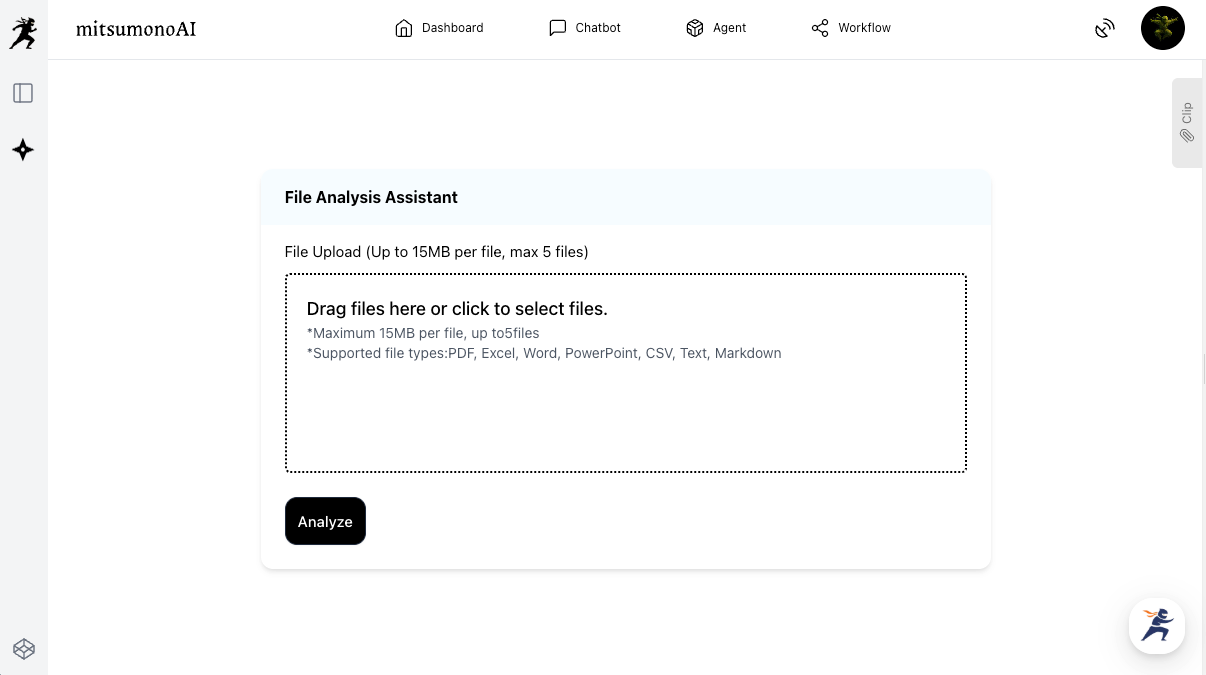
Prepare files such as customer service manuals, operational flowcharts, and product/service explanation documents used for employee training. Log in to the File Analysis Assistant and upload these files by dragging and dropping or clicking.
Step 2: Instructing the Generation of Role-Playing Simulation Methods
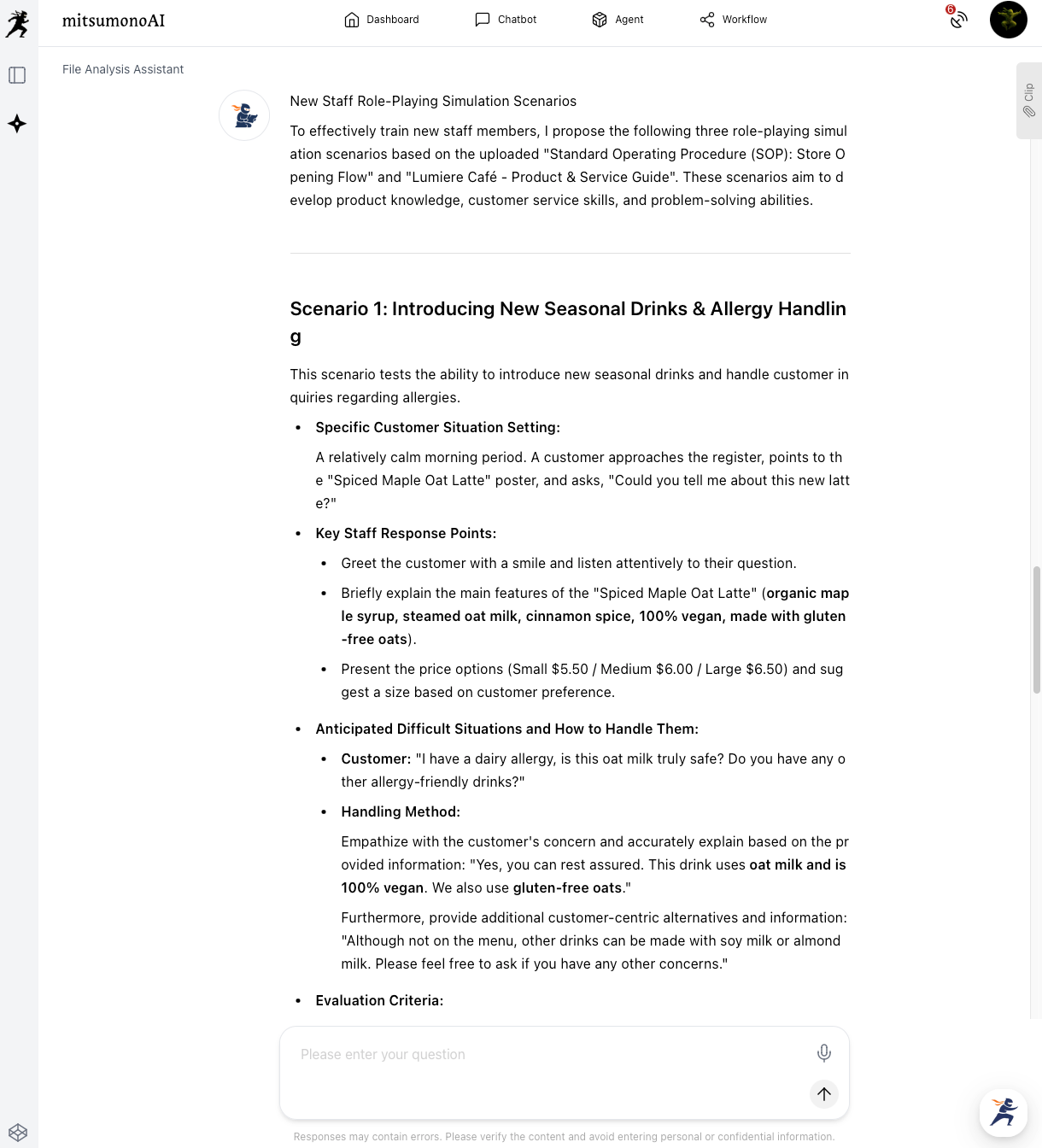
Once the file upload is complete, the screen will switch to the chat interface. Give the following instruction to devise new staff training simulation methods in a role-playing format based on the content of the uploaded manuals.
Each scenario should include a specific customer situation setting, key staff response points, anticipated difficult situations and how to handle them, and evaluation criteria."
The AI will output the analysis results and proposals, so review the content.
(Application) Refining Scenarios to Cultivate Adaptability to Various Situations
If you aim for even more practical role-playing based on the initial proposals, give the following additional instructions through the chat with the AI.
"In each scenario, add one more challenging situation setting, such as a case with complex customer requests or a complaint, and explain the specific procedure for staff response and the psychological approach during that time."
"Add one role-playing scenario each, assuming different customer attributes (e.g., a business traveler in a hurry, a family with small children, a foreign tourist, etc.), and specifically describe the recommended language and non-verbal communication points for each scenario."
"Add specific checklist-style evaluation items to the proposed criteria, incorporating our code of conduct (e.g., empathy for the customer, rapid problem-solving, team coordination, etc.). Also, provide a 5-level rating scale and a comment section for each item."
Step 3: Conducting the Simulation and Providing Feedback
Based on the simulation scenarios generated by the File Analysis Assistant, the new staff and the training supervisor conduct the actual role-playing. Afterward, specific feedback is provided based on the evaluation criteria proposed by the AI to improve skills.
Expected Results and Goals (Reference Example)
The time required to prepare role-playing for new staff training is significantly reduced, alleviating the burden on training supervisors. Through the diverse scenarios generated by the AI, staff can efficiently acquire various customer interaction skills, improving their on-site adaptability. As a result, the standardization and quality improvement of customer service are achieved, directly leading to increased customer satisfaction.
Furthermore, the standardization of the training process promotes the early readiness of new staff, contributing to overall organizational productivity improvement and ultimately helping to increase employee retention rates.
Target Metrics for the 6-Month Period
KGI (Key Goal Indicator):
- OJT period for new staff after 6 months: 20% reduction
KPI (Key Performance Indicators):
- Average role-playing evaluation score for new staff after initial training: 80 points or higher
- Training program creation time for training supervisors: 50% reduction
- Customer complaint rate caused by new staff: 15% reduction