AI Supports Everything from Menu Development to Analysis: A Practical Guide to Leveraging Data for Higher Average Customer Spending
Boosting the average customer spend requires more than just clever sales talk. This article details a strategic cycle using AI to develop high-profit menu items, generate the 'magic script' to sell them, and verify the effect with data.


Tools Used
- Product/Menu Development Planner
- Sensei AI - Restaurant
- File Analysis Assistant
- Review Analysis Assistant
The Veteran’s "Upselling Skill" Becomes the Standard Skill for All Staff, Thanks to AI
"I don't know how to recommend one more dish..."
"What if I push the recommendation too hard and the customer gets annoyed...?"
"The veteran staff are great at it, but it’s hard for new hires to imitate..."
While securing profit is crucial, a simple price increase risks losing customers. The key to solving this dilemma, which many restaurants face, lies in the staff's "proposal ability" or upselling skill.
However, this "upselling skill" often remains a skill exclusive to certain individuals, making it an extremely difficult task to standardize the quality across all staff.
In this article, we will introduce specific steps on how to use AI to create talk scripts that propose an "extra dish" in a natural way without causing customer discomfort, thereby raising the service level of your entire staff.
Specific Steps
Step 1: Use AI to Develop a Strategic "Extra Dish"
▶ Product/Menu Development Planner
The first crucial step is deciding "what" to recommend. Recommending a low-profit, high-labor product will increase sales but not profit. Utilize AI to develop strategic upselling menus that enhance both the average customer spend (check average) and the profit margin.
[Tip for Input]
The key to strategic menu development is to clearly state "high value-added menu for increasing average customer spend" in the "Strengths/Appeal Points" field, and to seriously consider the profit margin in the "Target Price Range/Cost Ratio."
Item | Input Tip | Example Input |
Company Profile | Briefly describe your business type and specialties. | Upscale Italian dining in a major city. Strong focus on house-made pasta and seasonal, locally sourced ingredients. |
Genre/Category | Clearly define the category of the menu you want to develop. | Dessert / Seasonal Sweet / Specialty Parfait |
Strengths/Appeal Points | Clearly state the purpose of the plan. | High value-added dessert to be ordered after a meal, aimed at increasing average customer spend. |
Main Ingredients/Techniques | List ingredients that give a special feeling while considering the cost. | Champagne Grapes (or similar high-end seasonal grape), house-made Pistachio Gelato, Mascarpone Cream |
Target Audience | Describe your existing customer base or the specific segment you want to target. | Diners in their 20s-40s. Customers looking for a slightly luxurious finish to their meal. |
Target Price Range/Cost Ratio | Inform the AI of the pricing and cost ratio needed to ensure profit. | $15.00–$18.00 (before tax/tip), Cost of Goods Sold (CoGS) within 30% |
Service Format | Clearly state how the product will be served to the customer. | Dine-in service only |
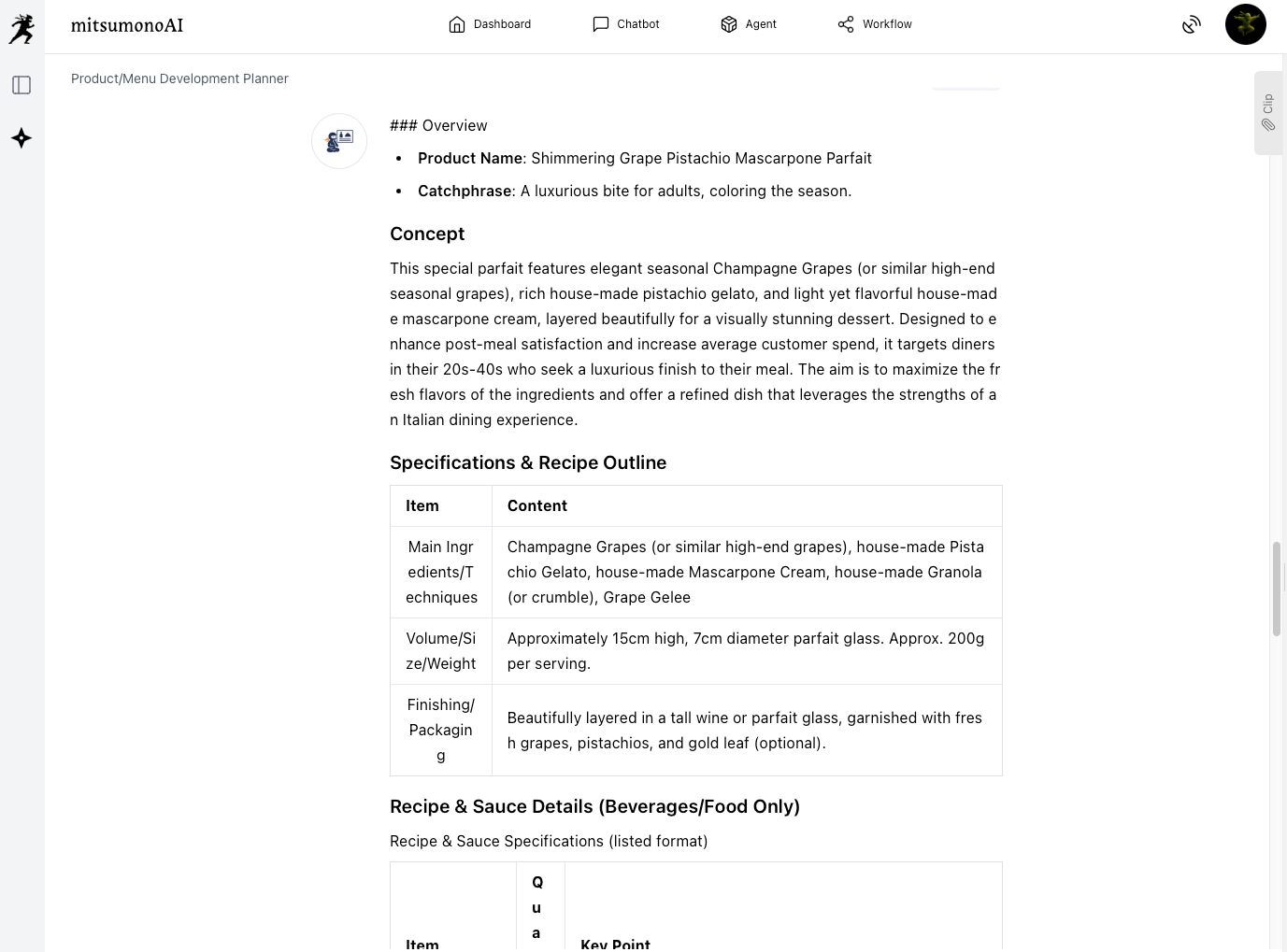
The AI proposed a specific menu: "Shimmering Grape Pistachio Mascarpone Parfait". It is recommended to use this proposal as a base and refine it while considering the actual situation of your restaurant.
Step 2: Use AI to Generate the Magic Words: "Talk Scripts"
▶ Sensei AI - Restaurant
Once the strategic menu is complete, the next step is to create the "magic words" to maximize its appeal and recommend it to customers.
Example Prompt for AI:
"Please provide three talk scripts for recommending the newly developed 'Shimmering Grape Pistachio Mascarpone Parfait' to customers who are considering a post-meal dessert. Please emphasize the rarity, such as 'Today's special grapes,' and suggest it in a natural flow."
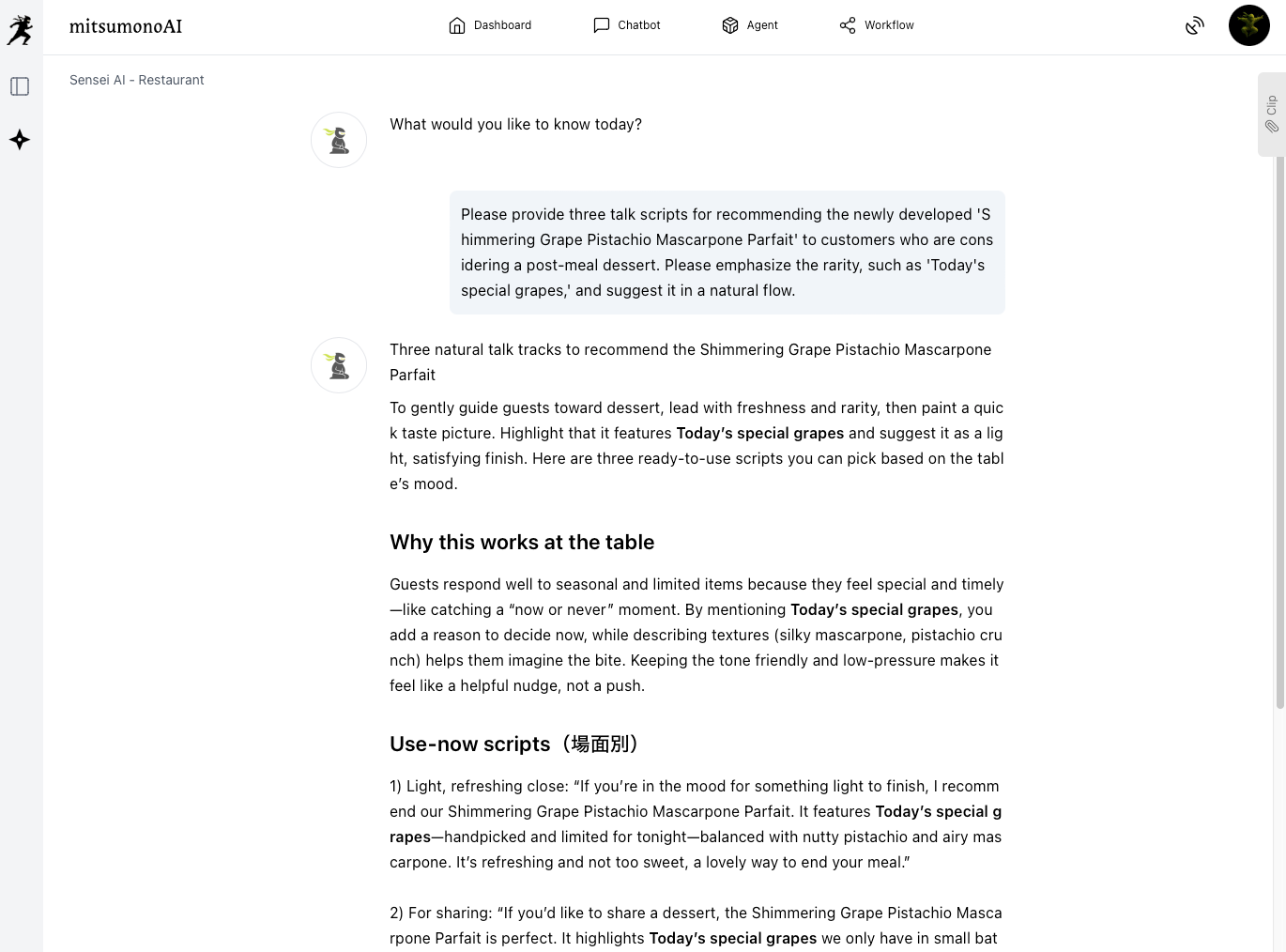
The AI proposed three talk patterns. Try implementing the option that is easiest to adopt in your restaurant.
Step 3: Use AI to Validate the Effect with Data and Plan the Next Move
▶ File Analysis Assistant, Review Analysis Assistant
Once the talk scripts are introduced, it is crucial to verify their effect and use the findings for improvement. Don't just "implement and forget"; apply the PDCA cycle based on data.
1. Quantitative Analysis (Sales Data)
[Tip for Input: File Analysis Assistant]
Upload CSV files of POS data from before and after script introduction to the File Analysis Assistant and ask the AI about the specific changes.
[Example Input Files]
- August_Order_Data (CSV)
- September_Order_Data (Excel)
After uploading the files, provide a specific instruction to the AI about what you want analyzed.
Example Prompt for AI:
"Compare the order data from August (pre-introduction) and September (post-introduction) and analyze the change in the number of orders for the 'Shimmering Grape Pistachio Mascarpone Parfait' and the resulting change in average customer spend. Specifically, tell me how the parfait order rate changed for customers who ordered pasta."
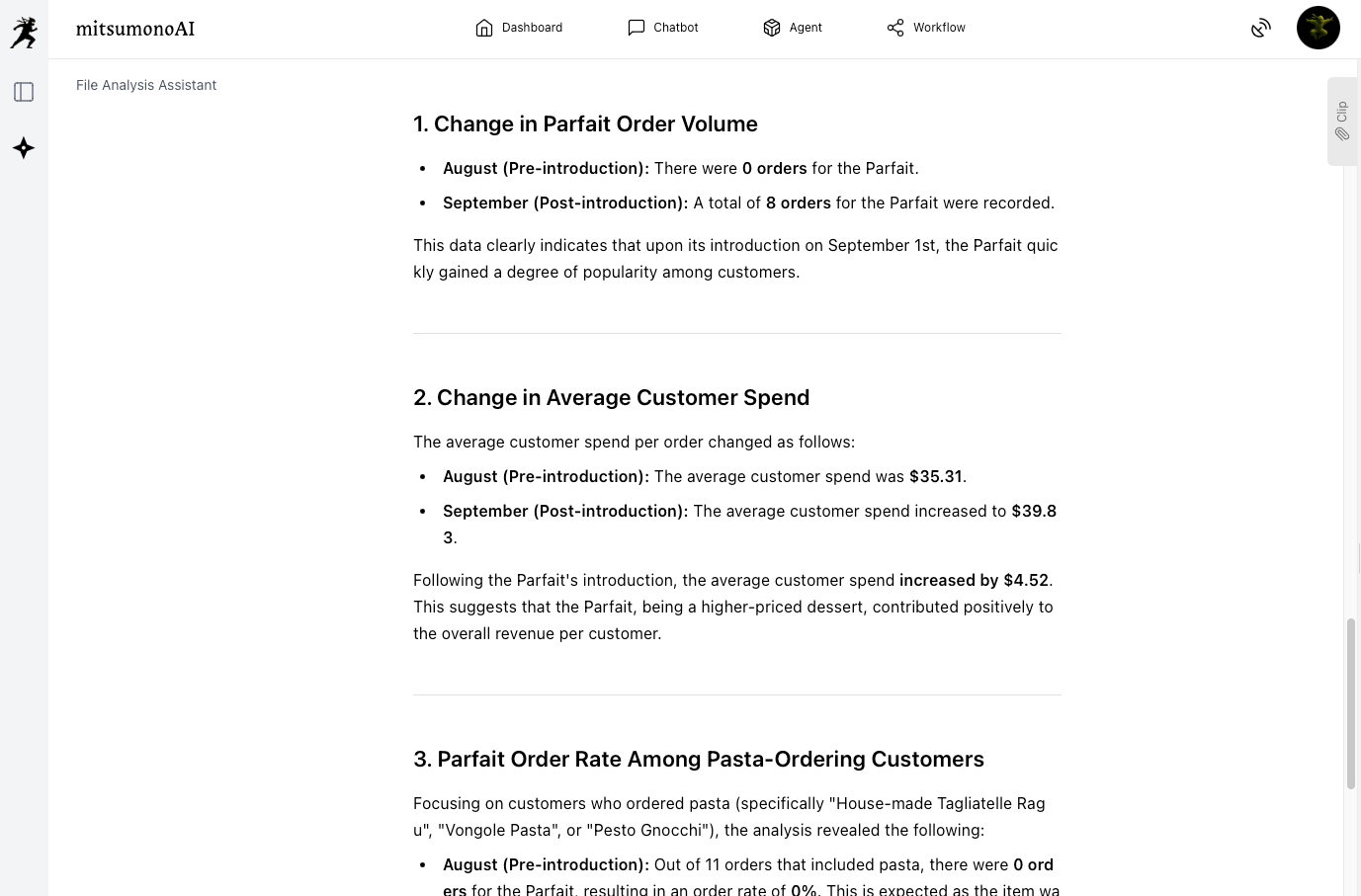
2. Qualitative Analysis (Customer Feedback)
[Tip for Input: Review Analysis Assistant]
Use the Review Analysis Assistant to gather the authentic voices of customers regarding the new menu and service. Inputting URLs from multiple review sites or a site with a large number of reviews will enhance the accuracy of the analysis.
Step 4: Consult on Improvement Actions After Analysis
▶ Sensei AI - Restaurant
Based on the analysis results (e.g., "Comments scattered that the parfait is delicious but a bit expensive"), please leverage the 'History' feature to consult with Sensei AI again.
Example Prompt for AI:
"Analysis shows some customers are hesitant about the parfait's price. To increase the perceived value of the price, please suggest a brief supplementary talk that simply conveys the quality of the ingredients."
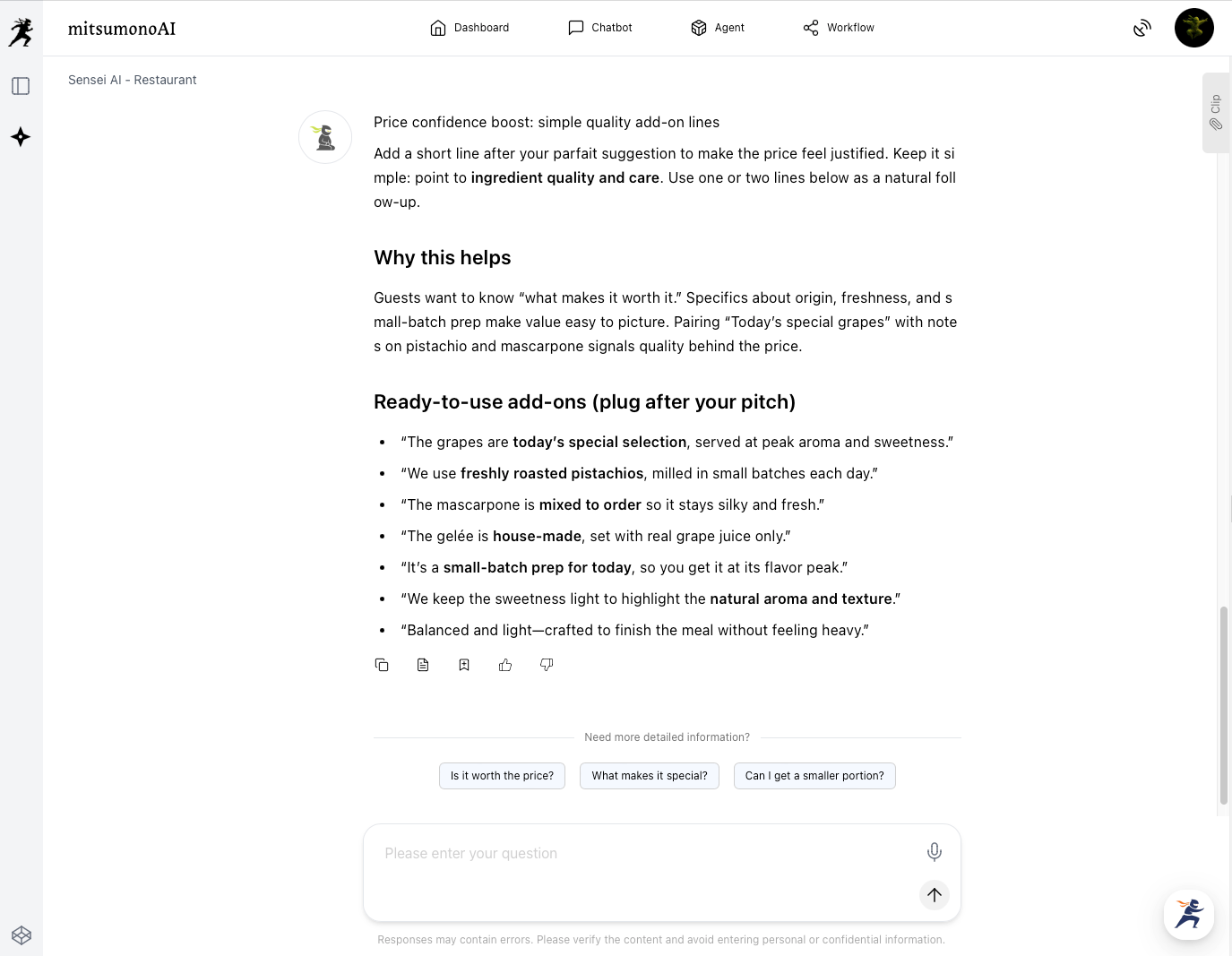
Achievable Outcomes Through Utilization (Examples)
- Elimination of Over-Reliance on Individual Skill and Standardization of Service Quality
The "upselling talk" that was once the tacit knowledge of veteran staff is now verbalized and systematized by AI based on data. Talk scripts that even new staff can confidently use raise the overall service level of the restaurant uniformly. - Data-Driven Menu Development and Increased Profitability
Develop strategic, high value-added menus based on objective data such as profit margins and customer needs, not just hunches. This achieves a highly profitable menu composition that improves both average customer spend and profit margin. - Establishment of a Sustainable Improvement Cycle
Instead of "developing and stopping," it becomes possible to rapidly cycle through PDCA by analyzing sales data and customer reviews with AI and connecting them to the next improvement action. This allows for continuous improvement in customer satisfaction and sales.
Target Numerical Goals for 12 Months from Implementation
KGI:
- Average Customer Spend: 15% Increase
KPIs:
- Order Ratio for High-Profit Margin Menus: 20% Increase
- Average Customer Spend for New Staff: Reach 90% of Veteran Staff's Level within 3 months