Overcoming the "Takeout Loses Flavor" Myth : Methods for Developing To-Go Menus That Boost Your Restaurant's Reputation
Are you struggling to meet takeout demand because your dishes lose their quality during transit? This guide explains how AI acts as a partner to design menus optimized for takeout, from container selection to final cooking instructions for the customer, ensuring brand integrity and satisfaction.

Delivering Your Best in Every Bite
The rising demand for takeout and delivery represents a massive opportunity for restaurants. However, unlike dining in, it presents several unique challenges:
- Quality Degradation: Texture and temperature suffer over time—ramen noodles get soggy, fried coatings lose their crunch, and soups cool down and form a film.
- The "Reheating" Gap: Customers often don't know the best way to warm food at home, failing to recreate the flavor intended by the chef.
- Lack of Development Time: While owners want to create dedicated takeout menus, the demands of daily operations leave little time or inspiration for new recipe development.
Haphazardly launching a takeout service risks giving customers the impression that "it’s better to eat at the restaurant," which not only hurts repeat takeout business but can also lower the overall evaluation of your dine-in experience.
AI Designs the "Post-Purchase Delicious Experience"
The Product/Menu Development Planner is a powerful partner for reverse-engineering the perfect dining experience at the customer's table.
- Optimized Concepts: AI proposes menu concepts based on the absolute requirement that the food must be in peak condition when eaten at home.
- Clear Instructions: AI can generate easy-to-follow manuals for the "final touch" the customer performs at home, such as separating noodles from soup or adding sauces last.
- Innovative Formats: You can gain ideas for new product formats that go beyond standard menus, such as utilizing freezing technology or offering semi-cooked meal kits.
By drastically reducing the time spent on menu development, owners and head chefs can focus on the more critical tasks of quality control and operational structure.
Practical Application | Creating "Home-Finished" Menus with AI
Using "Takeout Ramen" as an example, here is the process for developing a dedicated menu using the Product/Menu Development Planner.
Step 1: Build the Foundation with the [Product/Menu Development Planner]
First, enter the basic information of the menu you wish to develop into the relevant fields of the Product/Menu Development Planner.
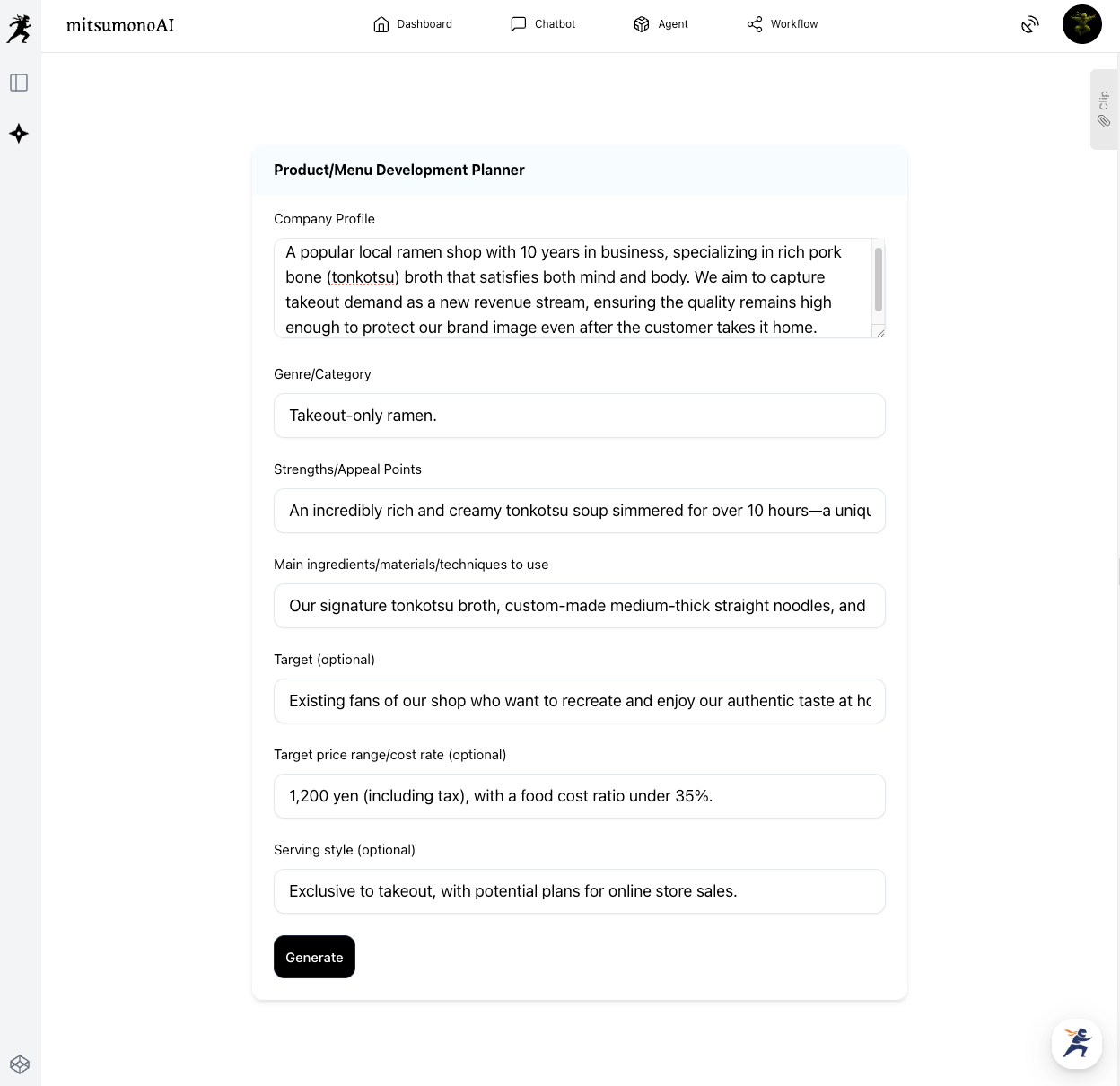
Clicking the "Generate" button will output product and menu drafts based on the information provided.
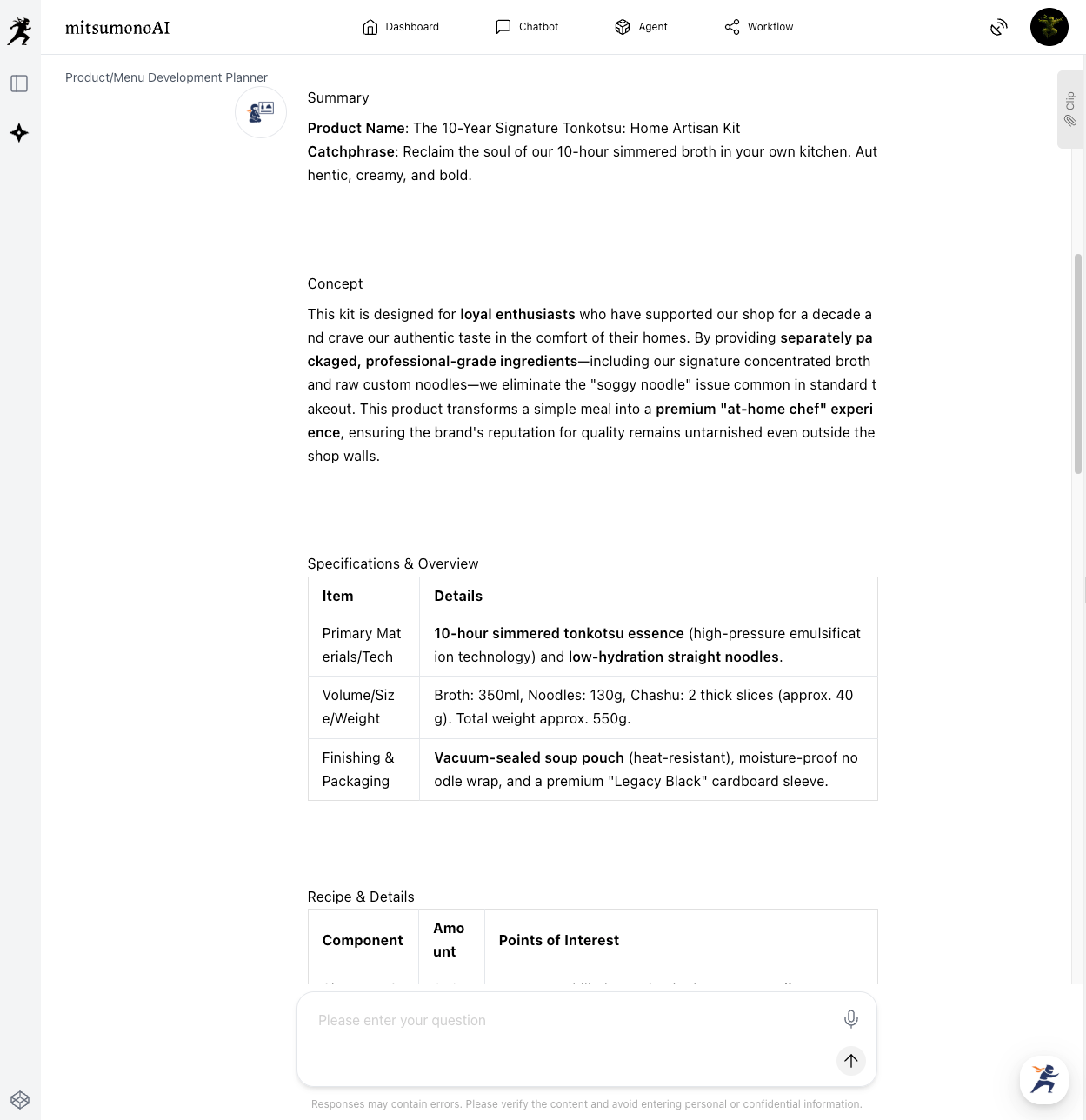
Review the content to see if it is realistically developable.
Step 2: Design the "Customer Experience" via AI Dialogue
Provide more specific and advanced instructions in the chat field. This step ensures the output is not just a menu idea, but a high-quality proposal that designs the entire customer experience.
Prompt: Product Refinement / Creating Customer Experience
"It is an absolute requirement that our 'Rich Tonkotsu Ramen' tastes delicious even after being taken home. Additionally, I want to design it so that the small effort the customer puts in at home becomes a 'fun experience.'
Please suggest three specific ideas for a takeout-only menu. Each idea must include:An attractive menu name to entice customers.The optimal way to separate soup, noodles, and toppings (packaging method).Concise and easy-to-understand instructions for heating and plating at home (draft for the instruction manual)."
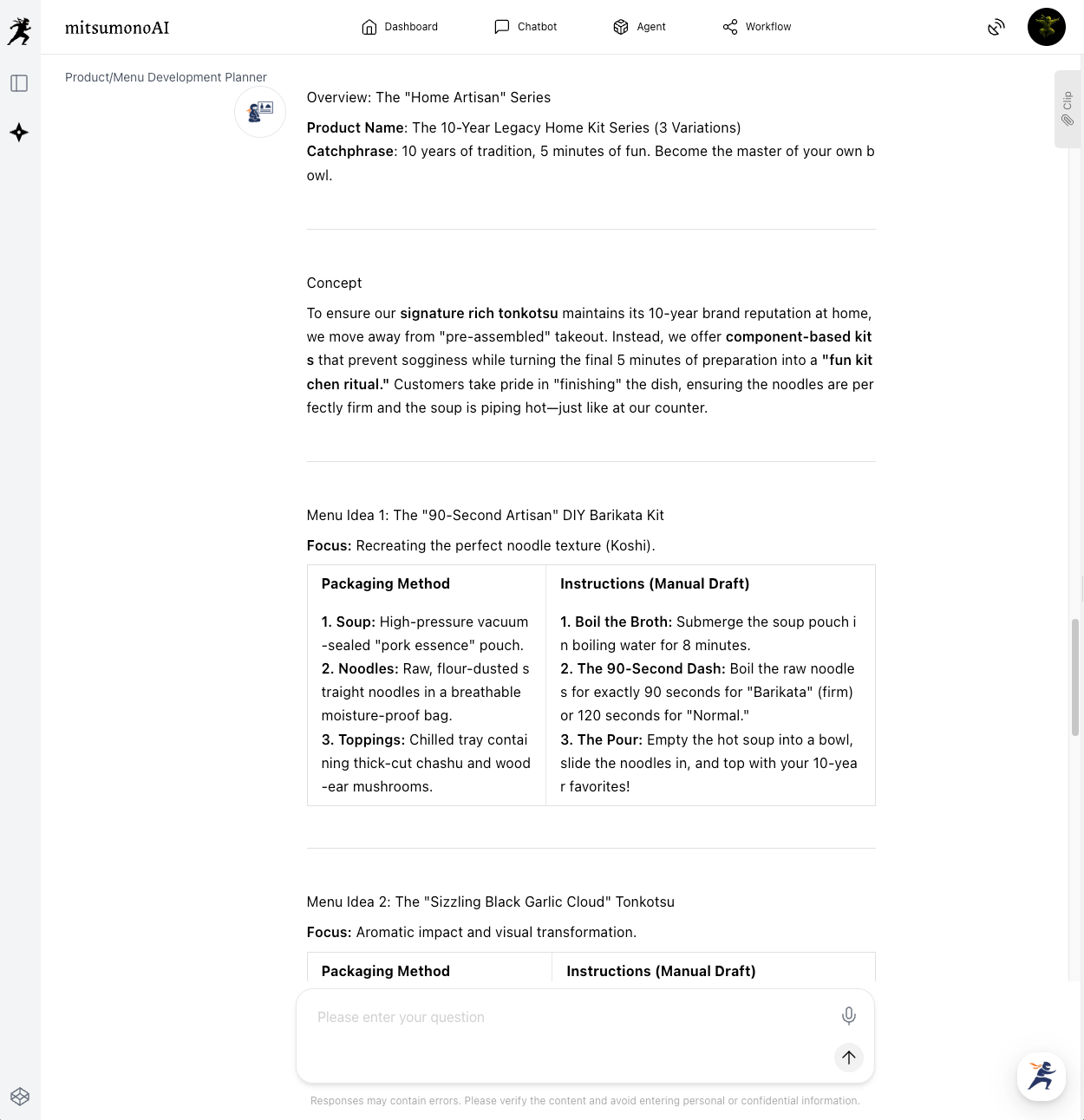
With this instruction, the AI returns specific proposals—such as an "Experimental Kit: Discover the Ultimate Tonkotsu with Your Own Senses"—including packaging details and draft manual text.
From Pasta to Cakes and Yakiniku: Bringing Specialty Flavors Home
This AI-driven development method is applicable to various business types:
- Italian Restaurants: "Fresh Pasta Meal Kit for Al Dente Perfection." Kits where the sauce is heated in a water bath and pasta is boiled for just one minute.
- Cafes & Patisseries: "At-Home Afternoon Tea Set." A beautiful box of scones, sandwiches, and cakes, with AI-generated tips on how rebaking the scones adds value.
- Yakiniku (Japanese BBQ) Shops: "Rare Cut Comparison Set." A set of five rare cuts bundled with a "Grilling Guide" created by AI to explain the best way to cook each specific cut.
Summary: Finding the "Right Answer for Takeout" through AI Collaboration
In this article, we explored how to use AI to deliver the best dining experience on the new stage of takeout. The key to takeout success lies in meticulously designing the "post-purchase customer experience."
AI can quickly propose comprehensive menu plans that include everything from quality maintenance methods to communication strategies for the customer. This approach is a powerful weapon for improving the quality of your takeout business and establishing new revenue streams.
With AI assistance, deliver your restaurant's passion and commitment to the customer's dining table in its finest form.
While we focused on takeout today, the Product/Menu Development Planner is a partner for all new menu development leveraging your strengths (ingredients, techniques, concepts).
In the following article, we explain how to use AI to generate hit product ideas and even handle the "Naming" process to ensure your brand stays in the customer's memory. Please take a look.
 mitsumonoAI